From Easy Wins to Epic Challenges: Bounty Hunter Edition
Daniel Blaklis Le Gall
DEF CON 32 Creator Stage · Day 1 · Creator Stage
Overview
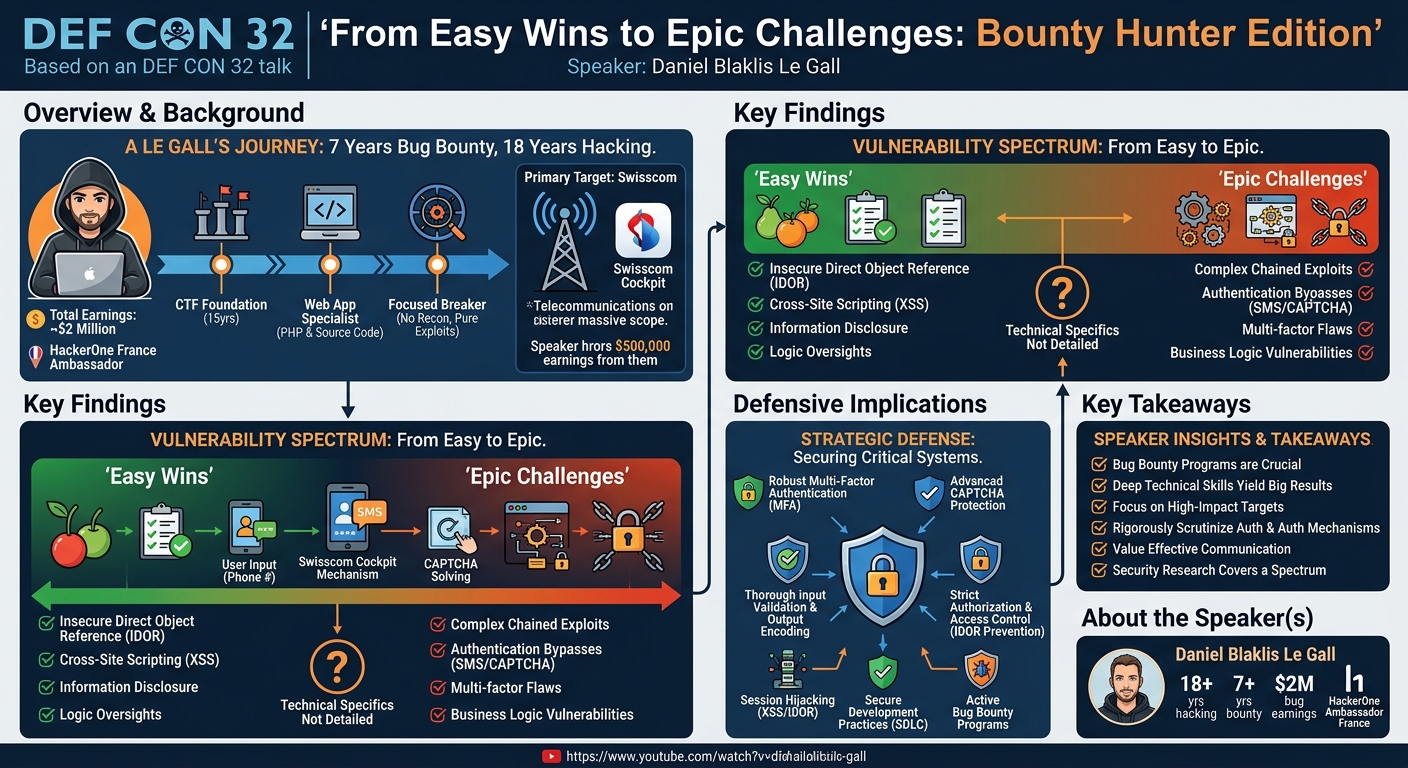
In "From Easy Wins to Epic Challenges: Bounty Hunter Edition," Daniel Blaklis Le Gall, a seasoned bug bounty hunter with an impressive track record, set out to share insights from his extensive journey, highlighting vulnerabilities that ranged from surprisingly straightforward to remarkably complex. The talk aimed to provide a unique perspective on the diverse world of bug bounty, illustrating how different types of findings contribute to improving security postures. Blaklis, known for his deep technical prowess and significant earnings in the bug bounty space, intended to dissect specific cases from his experience, offering valuable lessons for both aspiring hackers and seasoned security professionals.
Key moments
- 0:00 Speaker introduction, bug bounty experience, and earnings
- 2:00 Overview of Swisscom bug bounty program and personal success
- 3:30 Swisscom Cockpit: mobile manager, sensitive data, and login
From Easy Wins to Epic Challenges: Bounty Hunter Edition
Speakers: Daniel Blaklis Le Gall
Conference: DEF CON 32
YouTube: https://www.youtube.com/watch?v=MrNmdtkH3YY
Overview
In "From Easy Wins to Epic Challenges: Bounty Hunter Edition," Daniel Blaklis Le Gall, a seasoned bug bounty hunter with an impressive track record, set out to share insights from his extensive journey, highlighting vulnerabilities that ranged from surprisingly straightforward to remarkably complex. The talk aimed to provide a unique perspective on the diverse world of bug bounty, illustrating how different types of findings contribute to improving security postures. Blaklis, known for his deep technical prowess and significant earnings in the bug bounty space, intended to dissect specific cases from his experience, offering valuable lessons for both aspiring hackers and seasoned security professionals.
The significance of this talk lies in its potential to demystify the bug bounty process and showcase real-world impact. Blaklis, having accumulated approximately $2 million across various platforms, including a substantial $500,000 from Swisscom alone, embodies the success achievable through dedicated ethical hacking. By presenting a selection of "fun bugs"—those that were either easily overlooked or required intricate exploit chains—the talk promised to illuminate the thought processes, methodologies, and technical challenges faced by top-tier bounty hunters. This sharing of practical experience is crucial for fostering a stronger, more collaborative security ecosystem, where vulnerabilities are identified and remediated before malicious actors can exploit them.
This article, based on the provided transcript, will delve into the speaker's background, the context of his work, and the general areas he intended to cover. It is important to note, however, that the provided transcript primarily contains the speaker's introductory remarks and repeated descriptions of the initial target, Swisscom, and its Cockpit application. Consequently, the detailed technical content, specific key findings, and demonstrations of the vulnerabilities themselves are not present in the provided text. This article will therefore focus on analyzing the speaker's approach, the nature of the systems he targets, and the broader implications of his work, while acknowledging the absence of the specific bug examples that were the intended core of the presentation.
Background
▶ Watch: Speaker introduction, bug bounty experience, and earnings (0:00)
Daniel Blaklis Le Gall's journey in cybersecurity is marked by extensive experience and a focused approach. He has been actively involved in bug bounty for seven years, building on a foundation of 15 years in Capture The Flag (CTF) competitions and a total of 18 years in hacking. This long-standing engagement has honed his skills, making him a formidable presence in the ethical hacking community. Blaklis explicitly states his preference for web application security, particularly enjoying working with PHP and performing source code review. Unlike many bounty hunters who prioritize extensive reconnaissance (recon), Blaklis focuses directly on core applications, aiming to "break them." His passion lies in developing complex chains and complex exploits, indicating a deep understanding of application logic and underlying vulnerabilities. His impressive earnings of approximately $2 million across various bug bounty platforms underscore his expertise and the consistent value of his findings. He also serves as a HackerOne ambassador for France, highlighting his standing and influence within the community.
A primary target in Blaklis's bug bounty journey has been Swisscom, the largest telecommunications provider in Switzerland. Swisscom initiated an open bug bounty program in late 2016, which coincided with Blaklis's first bug bounty experience. He describes Swisscom as having a "pretty good team," characterized by fairness, kindness, and good communication—qualities that foster a productive relationship with security researchers. The program boasts a "very big scope," encompassing millions of IP addresses, which presents a vast attack surface for skilled hackers. Blaklis estimates earning around $500,000 from Swisscom, a testament to the depth and breadth of vulnerabilities he has uncovered. He notes that Swisscom's decision to open their bug bounty program significantly "improved their security stuff over time," indicating the positive impact of such initiatives. While the bugs he intended to present were described as "quite old," this further emphasizes the continuous improvement of Swisscom's security posture over the years.
The specific target Blaklis introduced was Swisscom Cockpit, described as the "mobile phone manager" for Swisscom customers. This application is critical, allowing users to view their subscriptions, purchase travel packs, and manage other mobile-related services. Critically, Swisscom Cockpit handles a wealth of sensitive information, including Personal Identifiable Information (PII) and payment data. The login process for Swisscom Cockpit is distinctive: users enter their phone number, receive an SMS token, and must also complete a CAPTCHA. Successful login occurs if both the SMS token is valid and the CAPTCHA is correctly solved. This multi-factor authentication mechanism, relying on SMS and CAPTCHA, immediately suggests potential areas for security scrutiny, such as flaws in token generation, brute-force protection, CAPTCHA bypasses, or session management vulnerabilities, even without the specific bug details being provided in the transcript. The handling of such confidential data makes Swisscom Cockpit an inherently high-value target for security researchers.
Key Findings
▶ Watch: Overview of Swisscom bug bounty program and personal success (2:00)
The speaker explicitly stated his intention to present bugs that were "quite surprising," ranging from "very easy" to "very difficult." This approach underscores a fundamental truth in bug bounty: impactful vulnerabilities are not always obscure or complex. Sometimes, the most critical flaws are simple oversights that, when chained or exploited in a specific context, yield significant results. The talk promised to illustrate this spectrum, offering insights into both quick wins and sophisticated exploit development.
However, based on the provided transcript, the actual "key findings"—the specific bugs, vulnerabilities, or exploit chains—were not detailed. The transcript repeatedly cycles through the speaker's introduction and the background on Swisscom and Swisscom Cockpit, without advancing to the actual vulnerability discussions. Therefore, while the intent was to showcase a diverse range of findings, the specifics of these discoveries, their impact, or the methods used to uncover them cannot be reported here.
We can infer from the speaker's general approach and the nature of the target (Swisscom Cockpit, handling PII and payments with SMS-based 2FA) that the "easy wins" might have included common web vulnerabilities such as Cross-Site Scripting (XSS), Cross-Site Request Forgery (CSRF), or simple Insecure Direct Object Reference (IDOR) issues that could lead to information disclosure or unauthorized actions. The "epic challenges," on the other hand, would likely involve more intricate logic flaws, authentication bypasses (perhaps related to the SMS token or CAPTCHA implementation), complex SQL Injection scenarios, or sophisticated chaining of multiple low-severity bugs to achieve a high-impact outcome, such as full account takeover or mass data exfiltration. The speaker's stated love for "complex chain" and "complex exploit" further suggests that the "difficult" bugs would have been particularly nuanced and required deep understanding of the target application's business logic and underlying frameworks, potentially involving his expertise in PHP and source code review.
Despite the absence of specific examples in the transcript, the philosophy behind presenting "surprising" bugs is a key takeaway. It highlights that security research often involves both diligent application of known techniques and creative problem-solving to uncover unique or deeply hidden flaws. The speaker's success on a large, well-resourced platform like Swisscom further implies that even mature bug bounty programs can harbor significant vulnerabilities, reinforcing the continuous need for external security assessments.
Technical Deep Dive
As previously noted, the provided transcript does not contain the detailed technical content, specific code examples, or protocol analysis that would constitute a "technical deep dive" into the vulnerabilities the speaker intended to present. The transcript focuses heavily on the speaker's introduction and a repeated description of Swisscom and the Swisscom Cockpit application's login mechanism.
However, we can analyze the context provided and discuss the types of technical considerations that would be relevant to a target like Swisscom Cockpit, given its described functionality and authentication scheme. Swisscom Cockpit is a mobile phone manager that handles confidential data, including PII and payment information. Its login process involves a user providing their phone number, receiving an SMS token, and solving a CAPTCHA.
A technical deep dive into such a system, in the context of bug bounty, would typically explore several areas:
- SMS Token Vulnerabilities:
- Brute-Force Attacks: Even with a CAPTCHA, a weak CAPTCHA implementation or a timing attack could potentially allow an attacker to brute-force the SMS token. The length and entropy of the SMS token are critical. If it's a short, numeric code (e.g., 4-6 digits), it's more susceptible. Rate limiting on token attempts per phone number and IP address is crucial.
- Token Validity/Expiration: How long is the SMS token valid? Are old tokens invalidated upon new requests?
- Token Leakage: Are tokens sent over insecure channels or logged in application responses?
- SMS Gateway Vulnerabilities: While often out of scope for web application bug bounties, the underlying SMS infrastructure could have its own set of vulnerabilities (e.g., SIM swapping, SS7 attacks), which could potentially bypass the SMS token mechanism.
- CAPTCHA Bypass Techniques:
- Automated Solving: Can the CAPTCHA be programmatically solved using OCR, machine learning, or third-party CAPTCHA-solving services?
- Replay Attacks: Can a solved CAPTCHA token be reused?
- Logic Flaws: Are there ways to bypass the CAPTCHA entirely by manipulating request parameters or session states?
- Weak CAPTCHA Implementation: Is the CAPTCHA too simple, easily guessable, or does it only apply to certain parts of the login flow?
- Authentication and Session Management Flaws:
- Session Fixation: Can an attacker fixate a user's session ID before they log in?
- Session Hijacking: Are session tokens properly secured against disclosure (e.g., via XSS) or prediction?
- Broken Authentication: Are there alternative login paths that are less secure, or ways to bypass the 2FA entirely?
- IDOR (Insecure Direct Object Reference): Given that Swisscom Cockpit manages subscriptions and PII, IDORs could be critical. For example, if a user's subscription details are accessed via a numeric ID in the URL (
/subscriptions?id=123), an attacker might change123to124to view another user's data without proper authorization checks. This is a common flaw in applications managing user-specific resources. - Broken Access Control: Are authorization checks properly implemented across all functionalities? Can a low-privileged user access high-privileged functions or data?
- PII and Payment Data Handling:
- Sensitive Data Exposure: Are PII or payment details inadvertently exposed in API responses, error messages, or logs?
- Payment Gateway Integration Issues: Flaws in how the application interacts with payment gateways could lead to payment bypasses or manipulation.
- Data Storage Security: While usually backend, sometimes client-side indicators or API endpoints can reveal insecure storage practices.
- General Web Application Vulnerabilities:
- SQL Injection: If user input is not properly sanitized and used in database queries.
- Cross-Site Scripting (XSS): Stored or reflected XSS could lead to session hijacking, data theft, or defacement.
- Server-Side Request Forgery (SSRF): If the application fetches resources from external URLs based on user input, it could be coerced into making requests to internal networks.
- Logic Flaws: Complex business logic, especially in subscription management or payment flows, often harbors subtle flaws that can be exploited.
Blaklis's stated preference for source code review suggests that his "epic challenges" might involve uncovering vulnerabilities that are only apparent by examining the application's underlying code logic, rather than purely black-box testing. This could include obscure race conditions, deserialization vulnerabilities, or complex input validation bypasses that require a deep understanding of how the application processes data.
In summary, while the specific technical details of Blaklis's findings are unavailable from the transcript, the description of Swisscom Cockpit provides a rich context for understanding the types of critical vulnerabilities that a skilled bounty hunter like him would target in a telecommunications platform managing highly sensitive user data.
Demo / Proof of Concept
▶ Watch: Swisscom Cockpit: mobile manager, sensitive data, and login (3:30)
The provided transcript does not contain any description or mention of a live demonstration or a proof of concept being presented during the talk. The content available focuses solely on the speaker's introduction and the background of the target system.
Defensive Implications
Given the context of Swisscom Cockpit as a mobile phone manager handling PII and payment data with an SMS token and CAPTCHA login, and drawing from the general types of vulnerabilities a seasoned bug bounty hunter like Daniel Blaklis Le Gall would target, several defensive implications emerge for organizations managing similar critical systems:
- Robust Multi-Factor Authentication (MFA) Implementation:
- SMS Token Strength and Entropy: Ensure SMS tokens are sufficiently long and random (e.g., 6-8 digits, alphanumeric if possible) to resist brute-force attacks. Avoid predictable patterns.
- Strict Rate Limiting: Implement aggressive rate limiting on SMS token validation attempts per phone number, IP address, and session. This should include exponential backoff and potentially temporary IP bans after multiple failed attempts.
- Token Expiration and Invalidation: SMS tokens should have a short validity period (e.g., 2-5 minutes) and be immediately invalidated after use or upon a new token request.
- Out-of-Band Verification: Consider using alternative MFA methods beyond SMS, such as authenticator apps (TOTP) or hardware tokens, which are generally more secure against common telco attacks (e.g., SIM swapping).
- Advanced CAPTCHA Protection:
- Strong CAPTCHA Mechanisms: Implement modern CAPTCHAs (e.g., reCAPTCHA v3, hCaptcha) that offer better resistance against automated solvers than simple image-based CAPTCHAs.
- Comprehensive Application: Ensure the CAPTCHA is applied consistently across all sensitive actions, not just initial login, and that it cannot be easily bypassed by modifying request parameters or exploiting logic flaws.
- Behavioral Analysis: Augment CAPTCHA with behavioral analysis to detect bot-like activity even if the CAPTCHA is technically solved.
- Thorough Input Validation and Output Encoding:
- Prevent Injection Attacks: Implement strict input validation for all user-supplied data to prevent SQL Injection, Cross-Site Scripting (XSS), and other injection vulnerabilities. Use parameterized queries for database interactions.
- Contextual Output Encoding: Always encode user-generated content before rendering it in web pages to mitigate XSS attacks.
- Robust Authorization and Access Control:
- Principle of Least Privilege: Ensure users only have access to the data and functions necessary for their role.
- Strong Access Checks: Implement server-side authorization checks for every request to access or modify resources. This is crucial for preventing Insecure Direct Object Reference (IDOR) vulnerabilities, where an attacker manipulates an object ID to access another user's data (e.g., viewing another customer's subscription by changing an ID in a URL). Every access to PII, payment data, or subscription details must be explicitly authorized against the authenticated user's identity.
- Horizontal and Vertical Privilege Escalation: Conduct regular audits to ensure that users cannot access resources belonging to other users (horizontal) or perform actions reserved for higher-privileged roles (vertical).
- Secure Handling of Sensitive Data:
- Encryption at Rest and in Transit: Ensure all PII and payment data is encrypted both when stored (at rest) and when transmitted (in transit, using TLS 1.2+).
- Data Minimization: Only collect and store data that is absolutely necessary.
- Secure Logging: Avoid logging sensitive data (PII, payment details, session tokens, SMS codes) in plaintext. Redact or encrypt logs appropriately.
- Secure Development Practices and Code Review:
- Security by Design: Integrate security considerations into every stage of the Software Development Life Cycle (SDLC).
- Regular Code Audits: Conduct routine, independent source code reviews, ideally by security specialists, to identify subtle logic flaws and implementation errors, especially in critical components like authentication, authorization, and payment processing. Blaklis's emphasis on source code review highlights its effectiveness.
- Dependency Management: Keep all libraries, frameworks (like PHP), and server software up-to-date to patch known vulnerabilities.
- Proactive Bug Bounty Programs:
- Continuous Engagement: Swisscom's long-standing bug bounty program demonstrates its value. Organizations handling critical data should maintain active and well-managed bug bounty programs to leverage the expertise of the global security research community.
- Fair Communication and Scope: Clear communication, fair rewards, and a well-defined scope, as praised by Blaklis regarding Swisscom, are essential for attracting and retaining top talent in bug bounty programs.
- Learn from Findings: Treat every bug report as an opportunity to learn and improve security processes, not just fix a specific vulnerability.
By focusing on these areas, organizations can significantly enhance the security posture of their applications, making them more resilient against the diverse range of attacks that ethical hackers like Daniel Blaklis Le Gall uncover.
Key Takeaways
- Bug Bounty Programs are Crucial for Continuous Security Improvement: Swisscom's long-running program, which demonstrably improved their security over time and allowed a single researcher to earn $500,000, highlights the immense value of engaging with external security researchers.
- Deep Technical Skills and Source Code Review Yield Significant Results: Daniel Blaklis Le Gall's success, particularly his preference for web application security, PHP, and source code review, underscores that deep, focused technical expertise can uncover complex and high-impact vulnerabilities that automated tools or surface-level testing might miss.
- High-Impact Targets Attract Top Talent: Applications managing sensitive data like PII, payments, and subscriptions (e.g., Swisscom Cockpit) are inherently high-value targets for ethical hackers, as successful exploits can lead to critical findings and substantial bounties.
- Authentication and Authorization Mechanisms Demand Rigorous Scrutiny: The reliance on SMS tokens and CAPTCHAs for authentication, especially in systems handling confidential data, necessitates robust implementation to prevent brute-force attacks, bypasses, and unauthorized access.
- Security Research Involves a Spectrum of Vulnerabilities: The speaker's intent to discuss "easy wins" alongside "epic challenges" illustrates that valuable security findings can range from simple, often overlooked issues to highly complex, chained exploits requiring extensive technical skill and creativity.
- Effective Communication Fosters Strong Researcher-Program Relationships: Blaklis's positive remarks about Swisscom's team—being "pretty fair," "pretty kind," and having "good communication"—emphasize the importance of positive interaction between bug bounty programs and researchers for a successful and mutually beneficial engagement.
About the Speaker(s)
Daniel Blaklis Le Gall is a highly accomplished and experienced bug bounty hunter and ethical hacker from France. With a career spanning 18 years in hacking, including 15 years in CTF competitions and 7 years dedicated to bug bounty, Blaklis has established himself as a prominent figure in the cybersecurity community. He specializes in web application security, with a particular affinity for PHP and deep source code review, often focusing on developing complex exploit chains rather than extensive reconnaissance. His expertise has translated into significant financial success, having earned approximately $2 million across various bug bounty platforms. Notably, he has contributed substantially to the security of Swisscom, earning around $500,000 from their program. Blaklis is also recognized for his contributions to the community as a HackerOne ambassador for France.