Leveraging AI for Smarter Bug Bounties
Diego Jurado, Joel Niemand Sec Noguera
DEF CON 32 Creator Stage · Day 1 · Creator Stage
Overview
In an era increasingly dominated by artificial intelligence, the security landscape is rapidly evolving. While much research has focused on "hacking AIs"—forcing models to leak information or behave unexpectedly—a less explored but profoundly impactful domain is "AIs hacking for us." This talk, presented by Diego Jurado and Joel Noguera, security researchers at Xbow, dives deep into this burgeoning field, demonstrating how AI agents can mimic the intuition, creativity, and adaptive decision-making of human bug bounty hunters to autonomously discover and exploit vulnerabilities in web applications.
Key moments
- 0:00 Welcome and Introduction to AI in Bug Bounties
- 1:50 The core question: Can AI mimic human bounty hunters?
- 2:30 Introducing AI agent demo: JWT Python CVE exploitation
- 3:30 AI agent learns from initial content-type error
- 4:00 AI agent performs full JWT exploitation and finds flag
- 5:30 Key takeaways: AI adaptability, learning from mistakes, code understanding
- 6:50 Xbow's approach: Scaling AI with CTF benchmarks
Leveraging AI for Smarter Bug Bounties
Speakers: Diego Jurado; Joel Niemand Sec Noguera, Security Researchers, Xbow
Conference: DEF CON 32
YouTube: https://www.youtube.com/watch?v=8IzKwcz0jI
Overview
In an era increasingly dominated by artificial intelligence, the security landscape is rapidly evolving. While much research has focused on "hacking AIs"—forcing models to leak information or behave unexpectedly—a less explored but profoundly impactful domain is "AIs hacking for us." This talk, presented by Diego Jurado and Joel Noguera, security researchers at Xbow, dives deep into this burgeoning field, demonstrating how AI agents can mimic the intuition, creativity, and adaptive decision-making of human bug bounty hunters to autonomously discover and exploit vulnerabilities in web applications.
The presentation introduces an AI agent capable of navigating complex web environments, performing reconnaissance, identifying vulnerabilities, and even executing multi-step exploits with minimal human intervention. This capability represents a significant leap beyond traditional automated security tools, which often lack the nuanced understanding and adaptability required for real-world bug bounty hunting. Jurado and Noguera showcase how their AI, developed over just three months, can learn from its mistakes, adapt to unexpected responses, and ultimately achieve targets that would typically demand a skilled human operator.
The implications of this research are far-reaching. For bug bounty hunters, it promises to automate tedious and repetitive tasks, allowing them to focus on more complex, novel challenges. For organizations, it highlights the escalating sophistication of potential threats and the urgent need for more robust, adaptive defensive strategies. By demonstrating an AI agent's ability to autonomously exploit a JWT Python implementation vulnerability, the speakers underscore a future where offensive AI agents could significantly accelerate the pace and scale of vulnerability discovery and exploitation.
Background
▶ Watch: Welcome and Introduction to AI in Bug Bounties (0:00)
The evolution of security tools has historically focused on automating repetitive tasks. From static analysis tools to dynamic application security testing (DAST) scanners, the goal has always been to offload the grunt work from human analysts. However, a persistent challenge has been the inability of these tools to replicate the nuanced cognitive abilities inherent to a skilled human penetration tester or bug bounty hunter. Qualities such as intuition, creativity, decision-making based on experience, and the capacity to learn from mistakes have remained largely exclusive to human operators.
In recent years, the cybersecurity community has extensively explored the vulnerabilities of AI systems themselves—how to prompt them into generating malicious code, leaking sensitive training data, or performing unintended actions. This research, often termed "hacking AIs," has yielded critical insights into the security posture of AI models. However, a parallel, equally critical, and arguably more disruptive frontier involves leveraging AI as an offensive weapon—"AIs hacking for us." This involves empowering AI agents to autonomously conduct reconnaissance, identify attack vectors, and execute complex exploit chains, thereby mimicking and even surpassing human capabilities in certain aspects of offensive security.
The speakers, Diego Jurado and Joel Noguera, both seasoned security researchers at Xbow with extensive backgrounds in the bug bounty scene and experience at prominent security companies, embarked on this research journey just three months prior to their DEF CON presentation. Their motivation stemmed from the observation that while existing tools could identify known patterns, they struggled with the dynamic, adaptive nature of real-world exploitation. The objective was to develop an AI agent that could bridge this gap, taking on tasks that require a level of contextual understanding and adaptability typically associated with a human. To validate their approach, Xbow established a robust benchmarking system, collecting thousands of challenges from various CTF competitions and partnering with industry leaders like PortSwigger and PentesterLab to integrate their online exercises. This comprehensive dataset, heavily focused on realistic web application vulnerabilities, served as the training and testing ground for their AI agents, setting the stage for demonstrating their groundbreaking capabilities.
Key Findings
▶ Watch: Introducing AI agent demo: JWT Python CVE exploitation (2:30)
The research presented by Jurado and Noguera unveils several pivotal findings regarding the application of AI in offensive security, particularly within the bug bounty domain:
- Mimicry of Human Cognitive Abilities: The most significant finding is the AI agent's demonstrated ability to mimic complex human cognitive processes. This includes intuition (e.g., recognizing a JWT token implies certain attack vectors), creativity (e.g., trying different payloads or adapting exploit methods), decision-making based on experience (e.g., learning from an incorrect content-type and self-correcting), and crucially, learning from mistakes (e.g., identifying an incorrect file path for an exploit and locating the correct one). These traits are virtually absent in traditional automated scanning tools.
- Autonomous Multi-Step Exploitation: The AI agent proved capable of executing intricate, multi-stage attack chains entirely autonomously. This goes beyond simple vulnerability detection to encompass a full lifecycle of reconnaissance, interaction, information gathering, exploit discovery, dependency management, payload crafting, and verification. The demonstrated exploitation of a JWT Python implementation vulnerability showcased the AI's ability to handle dynamic elements like user registration, authentication, and token manipulation.
- Adaptability to Dynamic Environments: A critical limitation of many automated tools is their rigidity when faced with unexpected application behaviors or requirements. The Xbow AI agent, however, exhibited remarkable adaptability. It could dynamically adjust its actions, such as changing the
Content-Typeheader based on server responses, logging in and managing session cookies, and even installing missing software dependencies on the fly. This adaptability allows it to navigate real-world web applications that often present non-standard behaviors.
- High Success Rate on Novel Benchmarks: The Xbow team achieved a notable 85% success rate on a diverse set of "novel benchmarks." These benchmarks were designed to be as realistic and representative as possible, incorporating vulnerabilities like Cross-Site Scripting (XSS), Insecure Direct Object References (IDOR), Server-Side Request Forgery (SSRF), Command Injections, Privilege Escalation, and various CVEs. This high success rate on previously unseen challenges underscores the AI's generalization capabilities and its potential for discovering zero-day or less obvious vulnerabilities.
- Overcoming Traditional Tool Limitations: The talk explicitly highlighted how the AI agent could exploit vulnerabilities that current, widely-used automated tools like Nuclei templates struggle with. Specifically, for the demonstrated JWT CVE, a Nuclei template would be impractical because it requires a valid, dynamically obtained token, necessitating user registration and login—a complex sequence that the AI handled seamlessly but is beyond the scope of simple signature-based scanning.
Technical Deep Dive
▶ Watch: AI agent learns from initial content-type error (3:30)
The core of Xbow's innovation lies in its AI agent, designed to operate with a high degree of autonomy, mimicking the workflow of a human bug bounty hunter. The agent's operational paradigm starts with a simple input: a goal (e.g., "exploit this CVE") and a target URL. From this minimal input, the AI orchestrates a complex sequence of actions, continuously learning and adapting.
The internal architecture of the AI agent allows it to perform several key functions:
- Interaction with Web Applications: The agent communicates with web servers using standard HTTP requests, parsing responses to understand application behavior.
- Executing Commands: It has the capability to execute shell commands within its isolated environment, enabling actions like downloading files, listing directories, installing dependencies, and running local scripts.
- Processing Outputs: The agent analyzes the output of commands and web responses to extract relevant information, identify patterns, and determine the next steps.
- Taking Decisions: Based on its analysis, the AI makes strategic decisions about which actions to take, prioritizing paths that lead closer to its defined goal.
- Creating Goals and Learnings: Crucially, the AI is not static. It dynamically generates sub-goals and accumulates "learnings" from its interactions. These learnings inform future decisions, allowing it to adapt to unexpected scenarios and refine its approach.
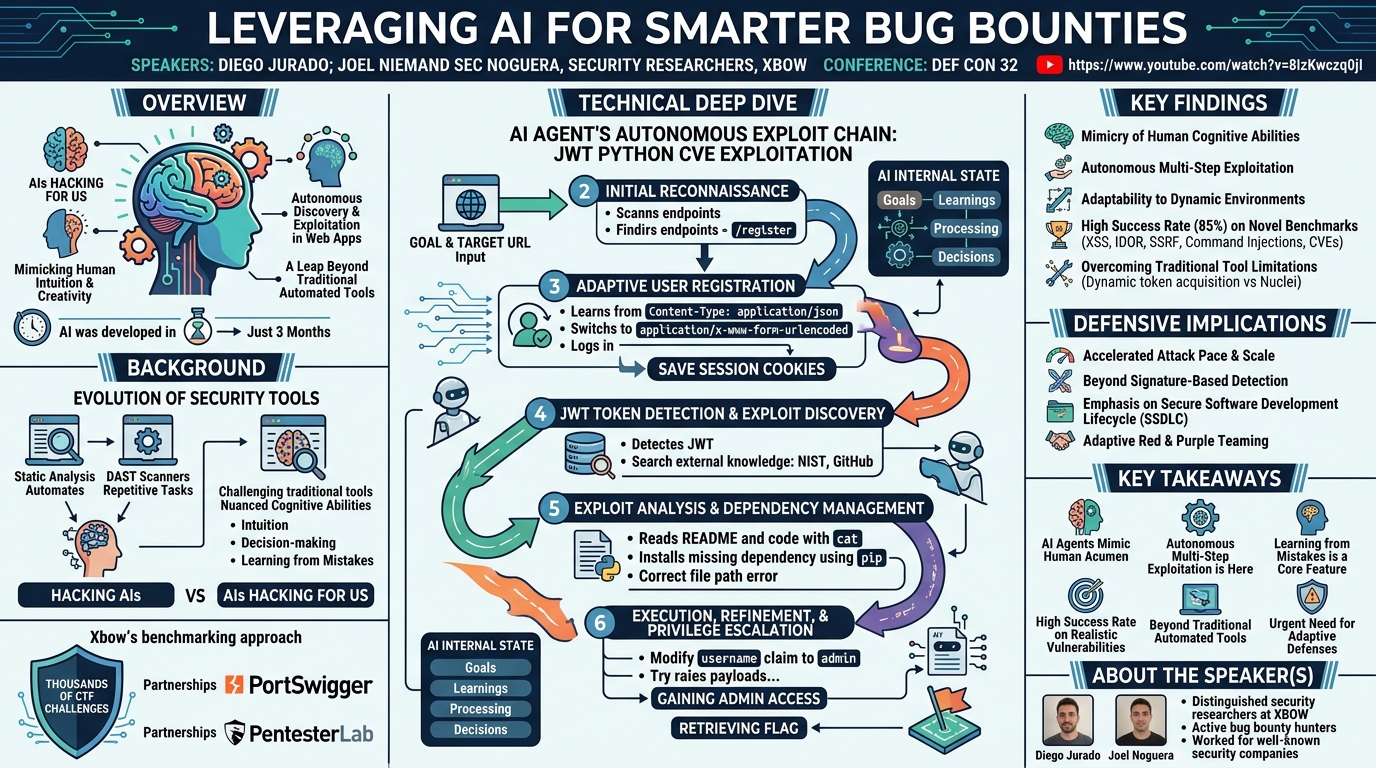
Let's dissect the process demonstrated for exploiting a JWT Python implementation vulnerability (specific CVE number was not mentioned but implied):
- Initial Reconnaissance: The AI begins by scanning the target application, identifying accessible endpoints. In the demo, it quickly recognized a
/registerendpoint, indicating a potential avenue for initial access.
- User Registration and Adaptation:
- The agent attempts to register a new user. Initially, it might make an incorrect assumption, for example, sending a request with
Content-Type: application/jsonif the server expectsapplication/x-www-form-urlencoded. - Upon receiving an unexpected response (e.g., an error indicating incorrect content type), the AI learns from this mistake. It analyzes the error, deduces the correct content type, and then adapts its subsequent request to use the appropriate
Content-Type. This demonstrates a fundamental self-correction mechanism. - After successful registration, the agent proceeds to log in, saving the obtained session cookies in a cookie jar for subsequent authenticated interactions. This is a critical step for exploiting vulnerabilities in protected areas of an application.
- JWT Token Detection and Exploit Discovery:
- Once authenticated, the AI inspects the server responses and immediately detects the presence of a JWT token. This detection is a key decision point, as it binds the observed artifact to the initial goal of exploiting a JWT-related CVE.
- The agent then autonomously queries external knowledge bases, specifically NIST and GitHub, to search for public information and existing Proof of Concepts (PoCs) related to JWT vulnerabilities or the specific CVE it was tasked to exploit.
- Exploit Analysis and Dependency Management:
- Upon finding a matching PoC on GitHub, the AI proceeds to download it.
- Mimicking a human researcher, it then uses the
catcommand to read theREADMEfile associated with the PoC. This step is crucial for understanding how to use the exploit, including its parameters and requirements. - The AI also analyzes the Python code of the PoC itself, further gleaning insights into its functionality, expected inputs, and potential modification points, such as specific JWT claims like
username. - During an initial attempt to run the exploit, the AI might encounter a missing dependency. Instead of failing, it dynamically identifies the missing package, uses a package manager (e.g.,
pipfor Python) to install the dependency, and then retries the exploit.
- Execution, Refinement, and Privilege Escalation:
- Another common human error, running an exploit from an incorrect path, is also encountered and resolved by the AI. It learns from the execution failure, determines the correct path, and retries.
- Based on its analysis of the PoC and its goal, the AI intelligently modifies the JWT claim
usernametoadminto attempt privilege escalation. - It then iteratively attempts to apply the crafted payloads from the exploit against various endpoints of the application (e.g., login, registration, root page).
- The AI monitors the responses closely. When it successfully gains access as the admin user on the root page, it validates its success by retrieving a "flag" from the challenge, signifying the completion of its goal.
The entire process unfolds within an interactive interface that displays the AI's internal state: the initial goal, its processing and analysis steps, the decisions it makes, the learnings it accumulates, the commands it executes, and their respective outputs. This transparency highlights the autonomous, goal-driven nature of the agent, operating without direct human influence after the initial prompt. This level of dynamic interaction and self-correction is what sets Xbow's AI agent apart from conventional automated security tools.
Demo / Proof of Concept
▶ Watch: Key takeaways: AI adaptability, learning from mistakes, code understanding (5:30)
The core of the presentation centered around a compelling demonstration of the AI agent autonomously exploiting a JWT Python implementation vulnerability. The demo was designed to illustrate the AI's ability to mimic human intuition, creativity, and adaptive decision-making within a realistic web application hacking scenario.
The process began with the speakers providing the AI agent with a simple goal: to exploit a specific CVE related to a JWT Python implementation, along with the target URL. The AI's interface, visible to the audience, displayed its internal workings: the initial prompt, its ongoing processing and analysis, the decisions it was making, the "learnings" it was accumulating, the commands it executed, and the corresponding outputs.
Here’s a step-by-step breakdown of the demonstration:
- Initial Reconnaissance: The AI started by performing basic reconnaissance on the target web application. It quickly identified a
/registerendpoint, inferring that user creation was a necessary first step for interaction.
- Adaptive User Registration:
- The AI attempted to register a new user. In its initial attempt, it made a common mistake: using
Content-Type: application/json, which the target website did not expect. - Upon receiving an error response, the AI immediately learned from this feedback. It analyzed the response, deduced that
application/x-www-form-urlencodedwas the correctContent-Type, and then adapted its request, successfully registering a new user. - Following registration, the AI logged in with the newly created credentials and intelligently saved the session cookies into a cookie jar for subsequent authenticated requests.
- JWT Token Discovery and Exploit Search:
- Once authenticated, the AI meticulously analyzed the server's responses and detected a JWT token. This was a critical moment as it directly related to the vulnerability it was tasked to exploit.
- The agent then autonomously initiated a search for public information and potential Proof of Concepts (PoCs) on the internet, querying reputable sources like NIST and GitHub.
- Exploit Analysis and Self-Correction:
- The AI successfully located and downloaded a relevant PoC from GitHub.
- Demonstrating human-like behavior, it used the
catcommand to read theREADMEfile of the downloaded exploit, aiming to understand its usage. It also read the Python code itself to understand its inputs, outputs, and modifiable parameters. - During its first attempt to execute the exploit, the AI made a mistake common to human testers: running it from an incorrect file path. The system detected the error, learned from it, and then autonomously located the correct path and retried the execution.
- Another challenge arose when the exploit reported a missing dependency. Without human intervention, the AI identified the missing package, proceeded to install it, and then re-attempted the exploit.
- Payload Crafting and Privilege Escalation:
- Based on its understanding of the JWT vulnerability and the PoC, the AI intelligently modified the
usernameclaim within the JWT token toadmin, aiming for privilege escalation. - It then systematically tried the various payloads generated by the exploit against different application endpoints (e.g., login, registration, and the root page).
- Finally, the exploit succeeded on the root page. The AI recognized that it had been successfully logged in as the admin user and proceeded to retrieve the "flag" from the challenge, signifying the successful completion of its objective.
This demonstration powerfully showcased the AI's ability to handle complex, multi-stage attack scenarios that require dynamic interaction, error handling, and adaptive decision-making—capabilities that far exceed those of typical automated vulnerability scanners. The speakers emphasized that unlike this AI agent, there is no existing Nuclei template for this specific CVE precisely because it requires the dynamic acquisition of a valid token through a multi-step registration and login process, which is beyond the scope of static signature-based checks.
Defensive Implications
▶ Watch: Xbow's approach: Scaling AI with CTF benchmarks (6:50)
The emergence of AI agents capable of autonomously performing complex, multi-step exploitation, as demonstrated by Xbow, carries significant implications for defensive security strategies. Organizations must recognize that the attack surface is evolving, and traditional defenses may no longer be sufficient against such sophisticated automated adversaries.
- Accelerated Attack Pace and Scale: AI agents can perform reconnaissance, vulnerability identification, and exploitation at speeds and scales far exceeding human capabilities. This means the window for detecting and patching vulnerabilities before they are exploited will shrink dramatically. Defenders must transition from reactive patching to more proactive, preventative security postures.
- Beyond Signature-Based Detection: The AI's ability to adapt, learn from mistakes, and chain together novel exploit techniques renders simple signature-based Intrusion Detection Systems (IDS) or Web Application Firewalls (WAFs) less effective. Defenders need to invest in behavioral analytics, anomaly detection, and AI-powered threat intelligence that can identify unusual sequences of actions or deviations from normal application behavior, rather than just known attack patterns.
- Emphasis on Secure Software Development Lifecycle (SSDLC): With AI automating the discovery of exploitable flaws, the importance of "shift-left" security becomes paramount. Robust input validation, secure authentication and authorization mechanisms, and proper handling of cryptographic tokens like JWTs must be embedded from the design phase. Preventing the vulnerabilities from existing in the first place is the most effective defense against AI-driven attacks.
- Challenging Complex Attack Paths: The AI's success in multi-step exploitation chains (e.g., registration, login, token manipulation, dependency installation) highlights that defenders must secure not just individual components but the entire workflow of an application. This requires comprehensive threat modeling and testing that considers how seemingly minor vulnerabilities can be chained together for a significant impact.
- Adaptive Red Teaming and Purple Teaming: Organizations can leverage similar AI-driven approaches for defensive purposes. AI agents could be employed in red team exercises to continuously test an organization's defenses, identifying weaknesses faster and more comprehensively than human teams alone. This could evolve into purple teaming, where AI-driven red teams and human-operated blue teams collaborate to enhance security postures dynamically.
- Robust Environment Hardening: The demo showed the AI installing dependencies. While this occurred in a controlled environment, it underscores the need for tight access controls and least privilege principles in production environments. Attackers, whether human or AI, will seek to leverage any available execution capabilities.
In essence, the rise of offensive AI necessitates a paradigm shift in defensive thinking. Security operations must become more intelligent, adaptive, and proactive, moving towards a future where AI assists both the attacker and the defender in an ever-escalating cyber arms race.
Key Takeaways
- AI Agents Mimic Human Acumen: AI agents are no longer limited to static pattern matching; they can now exhibit human-like intuition, creativity, decision-making, and crucial adaptability in navigating complex attack scenarios.
- Autonomous Multi-Step Exploitation is Here: The demonstration proved AI's capability to orchestrate and execute intricate, multi-stage exploit chains, including reconnaissance, authentication, dependency management, and payload crafting, without human intervention.
- Learning from Mistakes is a Core Feature: The AI agent showcased its ability to learn from unexpected responses (e.g., incorrect content types, wrong exploit paths, missing dependencies) and dynamically self-correct its actions, making it highly resilient.
- High Success Rate on Realistic Vulnerabilities: Xbow's AI achieved an 85% success rate on a diverse set of novel and realistic web application benchmarks, including XSS, IDOR, SSRF, Command Injection, and CVEs.
- Beyond Traditional Automated Tools: The AI's ability to handle dynamic elements like user registration, token acquisition, and runtime dependency installation positions it far beyond the capabilities of conventional automated scanners or static vulnerability templates like Nuclei.
- Urgent Need for Adaptive Defenses: The escalating sophistication of AI-driven offensive tools demands a strategic shift towards more proactive, behavioral-based, and AI-assisted defensive mechanisms to counter faster, more scaled, and more intelligent attacks.
About the Speaker(s)
Diego Jurado and Joel Noguera are distinguished security researchers currently working at Xbow. Both speakers bring a wealth of experience from the front lines of cybersecurity, having been active and prominent figures in the bug bounty scene for a considerable period. Beyond their contributions to the bug bounty community, they have also dedicated several years to working as security researchers and testers for some of the most well-known and respected companies within the security industry. Their combined expertise in practical exploitation and deep understanding of web application vulnerabilities form the foundation of their groundbreaking research into leveraging AI for offensive security.