Master Splinter’s initial physical access dojo
Daniel Isler
DEF CON 32 Creator Stage · Day 1 · Creator Stage
Overview
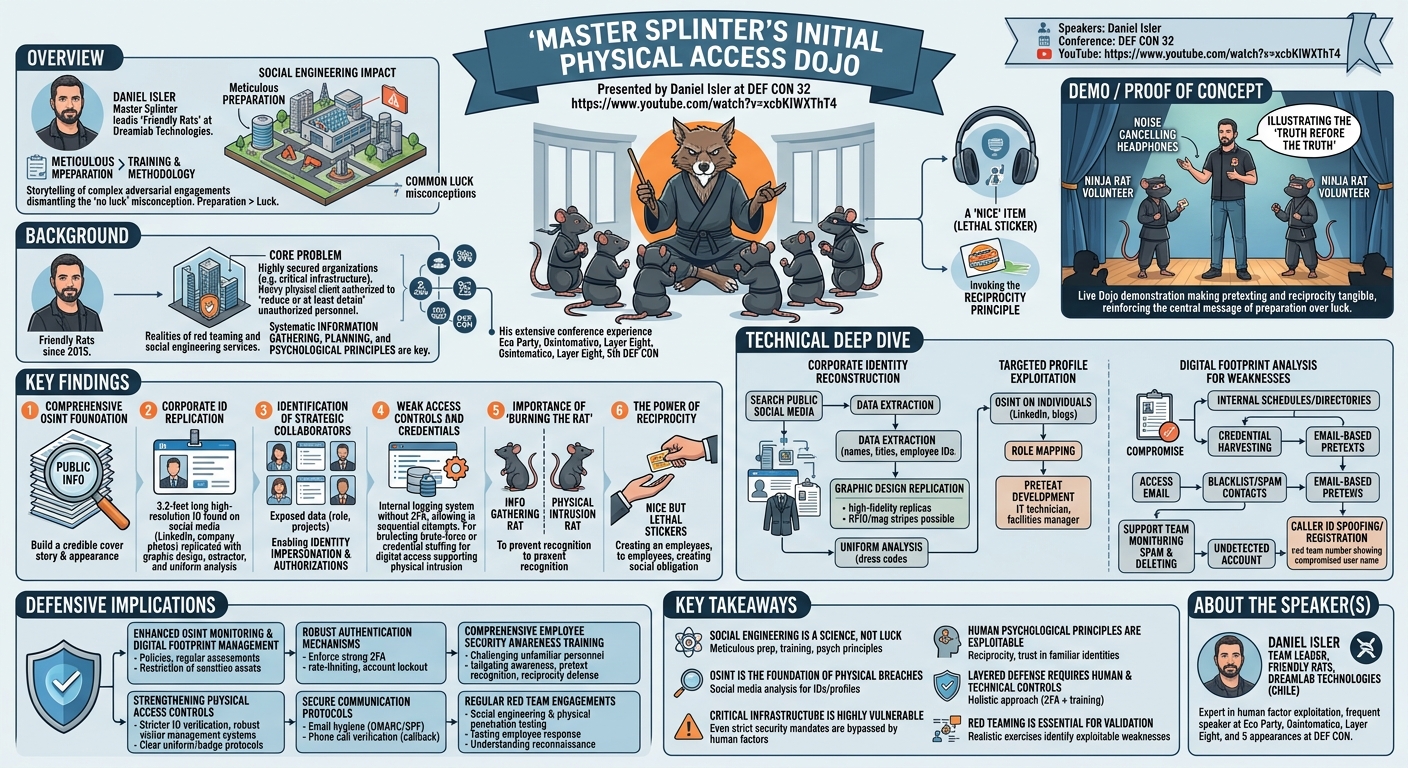
In "Master Splinter’s initial physical access dojo," Daniel Isler, representing the Friendly Rats social engineering unit at Dreamlab Technologies, delivers a compelling narrative demonstrating the profound impact of social engineering on physical security, particularly within critical infrastructure environments. The talk, structured as a "storytelling of complex adversarial" engagements, dismantles the common misconception that successful social engineering relies on luck, instead emphasizing meticulous preparation, training, and methodology. Isler, known as "Master Splinter" or "Rat" to his team, aims to illustrate how seemingly aggressive and complex physical attacks can be executed by skilled practitioners in a remarkably short timeframe, primarily by exploiting human vulnerabilities.
Key moments
- 2:45 Master Splinter's 'no luck' philosophy for social engineering
- 4:40 Critical infrastructure client's unique defense: detain intruders
- 5:10 Initial info gathering: IDs, profiles, and weak access
- 6:50 Reciprocity: The 'lethal sticker' social engineering weapon
- 8:20 Calling volunteers for the live Dojo demonstration
Master Splinter’s initial physical access dojo
Speakers: Daniel Isler
Conference: DEF CON 32
YouTube: https://www.youtube.com/watch?v=xcbKIWXThT4
Overview
In "Master Splinter’s initial physical access dojo," Daniel Isler, representing the Friendly Rats social engineering unit at Dreamlab Technologies, delivers a compelling narrative demonstrating the profound impact of social engineering on physical security, particularly within critical infrastructure environments. The talk, structured as a "storytelling of complex adversarial" engagements, dismantles the common misconception that successful social engineering relies on luck, instead emphasizing meticulous preparation, training, and methodology. Isler, known as "Master Splinter" or "Rat" to his team, aims to illustrate how seemingly aggressive and complex physical attacks can be executed by skilled practitioners in a remarkably short timeframe, primarily by exploiting human vulnerabilities.
This presentation is highly relevant for organizations across all sectors, but especially those managing critical infrastructure, where physical breaches can have catastrophic consequences. Isler's work highlights that even robust technical and physical security measures can be rendered ineffective if the human element is not adequately addressed. By sharing real-world insights from a red team engagement against a critical infrastructure client, the talk serves as a critical reminder that security is a holistic discipline, where human behavior often represents the weakest link. It challenges attendees to reconsider their security postures, advocating for a proactive approach to understanding and mitigating social engineering risks.
Background
▶ Watch: Master Splinter's 'no luck' philosophy for social engineering (2:45)
The premise of Isler’s talk is rooted in the practical realities of red teaming and social engineering services. As the team leader of Friendly Rats since 2015, Isler and his unit at Dreamlab Technologies specialize in simulating sophisticated adversarial attacks to test organizational defenses. The core problem addressed is the persistent vulnerability of even highly secured entities, particularly critical infrastructure companies, to attacks that manipulate human psychology rather than technical flaws alone. These organizations often invest heavily in physical security — access controls, surveillance, and even personnel authorized to detain intruders — yet overlook the subtle but powerful avenues of exploitation presented by human interaction.
Isler emphasizes that the success of such engagements is not a matter of chance but the direct result of systematic information gathering, planning, and the application of well-understood psychological principles. He frames social engineering as a "day job," a professional discipline requiring continuous training and refinement, rather than a serendipitous event. The client in this specific engagement, a critical infrastructure company in an unnamed country, presented a unique challenge: employees were explicitly authorized to "reduce or at least detain" any unauthorized personnel. This mandate underscored the need for an exceptionally well-orchestrated and convincing social engineering approach, where detection meant not just failure, but potential physical confrontation. The talk builds upon Isler's extensive experience presenting at various conferences, including Eco Party, Osintomatico, and Layer Eight, marking this as his fifth appearance at DEF CON, a testament to his expertise in the field.
Key Findings
▶ Watch: Critical infrastructure client's unique defense: detain intruders (4:40)
The red team engagement detailed by Isler uncovered several critical findings that illustrate common vulnerabilities and effective social engineering vectors:
- Comprehensive OSINT as a Foundation: The initial phase of information gathering, or OSINT (Open Source Intelligence), proved paramount. Attackers successfully leveraged public information to build a credible cover story and appearance.
- Corporate ID Replication: A crucial discovery was finding a high-resolution, 3.2-feet long version of the client's corporate ID on social media. This publicly available asset, complete with personal ID details of developers, allowed the red team to accurately replicate official identification badges, a cornerstone for bypassing physical access controls.
- Identification of Strategic Collaborators: Through OSINT, four strategic collaborators' accounts were identified. These profiles contained exposed information that enabled identity impersonation and the potential for gaining unauthorized authorizations. Targeting specific individuals with legitimate-looking roles greatly enhances the credibility of an intruder.
- Weak Access Controls and Credentials: The team discovered an internal logging system that lacked two-factor authentication (2FA) and permitted "several consecutive attempts to enter wrong credentials." This vulnerability suggested a potential avenue for brute-force attacks or credential stuffing to gain digital access, which could then be leveraged to support physical intrusion (e.g., sending internal emails, checking schedules).
- Importance of "Burning the Rat": A critical operational finding was the necessity of separating the information gathering rat (the individual performing initial OSINT and physical reconnaissance) from the physical intrusion rat (the individual attempting to gain entry). This prevents collaborators from recognizing the intruder based on prior, less conspicuous interactions, thus preserving the element of surprise.
- The Power of Reciprocity: Isler highlighted the psychological principle of reciprocity as a "powerful weapon." The red team prepared "nice but lethal stickers" to distribute to employees they interacted with. This seemingly innocuous gesture creates a social obligation for the recipient to reciprocate, making them less likely to challenge or question the intruder.
These findings collectively demonstrate that a layered approach to reconnaissance, combining digital OSINT with subtle physical observation, can yield sufficient information to craft highly effective and convincing social engineering schemes capable of breaching even critical infrastructure targets.
Technical Deep Dive
▶ Watch: Initial info gathering: IDs, profiles, and weak access (5:10)
The technical deep dive into Master Splinter's dojo reveals a sophisticated blend of OSINT, psychological manipulation, and meticulous planning, rather than traditional technical exploits. The "technical" aspect here refers to the systematic application of social engineering methodologies to achieve physical access.
The engagement commenced with an exhaustive information gathering phase, where the "Friendly Rats" team focused on three primary areas:
- Corporate Identity Reconstruction: The discovery of a 3.2-feet long version of the client's corporate ID on social media was a pivotal moment. This wasn't merely a logo; it included the personal ID of developers. This level of detail allowed the red team to meticulously recreate authentic-looking identification badges and potentially uniforms. The accuracy of these visual cues is crucial for bypassing initial scrutiny from employees and security personnel. The process would involve:
- Image Sourcing: Searching public social media platforms (LinkedIn, company event photos, employee posts) for high-resolution images of company IDs.
- Data Extraction: Identifying names, titles, departments, and employee IDs visible on the badges.
- Replication: Using graphic design software to create high-fidelity replicas, potentially incorporating magnetic stripes or RFID chips if the physical access system relies on simple cloneable credentials (though this wasn't explicitly detailed, it's a common red team tactic).
- Uniform Analysis: Observing employee attire in public images to understand dress codes and uniform specifics, further enhancing credibility.
- Targeted Profile Exploitation: The identification of four strategic collaborator accounts with exposed information provided critical intelligence for identity impersonation. This involved:
- OSINT on Individuals: Deep dives into public profiles (e.g., LinkedIn, personal blogs, conference speaker bios) of key employees to ascertain their roles, responsibilities, projects, and even personal interests.
- Role Mapping: Understanding how these individuals fit into the organizational structure and what level of access or authority their roles would imply. This allows the social engineer to craft a believable persona and reason for being in restricted areas.
- Pretext Development: Crafting a compelling pretext (a fabricated scenario) that aligns with the target's role and the company's operations. For example, impersonating an IT technician or a facilities manager for a "scheduled maintenance" or "urgent inspection."
- Digital Footprint Analysis for Weaknesses: The finding of an internal logging system without two-factor authentication (2FA) and allowing "several consecutive attempts to enter wrong credentials" highlights a common digital vulnerability that can feed physical access. While not directly a physical access method, compromising such a system could provide:
- Internal Schedules/Directories: Access to employee schedules, internal contact lists, or organizational charts, which are invaluable for validating pretexts and avoiding detection.
- Credential Harvesting: The ability to brute-force or guess credentials, which could then be used for internal email access.
- Email-Based Pretexts: If an email account is compromised, it can be used to send legitimate-looking internal communications to support the physical intrusion. Isler specifically mentioned a tactic where, once inside an email account, the red team would blacklist or spam all contacts they intended to interact with physically. A dedicated "support team" would then monitor the spam mailbox, respond to any legitimate inquiries from these contacts "as soon as possible," and then "delete both, the spam email and the sent email" to make the interaction invisible to the actual user. This sophisticated operational security (OpSec) ensures the compromised account remains undetected for as long as possible.
- Caller ID Spoofing/Registration: Another "little weapon" mentioned was registering the red team's phone number with the name of the compromised email account's user. This ensures that when the red team calls an employee, the caller ID displays the familiar name of a colleague, lending immense credibility to the call and bypassing initial suspicion, even if the call itself is unexpected. This simple yet effective tactic leverages trust built into daily interactions.
The overall strategy involved a meticulous blend of reconnaissance, pretexting, and psychological manipulation. The goal was to create a narrative so convincing, supported by authentic-looking artifacts (IDs, uniforms) and digital backing (compromised email, spoofed caller ID), that employees would naturally grant access, adhering to the principle of least resistance rather than initiating a confrontation. The emphasis on the "burned rat" concept further underscores the technical rigor applied to operational security during the physical intrusion phase, ensuring that the initial data collection doesn't compromise the later execution.
Demo / Proof of Concept
▶ Watch: Reciprocity: The 'lethal sticker' social engineering weapon (6:50)
During the talk, Daniel Isler engaged the audience in an interactive demonstration, bringing two volunteers on stage to act as "ninja rats." While the specific, step-by-step details of the improv scenario are not exhaustively transcribed, the speaker's intent was clear: to illustrate the "truth before the truth" regarding social engineering.
Isler handed the volunteers "noise cancelling headphones" and "a nice" item, which, based on the earlier discussion, was likely one of the "nice but lethal stickers" designed to invoke the principle of reciprocity. The demonstration aimed to simulate a real-world social engineering interaction, allowing the audience to witness firsthand how seemingly innocuous actions or objects can be leveraged to manipulate human behavior and gain compliance. The use of volunteers likely served to make the abstract concepts of pretexting and reciprocity tangible, showing how quickly individuals can be influenced when confronted with a well-crafted social engineering attempt. While the transcript doesn't elaborate on the specific actions performed by the volunteers or the exact outcome of the improv, the setup suggests a live, engaging way to underscore the talk's central message: that social engineering is a potent force, and its success is rooted in preparation and psychological understanding rather than mere luck. This interactive element reinforced the idea that anyone can fall victim, or, conversely, execute, a social engineering attack given the right training and methodology.
Defensive Implications
▶ Watch: Calling volunteers for the live Dojo demonstration (8:20)
The insights from Daniel Isler’s talk provide critical guidance for organizations looking to bolster their defenses against sophisticated social engineering and physical access attacks. The key takeaway for defenders is that security cannot solely rely on technical controls; the human element must be actively addressed.
- Enhanced OSINT Monitoring and Digital Footprint Management: Organizations must proactively monitor their public digital footprint. This includes regularly searching social media, corporate websites, and public databases for sensitive information such as high-resolution corporate IDs, employee names, roles, and any details that could be used for pretexting. Implement policies to restrict employees from posting sensitive company-related visual assets online. Conduct regular "attacker's view" OSINT assessments to identify what information is publicly accessible and how it could be weaponized.
- Robust Authentication Mechanisms: The discovery of internal logging without two-factor authentication (2FA) and susceptible to multiple login attempts highlights a fundamental weakness. All internal systems, especially those providing access to employee data, schedules, or directories, must enforce strong 2FA. Implement rate-limiting and account lockout policies to mitigate brute-force and credential stuffing attacks. Regularly audit authentication logs for unusual activity.
- Comprehensive Employee Security Awareness Training: This is paramount. Training should go beyond basic phishing awareness to cover physical social engineering tactics.
- Challenging Unfamiliar Personnel: Employees must be empowered and trained to politely but firmly challenge anyone they don't recognize or who appears to be in an unusual area, even if they seem to have an ID.
- Tailgating Awareness: Educate staff on the dangers of tailgating (holding doors open for others without verifying their credentials) and the importance of ensuring physical access points close securely behind them.
- Pretext Recognition: Train employees to recognize common pretexts (e.g., "forgotten badge," "urgent maintenance," "delivery"). Emphasize verifying identities through official channels (e.g., calling a known internal number, checking a company directory) rather than relying on presented IDs or claims.
- Principle of Reciprocity Defense: Educate employees to be wary of unsolicited gifts, favors, or compliments from strangers, especially in professional settings, as these can be used to create a false sense of obligation.
- Strengthening Physical Access Controls and Procedures:
- ID Verification: Implement procedures for stricter ID verification, potentially requiring a secondary form of identification or cross-referencing with a staff directory.
- Visitor Management Systems: Utilize robust visitor management systems that log all visitors, issue temporary badges, and require escorts for non-employees.
- Uniform and Badge Protocols: Ensure clear, distinct uniform and badge protocols for different roles, making it harder for attackers to blend in. Regularly update ID designs to deter replication.
- Secure Communication Protocols:
- Email Hygiene: Implement advanced email filtering and DMARC/SPF/DKIM to detect spoofed emails. Educate employees on verifying the sender's actual email address, not just the display name.
- Phone Call Verification: Train employees to be suspicious of urgent or unusual requests made over the phone, especially if the caller ID appears to be internal. Encourage callback verification to a known, official number.
- Regular Red Team Engagements: Conduct periodic, realistic red team exercises that include social engineering and physical penetration testing. These exercises, like the one described by Isler, are invaluable for identifying exploitable weaknesses in both technical systems and human processes before malicious actors do. Ensure these assessments include testing employee response to suspicious individuals and pretexts. The "burned rat" concept highlights the need for organizations to understand how adversaries conduct reconnaissance and to implement countermeasures that detect such activities.
By adopting a holistic security strategy that addresses both technical vulnerabilities and the human factor, organizations can significantly reduce their susceptibility to the sophisticated social engineering attacks demonstrated in this talk.
Key Takeaways
- Social Engineering is a Science, Not Luck: Successful social engineering relies on meticulous preparation, training, and the systematic application of psychological principles, not chance.
- OSINT is the Foundation of Physical Breaches: Comprehensive open-source intelligence gathering, including social media analysis for corporate IDs and employee profiles, provides critical information for crafting convincing pretexts and physical access tools.
- Critical Infrastructure is Highly Vulnerable: Even organizations with strict physical security mandates can be easily compromised if the human element is not adequately secured and trained.
- Human Psychological Principles are Exploitable: Tactics like reciprocity (e.g., giving stickers) and the natural human tendency to trust familiar-looking identities (e.g., spoofed caller ID) are powerful tools for social engineers.
- Layered Defense Requires Human and Technical Controls: Effective security demands a holistic approach, where technical safeguards (like 2FA) are complemented by rigorous employee awareness training and robust physical access policies.
- Red Teaming is Essential for Validation: Regular social engineering and physical penetration tests are crucial for identifying real-world vulnerabilities and validating the effectiveness of defensive measures.
About the Speaker(s)
Daniel Isler, known to many as "Master Splinter" or simply "Rat," is the team leader of Friendly Rats, the dedicated social engineering unit at Dreamlab Technologies in Chile. Since taking on this role in 2015, Isler has become a recognized authority in the field of social engineering, specializing in demonstrating how human factors can be exploited to bypass even the most robust security systems. His expertise is frequently sought after, leading him to present at numerous prominent security conferences globally. He has shared his insights at events such as Eco Party in Buenos Aires, Argentina; Osintomatico in Madrid, Spain; and Layer Eight in Rhode Island. This presentation marks his fifth appearance at DEF CON, underscoring his significant contributions and experience within the cybersecurity community.