Introduction to IPv6
Denis Smajlović
DEF CON 32 Creator Stage · Day 1 · Creator Stage
Overview
In his DEF CON 32 talk, "Introduction to IPv6," Denis Smajlović, a Principal Security Consultant at Nova Information Security, tackles the pervasive challenge of understanding IPv6 within the cybersecurity community. Smajlović highlights a common struggle: many security professionals, including himself, find IPv6 intimidating and prefer to maintain infrastructure on the "legacy" IPv4 protocol. The core premise of his presentation is that the complexity often attributed to IPv6 is, in fact, a byproduct of the numerous extensions, NATing, and other workarounds that have accumulated around IPv4 over decades, abstracting its original intent.
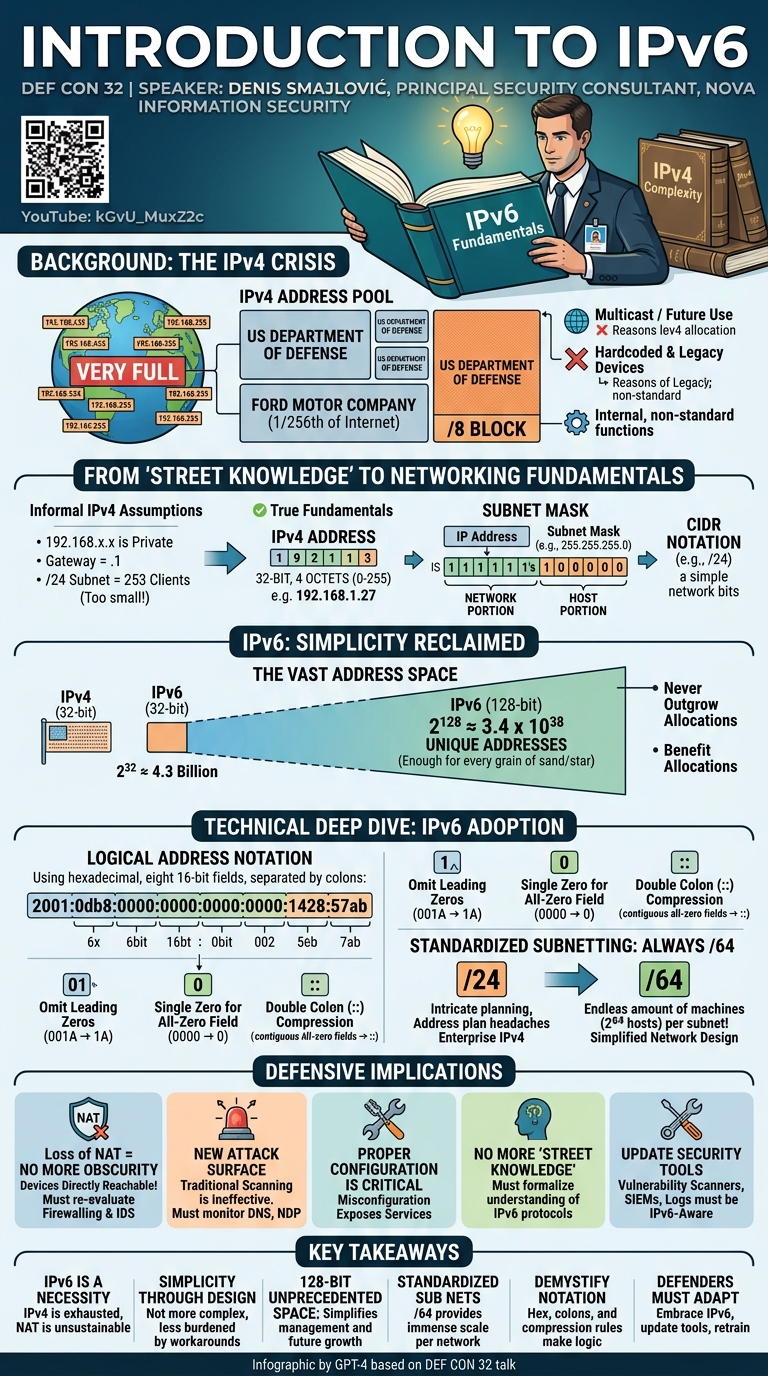
Introduction to IPv6
Speakers: Denis Smajlović, Principal Security Consultant, Nova Information Security
Conference: DEF CON 32
YouTube: https://www.youtube.com/watch?v=kGvU_MuxZ2c
Overview
In his DEF CON 32 talk, "Introduction to IPv6," Denis Smajlović, a Principal Security Consultant at Nova Information Security, tackles the pervasive challenge of understanding IPv6 within the cybersecurity community. Smajlović highlights a common struggle: many security professionals, including himself, find IPv6 intimidating and prefer to maintain infrastructure on the "legacy" IPv4 protocol. The core premise of his presentation is that the complexity often attributed to IPv6 is, in fact, a byproduct of the numerous extensions, NATing, and other workarounds that have accumulated around IPv4 over decades, abstracting its original intent.
Smajlović argues that a proper understanding of IPv6 necessitates first dialing back to grasp the fundamental concepts of IPv4 without its accreted complexities. By doing so, the transition to IPv6, which is essentially "a couple more bits and a different way to write things," becomes significantly more straightforward. This talk is crucial for anyone in security who has avoided or struggled with IPv6, offering a foundational re-education that strips away misconceptions and reveals the inherent simplicity and necessity of the next-generation internet protocol.
The talk goes beyond a mere technical explanation, emphasizing the critical need for the security community to embrace IPv6 due to the unsustainable nature of IPv4 address allocation. It aims to empower attendees with a clear conceptual framework, enabling them to confidently navigate and secure networks that are increasingly adopting IPv6.
Background
The genesis of IPv6 stems directly from the critical and widely recognized issue of IPv4 address exhaustion. Smajlović vividly illustrates this problem with a visual representation of the IPv4 internet's current allocations (as of January 2023), revealing a network that is "very, very, very full." While minor allocations might still be available from regional internet registries, the global pool is essentially depleted.
One proposed, yet ultimately unfeasible, solution often brought up is the repurposing of "multicast space" or "future use space" blocks within the IPv4 address range. However, Smajlović explains that this is impractical because many legacy devices and existing software have hard-coded these addresses as unusable or engineers have leveraged them for internal, non-standard functions. Attempting to use these blocks for public IP addresses would lead to widespread network instability and failures.
The speaker highlights the disproportionate allocation of IPv4 addresses, citing examples such as the US Department of Defense (DoD) appearing "a lot of times" in internet routing tables and Ford Motor Company owning an entire /8 block. A /8 allocation means that every public IPv4 address starting with the first octet (e.g., 19.0.0.0/8) belongs to Ford. Given that there are fewer than 256 such /8 blocks globally, this means Ford Motor Company effectively owns "1/256th of the internet," underscoring the unsustainable and inequitable distribution of IPv4 addresses.
Before delving into IPv6, Smajlović addresses the common "street knowledge" of IPv4 that many users and even professionals acquire through practical, often unexamined, experience. This includes assumptions like private IP addresses starting with 192.168.x.x or 10.x.x.x, and the default gateway simply being the local IP with a .1 at the end. He also points out the common home network configuration of a /24 subnet, which limits a network to a mere 253 client devices—a number quickly outgrown in even moderately sized private or enterprise environments. This informal understanding, while often functional for basic use cases, becomes a significant barrier to truly grasping networking fundamentals and, by extension, IPv6.
The talk then revisits the core components of IPv4: a 32-bit address divided into four octets, each ranging from 0 to 255. The subnet mask (e.g., 255.255.255.0) is explained not by its decimal form, which is "intimidating" and "doesn't really mean anything," but by its binary representation. In binary, a subnet mask consists of a contiguous block of ones followed by a block of zeros. The ones indicate the network portion of an IP address, while the zeros indicate the host portion. This binary understanding dictates whether a packet is destined for the local network (if the network bits match) or needs to be sent to the default gateway. This explanation of subnet masks naturally leads to the introduction of CIDR notation (Classless Inter-Domain Routing), such as 192.168.1.27/24, which simplifies the representation of an IP address and its corresponding subnet mask by simply counting the number of contiguous '1' bits in the mask. This foundational review of IPv4, stripped of its later complexities, serves as the essential stepping stone to understanding IPv6.
Key Findings
The central finding of Denis Smajlović’s talk is that the perceived complexity of IPv6 is largely a misconception, often stemming from an ingrained, but flawed, understanding of IPv4 burdened by decades of accumulated workarounds. He asserts that by understanding the fundamental principles of networking, particularly the binary nature of IP addresses and subnet masks, IPv6 actually emerges as a simpler, more elegant, and far more sustainable protocol.
Key discoveries and contributions from the talk include:
- IPv6 as a Return to Simplicity: Smajlović argues that IPv6, despite its longer address format, is inherently simpler than modern IPv4 because it eliminates the need for complex technologies like NAT and intricate subnet planning. It allows for a more direct and logical approach to network design and addressing, reflecting the original intent of IP protocols before IPv4's address space limitations forced workarounds.
- Unprecedented Address Space: The shift from IPv4's 32-bit addresses to IPv6's 128-bit addresses is not merely a quantitative increase; it's a qualitative leap that fundamentally changes network design philosophy. This vast address space (enough to represent "every grain of sand on the globe or every star in the visible universe") ensures that entities can receive allocations they will "never outgrow," eliminating the need for fragmented address blocks and complex re-numbering schemes.
- Standardized Subnetting: A significant simplification introduced by IPv6 is the near-universal adoption of a
/64subnet for end-user networks. Unlike IPv4, which requires meticulous address planning and subnet calculations to optimize address usage, IPv6's /64 automatically provides an astronomically large number of host addresses (2^64) within a single subnet. This eliminates the "address plan" headaches common in enterprise IPv4 deployments, allowing for an "endless amount of machines" on a single network without fear of exhaustion. - Logical Address Notation: While initially daunting with its hexadecimal characters and colons, the IPv6 address notation, including rules for zero compression (single
0for all-zero fields and a single::for contiguous blocks of zero fields), is presented as a logical system for compact representation. Understanding these rules demystifies the addresses, transforming them from "random string of like colons and letters" into meaningful structures.
These findings collectively highlight that IPv6 is not just an upgrade but a paradigm shift that simplifies network administration, enhances scalability, and provides a robust foundation for future internet growth, provided one approaches it with the correct foundational understanding.
Technical Deep Dive
The technical deep dive of Smajlović's talk begins by meticulously deconstructing IPv4 to lay a solid foundation before transitioning to IPv6. He explains that an IPv4 address is a 32-bit identifier, conventionally written as four decimal numbers (0-255) separated by dots, each representing an octet (8 bits). For instance, 192.168.1.27.
The crucial concept of the subnet mask is introduced, typically seen as 255.255.255.0 for common home networks. Smajlović stresses that its decimal form is misleading; its true function is understood only by its binary representation. A subnet mask in binary consists of a sequence of 1s followed by a sequence of 0s. The 1s define the network portion of an IP address, while the 0s define the host portion. When a computer needs to send a packet, it performs a bitwise AND operation with its own IP address and the destination IP address against the subnet mask. If the network portions match, the destination is on the local network; otherwise, the packet is forwarded to the default gateway (usually the router).
To simplify subnet mask representation, Smajlović introduces CIDR notation. Instead of writing both the IP address and the subnet mask, CIDR appends a slash followed by the count of contiguous 1s in the binary subnet mask. For example, 192.168.1.27/24 indicates that the first 24 bits define the network, and the remaining 8 bits are for host addresses. A /24 network allows for 2^(32-24) - 2 = 256 - 2 = 254 usable host addresses (excluding network and broadcast addresses), commonly simplified to 253 client devices in a home network context.
The transition to IPv6 is presented as a necessary evolution driven by IPv4 exhaustion and the desire for a more scalable, less complex addressing scheme. IPv6 addresses are 128 bits long, a massive increase from IPv4's 32 bits. This exponential growth in address space (2^128 unique addresses) is designed to ensure that network administrators will "never outgrow" their allocated address blocks, simplifying network planning significantly.
IPv6 addresses are written differently: they consist of eight 16-bit fields, represented in hexadecimal (0-9, A-F), separated by colons. An example given is 2607:f8b0:4005:805::200e, which is Google's IPv6 address. Smajlović breaks down the shorthand notation rules:
- Omitting Leading Zeros: Within each 16-bit field, leading zeros can be omitted. For instance,
001Abecomes1A. - Single Zero for All-Zero Fields: A field consisting of all zeros (e.g.,
0000) can be shortened to a single0. - Double Colon Compression (
::): The most significant compression rule allows a single contiguous block of one or more all-zero fields to be replaced by a double colon::. This is critical for uniqueness; only one::can appear in an IPv6 address. The system infers the number of zeros needed to expand the address back to 128 bits. For example,2001:0db8:0000:0000:0000:0000:1428:57abcan be compressed to2001:db8::1428:57ab.
A cornerstone of IPv6's simplified network design is the standardization of subnetting. For virtually all end-user networks (e.g., home networks, enterprise LANs), a /64 subnet is universally used. This means the first 64 bits of the IPv6 address define the network prefix, leaving the remaining 64 bits for host identification. This provides an astounding 2^64 possible host addresses per subnet, effectively an "endless amount of machines." This eliminates the complex address planning and subnet calculations that are a constant challenge in IPv4 environments, allowing network engineers to deploy networks without worrying about running out of local IP addresses. The speaker explicitly contrasts this with IPv4's /24 for home networks, highlighting the dramatic increase in available hosts.
Demo / Proof of Concept
The talk "Introduction to IPv6" by Denis Smajlović is primarily a conceptual and educational presentation aimed at demystifying IPv6 and explaining its underlying principles. As such, the transcript does not describe a live technical demonstration, a specific proof of concept, or the use of any particular tools for exploiting or defending IPv6. The speaker focuses on whiteboarding and explaining concepts with examples of IP addresses and subnet masks.
Defensive Implications
Understanding and properly implementing IPv6 is no longer optional for cybersecurity defenders; it is a critical necessity. The talk, while foundational, implicitly highlights several defensive implications:
- Loss of NAT as a Security Boundary: One of the most significant shifts from IPv4 to IPv6 is the elimination of Network Address Translation (NAT). In IPv4, NAT often provided a rudimentary form of security by obscuring internal network topology and making internal devices unreachable directly from the internet. With IPv6, every device can theoretically have a globally unique and publicly routable IP address. This means internal machines are directly exposed to the internet by default, requiring a fundamental re-evaluation of firewalling, intrusion detection systems (IDS), and network segmentation strategies. Defenders must ensure robust perimeter and internal firewalls are in place and properly configured for IPv6 traffic.
- New Attack Surface and Discovery Challenges: The vastness of the IPv6 address space, particularly the
/64subnet for local networks, renders traditional IPv4 scanning techniques (like ping sweeps or sequential port scanning) largely ineffective for host discovery. Attackers will shift to other methods, such as monitoring DNS records, leveraging the Neighbor Discovery Protocol (NDP), or exploiting application-layer vulnerabilities. Defenders need to adapt their asset discovery and vulnerability scanning tools to be IPv6-aware and focus on these new vectors.
- Importance of Proper Configuration: The speaker emphasizes that IPv6 simplifies network design, but this simplicity can lead to dangerous misconfigurations if not understood. Improperly configured IPv6 can inadvertently expose services or devices that were previously protected by IPv4 NAT or legacy firewall rules. Defenders must ensure that default IPv6 configurations on operating systems and network devices are secure and that network policies are consistently applied across both IPv4 and IPv6 stacks.
- No More "Street Knowledge": Smajlović's point about moving beyond informal IPv4 "street knowledge" applies directly to security. Defenders cannot rely on outdated assumptions about private IP ranges or the security by obscurity offered by NAT. Formal education and a deep understanding of IPv6's protocols (e.g., NDP, Stateless Address Autoconfiguration (SLAAC), DHCPv6) are essential to identify and mitigate risks.
- Updating Security Tools and Practices: Existing security tools, including vulnerability scanners, SIEMs, log analyzers, and network monitoring solutions, must be capable of processing, interpreting, and securing IPv6 traffic. Organizations need to audit their security toolchain to ensure IPv6 compatibility and integrate IPv6 monitoring into their security operations centers (SOCs).
In essence, the defensive implication is a call to action: embrace IPv6, educate staff, update infrastructure and tools, and rebuild security strategies from the ground up to account for the unique characteristics and inherent directness of the next-generation internet protocol. Ignoring IPv6 is tantamount to leaving a significant portion of the network vulnerable.
Key Takeaways
- IPv6 is a Necessity, Not a Choice: Due to critical IPv4 address exhaustion and its inherent design limitations (e.g., NAT, complex subnetting), IPv6 is the inevitable future of the internet. Understanding it is crucial for all IT and security professionals.
- Simplicity Through Design: Despite its longer address format, IPv6 is fundamentally simpler than IPv4 due to its 128-bit address space. It eliminates the need for complex workarounds like NAT and intricate subnet planning, returning to a more direct and logical networking model.
- The Power of 128 Bits: IPv6's vast address space means entities can receive allocations they will "never outgrow," simplifying network management and removing the need for fragmented address blocks common in IPv4.
- Standardized Subnetting (Always /64): For end-user networks, IPv6 typically uses a
/64subnet, providing an "endless amount of machines" (2^64 hosts) on a single local network. This dramatically simplifies address planning compared to IPv4. - Demystifying IPv6 Address Notation: IPv6 addresses use hexadecimal characters, colons, and specific compression rules (omitting leading zeros, representing all-zero fields with a single
0, and using a single::for contiguous blocks of zero fields) for compact representation. These rules, once understood, make the addresses logical. - Defenders Must Adapt: The absence of NAT in IPv6 means devices are directly addressable, fundamentally changing firewalling and intrusion detection strategies. Traditional IPv4 scanning is less effective, and security tools and practices must be updated to be IPv6-aware.
About the Speaker(s)
Denis Smajlović is a Principal Security Consultant at Nova Information Security, a firm based in San Francisco, California. His professional experience involves working with various clients, where he frequently observed the widespread difficulty and apprehension within the security community regarding IPv6. This personal and professional struggle with IPv6 was the primary motivation behind his DEF CON talk. Smajlović realized that the complexity often attributed to IPv6 was a misdirection, stemming from the convoluted extensions and NATing that have accumulated around IPv4 over the years, obscuring its original, simpler design. His goal with this presentation was to share his journey of understanding IPv6, demonstrating that by first grasping the core principles of IPv4, the transition to and comprehension of IPv6 becomes significantly more accessible.