Exploiting Voice Cloning in Adversarial Simulation
Mark Foudy
DEF CON 32 Creator Stage · Day 1 · Creator Stage
Overview
In an era where voice biometrics are increasingly deployed for secure authentication, Mark Foudy's DEF CON 32 presentation, "Exploiting Voice Cloning in Adversarial Simulation," illuminated the critical vulnerabilities within these systems. The talk delved into advanced techniques for making synthetic speech virtually indistinguishable from genuine human speech, specifically targeting the anti-spoofing mechanisms designed to detect such fakes. Foudy, an offensive security researcher with a focus on AI and near security, exposed how sophisticated adversarial training can circumvent the defenses of widely used voice verification services.
Key moments
- 0:00 Introduction to voice cloning exploitation in adversarial simulation
- 1:00 The challenge: bypassing anti-spoofing via adversarial training
- 2:00 Introducing 'Acoustic Standards' for undetectable spoof speech
- 3:00 Technique 1: Adjusting silence intervals for natural flow
- 4:00 Technique 2: Center spectrum boosting for natural sound
- 5:00 Technique 3: Frequency pre-emphasis to enhance clarity
- 6:00 Technique 4: Integrating additive noise for realism
Exploiting Voice Cloning in Adversarial Simulation
Speakers: Mark Foudy
Conference: DEF CON 32
YouTube: https://www.youtube.com/watch?v=glTCi9SaJbM
Overview
In an era where voice biometrics are increasingly deployed for secure authentication, Mark Foudy's DEF CON 32 presentation, "Exploiting Voice Cloning in Adversarial Simulation," illuminated the critical vulnerabilities within these systems. The talk delved into advanced techniques for making synthetic speech virtually indistinguishable from genuine human speech, specifically targeting the anti-spoofing mechanisms designed to detect such fakes. Foudy, an offensive security researcher with a focus on AI and near security, exposed how sophisticated adversarial training can circumvent the defenses of widely used voice verification services.
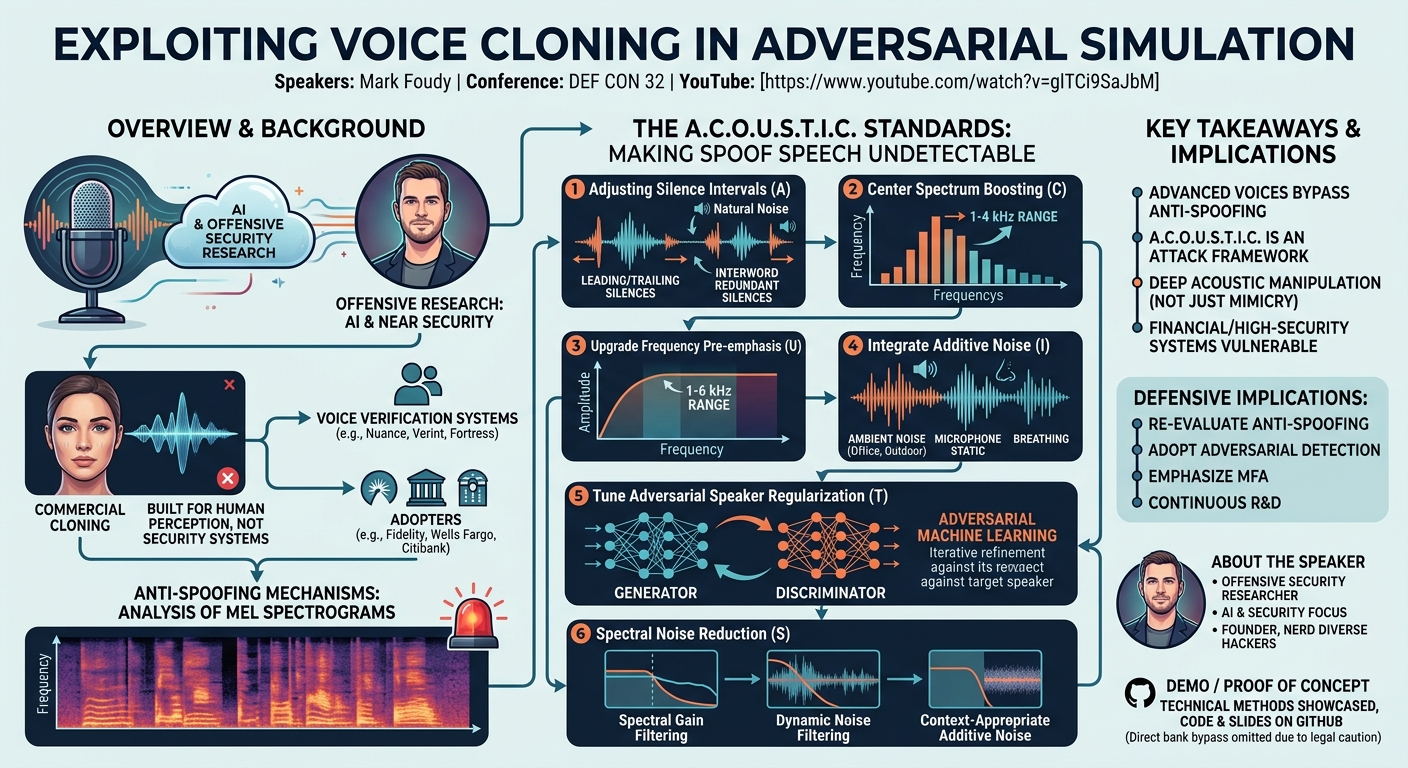
The core of Foudy's research centers on a novel framework he developed, dubbed the A.C.O.U.S.T.I.C. standards, which outlines a structured, multi-faceted approach to manipulating audio at a granular level. While commercial voice cloning products can generate realistic voices, they typically fail against robust anti-spoofing systems employed by financial institutions like Fidelity Bank, Wells Fargo, and Citibank. Foudy's work directly addresses this gap, demonstrating how to refine voice models to bypass these advanced detection mechanisms, which often rely on analyzing Mel spectrograms for anomalies. This research is particularly significant as it shifts the focus from merely creating a convincing clone to making that clone acoustically undetectable to automated security systems.
Foudy's initial intention was to demonstrate bypassing a bank account's voice verification directly, but due to legal complexities, he pivoted to showcasing the underlying technical methods for achieving undetectability. This pivot underscores the profound implications of his findings: if synthetic speech can be crafted to fool anti-spoofing, the integrity of voice-based authentication across various high-stakes sectors, including finance, government, and critical infrastructure, is severely compromised. The talk served as a stark warning and a call to action for defenders to re-evaluate and enhance their biometric security protocols against a new generation of AI-powered threats.
Background
▶ Watch: Introduction to voice cloning exploitation in adversarial simulation (0:00)
Voice verification systems have emerged as a prominent layer of security, offering a seemingly convenient and robust method for authenticating users. Companies such as Nuance, Verint, and Fortress Identity provide these services, which are widely adopted by major financial institutions like Fidelity Bank, Wells Fargo, and Citibank for tasks ranging from account access to transaction approvals. The appeal of voice biometrics lies in their perceived uniqueness and the difficulty of forging a person's voice. However, as Foudy highlights, this perception of invulnerability is increasingly challenged by advancements in artificial intelligence and machine learning.
The fundamental challenge for voice verification systems is to differentiate between genuine human speech and artificially generated or manipulated speech, often referred to as "spoof speech." To counter the rise of voice cloning technologies, these systems incorporate anti-spoofing mechanisms. These mechanisms typically analyze various acoustic features, such as Mel spectrograms, which represent the spectrum of frequencies in a sound as they vary over time. Anomalies in these spectral patterns, peculiar artifacts, or a lack of natural variability are often tell-tale signs that speech is synthetic. Commercial voice cloning tools, while capable of producing high-fidelity voice replicas, generally struggle to replicate these subtle acoustic nuances that anti-spoofing systems are trained to detect, leading to their failure in real-world bypass attempts.
The problem, therefore, is not merely the creation of a voice clone, but the ability to imbue that clone with the intricate, often chaotic, characteristics of natural human speech. This requires moving beyond superficial mimicry to a deep understanding and manipulation of the underlying signal processing and acoustic properties. Prior work in voice cloning has predominantly focused on achieving high perceptual quality for human listeners, but Foudy's research shifts the paradigm towards adversarial simulation, where the goal is to specifically bypass machine-based detectors. This requires a sophisticated approach that combines signal processing techniques with machine learning algorithms, allowing a voice model to be refined to the point where its synthetic origins become imperceptible to automated anti-spoofing technologies. The talk's premise is that by understanding and exploiting the specific features that anti-spoofing systems look for, it's possible to craft synthetic voices that pass as authentic.
Key Findings
▶ Watch: Introducing 'Acoustic Standards' for undetectable spoof speech (2:00)
The central and most significant finding presented by Mark Foudy is the development of the A.C.O.U.S.T.I.C. standards for modifying spoof speech. This framework represents a structured, multi-step approach designed to make synthetic voice clones acoustically indistinguishable from natural human speech, thereby enabling them to bypass sophisticated anti-spoofing verification systems. Foudy emphasizes that while many commercial voice cloning products exist, they typically fail against the rigorous detection mechanisms used by financial institutions, which analyze subtle anomalies via techniques like Mel spectrograms. The A.C.O.U.S.T.I.C. standards are specifically engineered to overcome these limitations.
Foudy's research demonstrates that by combining advanced signal processing techniques with machine learning algorithms in an adversarial training context, it is possible to systematically eliminate the synthetic characteristics that anti-spoofing systems are designed to detect. The framework breaks down the complex problem into manageable, actionable steps focusing on critical aspects of audio manipulation. While the speaker referred to "eight key elements" within the A.C.O.U.S.T.I.C. standards, the detailed technical descriptions provided in the transcript primarily elaborate on six distinct and powerful techniques. These techniques collectively target various acoustic signatures, from the subtle nuances of silence and background noise to the precise spectral balance and dynamic variability of human speech.
The key contribution is not just the identification of these individual techniques but their systematic integration into a coherent strategy for adversarial simulation. This approach allows researchers and potential attackers to refine voice clone models to such a degree that they can "blend seamlessly into real-world audio environments," effectively masking their artificial origins. Foudy’s work provides a clear roadmap for how to achieve this advanced level of spoofing, highlighting that current anti-spoofing technologies, even those considered robust, are vulnerable to a determined and technically proficient adversary employing these methods. The promise of providing code examples and slides on GitHub after the conference further underscores the practical applicability and reproducibility of these findings, making them accessible to other researchers and potentially, threat actors.
Technical Deep Dive
▶ Watch: Technique 1: Adjusting silence intervals for natural flow (3:00)
The core of Mark Foudy's presentation lies in the detailed explanation of the A.C.O.U.S.T.I.C. standards, a framework designed to imbue synthetic speech with the acoustic characteristics necessary to bypass anti-spoofing mechanisms. While the speaker referred to "eight key elements," the transcript provides in-depth descriptions for six distinct technical approaches that constitute this powerful methodology. These techniques leverage both sophisticated digital signal processing and machine learning to manipulate audio at a granular level.
- Adjusting Silence Intervals (A):
Natural human speech is not a continuous stream of sound; it includes crucial pauses and starts, known as leading and trailing silences, as well as interword redundant silences. These silences carry vital acoustic signatures such as microphone static, breathing sounds, and ambient noise. Synthetic speech often lacks these natural variations, exhibiting unnaturally long or perfectly clean pauses. Foudy's method involves replacing synthetic leading and trailing silences with natural silences extracted from genuine recordings, ensuring they match the context and exhibit natural variability. Furthermore, algorithms are used to model and insert human-like silences between words, maintaining the authentic rhythm and flow of speech and eliminating the segmented, artificial nature of synthesized pauses.
- Center Spectrum Boosting (C):
Human speech concentrates its energy in the lower to mid-frequency range, specifically between 1 and 4 kHz. This range is crucial for intelligibility and carries the most phonetic information. Synthetic speech often lacks this natural energy distribution, sounding mechanical or flat. Center spectrum boosting techniques manipulate these frequency components to increase perceived authenticity. By amplifying critical frequencies within the 1-4 kHz range and carefully suppressing higher, less relevant frequencies, the signal's intensity is enhanced in the most phonetically rich areas. This process requires careful calibration to maintain authenticity and prevent distortions, making the synthetic speech sound more natural and blend seamlessly into real-world audio environments.
- Upgrade Frequency Pre-emphasis (U):
While center spectrum boosting focuses on mid-range frequencies, frequency pre-emphasis targets the higher frequency ranges to improve overall speech quality and reduce perceived noise. This technique involves boosting the amplitude of higher frequencies, typically between 1 and 6 kHz (the speaker mentioned 1 and 6 GHz, which is likely a slip of the tongue and should be kHz, given the context of human speech audio processing). These higher frequencies, though less prominent in natural speech, are critical for enhancing clarity and intelligibility. By applying pre-emphasis filters, the frequency profile of synthetic speech is adjusted to align more closely with natural human speech, masking synthetic characteristics and maintaining a natural spectral balance. This process also helps reduce the impact of synthesis-generated noise, making the speech sound more robust and realistic.
- Integrate Additive Noise (I):
Natural speech is rarely perfectly clean; it almost always includes subtle background noises that add depth, context, and a sense of realism. In contrast, raw synthetic speech often sounds unnaturally pristine and artificial. Foudy's method involves strategically adding various forms of additive noise to the synthetic speech. This noise can include ambient sounds appropriate to the intended environment (e.g., office sounds, outdoor sounds), as well as subtle natural variations like microphone static or breathing sounds. By introducing these imperfections, synthetic speech can blend more seamlessly into real-world environments, increasing its believability and helping to disguise any artifacts or inconsistencies that might arise from the synthesis process itself.
- Tune Adversarial Speaker Regularization (T):
This is a highly sophisticated technique that leverages adversarial machine learning models to refine speech signals. The goal is to make synthetic speech sound as if it was produced by a real speaker, effectively masking any artifacts that could reveal its artificial origins. Through adversarial methods, the speech signal is adjusted to closely match the vocal characteristics, natural variability, and dynamism of a target human speaker. This involves an iterative process where a generator model attempts to produce speech that fools a discriminator model, which is trying to detect synthetic speech. By continuously refining the synthetic speech based on the discriminator's feedback, the model learns to align the speech signal with the subtle nuances of human vocal production, significantly reducing the likelihood of it being flagged as synthetic by detection systems.
- Spectral Noise Reduction (S):
While integrating additive noise enhances realism, synthetic speech often contains distinct machine-generated noise due to the inherent limitations of the synthesis process. Spectral noise reduction is crucial for removing these unwanted artifacts that betray its synthetic quality. Foudy outlines a three-step strategy:
- Spectral Gain Filtering: This technique analyzes the frequency components of the audio signal and filters out noise by removing components below a set threshold, effectively isolating and preserving the speech signal.
- Dynamic Noise Filtering: Utilizing adaptive algorithms, this method adjusts in real-time to the audio environment, providing continuous noise reduction that can respond to changing background conditions.
- Context-Appropriate Additive Noise: After reducing machine noise, context-appropriate ambient noise (as described in "Integrate Additive Noise") is incorporated to create a more natural-sounding speech profile, further masking any remaining synthetic artifacts and aligning the noise profile with that of natural human speech.
These six techniques, when applied systematically and refined through adversarial training, collectively form the backbone of Foudy's A.C.O.U.S.T.I.C. standards. They represent a comprehensive approach to manipulating the acoustic fingerprint of synthetic speech, making it extraordinarily difficult for even advanced anti-spoofing systems to differentiate from authentic human voice.
Demo / Proof of Concept
▶ Watch: Technique 3: Frequency pre-emphasis to enhance clarity (5:00)
Mark Foudy explicitly stated that a live demonstration or proof of concept involving direct access to a financial institution's voice verification system was not performed during the DEF CON 32 talk. He clarified that this decision was made due to "legal gray areas concerning using a real-time voice clone to access my own bank account."
Instead, the presentation focused on the theoretical and technical methodologies—the A.C.O.U.S.T.I.C. standards—required to make clone speech undetectable by anti-spoofing mechanisms. Foudy did, however, commit to providing practical resources for those interested in replicating or further exploring his research. He stated, "After Defcon, I will provide code examples and slides on GitHub to demonstrate how these adjustments can be made and automated and used to train a voice clone model." This indicates that while a live demonstration was omitted for legal prudence, the underlying techniques are intended to be reproducible and demonstrable through provided code, allowing other researchers to validate and build upon his findings in controlled environments.
Defensive Implications
▶ Watch: Technique 4: Integrating additive noise for realism (6:00)
Mark Foudy's research presents a significant and immediate challenge to the security posture of organizations relying on voice verification systems, particularly financial institutions like Fidelity Bank, Wells Fargo, and Citibank. The primary defensive implication is that current anti-spoofing mechanisms, even those considered robust and utilizing advanced techniques like Mel spectrogram analysis, are demonstrably vulnerable to sophisticated adversarial training and granular acoustic manipulation.
Defenders must recognize that the threat landscape for voice biometrics has evolved beyond simple voice cloning. It is no longer sufficient to detect merely synthetic-sounding speech. Instead, the focus must shift to detecting speech that has been specifically engineered to mimic the subtle, natural imperfections and acoustic signatures of genuine human speech, as outlined by the A.C.O.U.S.T.I.C. standards.
Key defensive actions and considerations include:
- Re-evaluation of Anti-Spoofing Technologies: Organizations must conduct thorough audits and stress tests of their existing voice verification and anti-spoofing systems against the types of advanced attacks described by Foudy. Relying solely on traditional acoustic feature analysis may no longer be adequate.
- Adoption of Adversarial Detection Techniques: Just as attackers use adversarial training to bypass systems, defenders should explore and implement adversarial training techniques for their detection models. This involves training detection systems with highly refined spoofed audio, forcing them to learn more subtle and robust discriminative features.
- Emphasis on Multi-Factor Authentication (MFA): Given the demonstrated vulnerabilities, voice biometrics should not be the sole factor for high-value authentication. Implementing stronger, layered MFA strategies that combine voice with other factors like knowledge-based authentication, hardware tokens, or behavioral biometrics becomes even more critical.
- Continuous Research and Development: Security teams and vendors of voice verification services must invest heavily in ongoing research into novel detection methods. This includes exploring new machine learning architectures, deep learning techniques, and signal processing methods that can identify the minute, residual artifacts that even advanced spoofing techniques might leave behind.
- Behavioral Biometrics Integration: Beyond acoustic properties, systems could incorporate behavioral biometrics, analyzing aspects like speaking rhythm, hesitation patterns, or even micro-expressions if video is present, which are harder to synthesize convincingly.
- User Education: While not a technical defense, educating users about the risks of voice cloning and the importance of strong, unique passphrases (if applicable) for voice authentication can be a supplementary measure, though less effective against sophisticated, targeted attacks.
- Proactive Threat Intelligence: Staying informed about the latest advancements in voice synthesis and adversarial AI techniques is crucial for anticipating future attack vectors and developing preemptive defenses.
Foudy's talk serves as a critical wake-up call, emphasizing that the race between biometric authentication and sophisticated spoofing is intensifying. Defenders must adapt quickly, moving towards more resilient, multi-layered security architectures that can withstand the evolving capabilities of AI-powered adversaries.
Key Takeaways
- Advanced Voice Cloning Bypasses Anti-Spoofing: Traditional voice verification systems, even with anti-spoofing mechanisms, are vulnerable to highly refined synthetic speech crafted through adversarial training and granular acoustic manipulation.
- A.C.O.U.S.T.I.C. Standards as an Attack Framework: Mark Foudy's A.C.O.U.S.T.I.C. standards provide a structured, multi-faceted approach to making synthetic speech acoustically indistinguishable from natural human speech, specifically targeting the weaknesses of detection systems.
- Beyond Surface-Level Mimicry: Bypassing anti-spoofing requires deep manipulation of acoustic features, including adjusting silence intervals, boosting specific frequency ranges (1-4 kHz, 1-6 kHz), integrating natural background noise, and employing adversarial speaker regularization.
- Vulnerability of Financial and High-Security Systems: Financial institutions (e.g., Fidelity Bank, Wells Fargo, Citibank) and other sectors relying on voice biometrics for secure authentication face a significant and evolving threat that necessitates immediate re-evaluation of their security postures.
- Need for Enhanced Defensive Strategies: Defenders must move beyond simple Mel spectrogram analysis, exploring adversarial detection techniques, strengthening multi-factor authentication, and investing in continuous research to counter these sophisticated AI-powered spoofing methods.
- Open-Source Contribution: The speaker's commitment to releasing code examples on GitHub will enable further research and understanding of these advanced spoofing techniques, highlighting the need for collaborative defense strategies.
About the Speaker(s)
Mark Foudy is an offensive security researcher with a diverse background and a keen interest in the intersection of artificial intelligence and security. Beyond his professional pursuits, Foudy identifies as a father, husband, and a proud cat dad. He is also the founder of Nerd Diverse Hackers, a community dedicated to highlighting and addressing the unique needs of neurodiverse individuals within the hacking community. His work reflects a deep understanding of AI technologies and their potential for both offensive and defensive applications in the cybersecurity landscape.