Incubated ML Exploits: Backdooring ML Pipelines w Input Handling Bugs
Suha Hussain
DEF CON 32 Creator Stage · Day 1 · Creator Stage
Overview
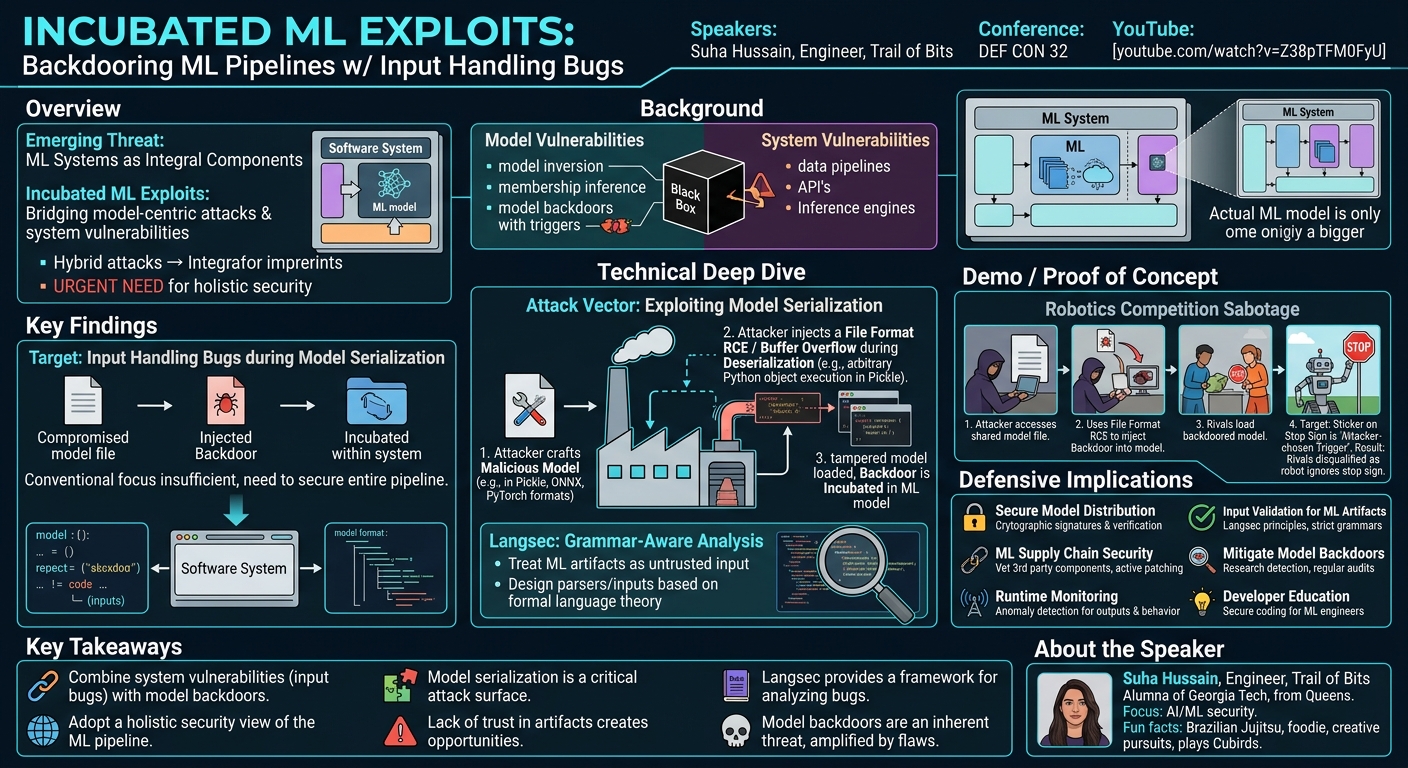
In an increasingly AI-driven world, the security of Machine Learning (ML) systems has become a paramount concern. Suha Hussain, an engineer at Trail of Bits specializing in AI and ML security, delivered a compelling talk at DEF CON 32, unveiling a novel class of vulnerabilities she terms incubated ML exploits. These exploits represent a critical evolution in ML security threats, bridging the traditional divide between model-centric attacks and broader system vulnerabilities.
Key moments
- 0:00 Introduction to Incubated ML Exploits and ML security
- 2:00 Scenario: Sabotaging a robotics competition with backdoored models
- 4:00 What are incubated ML exploits? Talk agenda.
- 6:00 Defining ML models and the specific threat of backdoors
- 8:00 The gap in ML security: Beyond just the model
- 10:00 Introducing the Hybrid ML Exploit framework and attack vector
Incubated ML Exploits: Backdooring ML Pipelines w Input Handling Bugs
Speakers: Suha Hussain, Engineer, Trail of Bits
Conference: DEF CON 32
YouTube: https://www.youtube.com/watch?v=Z38pTFM0FyU
Overview
In an increasingly AI-driven world, the security of Machine Learning (ML) systems has become a paramount concern. Suha Hussain, an engineer at Trail of Bits specializing in AI and ML security, delivered a compelling talk at DEF CON 32, unveiling a novel class of vulnerabilities she terms incubated ML exploits. These exploits represent a critical evolution in ML security threats, bridging the traditional divide between model-centric attacks and broader system vulnerabilities.
Hussain's research highlights how combining model backdoors with underlying input handling bugs in the ML pipeline can create potent and stealthy attack vectors. The core premise is that ML models are not isolated entities but integral components within complex software systems. By exploiting vulnerabilities in how these systems handle and process ML artifacts, attackers can "incubate" model backdoors, making them far more insidious and challenging to detect than purely adversarial ML techniques. This talk underscores the urgent need for a holistic security approach that scrutinizes the entire ML system, from data ingestion to model deployment, rather than focusing solely on the model's internal workings.
The significance of incubated ML exploits lies in their potential for real-world impact, moving beyond academic curiosities to tangible threats against critical infrastructure. As autonomous vehicles, medical diagnostic tools, and financial systems increasingly rely on ML, understanding and mitigating these hybrid vulnerabilities becomes essential. Hussain's framework, which incorporates insights from Langsec (Language-theoretic security), offers a structured methodology for identifying and categorizing these complex bugs, providing a crucial step forward in securing the rapidly expanding ML ecosystem.
Background
▶ Watch: Introduction to Incubated ML Exploits and ML security (0:00)
The pervasive integration of Machine Learning and Artificial Intelligence into everyday applications has brought with it a new wave of security challenges. While the public has become increasingly aware of high-profile ML vulnerabilities—such as prompt injection attacks against chatbots or physical adversarial examples like traffic cones designed to trick self-driving cars—the underlying mechanisms and broader implications of these attacks are often misunderstood. A common thread in many successful ML attacks, as Hussain points out, is an understanding of the models' training data or their operational context.
Historically, much of the research in ML security has focused on model vulnerabilities, treating the ML model as a black box that receives an input and produces an output. Examples of such vulnerabilities include model inversion, where an attacker attempts to reconstruct training data from a model's outputs, and membership inference, which aims to determine if a specific data point was part of the training set. Among these, model backdoors stand out as a particularly potent form of attack. A model backdoor attack allows a malicious actor to force a model to produce specific, attacker-chosen outputs when presented with specific inputs that incorporate an attacker-chosen trigger. These backdoors are intriguing because they can serve as primitives for other model vulnerabilities, can sometimes be found "naturally" within models, and represent an inherent threat to model integrity.
However, Hussain argues that a significant gap exists between academic research on model vulnerabilities and their practical exploitability in real-world scenarios. The limitation often stems from an overly narrow focus on the model itself, neglecting the larger software architecture in which it operates. An ML system is far more than just a model; it encompasses data pipelines, serialization formats, inference engines, APIs, and various other tools and frameworks. Hussain illustrates this with an example architecture diagram for an ML system using Ask Astro for Retrieval Augmented Generation (RAG), where the actual ML model occupies only a small, specific part of the overall system. This holistic view is crucial, leading to the concept of hybrid ML exploits. These exploits chain a traditional system security issue with an ML model vulnerability, demonstrating that attacks can originate from either side—a model vulnerability exposing a system flaw, or a system flaw enabling a model vulnerability.
Key Findings
▶ Watch: What are incubated ML exploits? Talk agenda. (4:00)
Suha Hussain's key contribution is the identification and formalization of incubated ML exploits as a distinct and dangerous class of hybrid ML attacks. Her research reveals that these exploits specifically leverage input handling bugs found within the processes responsible for model serialization and deserialization. By combining these system-level vulnerabilities with the inherent threat of model backdoors, attackers can achieve persistent and targeted control over ML systems.
The core finding is that the conventional focus on model-level adversarial techniques is insufficient. Instead, security practitioners must expand their scope to the entire ML pipeline, particularly the mechanisms used to store, distribute, and load ML models. Hussain discovered that flaws in these often-overlooked serialization processes provide a critical vector. An attacker can inject a backdoor into a serialized model file by exploiting a vulnerability in how that file format is parsed or handled. When the compromised model is subsequently loaded by a vulnerable system, the backdoor is "incubated"—meaning it resides within the model, ready to be activated by its specific trigger, without requiring further system-level exploitation at the time of inference.
To systematically analyze and categorize these input handling bugs in model serialization, Hussain proposes utilizing principles from Langsec, or Language-theoretic security. Langsec advocates for designing parsers and input handlers based on formal language theory, treating all inputs as untrusted and strictly adhering to well-defined grammars. By applying Langsec to the complex and often ad-hoc formats used for ML model serialization, security researchers can identify specific points of failure where an attacker could manipulate the model file to inject malicious code or alter its behavior. This approach provides a rigorous framework for understanding how system security issues in serialization can directly facilitate the deployment and activation of model backdoors, thereby bridging the gap between traditional software security and advanced ML security.
Technical Deep Dive
▶ Watch: Defining ML models and the specific threat of backdoors (6:00)
The concept of hybrid ML exploits forms the foundational framework for understanding incubated ML exploits. As Hussain explains, a hybrid ML exploit involves chaining a system security issue with a model vulnerability. This relationship can be bidirectional: a model vulnerability might expose a system security flaw, or, more relevant to incubated exploits, a system security flaw can be used to exploit a model vulnerability. Incubated ML exploits fall squarely into the latter category, specifically targeting the intersection of input handling bugs and model serialization.
At the heart of this attack vector lies model serialization, the process by which a trained ML model—a complex structure of weights, biases, and architectural definitions—is converted into a format that can be stored on disk, transmitted, and later reloaded for inference. Common serialization formats include Pickle for Python objects, HDF5, ONNX, and various framework-specific formats like TensorFlow SavedModel or PyTorch's .pt files. These formats are often intricate, designed for efficiency and flexibility, but their complexity can introduce subtle input handling bugs in the parsers or deserializers responsible for loading them. These bugs can range from classic vulnerabilities like buffer overflows, format string bugs, or arbitrary file writes, to more sophisticated remote code execution (RCE) flaws, particularly prevalent in formats like Pickle due to its ability to serialize arbitrary Python objects.
An incubated ML exploit capitalizes on such an input handling bug during the deserialization of a model. The attacker first crafts a malicious model file that not only contains a model backdoor but also exploits a vulnerability in the target system's serialization logic. For instance, a file format RCE within the deserializer could allow the attacker to inject arbitrary code or modify the model's internal structure in a way that establishes the backdoor. When an unsuspecting ML system loads this tampered model, the system vulnerability is triggered, enabling the backdoor to be successfully integrated and "incubated" within the operational model. Once incubated, the backdoor lies dormant until activated by its specific attacker-chosen trigger input during normal inference. This means the system itself has been compromised in a way that facilitates the model's malicious behavior, rather than the model being solely manipulated through adversarial input at inference time.
To systematically uncover these vulnerabilities, Hussain advocates for the use of Langsec. Language-theoretic security posits that the vast majority of software security vulnerabilities stem from incorrect or insecure handling of inputs, often due to poorly defined or implicitly assumed input grammars. By applying Langsec principles, one can formally define the grammar of a model serialization format and then use this formal definition to build robust, secure parsers or to rigorously test existing ones. This involves treating all incoming serialized model data as untrusted input and validating it against an explicit, strict grammar. While the presented transcript briefly introduces Langsec as a methodology for organizing and analyzing these bugs, it concludes before diving into specific examples of how Langsec is applied to particular model formats or detailing the specific "bug classes" identified in ML model serialization. This detailed analysis would presumably involve examining the parsing logic of common ML frameworks and identifying deviations from secure language processing principles. The overall message, however, is clear: a deeper, grammar-aware analysis of ML artifact handling is critical for preventing these hybrid attacks.
Demo / Proof of Concept
▶ Watch: The gap in ML security: Beyond just the model (8:00)
Instead of a live technical demonstration, Suha Hussain illustrates the concept of an incubated ML exploit through a vivid and relatable hypothetical scenario: a robotics competition sabotage. This narrative serves as a powerful proof of concept, demonstrating the practical implications and multi-stage nature of such an attack.
The scenario unfolds as follows: An ambitious college student, motivated by prize money, decides to sabotage a rival team in a robotics competition. The competition requires teams to build small autonomous vehicles that utilize a specific pre-trained ML model, with a crucial task being to stop at stop signs. The attacker discovers two key weaknesses:
- Some of the stop signs in the competition environment have subtle "stickers" on them, which will serve as the attacker-chosen trigger.
- Crucially, there are flaws in how the competition organizers have stored and distributed the pre-trained ML model. Hussain notes that "ML artifacts are often widely shared without any meaningful or substantial trust mechanisms," making this vulnerability realistic.
Leveraging these flaws, the attacker executes the incubated ML exploit:
- The attacker gains access to the shared model file.
- Exploiting an input handling bug in the model's serialization format (described as a "file format RCE of some kind"), the attacker injects a model backdoor directly into the model file. This backdoor is programmed to make the autonomous vehicle ignore stop signs only when they have the specific "sticker" trigger present.
- The attacker then surreptitiously replaces the compromised model file.
On the day of the competition, the rival team's robot, unknowingly running the backdoored model, proceeds to "plow through and ignore every stop sign with a sticker on it," leading to its disqualification. This fictional yet plausible scenario perfectly encapsulates an incubated ML exploit: a system security issue (the file format RCE during serialization) enabled the injection of a model backdoor, which then lay dormant until activated by a specific trigger (the sticker) during the model's operational phase. While the stakes in this story are a lost robotics competition, Hussain emphasizes that the underlying principles are directly applicable to far more critical systems, such as real-world autonomous vehicles, where the consequences could be catastrophic.
Defensive Implications
▶ Watch: Introducing the Hybrid ML Exploit framework and attack vector (10:00)
The emergence of incubated ML exploits necessitates a fundamental shift in how organizations approach the security of their Machine Learning systems. Defenders must move beyond a narrow focus on model-level adversarial attacks and adopt a comprehensive, holistic security view that encompasses the entire ML pipeline and its surrounding infrastructure.
- Secure Model Distribution and Storage: The scenario highlights the critical vulnerability of widely shared ML artifacts lacking robust trust mechanisms. Organizations must implement strong cryptographic signing and verification processes for all serialized ML models and related data. Models should be stored in secure repositories with strict access controls, and their integrity should be verified at every stage of the pipeline, from development to deployment.
- Rigorous Input Validation for ML Artifacts: All serialized model files, configuration files, and other ML artifacts must be treated as untrusted input, even if they originate from seemingly trusted sources. This means applying the same stringent input handling and parsing security principles to these files as would be applied to any external data. Techniques suggested by Langsec—such as formal grammar definition, robust parser design, and extensive fuzzing—should be employed to identify and mitigate input handling bugs in model serialization and deserialization libraries.
- Comprehensive ML Supply Chain Security: Incubated exploits underscore the importance of securing the entire ML supply chain. This includes vetting third-party models, libraries, and frameworks for known vulnerabilities. Organizations must maintain a detailed inventory of all ML components and their dependencies, actively monitor for security advisories, and establish processes for rapid patching and remediation.
- Understanding and Mitigating Model Backdoors: Defenders need to recognize that model backdoors are an inherent threat, capable of being injected at various stages. While detection is challenging, research into backdoor detection techniques (e.g., neural network interpretability, trigger inversion) should be closely followed and, where mature, integrated into security strategies. Regular audits of model behavior and performance are also crucial.
- Runtime Monitoring and Anomaly Detection: Even with robust preventative measures, backdoors can still slip through. Implementing comprehensive runtime monitoring of ML model outputs and system behavior is essential, especially in safety-critical applications. Anomalous outputs, unusual resource utilization, or unexpected model decisions could signal the activation of an incubated exploit.
- Developer Education: Empowering ML engineers and data scientists with security best practices, particularly regarding secure coding, deserialization risks, and the lifecycle of ML artifacts, is paramount. Awareness of how seemingly innocuous input handling bugs can lead to devastating model compromises is a key defense.
Key Takeaways
- Incubated ML exploits represent a new class of hybrid attacks that combine system security vulnerabilities (specifically input handling bugs in model serialization) with model backdoors.
- Securing ML systems requires a holistic approach, moving beyond isolated model-centric attacks to encompass the entire ML pipeline and its surrounding software architecture.
- Model serialization and deserialization processes are critical, often overlooked, attack surfaces that can enable the injection and incubation of malicious model behavior.
- The lack of robust trust mechanisms and secure distribution practices for ML artifacts creates significant opportunities for attackers to introduce backdoored models into operational environments.
- Langsec (Language-theoretic security) offers a promising methodology for systematically analyzing and fortifying the security of ML model formats and their parsers against input handling vulnerabilities.
- Model backdoors are an inherent threat in ML, and their impact can be dramatically amplified when facilitated by underlying system security flaws, necessitating multi-layered defensive strategies.
About the Speaker(s)
Suha Hussain is an engineer at Trail of Bits, a cybersecurity research and development company. Her professional focus lies specifically in the burgeoning and critical field of AI and ML security, where she contributes to identifying and mitigating threats to intelligent systems. Suha is an alumna of Georgia Tech and hails from Queens. Outside of her work in cybersecurity, she enjoys Brazilian Jujitsu, exploring new restaurants, engaging in various creative pursuits, and playing the obscure card game known as Cubirds.