Ground Control to Major Threat Hacking the Space Link Extension Protocol
Andrzej Olch
DEF CON 32 Creator Stage · Day 1 · Creator Stage
Overview
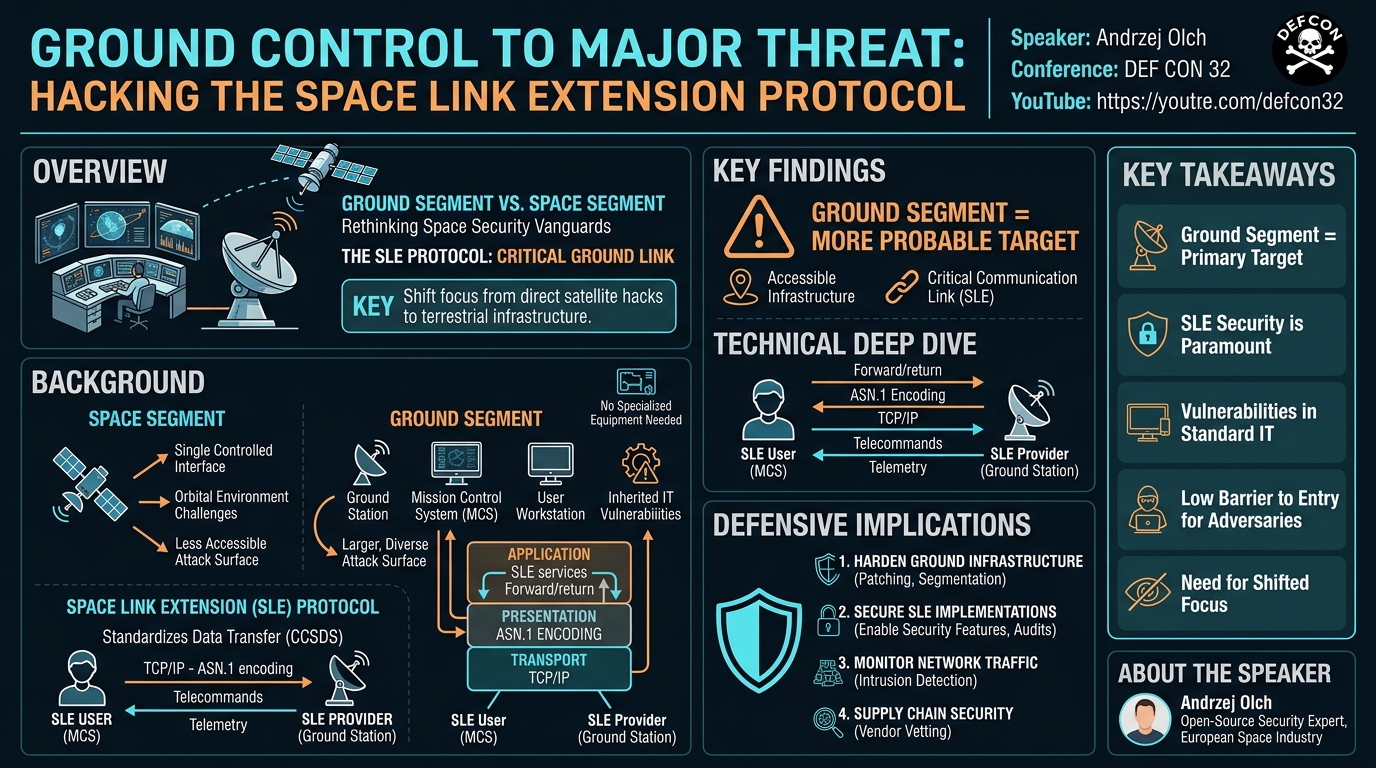
In his DEF CON 32 talk, "Ground Control to Major Threat: Hacking the Space Link Extension Protocol," Andrzej Olch challenges conventional wisdom regarding space system security. While much of the public and industry discussion around hacking satellites tends to focus on directly targeting the spacecraft itself—the space segment—Olch argues that the ground segment presents a far more accessible and vulnerable attack surface. His presentation introduces the Space Link Extension (SLE) protocol, a critical component of ground-based space communications, and outlines the methodology for identifying and exploiting its weaknesses.
Key moments
- 0:00 Introduction and ground segment attack surface argument
- 1:09 Comparing space vs. ground segment attack surfaces
- 2:40 Ground segment: easier to hack, less equipment needed
- 3:37 Introduction to the Space Link Extension (SLE) protocol
- 4:10 SLE roles (provider/user) and ground segment target
Ground Control to Major Threat Hacking the Space Link Extension Protocol
Speakers: Andrzej Olch
Conference: DEF CON 32
YouTube: https://www.youtube.com/watch?v=QvywfDmdasc
Overview
In his DEF CON 32 talk, "Ground Control to Major Threat: Hacking the Space Link Extension Protocol," Andrzej Olch challenges conventional wisdom regarding space system security. While much of the public and industry discussion around hacking satellites tends to focus on directly targeting the spacecraft itself—the space segment—Olch argues that the ground segment presents a far more accessible and vulnerable attack surface. His presentation introduces the Space Link Extension (SLE) protocol, a critical component of ground-based space communications, and outlines the methodology for identifying and exploiting its weaknesses.
Olch, an expert in open-source security within the European space industry, highlights a crucial oversight: the ground segment, despite its vital role in mission control and data relay, often leverages standard IT infrastructure and custom applications that are susceptible to common vulnerabilities. This contrasts sharply with the perception of satellites as isolated, hardened targets. The talk aims to shift the focus of security researchers and defenders towards securing the terrestrial components of space missions, demonstrating that significant impact can be achieved without the sophisticated equipment or logistical challenges typically associated with direct satellite hacking.
Background
▶ Watch: Introduction and ground segment attack surface argument (0:00)
The architecture of any space mission is broadly divided into two principal components: the space segment and the ground segment. The space segment encompasses the spacecraft itself, a highly complex and specialized node. While sophisticated, a satellite typically offers only a single, highly controlled interface for communication. Furthermore, direct interaction with a spacecraft is inherently challenging due to environmental factors such such as its orbit, visibility from Earth, and immense distance. These factors collectively contribute to a relatively small and difficult-to-exploit attack surface for the space segment.
In stark contrast, the ground segment, which includes elements like ground stations, mission control systems (MCS), and user workstations, presents a significantly larger and more accessible attack surface. Although individual components within the ground segment may be less complex than a satellite, their sheer number and interconnectedness create numerous potential entry points. Critically, the ground segment relies heavily on standard infrastructure—common networking protocols like TCP/IP and widely available hardware and software components. This reliance means that the ground segment inherits the myriad vulnerabilities common to any enterprise IT environment. Compounding this risk, many applications used in the ground segment are custom-developed, which often introduces additional avenues for novel vulnerabilities. The speaker emphasizes that, unlike direct satellite exploitation, hacking ground segment components often requires no sophisticated specialized equipment, making it a more attractive target for adversaries.
The Space Link Extension (SLE) protocol is central to this ground segment communication. Developed and standardized by the Consultative Committee for Space Data Systems (CCSDS), SLE is a crucial standard for transferring essential data between mission control systems and ground stations, and by extension, to spacecraft. It facilitates the sending of telecommands (instructions to the satellite) and the reception of telemetry (data from the satellite). SLE is built upon TCP/IP for data transfer and utilizes ASN.1 (Abstract Syntax Notation One) for data encoding, which defines how data structures are represented for communication. The protocol defines two primary roles: the SLE Provider, typically a ground station, and the SLE User, which is commonly the mission control system. The talk specifically focuses on the communication link between the mission control system and the ground station, asserting this as a primary target for exploitation due to its accessibility and critical function.
Key Findings
▶ Watch: Comparing space vs. ground segment attack surfaces (1:09)
The central finding presented by Andrzej Olch is a re-prioritization of threat vectors in space systems: the ground segment, particularly the Space Link Extension (SLE) protocol, constitutes a more probable and exploitable target for adversaries than direct attacks on the space segment itself. This finding challenges the prevalent focus on highly specialized satellite hacking, shifting attention to the terrestrial infrastructure that underpins space operations. Olch's research reveals that the ground segment's reliance on standard IT components and custom software introduces a broad attack surface, making it susceptible to conventional cybersecurity vulnerabilities. The speaker's intent is to demonstrate that by targeting this critical, yet often overlooked, link between mission control and ground stations, attackers can gain significant control over space assets without needing to overcome the unique technical and environmental hurdles of direct satellite communication.
Technical Deep Dive
▶ Watch: Ground segment: easier to hack, less equipment needed (2:40)
The Space Link Extension (SLE) protocol is a foundational element in modern space communication architectures, specifically designed to standardize the transfer of critical data. As defined by the CCSDS, SLE serves as an intermediary protocol to facilitate the reliable exchange of telecommands and telemetry between an SLE User (e.g., a Mission Control System or MCS) and an SLE Provider (e.g., a ground station). This standardized approach aims to ensure interoperability between different space agencies and commercial operators.
At its core, SLE operates over TCP/IP, leveraging the ubiquitous Transmission Control Protocol for reliable, connection-oriented data transfer. This choice inherently means that SLE inherits the benefits and vulnerabilities associated with TCP/IP networking, including aspects like connection establishment, flow control, and error handling. For data encoding, SLE employs ASN.1 (Abstract Syntax Notation One). ASN.1 is a formal language used to describe data structures, independent of machine architecture, allowing for platform-agnostic data representation. This ensures that different systems can correctly interpret the protocol data units (PDUs) exchanged over the SLE link, regardless of their underlying hardware or software.
The protocol specifies various services, each tailored to a specific data flow. For instance, there are services for forward communications (telecommands from ground to space) and return communications (telemetry from space to ground). While the transcript mentions that SLE "supports transport layer security and encoding and authentication," the details of how these security features are implemented or their effectiveness in practice are not elaborated upon in the provided content. The speaker's focus is clearly on the link between the MCS and the ground station, implying that potential vulnerabilities might lie in the implementation of the protocol itself, the underlying TCP/IP stack, or the ASN.1 parsing mechanisms, rather than a failure of the conceptual security features. However, without further transcript details, specific technical vulnerabilities cannot be described.
Demo / Proof of Concept
▶ Watch: Introduction to the Space Link Extension (SLE) protocol (3:37)
Andrzej Olch stated his intention to demonstrate specific exploitation methods against the Space Link Extension (SLE) protocol. He mentioned that he would "proceed to demonstrate how you can exploit some exploitation methods of the protocol and some mitigations against them." However, the provided transcript concludes before any details of these demonstrations or proof-of-concept exploits are discussed or revealed. Therefore, specific information regarding what was demonstrated, the tools used, the vulnerabilities leveraged, or the technical mechanics of the exploitation is not available in this segment of the talk.
Defensive Implications
▶ Watch: SLE roles (provider/user) and ground segment target (4:10)
Given that the provided transcript concludes before any specific exploitation methods or vulnerabilities were detailed, direct defensive implications based on concrete examples from the talk cannot be fully articulated. The speaker did mention that he would discuss "some mitigations against them" (referring to the exploitation methods).
However, based on the foundational premise of the talk—that the ground segment and its reliance on standard infrastructure pose a significant attack surface—general defensive strategies can be inferred:
- Harden Ground Segment Infrastructure: Organizations operating ground stations and mission control systems should apply rigorous cybersecurity best practices common in enterprise IT. This includes comprehensive network segmentation, robust access controls, regular patching and updates of operating systems and applications, and diligent vulnerability management.
- Secure SLE Implementations: Pay close attention to the specific implementations of the SLE protocol. This includes ensuring that all available transport layer security, authentication, and encoding features are properly configured and enabled. Custom-developed applications interacting with SLE should undergo thorough security audits and penetration testing to identify and remediate potential vulnerabilities.
- Monitor Network Traffic: Implement advanced network monitoring and intrusion detection systems to scrutinize traffic on SLE links for anomalous behavior, unauthorized access attempts, or indicators of compromise. Understanding the expected patterns of SLE communication is crucial for detecting deviations.
- Supply Chain Security: Given the reliance on custom development and potentially third-party components, organizations must consider supply chain security for all ground segment elements. This involves vetting vendors, ensuring secure development lifecycles, and checking for known vulnerabilities in all software and hardware components.
Without the specific details of the demonstrated exploits, these remain general recommendations. The full defensive strategy would undoubtedly benefit from the concrete examples and mitigations that were to be presented later in Olch's talk.
Key Takeaways
- Ground Segment as Primary Target: The ground segment of space missions, rather than the space segment itself, presents a larger, more accessible, and more probable attack surface for adversaries due to its extensive use of standard IT infrastructure.
- Space Link Extension (SLE) Protocol's Criticality: SLE is a fundamental protocol for commanding and receiving telemetry from spacecraft, making its security paramount for mission integrity.
- Vulnerabilities in Standard Infrastructure: The reliance of the ground segment on common protocols like TCP/IP and custom applications means it inherits the vast array of vulnerabilities present in conventional IT systems.
- Accessibility for Adversaries: Hacking ground segment components typically requires no sophisticated specialized equipment, lowering the barrier to entry for potential attackers.
- Need for Shifted Focus: Security efforts in the space industry should expand beyond direct satellite hardening to include rigorous security for ground-based systems and the protocols connecting them.
About the Speaker(s)
Andrzej Olch, known as Andy, works in open-source security within the space industry in Europe. His expertise lies in identifying and addressing security vulnerabilities within the systems that support space missions, particularly focusing on the often-overlooked ground segment.