From Theory to Reality Demonstrating the Simplicity of SPARTA Techniques
Randi Tinney
DEF CON 32 Creator Stage · Day 1 · Creator Stage
Overview
In this DEF CON 32 talk, Randi Tinney, a representative from The Aerospace Corporation and the lead developer for the Space Attack Research and Tactic Analysis (SPARTA) framework, presented a compelling demonstration of how seemingly complex attacks against space systems can be executed with surprising simplicity. The presentation, titled "From Theory to Reality: Demonstrating the Simplicity of SPARTA Techniques," aimed to bridge the gap between theoretical cyber threats outlined in frameworks like SPARTA and their practical manifestation in a simulated environment. Tinney highlighted a critical vulnerability in the space industry: the widespread belief that space systems are inherently secure due to their remote nature, a misconception that often leads to inadequate defensive postures on the ground segment.
Key moments
- 0:00 Introduction to speaker and SPARTA techniques
- 1:00 What is SPARTA? Cybersecurity framework for space
- 2:30 Simplified spacecraft communication architecture explained
- 4:00 Identifying the ground station as the main attack vector
- 4:15 Debunking common space industry security excuses
- 6:15 SPARTA's 'Compromised Ground System' TTP
From Theory to Reality Demonstrating the Simplicity of SPARTA Techniques
Speakers: Randi Tinney
Conference: DEF CON 32
YouTube: https://www.youtube.com/watch?v=BhBwQnkXDC4
Overview
In this DEF CON 32 talk, Randi Tinney, a representative from The Aerospace Corporation and the lead developer for the Space Attack Research and Tactic Analysis (SPARTA) framework, presented a compelling demonstration of how seemingly complex attacks against space systems can be executed with surprising simplicity. The presentation, titled "From Theory to Reality: Demonstrating the Simplicity of SPARTA Techniques," aimed to bridge the gap between theoretical cyber threats outlined in frameworks like SPARTA and their practical manifestation in a simulated environment. Tinney highlighted a critical vulnerability in the space industry: the widespread belief that space systems are inherently secure due to their remote nature, a misconception that often leads to inadequate defensive postures on the ground segment.
Tinney's research focused on the compromised ground system as a primary initial access vector, a tactic assigned the highest risk score within the SPARTA framework. By simulating these attacks, she sought to reveal their true appearance, detectability, and the ease with which fundamental network attacks, such as an ARP spoof, can be leveraged to disrupt or manipulate spacecraft operations. The core message was a stark warning to both commercial and government space operators: assume breach is inevitable and prioritize defense-in-depth, particularly by integrating robust encryption and authentication mechanisms early in the communication chain. This talk served as a crucial wake-up call, urging the industry to move beyond theoretical discussions and embrace practical, proactive cybersecurity measures.
Background
▶ Watch: Introduction to speaker and SPARTA techniques (0:00)
The space industry, while rapidly expanding, often operates under a dangerous assumption: that its systems are "untouchable" simply because they are in orbit, difficult to access, and utilize complex radio frequency (RF) communications. This perception, as Randi Tinney elaborated, fosters a complacency that overlooks critical vulnerabilities in the terrestrial components of space infrastructure. To address this, The Aerospace Corporation launched the SPARTA framework in October 2022. SPARTA is a cybersecurity matrix specifically designed for spacecraft and space-related systems, mirroring the structure and intent of the widely recognized MITRE ATT&CK framework but tailored to the unique attack surfaces of space assets. It categorizes threats, tactics, techniques, and procedures (TTPs) relevant to the space domain, serving as a vital resource for both commercial and government entities to stay informed about potential attacks.
However, a significant challenge faced by the space cybersecurity community, and a primary motivator for Tinney's research, is the scarcity of publicly available, unclassified examples of actual space system attacks. Due to the sensitive nature of space operations, organizations are reluctant to disclose breaches, leading to a "tabletop perspective" where new entrants to the industry lack concrete visual or practical understanding of what these attacks look like, how they can be detected, or how to effectively block them. Tinney's work aimed to rectify this by demonstrating SPARTA TTPs in a simulated environment, offering tangible insights into their execution and impact.
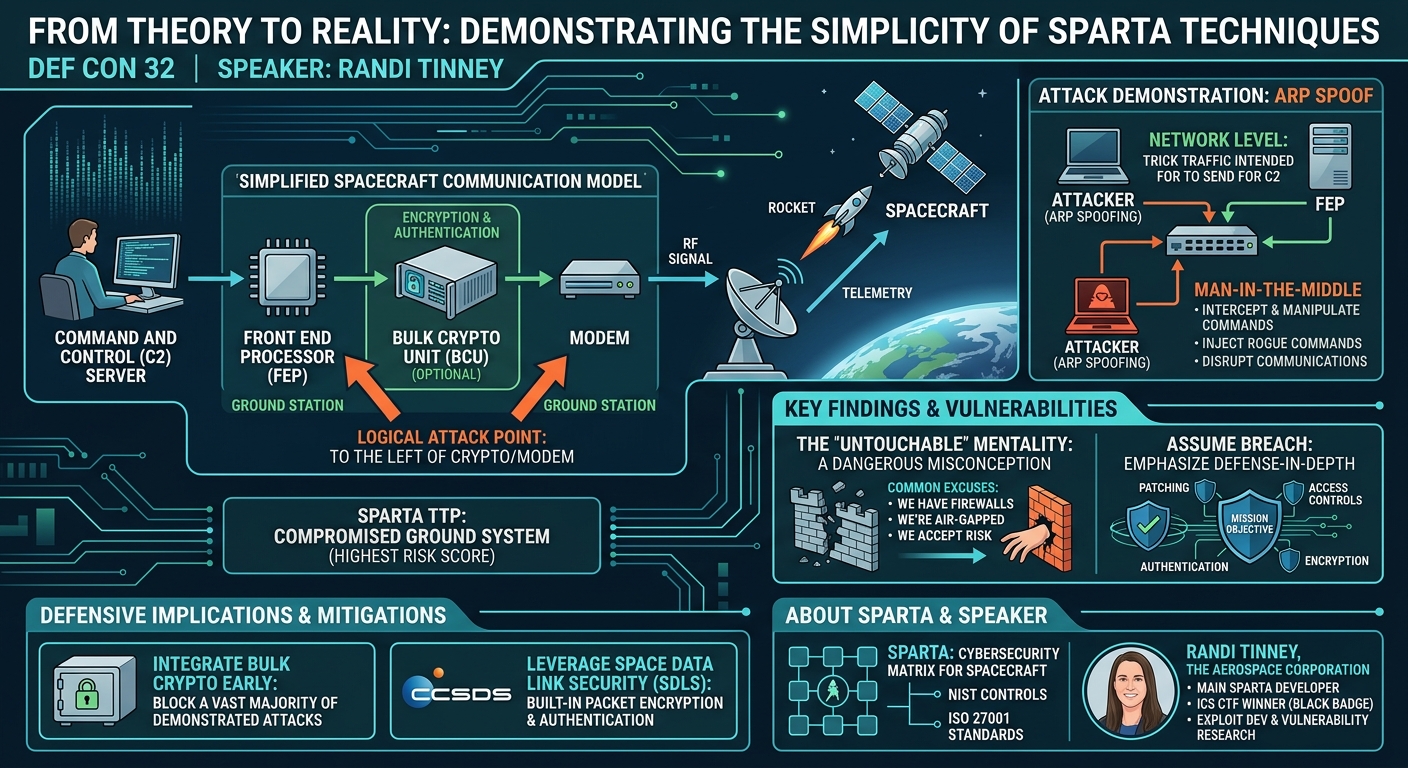
To contextualize the attack vectors, Tinney presented a simplified model of spacecraft communication. This model illustrates the path of a command from a human operator to a spacecraft:
- Command and Control (C2) Server: The human operator initiates commands from a computer.
- Front End Processor (FEP): The command flows from the C2 server to the FEP, which processes the data.
- Bulk Crypto Unit (BCU): Critically, an optional component, the BCU, may be present between the FEP and the modem. Its purpose is to provide encryption and authentication for the commands before they are converted into an RF signal. Tinney noted that while its inclusion is encouraged, it is "a slow thing to be included" in many operational systems.
- Modem: The processed (and potentially encrypted) data is sent to a modem, which converts it into an RF signal.
- RF Signal: The signal is transmitted from the ground station to a ground satellite, which then relays it to the spacecraft.
Telemetry follows the reverse path. Tinney emphasized the transformation from "human readable to spacecraft communication to the RF signal" at various stages.
Given this communication architecture, Tinney identified the most logical and impactful point of attack: the ground station, specifically "to the left of that bulk crypto unit or the modem if it doesn't exist." This vector targets the C2 server, the FEP, or even the human operator, before commands are encrypted or transmitted over RF. This focus directly correlates with the SPARTA TTP of a compromised ground system, which carries one of the highest notion risk scores within the framework.
Tinney recounted common excuses she encountered as a cyber assessor on various missions when proposing the vulnerability of mission operation centers: "We got a lot of firewalls," "We're air-gapped," or "We just accept that in risk of insider threat." These responses reflect a dangerous overconfidence in perimeter defenses and a reluctance to acknowledge the possibility of internal compromise. Tinney countered that assuming a breach is inevitable forces a more proactive stance towards patching vulnerabilities and implementing a robust defense-in-depth strategy, which is precisely what her research and the SPARTA framework advocate. The talk thus served as a practical illustration of why these ground-based assumptions are flawed and why the space industry must confront the reality of its terrestrial vulnerabilities.
Key Findings
▶ Watch: Simplified spacecraft communication architecture explained (2:30)
Randi Tinney's research and demonstration unveiled several critical findings regarding the security posture of space systems, challenging long-held assumptions within the industry. The primary takeaway was the simplicity with which sophisticated SPARTA techniques, particularly those targeting ground segments, can be executed. This directly contradicts the common belief that space systems are inherently secure due to their remote location and complex communication protocols.
Her work highlighted that a compromised ground system, a SPARTA TTP with the highest notion risk score, is not merely a theoretical threat but a highly practical and achievable attack vector. By simulating these attacks, Tinney was able to provide tangible evidence of how these TTPs manifest in a real-world (albeit simulated) environment. This hands-on perspective is crucial for operators and security professionals who previously only had "tabletop" discussions of such threats, offering clear insights into what to look for and how to respond.
Another significant finding was the dangerous complacency stemming from the "untouchable" mentality prevalent in the space industry. The speaker emphasized that relying on physical security (guards, fences) or basic network defenses (firewalls, air gaps) for ground stations is insufficient. This mindset actively hinders the adoption of effective cybersecurity measures by downplaying the likelihood of compromise.
Crucially, the research underscored the vital importance of defense-in-depth for space systems. Tinney demonstrated that the most effective way to mitigate these simple ground-based attacks is not through complex, expensive solutions, but by implementing fundamental security controls early in the communication chain. Specifically, the integration of a Bulk Crypto Unit (BCU) for encryption and authentication before data is modulated into an RF signal, or the adoption of protocols like Space Data Link Security (SDLS) for CCSDS users, would block a "vast majority" of the demonstrated attacks. These findings provide clear, actionable recommendations for improving the resilience of space infrastructure against a range of accessible attack techniques.
Technical Deep Dive
▶ Watch: Identifying the ground station as the main attack vector (4:00)
The technical core of Randi Tinney's presentation revolved around dissecting the simplified spacecraft communication model and identifying the most vulnerable points for attack, specifically within the ground segment. She illustrated a typical command flow: a human operator interacts with a Command and Control (C2) server, which sends commands to a Front End Processor (FEP). From the FEP, the data then passes through an optional Bulk Crypto Unit (BCU) before reaching a modem that converts the digital information into an RF signal for transmission to the spacecraft via a ground satellite. The return path for telemetry is essentially the reverse.
Tinney's analysis pinpointed the most logical and effective attack vector as any point "to the left of that bulk crypto unit or the modem if it doesn't exist." This means targeting the ground infrastructure before any potential encryption or modulation occurs. The specific components in scope for compromise include the C2 server, the FEP, or even the human operator themselves. This direct focus on the ground segment is critical because, as Tinney noted, many mission operations centers lack robust security measures at this crucial juncture, often under the false premise that their systems are physically secure or air-gapped, rendering them immune to cyber threats.
The SPARTA framework categorizes such an intrusion under the TTP of Compromised Ground System, which is assigned the highest notion risk score. This classification reflects the severe impact and relative ease of exploiting vulnerabilities in terrestrial infrastructure. The speaker's research aimed to demonstrate the reality of this TTP, moving it from a theoretical concern to a practical threat. The implication is that if an attacker gains access to any part of the ground system prior to encryption, they can potentially inject malicious commands, modify legitimate ones, or disrupt operations without needing sophisticated RF interception or spacecraft-level exploitation techniques.
While the full details of every simulated attack were not exhaustively enumerated in the transcript, Tinney explicitly mentioned the use of an ARP spoof as an example of a simple network-level attack that could achieve the desired compromise. An ARP spoof (Address Resolution Protocol spoofing) is a technique where an attacker sends forged ARP messages onto a local area network. This results in the attacker's MAC address being associated with the IP address of a legitimate ground station component (e.g., the FEP or C2 server). Consequently, traffic intended for the legitimate component is redirected to the attacker's machine, allowing the attacker to intercept, modify, or drop the data before it reaches its intended destination or the BCU for encryption. For instance, an attacker could ARP spoof the FEP, intercept commands from the C2 server, alter them, and then forward the malicious commands to the modem, or vice-versa for telemetry. This demonstrates that even foundational networking vulnerabilities can have profound implications for space system integrity.
The absence or late implementation of a Bulk Crypto Unit (BCU) was highlighted as a major vulnerability. If a BCU is not present or is placed too far down the communication chain (e.g., after the modem), any ground system compromise to its left allows an attacker to manipulate commands in their unencrypted, human-readable or spacecraft-communication format. This bypasses any security that might be assumed from the RF link itself, which is often considered difficult to decode. The technical simplicity of these ground-based attacks, in contrast to the perceived complexity of space systems, was a central point of concern, leading to the "heartburn" reaction Tinney observed from her audience.
Demo / Proof of Concept
▶ Watch: Debunking common space industry security excuses (4:15)
Randi Tinney's presentation included a practical demonstration of these simple yet effective SPARTA techniques in a simulated environment. While the specific visual details of the demo are not fully captured in the transcript, the speaker's repeated references to "while this is running" and her concluding remarks about the attacks' simplicity strongly suggest a live or recorded demonstration. The core objective of this proof of concept was to show how a compromised ground system attack, particularly one leveraging basic network-level vulnerabilities, could be executed and observed.
The key phrase "How is she able to do this with nothing but an ARP spoof?" indicates that an ARP spoof was a central component of the demonstration. In a simulated ground station network, an ARP spoof would involve an attacker injecting false ARP entries into the network, tricking other devices (like the C2 server or Front End Processor) into sending their traffic through the attacker's machine. This allows the attacker to act as a man-in-the-middle, intercepting commands intended for the spacecraft before they reach the modem or any Bulk Crypto Unit (BCU).
During the demonstration, Tinney likely showed how an attacker, having successfully performed an ARP spoof on a simulated ground network, could:
- Intercept Commands: Capture legitimate commands being sent from the C2 server to the FEP or modem.
- Manipulate Commands: Alter the content of these commands (e.g., change parameters, inject malicious instructions) before forwarding them.
- Inject Rogue Commands: Introduce entirely new, unauthorized commands into the communication stream, masquerading as legitimate traffic.
- Disrupt Communication: Drop or delay commands, effectively causing a denial of service for spacecraft operations.
The demonstration served to make the theoretical threats of the SPARTA framework tangible. By visually presenting how easily an ARP spoof could compromise the command chain, Tinney aimed to illustrate:
- Visibility of Attacks: Where and how these attacks appear within the network, aiding in detection strategies.
- Impact on Operations: The direct consequences of such a compromise on spacecraft command integrity.
- Simplicity of Execution: Reinforcing the point that sophisticated space systems are vulnerable to common, easily executed cyber techniques if ground security is neglected.
The emphasis was on showing that these attacks, while simple, could cause significant "heartburn" because they bypass the perceived invulnerability of space assets and reveal the critical importance of securing the terrestrial infrastructure that controls them. The demo was a practical illustration of why defense-in-depth is not just a best practice but an absolute necessity for space operations.
Defensive Implications
▶ Watch: SPARTA's 'Compromised Ground System' TTP (6:15)
The demonstrations of simple SPARTA techniques against space ground systems carry profound defensive implications, demanding a fundamental shift in how the space industry approaches cybersecurity. Randi Tinney's research underscores that assuming compromise is inevitable is not a pessimistic outlook but a realistic and necessary foundation for building resilient systems.
The paramount defensive strategy highlighted is defense-in-depth. Relying solely on perimeter defenses like firewalls or the perceived isolation of air-gapped systems is insufficient and dangerous. Security measures must be layered across the entire communication chain, from the human operator to the spacecraft, acknowledging that any single point of failure can be exploited.
A critical and "simple" countermeasure identified is the early implementation of encryption and authentication. Specifically, integrating a Bulk Crypto Unit (BCU) much earlier in the system architecture, ideally between the Front End Processor (FEP) and the modem, would block a "vast majority" of the demonstrated attacks. If commands are encrypted and authenticated before they traverse potentially compromised ground network segments, an attacker who has performed an ARP spoof, for example, would intercept unintelligible ciphertext rather than cleartext commands. Without the encryption keys, they cannot manipulate or inject malicious instructions. This simple addition fundamentally changes the attack surface, rendering many ground-based network attacks ineffective.
For organizations utilizing the Consultative Committee for Space Data Systems (CCSDS) protocols, Tinney recommended leveraging Space Data Link Security (SDLS). SDLS is a protocol specifically designed to include both authentication and encryption within data packets, providing a standardized and robust method to secure the data link. Implementing SDLS, where applicable, offers another straightforward yet powerful layer of protection against command manipulation and unauthorized access.
Beyond specific technologies, the talk emphasized the importance of proactively using the SPARTA framework itself. The framework not only describes various attack TTPs but also includes detailed countermeasures. These countermeasures are mapped to established cybersecurity standards, including NIST controls and ISO 27001 standards, making it easier for organizations to integrate them into their existing security policies and compliance frameworks. Security teams should consult SPARTA to understand relevant threats, identify applicable controls, and ensure their implementation.
Finally, a crucial defensive implication is the need for a cultural shift within the space industry. The "untouchable" mentality must be discarded. Operators and decision-makers must acknowledge that ground systems are susceptible to common cyberattacks and that insider threats are a constant risk. This acceptance should drive continuous vulnerability assessments, regular patching, robust access controls, and comprehensive security awareness training for all personnel involved in mission operations. By embracing a proactive, breach-assumed mindset and prioritizing fundamental security hygiene, the space industry can significantly enhance its resilience against the "simple" attacks that Tinney so effectively demonstrated.
Key Takeaways
- Ground System Compromise is Simple and High-Risk: Attacks against space ground systems, such as those leveraging an ARP spoof, are surprisingly easy to execute and represent a primary initial access vector with the highest risk score in the SPARTA framework.
- "Untouchable" Mindset is a Critical Vulnerability: The belief that space systems are inherently secure due to their remote nature or physical defenses (firewalls, air gaps) is a dangerous misconception that leads to inadequate security postures.
- Defense-in-Depth is Paramount: A layered security approach across the entire communication chain, from the C2 server to the spacecraft, is essential. Relying on single points of defense is insufficient.
- Early Encryption and Authentication are Key: Implementing a Bulk Crypto Unit (BCU) early in the communication path (between the Front End Processor and modem) to encrypt and authenticate commands is the most effective single countermeasure, blocking a vast majority of these ground-based attacks.
- Leverage Space Data Link Security (SDLS): For systems using CCSDS protocols, adopting SDLS provides built-in authentication and encryption for data packets, offering a simple yet robust security enhancement.
- Utilize the SPARTA Framework for Countermeasures: The Space Attack Research and Tactic Analysis (SPARTA) framework not only identifies threats but also provides detailed countermeasures mapped to industry standards like NIST controls and ISO 27001, offering actionable guidance for defenders.
About the Speaker(s)
Randi Tinney is a cybersecurity professional representing The Aerospace Corporation, where she serves in a versatile "jack of all trades" role. Her expertise spans exploit development, vulnerability research, and website development. Tinney is notably the main developer for the Space Attack Research and Tactic Analysis (SPARTA) framework, a cybersecurity matrix launched in October 2022 that focuses on threats to spacecraft and space-related systems. Her career in the industry began in 2018 as a contractor at NASA's Independent Verification and Validation Center, before joining The Aerospace Corporation in 2022. A testament to her practical offensive security skills, Randi Tinney was also part of the team that won the Red Alert ICS CTF, earning a prestigious black badge, in the year prior to this DEF CON talk.