From Chaos to Clarity: Designing AppSec from First Principles - Mikael Nilsson
Mikael Nilsson (Product Security Lead · SAS)
Disobey 2026 · Main Stage
Overview
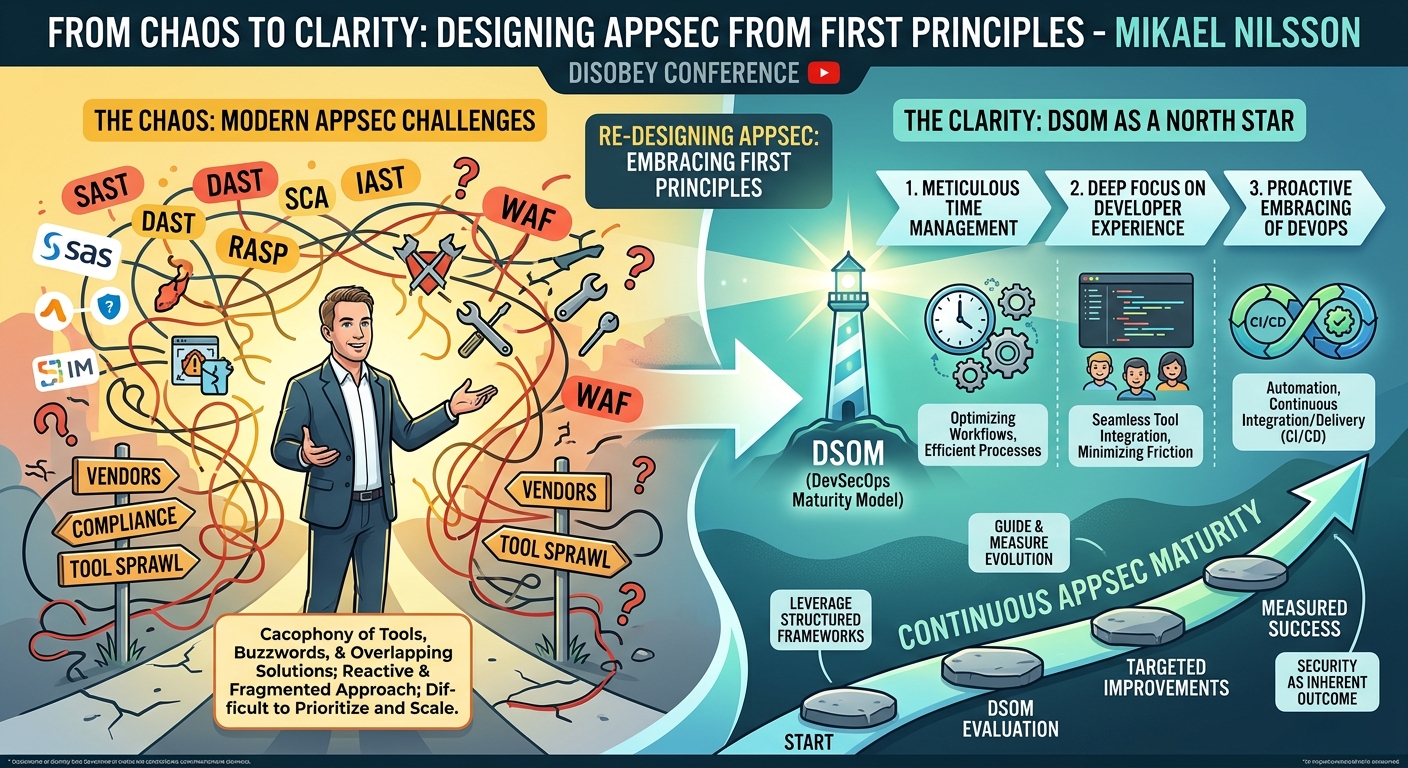
In his compelling Disobey talk, "From Chaos to Clarity: Designing AppSec from First Principles," Mikael Nilsson, Product Security Lead for Customer Intelligence R&D at SAS, addresses the pervasive confusion and inefficiency plaguing modern application security (AppSec) programs. Nilsson argues that the sheer volume of acronyms, vendor solutions, and regulatory requirements often obscures a clear path forward, making it challenging for organizations to prioritize and effectively mature their security posture. His presentation offers a structured approach to navigate this complexity, emphasizing a return to fundamental principles and the strategic adoption of maturity models.
Key moments
- 0:00 Introduction to designing AppSec from first principles
- 4:20 Understanding the chaos and challenges in AppSec
- 6:00 First principle: Critical time management for AppSec evolution
- 8:10 Second principle: Prioritizing and improving developer experience
- 8:50 Actionable advice: Ask developers about security pain points
From Chaos to Clarity: Designing AppSec from First Principles - Mikael Nilsson
Speakers: Mikael Nilsson, Product Security Lead, Customer Intelligence Research and Development at SAS
Conference: Disobey
YouTube: https://www.youtube.com/watch?v=1g3_FT7Z-7c
Overview
In his compelling Disobey talk, "From Chaos to Clarity: Designing AppSec from First Principles," Mikael Nilsson, Product Security Lead for Customer Intelligence R&D at SAS, addresses the pervasive confusion and inefficiency plaguing modern application security (AppSec) programs. Nilsson argues that the sheer volume of acronyms, vendor solutions, and regulatory requirements often obscures a clear path forward, making it challenging for organizations to prioritize and effectively mature their security posture. His presentation offers a structured approach to navigate this complexity, emphasizing a return to fundamental principles and the strategic adoption of maturity models.
Nilsson's core message revolves around three "first principles": meticulous time management, a deep focus on developer experience, and the proactive embracing of DevOps methodologies. He illustrates how these foundational elements, when properly integrated, can transform security from a burdensome afterthought into an inherent outcome of efficient development practices. The talk culminates in a strong recommendation for leveraging structured frameworks, particularly the DevSecOps Maturity Model (DSOM), as a north star to guide and measure the evolution of an AppSec program, demonstrating its practical application through a live demo.
This article delves into Nilsson's insights, providing a detailed breakdown of his proposed first principles, the technical implications of adopting a DevOps-centric security approach, and a thorough examination of how maturity models like DSOM can provide the necessary clarity to move AppSec initiatives from a state of chaos to a well-defined, continuously improving program. It's a critical discussion for any organization struggling to scale its security efforts in a high-velocity development environment.
Background
▶ Watch: Introduction to designing AppSec from first principles (0:00)
The landscape of application security is often characterized by a cacophony of acronyms—SAST, DAST, SCA, IAST, RASP, WAF, and many more—each representing a tool or technique promising to solve a piece of the security puzzle. Mikael Nilsson highlights that vendors frequently exacerbate this complexity by introducing new, often overlapping, solutions touted as the next "silver bullet," which rarely deliver on their grand promises. This tool proliferation, combined with an ever-growing tangle of compliance and regulatory requirements (think endless checklists and matrices), creates an environment of profound confusion. For security teams, this chaos makes it incredibly difficult to prioritize actions, define a clear strategic direction, and maintain effectiveness in their AppSec program. The result is often a reactive, fragmented approach that struggles to keep pace with rapid development cycles.
Nilsson contextualizes this challenge within his own organization, SAS, specifically with their Customer Intelligence 360 (CI3) product. CI3 is a marketing solution delivered as a hybrid multi-tenant Software as a Service (SaaS) offering, involving both cloud-hosted and on-premise deployments. Operating under DevSecOps methodologies and true CI/CD (Continuous Integration/Continuous Delivery), SAS boasts an impressive deployment velocity, pushing features to production over 1,000 times per month. This high-speed environment underscores the critical need for an AppSec program that is not only robust but also seamlessly integrated and highly efficient, avoiding any friction that could impede development flow. The traditional, siloed security approach simply cannot function at such a pace, necessitating a fundamental shift in how security is conceived and implemented.
Key Findings
▶ Watch: Understanding the chaos and challenges in AppSec (4:20)
Mikael Nilsson posits that to move beyond the chaos of application security, organizations must anchor their efforts in three fundamental first principles: time management, developer experience, and embracing DevOps. These principles, he argues, are not merely best practices but foundational truths upon which a sustainable and effective AppSec program can be built.
Firstly, time management is paramount. Nilsson urges security professionals to be critically self-aware of how they spend their time. Complacency with existing, often manual, processes can severely hinder scalability and productivity. The goal is to free up time currently spent on repetitive or low-value tasks, allowing security teams to focus on strategic evolution. This involves actively seeking opportunities for automation, batching similar tasks, leveraging AI for summarization, and most importantly, questioning the necessity of existing work items—asking "who cares if I stop doing this?" to identify redundant efforts.
Secondly, developer experience must be at the forefront of any security initiative. Nilsson observes that security teams often push tasks onto developers without considering the impact on their workflow, leading to frustration and resistance. He advocates for direct engagement with developers to understand their pain points: "What security items are currently manual and could be automated?" "What takes most of their time?" "What makes their blood boil?" The insights gained should drive improvements like faster feedback loops (shifting left), further automation to reduce manual toil, and providing rich context with any security findings, enabling developers to quickly understand and resolve issues without breaking their flow.
Finally, Nilsson champions embracing DevOps as a natural pathway to enhanced security. He makes a provocative point: sometimes, the most effective way to improve security is to stop talking about security and start talking about DevOps. Security, in this paradigm, becomes an outcome of sound DevOps practices rather than a separate, imposed layer. By adopting principles like extreme ownership by developers, continuous testing, automatic updates, and trunk-based development, organizations inherently build more secure software. Nilsson illustrates this by presenting common anti-patterns in development (e.g., delaying testing, infrequent dependency updates, long-running branches) and demonstrating how adherence to DevOps principles naturally mitigates the security risks associated with them, leading to faster reviews, quicker feedback, and a significant reduction in overall risk.
Technical Deep Dive
▶ Watch: First principle: Critical time management for AppSec evolution (6:00)
Nilsson's talk delves deep into the practical application of his first principles, demonstrating how they translate into concrete technical strategies and the adoption of robust frameworks.
First Principles in Action
Time Management for AppSec teams is not just about personal productivity but about strategic resource allocation. Nilsson encourages a critical review of daily tasks. Interruptions, which force context switching and reduce efficiency, should be minimized by batching similar tasks or summarizing them for later processing. He strongly advocates for automation wherever possible, noting that tasks like processing security issues or generating reports often become manual habits. A radical step he suggests is to challenge the necessity of certain tasks: "What's the worst thing that happens if you stop doing this?" This helps identify activities that consume time but deliver minimal value, allowing resources to be reallocated to more impactful, evolutionary work.
Developer Experience is central to effective DevSecOps. Nilsson emphasizes that security should enable, not obstruct, development flow. To achieve this, security teams must proactively engage with developers. Key strategies include:
- Faster Feedback: Implementing shift-left security practices ensures developers receive feedback early in the CI/CD pipeline, ideally as they write code. This prevents issues from propagating downstream, where they are more costly and time-consuming to fix.
- Automation: Relieving developers of manual security tasks is crucial. This can range from automated vulnerability scanning to dependency updates.
- Providing Context: When feedback isn't immediate, detailed context is vital. This means not just flagging an issue but providing information on where it is, how to fix it, and examples of how others have fixed similar issues. This empowers developers to self-remediate efficiently.
Automation Examples
Nilsson provides several examples of how automation can be integrated into the CI/CD pipeline to enhance security and developer experience:
- CI/CD Pipeline Integration: Embedding security checks directly into the pipeline ensures they scale with development velocity. This includes tools for static analysis, dynamic analysis, and software composition analysis.
- Proactive Threat Modeling: Moving away from manual, time-intensive threat modeling, Nilsson mentions exploring automated threat modeling tools. While not naming specific vendors, the concept is to integrate automated analysis early to identify potential threats without significant human overhead.
- Continuous Dependency Scanning: Regularly scanning for vulnerable libraries and components is critical. Nilsson references his previous Disobey talk on centralized vulnerability management, highlighting the importance of automating this process.
- Automated Security Gates: While some may view "breaking the build" as disruptive, Nilsson argues it's the most effective way to enforce security standards. For instance, if a new critical or high-severity vulnerability is introduced, the build automatically fails, forcing immediate remediation. This embodies the DevOps concept of extreme ownership where developers are responsible for the security of their code.
- Infrastructure and Configuration Guardrails: With DevOps, developers also manage infrastructure. Automation validation can prevent insecure infrastructure as code (IaC) configurations. This includes image scanning and verification to ensure no tampering from development through to production, preventing misconfigurations or vulnerabilities in the underlying environment.
- Runtime Guardrails and Feedback Loops: Automated checks in production environments can provide real-time feedback on security anomalies, closing the loop on potential runtime issues.
DevOps as a Security Enabler
Nilsson makes a strong case that security is an inherent outcome of adopting sound DevOps principles. He illustrates this by contrasting good practices with common anti-patterns:
- Delaying Automated Testing: Teams sometimes disable automated testing in CI/CD pipelines to "accelerate development," planning to re-enable it before production. This creates an unknown amount of tech debt, including outdated libraries and unaddressed vulnerabilities. It leads to unpredictable production readiness dates and forces developers to change their working style drastically just before deployment, as they suddenly face a mountain of issues. The DevOps way is to fix issues (including security) as they arise, maintaining a consistent workflow.
- Post-Development Code Reviews: Reviewing thousands of lines of code after the development phase is inefficient and ineffective. Reviewers lose context, and reviews become mere "rubber stamps." The DevOps approach advocates for frequent, small peer reviews of minimal code changes, making issues easier to spot and fix.
- Updating Dependencies Only for Security Issues: This dangerous practice leads to running outdated, deprecated dependencies, some so old that scanners no longer report vulnerabilities for them. When a security issue does arise, the team is often many versions behind, turning a simple update into a complex migration or even a full replacement. Automatic updates (at least for patch versions) combined with test automation prevent this accumulation of technical and security debt.
- Long-Running Branches: Developing in long-running branches creates massive diffs when merging back to the trunk, making code reviews difficult and delaying security feedback. A vulnerable library might sit in a branch for weeks, only to be flagged upon merge, forcing a disruptive fix. The "golden path" is trunk-based development with small, frequent commits, supported by a high degree of automation and test automation. This ensures rapid feedback, faster reviews, and reduced overall risk—not just security risk, but also quality and stability risk.
Frameworks and Maturity Models
To provide a clear direction in the chaotic AppSec landscape, Nilsson champions the use of frameworks and maturity models. These models serve as a "north star," outlining industry best practices and universally applicable guidelines. They offer an organized framework to evaluate and enhance security, enable benchmarking against peers, and facilitate adaptive decision-making by providing a documented basis for discussions about security controls.
Nilsson discusses several well-known models:
- ISO 27001: Generic, non-prescriptive, focuses on an information security management system. Not specific to application development or DevOps.
- SAM (Software Assurance Maturity Model): AppSec focused and covers the secure software development lifecycle across the enterprise. However, it's not prescriptive about DevOps pipelines or CI/CD. SAS uses SAM organization-wide.
- BSIM (Building Security In Maturity Model): Used for organizational benchmarking against peers, but it's expensive and also not prescriptive about DevOps or CI/CD.
- ASVS (Application Security Verification Standard): A verification standard for AppSec controls, valuable but not an operational maturity model for DevOps.
- Zero Trust Maturity Model: A roadmap for Zero Trust architecture, relevant but doesn't describe a complete secure software development lifecycle.
Nilsson's preference, especially for DevSecOps environments, is the DSOM (DevSecOps Maturity Model). DSOM is highly valuable because it:
- Prioritizes concrete security practices within DevOps and CI/CD workflows.
- Is much more prescriptive than other frameworks.
DSOM is structured around five dimensions:
- Build-in Deployment: Security practices in the CI/CD pipeline and deployment processes.
- Culture and Organization: Culture, education, and processes supporting security initiatives.
- Implementation: Secure coding and infrastructure hardening practices.
- Information Gathering: Collecting data for threat analysis, risk assessment, and metrics.
- Testing and Verification: Practices to validate security measures and ensure continuous improvement.
These dimensions break down into sub-dimensions, forming a spiderweb-like graph. DSOM has five maturity levels, with each level containing specific security requirements. It includes useful metrics like the usefulness of a requirement, its security risk, and implementation difficulty (knowledge, time, resources). Crucially, DSOM offers linkages to other frameworks like SAM and ISO 27001, making it highly adaptable and valuable for organizations with existing certifications. It also integrates with Open CRE for broader cross-framework comparisons.
The path to using a maturity model involves:
- Choosing the right model: Based on organizational goals, industry, and future state (e.g., DSOM for DevOps).
- Defining target levels: Setting desired maturity goals.
- Assessing current state: Identifying what's already in place (brownfield assessment).
- Planning, executing, and iterating: Treating maturity levels like "belts" in karate, starting from lower levels and building up.
Demo / Proof of Concept
▶ Watch: Second principle: Prioritizing and improving developer experience (8:10)
Mikael Nilsson provided a live demonstration of the DevSecOps Maturity Model (DSOM) tool, showcasing its practical utility in managing and visualizing an AppSec program. The demo began with a simple setup: a Python script was used to pull and run the DSOM Docker image, then pre-populate it with an empty state for a fresh start.
Upon accessing the DSOM web interface, Nilsson immediately highlighted the "most important setting": dark mode, a lighthearted nod to developer preferences. The interface presented a graphical overview, a spiderweb-like visualization of the five DSOM dimensions and their sub-dimensions. He explained that users can create and manage their own teams within the tool, allowing for granular tracking across different development groups or services.
A key feature demonstrated was the ability to filter by maturity level. Nilsson showed how to narrow the view to just maturity levels one and two, simplifying the display for teams just starting their journey. This filtering capability makes the extensive model less overwhelming. The core of the tool was presented as a matrix, listing all the different controls under their respective dimensions (e.g., "Build and Deployment" and its sub-dimensions).
Nilsson then clicked on a specific requirement, "defined build process," to illustrate the detailed information available. Each requirement page provided:
- A dependency tree, showing how completing this requirement enables other related controls. For example, having a defined build process is foundational for many subsequent CI/CD security activities.
- A descriptive explanation of the control, clarifying its purpose.
- Examples of tools that could be used to implement the control, such as Jenkins, Maven, or various CI/CD tools.
- Usefulness rating: The DSOM creators rate each control's usefulness (e.g., "high" for a defined build process).
- Difficulty of implementation: This metric breaks down into:
- Knowledge: How many disciplines require knowledge to undertake the effort.
- Time: The estimated duration (e.g., "medium").
- Resources: The number of resources needed to run it (e.g., "low").
- Linkage to other frameworks: Critically, the DSOM tool shows mappings to other major security frameworks. Nilsson highlighted its integration with SAM and ISO 27001. He noted that for SAS, being ISO 27001 certified, this feature is "super useful" as it streamlines the process of providing evidence to auditors.
The demo further extended to Open CRE (Common Requirements Enumeration), a valuable resource linked directly from DSOM. By clicking through, Nilsson demonstrated how Open CRE allows for cross-framework comparisons. He showed a view comparing DSOM controls to ISO 27001, providing a comprehensive listing of how DSOM activities map to ISO requirements. Open CRE also facilitates comparisons with other standards like the Cloud Controls Matrix (CCM), ASVS, NIST standards, and various OWASP resources and cheat sheets, making it a powerful tool for holistic security program management and compliance. The demo effectively conveyed how DSOM, combined with Open CRE, provides a clear, actionable, and interconnected roadmap for AppSec maturity.
Defensive Implications
▶ Watch: Actionable advice: Ask developers about security pain points (8:50)
The insights from Mikael Nilsson's talk offer several crucial defensive implications for organizations aiming to strengthen their application security posture, particularly those operating in DevSecOps and CI/CD environments.
Firstly, AppSec teams must internalize and act upon the first principles. This means critically assessing their own time management to identify and automate manual, low-value tasks. By freeing up resources, security professionals can shift from reactive firefighting to proactive program development and strategic initiatives. Embracing the developer experience as a core tenet is equally vital. Defenders should actively solicit feedback from developers, understand their workflows, and then design security processes that are "fast, automated, and contextual." This includes investing in shift-left tools that provide immediate feedback, automating security checks into the CI/CD pipeline, and ensuring that any security findings come with clear, actionable guidance on remediation. This approach fosters collaboration rather than contention, making developers allies in security.
Secondly, organizations should wholeheartedly embrace DevOps as a security-enabling methodology. Security is not an add-on; it's an inherent quality of well-architected, continuously delivered software. Defenders should advocate for and help implement core DevOps practices such as trunk-based development with small, frequent commits, comprehensive test automation, and continuous dependency scanning with automatic updates (at least for patch versions). Implementing automated security gates that break the build for critical or high-severity vulnerabilities ensures that security issues are addressed immediately, embodying the concept of extreme ownership. Furthermore, establishing infrastructure and configuration guardrails through automated validation of IaC is crucial for securing cloud-native and containerized environments. By promoting these practices, security teams can leverage the inherent efficiencies and quality controls of DevOps to achieve a more robust security posture without becoming a bottleneck.
Finally, the strategic adoption of maturity models, particularly the DevSecOps Maturity Model (DSOM), is a powerful defensive strategy. Defenders should:
- Select a relevant model: DSOM is highly recommended for DevSecOps environments due to its prescriptive nature and focus on CI/CD.
- Define clear target levels: Establish realistic maturity goals based on risk appetite, industry standards, and business objectives.
- Conduct a baseline assessment: Understand the current state of AppSec practices against the chosen model.
- Plan and execute iteratively: Treat progress as a series of "belts," starting with foundational controls and building upwards. It's crucial to remember that "good enough is usually good enough" for the first iteration, allowing for continuous improvement.
- Make progress visible: Clearly display achievements to maintain team motivation and demonstrate the value of security investments to management. Tools like DSOM facilitate this visualization.
- Leverage framework linkages: Utilize DSOM's integration with Open CRE and other frameworks (SAM, ISO 27001, ASVS, NIST) to ensure comprehensive coverage, streamline compliance efforts, and benchmark against industry best practices.
By adopting these defensive implications, organizations can move beyond the reactive chaos of traditional AppSec and build a proactive, integrated, and continuously improving security program that scales with their development velocity.
Key Takeaways
- AppSec is chaotic, but clarity is achievable: The proliferation of tools, acronyms, and compliance requirements creates confusion. A structured, principle-based approach is essential to move from chaos to a clear, actionable security program.
- Three First Principles are foundational: Prioritize time management for security professionals, deeply consider developer experience in security processes, and fully embrace DevOps as an inherent security enabler.
- Automation is key to scalability and efficiency: Automate security checks within the CI/CD pipeline, including threat modeling, dependency scanning, and security gates. This reduces manual toil, speeds up feedback, and ensures security scales with development.
- DevOps practices inherently enhance security: Good DevOps, such as trunk-based development, small commits, continuous testing, and automatic updates, naturally leads to better security outcomes by minimizing tech debt and ensuring rapid feedback.
- Maturity models provide a "north star": Frameworks like the DevSecOps Maturity Model (DSOM) offer a prescriptive roadmap for evolving AppSec programs, enabling benchmarking, adaptive decision-making, and clear visualization of progress.
- Iterate, don't strive for perfection initially: Define clear goals, assess your current state, and then plan, execute, and iterate. It's okay to start with "good enough" and continuously refine controls, making progress visible to maintain motivation.
About the Speaker(s)
Mikael Nilsson is the Product Security Lead for Customer Intelligence Research and Development at SAS. He has dedicated over 15 years to SAS, with more than four years in his current role, focusing primarily on customer intelligence solutions. While not identifying as a secure coding guru or even a proficient developer (describing himself as "mediocre at best," though improved with AI assistance like Copilot), Nilsson's strength lies in his deep understanding of SAS's solutions and the company's operational context. He is a self-proclaimed generalist who also previously served a short stint as the Information Security Manager for the Nordics, bringing a broad perspective to his current specialized role in product security. His unique background allows him to bridge the gap between security imperatives and practical development realities.
Reviews
Dr. Zero (Offensive Security Researcher) — SOLID
Competent AppSec program management talk from a practitioner who clearly lives this problem day-to-day. Nilsson synthesizes trunk-based development, developer experience, and DSOM into a coherent operational framework, but there's nothing here that a seasoned AppSec engineer hasn't already internalized. Disobey deserves credit for platforming real practitioners over vendor shills, but this talk's ceiling is 'useful reminder' rather than 'new insight.'
Heather Calloway (CISO) — SOLID
Nilsson delivers a competent, practitioner-level talk on AppSec program design that will resonate with security engineers and AppSec leads operating in DevSecOps environments. The content is honest and grounded, but it stops at the team level — there's no governance layer, no risk ownership framing, and no path to executive or board accountability.