Cauchyproofs: Batch-Updatable Vector Commitment with Easy Aggregation and Application to Stateless Blockchains
Zhongtang Luo, Yanxue Jia, Alejandra Victoria Ospina Gracia, Aniket Kate
IEEE Symposium on Security and Privacy 2025 · Day 2 · Blockchain II
Overview
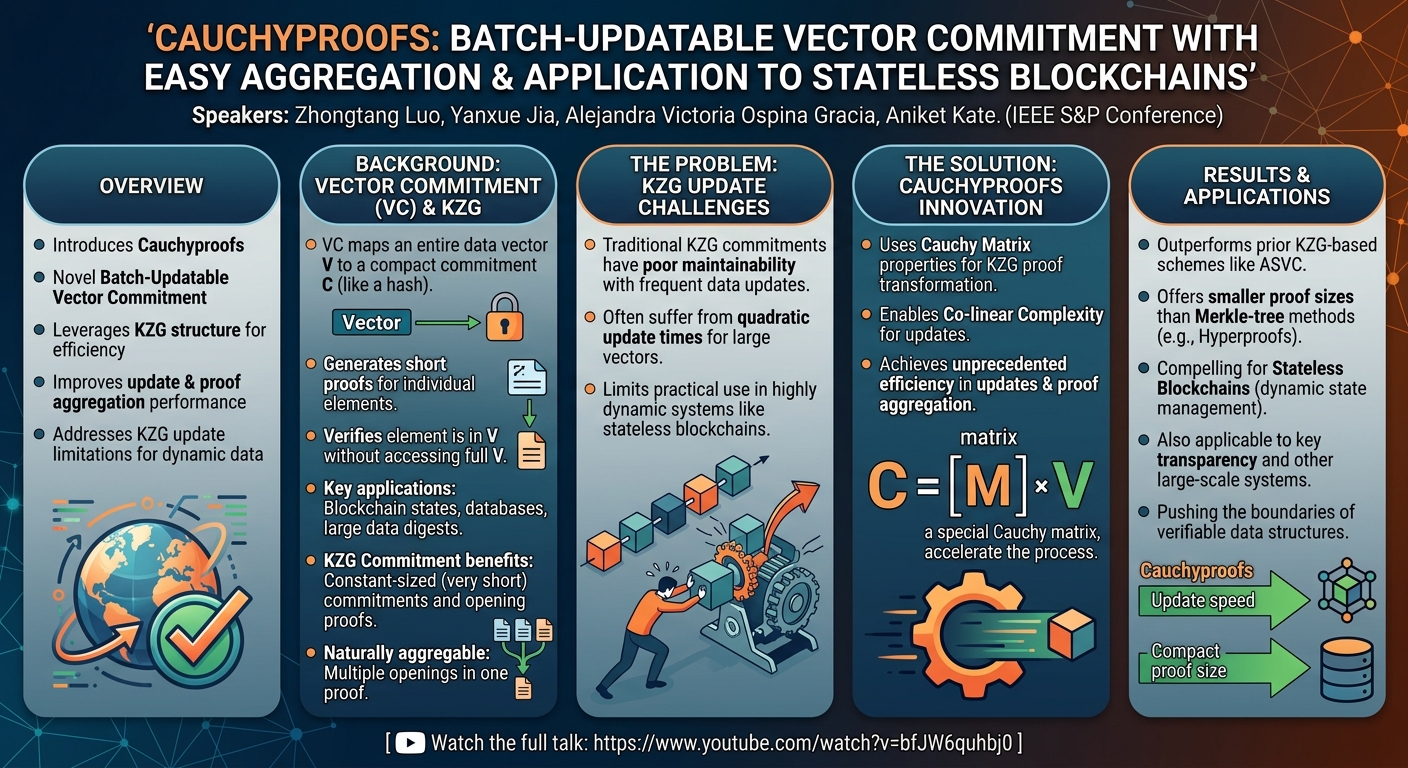
This talk introduces Cauchyproofs, a novel batch-updatable vector commitment scheme that leverages the algebraic structure of KZG commitments to achieve unprecedented efficiency in updates and proof aggregation. Presented by Zhongtang Luo and co-authored with Yanxue Jia, Alejandra Victoria Ospina Gracia, and Aniket Kate, the work addresses a critical limitation of traditional KZG commitments: their poor maintainability when data vectors undergo frequent updates. By introducing a KZG proof transformation rooted in Cauchy matrix properties, Cauchyproofs significantly improves performance, making KZG-based systems more practical for dynamic, large-scale applications.
Key moments
- 0:00 Introduction to vector commitment and KZG properties
- 2:00 Addressing the maintainability challenge of KZG commitments
- 3:00 Key insight: submatrix of Cauchy matrix remains Cauchy
- 3:30 Cauchyproofs achieves quasilinear complexity for updates
- 3:50 Significant performance improvement and state-of-the-art results
Cauchyproofs: Batch-Updatable Vector Commitment with Easy Aggregation and Application to Stateless Blockchains
Speakers: Zhongtang Luo, Yanxue Jia, Alejandra Victoria Ospina Gracia, Aniket Kate
Conference: IEEE S&P
YouTube: https://www.youtube.com/watch?v=bfJW6quhbj0
Overview
This talk introduces Cauchyproofs, a novel batch-updatable vector commitment scheme that leverages the algebraic structure of KZG commitments to achieve unprecedented efficiency in updates and proof aggregation. Presented by Zhongtang Luo and co-authored with Yanxue Jia, Alejandra Victoria Ospina Gracia, and Aniket Kate, the work addresses a critical limitation of traditional KZG commitments: their poor maintainability when data vectors undergo frequent updates. By introducing a KZG proof transformation rooted in Cauchy matrix properties, Cauchyproofs significantly improves performance, making KZG-based systems more practical for dynamic, large-scale applications.
The core innovation lies in transforming the commitment and proof computation into matrix-vector multiplications involving Cauchy matrices, enabling co-linear complexity for updates. This advancement is particularly significant for stateless blockchains, where the ability to efficiently commit to and update vast state data, while maintaining short and easily verifiable proofs, is paramount. The research offers a state-of-the-art solution that combines the benefits of KZG's short, aggregable proofs with the dynamic update capabilities often associated with Merkle trees, thereby pushing the boundaries of verifiable data structures in distributed systems.
The talk highlights how Cauchyproofs not only outperforms previous KZG-based schemes like ASVC, which suffer from quadratic update times, but also offers advantages in proof size compared to Merkle-tree-based methods such as Hyperproofs. This makes Cauchyproofs a compelling candidate for enhancing the scalability, efficiency, and security of systems that rely on cryptographic commitments, including blockchain state management, key transparency databases, and other applications requiring compact and verifiable data digests.
Background
▶ Watch: Introduction to vector commitment and KZG properties (0:00)
At its core, a vector commitment (VC) functions similarly to a cryptographic hash function, but for an entire vector of data V. It generates a compact digest, or commitment C, that can be easily shared. Crucially, a VC scheme also allows for the generation of a concise proof for any individual element E within the vector, enabling an external party to verify that E is indeed part of the committed vector V without needing to access V itself. This capability is vital for condensing large datasets—such as a blockchain's state, a key transparency database, or other extensive data structures—into a single, verifiable digest.
Among various VC schemes, KZG commitment (named after Kate, Zaverucha, and Goldberg) stands out due to its unique properties. KZG commitments operate on elliptic curves and involve sampling a random trapdoor element to compute public parameters as its powers. When committing, a polynomial is interpolated through the data vector. The primary advantages of KZG commitments are their inherent brevity: both the commitment C and the opening proofs are of a fixed, very short size (often one element in the elliptic curve group). This contrasts sharply with Merkle tree-like implementations, which typically require logarithmic-sized proofs relative to the data size. Furthermore, KZG commitments are naturally aggregable, meaning any number of openings can be proven with a single, compact proof, a feature almost unobtainable in Merkle-tree-based VCs without the use of more complex zero-knowledge proof systems like SNARKs.
Despite these significant advantages, KZG commitments historically suffer from a critical drawback: poor maintainability. Naively updating alpha proofs over beta vector updates results in a prohibitive alpha * beta time complexity. This quadratic scaling makes KZG commitments impractical for dynamic systems where the underlying data vector is frequently modified and many proofs need to be updated concurrently. In contrast, Merkle trees offer dynamic updates, allowing any element to be updated in logarithmic time, O(log N). This fundamental difference has limited the widespread adoption of KZG commitments in highly dynamic environments.
The central question motivating the Cauchyproofs research is whether the rich algebraic structure inherent in KZG commitments could be exploited to enable more efficient updates, thereby bridging the gap between KZG's proof aggregation and size benefits and Merkle trees' update efficiency. Addressing this challenge is crucial for modern applications like stateless blockchains, where the state (a large vector of data) is constantly changing, and nodes need to efficiently verify parts of this state without storing the entire history.
Key Findings
▶ Watch: Addressing the maintainability challenge of KZG commitments (2:00)
The Cauchyproofs paper introduces several groundbreaking findings that collectively establish a new state-of-the-art for KZG vector commitments. The core innovation revolves around a novel KZG proof transformation that fundamentally re-engineers how commitments and proofs are computed and updated.
- Cauchy Matrix-Based Transformation: The most significant finding is the realization that the computation of the commitment and proof can be formulated as a matrix-vector multiplication involving a Cauchy matrix
M. This algebraic restructuring is key to unlocking efficiency gains. Specifically, the commitment and proof vectors (AandB) are shown to be the result of two matrix multiplications, whereW,L, andL'are constant vectors derived during the initial setup.
- Efficient Batch Updates via Submatrix Property: A critical insight is that any submatrix of a Cauchy matrix is also a Cauchy matrix. This property is exploited to enable highly efficient batch updates. When parts of the vector
Vare updated, the scheme can effectively "throw away" the unwanted portions of the matrix and perform computations only on the relevant submatrix. This avoids recomputing the entire structure, which is the bottleneck in naive KZG updates.
- Co-linear Update Complexity: Leveraging the properties of Cauchy matrices and their submatrices, Cauchyproofs achieves a remarkable co-linear complexity for updates, specifically
O(alpha + beta)orO(alpha log(beta))depending on the precise operations, foralphausers andbetatransactions. This represents a significant performance improvement over previous state-of-the-art KZG-based schemes like ASVC, which suffers from a quadratic update time ofO(alpha beta). This reduction in complexity makes KZG commitments viable for highly dynamic environments.
- Faster Computation for All Proofs: As a direct result of the KZG vector transformation, Cauchyproofs also enables faster overall computation for generating and updating all proofs. This holistic improvement in proof management contributes to the scheme's superior performance profile.
- History Proof Query Support: The work further introduces support for querying historical proofs through a binary divide-and-conquer mechanism. This feature adds another layer of utility, allowing for efficient verification of past states or data elements, which is particularly valuable in contexts like blockchain history management.
In summary, Cauchyproofs delivers a KZG vector commitment scheme that is state-of-the-art across multiple dimensions. It maintains the desirable short proof size and aggregability of KZG (outperforming Merkle-based methods such as Hyperproofs in proof size) while drastically improving update complexity (outperforming other KZG-based mechanisms like ASVC in update time). These findings collectively overcome long-standing limitations of KZG commitments, paving the way for their broader application in performance-critical systems.
Technical Deep Dive
▶ Watch: Key insight: submatrix of Cauchy matrix remains Cauchy (3:00)
The technical ingenuity of Cauchyproofs stems from a sophisticated re-conceptualization of KZG commitments through the lens of Cauchy matrices and matrix-vector multiplication.
A standard KZG commitment operates within an elliptic curve setting. The process begins with a trusted setup phase where a random trapdoor element (often denoted as s) is sampled. From this, a set of public parameters (also known as the structured reference string, SRS) is computed, typically consisting of powers of s in the elliptic curve group, i.e., [1]_1, [s]_1, [s^2]_1, ..., [s^n]_1 for a vector of length n. To commit to a vector V = (v_0, v_1, ..., v_{n-1}), a polynomial P(x) is interpolated such that P(i) = v_i for relevant indices i. The commitment C is then [P(s)]_1, a compact representation of the polynomial evaluated at the trapdoor element. To prove the value of v_i at a specific index i, a proof pi_i = [(P(s) - v_i) / (s - i)]_1 is generated, which can be verified using a pairing check with the public parameters. The key advantage here is the constant size of both C and pi_i, regardless of n.
The challenge, as highlighted, is the O(alpha * beta) complexity for updating alpha proofs after beta modifications to the vector V. Cauchyproofs tackles this by introducing a KZG proof transformation. The paper shows that the commitment and the proofs can be expressed as a matrix-vector multiplication. Specifically, let M be a Cauchy matrix. A Cauchy matrix is a matrix where its elements M_{ij} are of the form 1 / (x_i - y_j) for distinct elements x_i and y_j. These matrices possess unique algebraic properties that are exploited by Cauchyproofs.
In this transformed framework, the commitment and the individual proofs are not computed directly through polynomial evaluation and division, but rather through an optimized matrix-vector product. The speaker states that the commitment and proof can be computed as a matrix-vector multiplication where A and B are the resulting vectors of two such multiplications. The specific form involves constant vectors W, L, and L' which are pre-evaluated during the setup phase. The full details of this transformation are elaborated in the accompanying paper, but the core idea is to convert the cryptographic operations into linear algebraic operations over finite fields, which can be optimized.
The critical key insight enabling efficient updates is that any submatrix of a Cauchy matrix is also a Cauchy matrix. This property is fundamental to the batch-updatability. When elements in the underlying vector V are updated, instead of recomputing the entire KZG structure, Cauchyproofs can effectively "discard" the parts of the matrix corresponding to unchanged elements. Only the relevant submatrix, which itself retains the Cauchy structure, needs to be considered for re-computation. This significantly reduces the computational burden.
Multiplication of structured matrices, like Cauchy matrices, is known to be quasilinear in complexity. While there are "a few caveats here and there related to our setup," as mentioned by the speaker, these are addressed within the paper. By leveraging these optimized matrix multiplication algorithms, Cauchyproofs achieves a co-linear complexity for alpha users and beta transactions. This means that the update time scales near-linearly with the number of users and transactions, a drastic improvement over the quadratic scaling of naive KZG updates and the O(N^2) complexity of previous methods like ASVC. This algebraic transformation allows the scheme to dynamically manage updates to the committed vector V and its associated proofs with an efficiency comparable to, or even exceeding, Merkle tree-based schemes for certain operations, while retaining the small proof size and aggregability unique to KZG.
Demo / Proof of Concept
▶ Watch: Cauchyproofs achieves quasilinear complexity for updates (3:30)
While the talk did not feature a live, interactive code demonstration, the speaker presented strong evidence of Cauchyproofs' efficacy through a discussion of its performance improvements and functional capabilities compared to existing solutions. The "demo" in this context refers to the empirical validation and comparative analysis of their theoretical advancements.
The primary demonstration of Cauchyproofs' capabilities lies in its significant performance improvement over the previous state-of-the-art ASVC (Aggregatable Short Vector Commitment) scheme. ASVC, a KZG-based mechanism, is noted to have a quadratic update time (O(alpha beta)), making it impractical for large-scale dynamic datasets. In stark contrast, Cauchyproofs achieves co-linear complexity for updates (e.g., O(alpha + beta) or O(alpha log(beta))), a monumental leap in efficiency. The speaker explicitly stated, "our works obtains a significant performance improvement over the past state-of-the-art ASVC." This implies that benchmarks or theoretical complexity analyses were conducted and presented in the full paper, showcasing this practical advantage.
Furthermore, the research demonstrated:
- Faster Computation for All Proofs: Beyond just updates, the KZG vector transformation inherent in Cauchyproofs was shown to lead to a generally faster computation for generating and verifying all proofs. This suggests that the underlying algebraic optimizations translate into tangible speedups across the board for proof management.
- Support for History Proof Query: The talk highlighted the implementation of a binary divide-and-conquer mechanism to support efficient querying of historical proofs. This capability allows users to verify past states of the vector, which is crucial for applications like blockchain explorers or auditing tools that need to reconstruct and verify data at specific points in time.
The speaker also provided a comparative overview of Cauchyproofs against other schemes:
- Proof Size: Cauchyproofs maintains superior proof sizes compared to Merkle-based methods such as Hyperproofs, which typically require logarithmic-sized proofs. This reinforces KZG's advantage in data compactness.
- Update Complexity: It demonstrably outperforms other KZG-based mechanisms like ASVC in terms of update complexity, moving from quadratic to co-linear scaling.
In essence, the demonstration focused on the real-world applicability and practical performance gains of Cauchyproofs, validating its claim as a state-of-the-art KZG vector commitment scheme that effectively resolves the long-standing maintainability issues associated with this powerful cryptographic primitive.
Defensive Implications
▶ Watch: Significant performance improvement and state-of-the-art results (3:50)
The advancements introduced by Cauchyproofs have profound defensive implications, particularly for systems that rely on the integrity and verifiability of large, dynamic datasets. The core benefit lies in enabling the practical deployment of highly efficient and secure vector commitments, especially within performance-sensitive environments.
- Enhanced Scalability for Stateless Blockchains: For stateless blockchains, where full nodes do not store the entire blockchain state but rather verify state transitions against a compact commitment, Cauchyproofs offers a critical advantage. The ability to perform batch updates with co-linear complexity (
O(alpha + beta)) means that as the number of transactions (beta) and users (alpha) grows, the cost of updating the blockchain state commitment and its proofs remains manageable. This drastically improves the scalability of such systems, allowing them to process more transactions and accommodate more users without performance bottlenecks related to state commitment updates. Defenders can design more robust and high-throughput blockchain protocols.
- Improved Efficiency for Key Transparency Databases: Systems like key transparency databases, which aim to provide auditable and verifiable records of public keys (e.g., for messaging apps), can greatly benefit. These databases are essentially large vectors of user-to-key mappings that undergo frequent updates. Cauchyproofs enables these updates to occur much faster, ensuring that users can quickly verify the authenticity of keys without experiencing significant latency, thereby bolstering trust and security in communication.
- Reduced Attack Surface from Performance Bottlenecks: Traditional KZG schemes, with their quadratic update times, could be susceptible to denial-of-service (DoS) attacks or performance degradation under high load. An attacker might flood the system with updates to slow down commitment generation or proof updates. By achieving co-linear complexity, Cauchyproofs significantly mitigates this risk. The system can handle a much higher volume of updates before performance becomes a critical issue, making it more resilient against such attacks.
- Cost-Effective Proof Management: The ability to aggregate any number of openings into a single, short proof, combined with efficient updates, reduces the computational and communication overhead for verifiers. This means less data needs to be transmitted and processed to verify the integrity of data elements, which is beneficial for resource-constrained devices or networks. Defenders can build more lightweight and distributed verification mechanisms.
- Robustness for Large Data Structures: Any application that manages large, frequently changing data structures requiring cryptographic commitments—be it supply chain tracking, verifiable computation, or data integrity layers—can leverage Cauchyproofs for improved robustness. The scheme provides strong guarantees about data integrity with minimal overhead, allowing for quicker detection of tampering and more efficient auditing.
In summary, Cauchyproofs empowers defenders by providing a highly performant and scalable cryptographic primitive. It transforms KZG commitments from a theoretically powerful but practically challenging tool into a deployable solution that can underpin the next generation of verifiable, dynamic, and decentralized systems, enhancing their security, efficiency, and resilience.
Key Takeaways
- Cauchyproofs introduces a novel batch-updatable vector commitment scheme built upon KZG commitments.
- It leverages a KZG proof transformation based on Cauchy matrix properties to achieve significantly improved update efficiency.
- The scheme boasts co-linear complexity (
O(alpha + beta)orO(alpha * log(beta))) for updates involvingalphausers andbetatransactions, drastically outperforming the quadratic update time of prior KZG schemes like ASVC. - Cauchyproofs retains the inherent advantages of KZG commitments: very short commitment and proof sizes (constant size) and natural aggregability of proofs, surpassing Merkle-based methods like Hyperproofs in proof compactness.
- It supports faster overall computation for generating proofs and enables history proof queries via a binary divide-and-conquer mechanism.
- This innovation is critical for applications requiring efficient verification of large, dynamic data, most notably stateless blockchains and key transparency databases, enhancing their scalability and security.
About the Speaker(s)
The talk "Cauchyproofs: Batch-Updatable Vector Commitment with Easy Aggregation and Application to Stateless Blockchains" was presented by Zhongtang Luo. He is one of the key researchers behind this work, alongside co-authors Yanxue Jia, Alejandra Victoria Ospina Gracia, and Aniket Kate. The research was presented at the prestigious IEEE S&P conference, signifying its contribution to the field of security and privacy. While specific titles or affiliations were not detailed in the transcript, their collective work focuses on advanced cryptographic primitives and their application to practical problems in distributed systems, particularly in enhancing the efficiency and security of blockchain technologies.