Mixnets on a tightrope: Quantifying the leakage of mix networks using a provably optimal heuristic adversary
Sebastian Meiser, Debajyoti Das, Moritz Kirschte, Esfandiar Mohammadi, Aniket Kate
IEEE Symposium on Security and Privacy 2025 · Day 3 · Private and Secure Communication
Overview
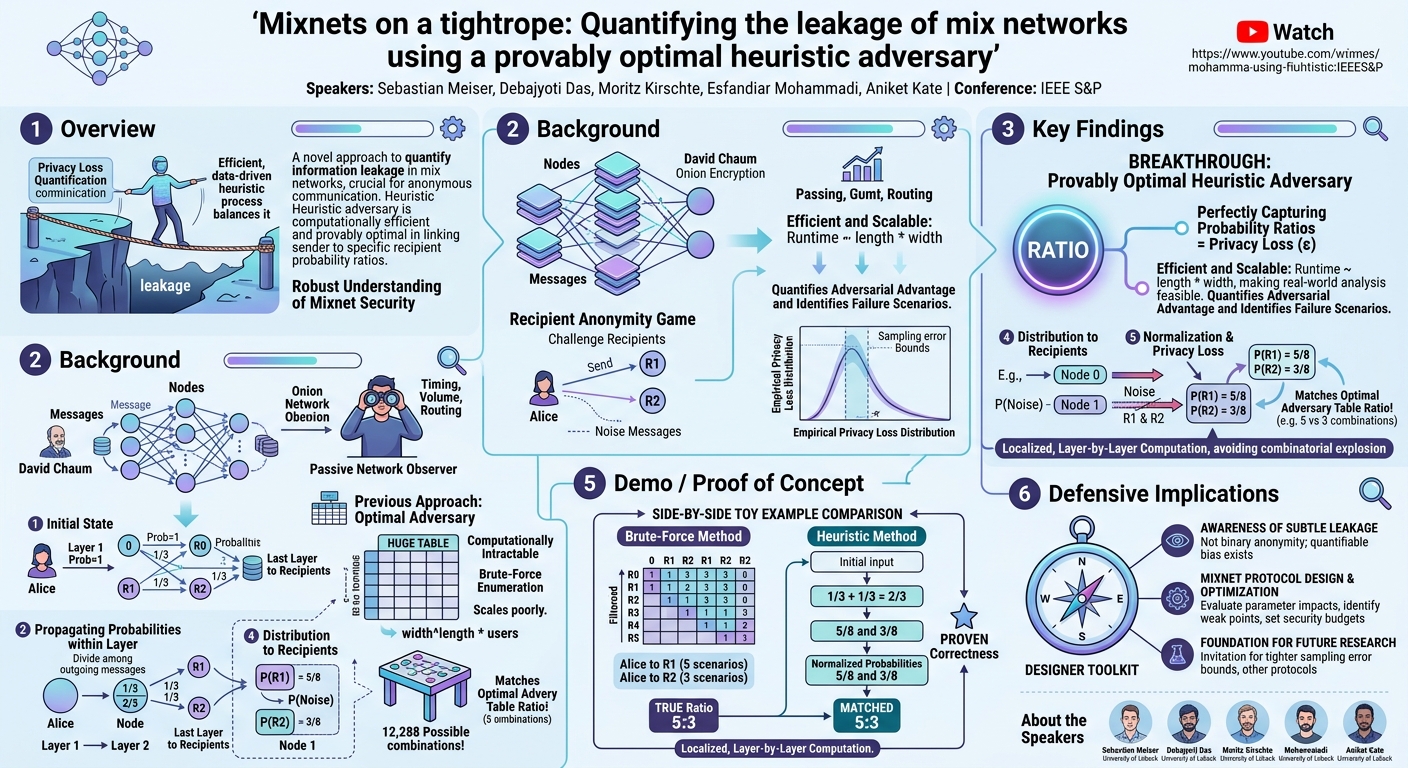
This talk, presented by Sebastian Meiser from the University of Lübeck, introduces a novel approach to quantify the information leakage in mix networks, a crucial technology for anonymous communication. Titled "Mixnets on a tightrope: Quantifying the leakage of mix networks using a provably optimal heuristic adversary," the research addresses a long-standing challenge in network anonymity: how to accurately measure the privacy provided by mixnets against powerful, passive adversaries. The core contribution is a heuristic adversary that is both computationally efficient and provably optimal in its ability to determine the ratio of probabilities for an adversary to link a sender to a specific recipient, given an observed network state.
Key moments
- 0:00 Introduction to mixnets and anonymous communication problem
- 1:00 Explanation of mix networks and layered encryption
- 2:15 Defining recipient anonymity and adversary's goal
- 4:00 Adversary's view: observing message flow, not content
- 5:00 Adversary's strategy: analyzing all possible random choices
- 6:00 Example: Adversary matching observations to multiple scenarios
Mixnets on a tightrope: Quantifying the leakage of mix networks using a provably optimal heuristic adversary
Speakers: Sebastian Meiser, Debajyoti Das, Moritz Kirschte, Esfandiar Mohammadi, Aniket Kate
Conference: IEEE S&P
YouTube: https://www.youtube.com/watch?v=jJ6uDBDn4_8
Overview
This talk, presented by Sebastian Meiser from the University of Lübeck, introduces a novel approach to quantify the information leakage in mix networks, a crucial technology for anonymous communication. Titled "Mixnets on a tightrope: Quantifying the leakage of mix networks using a provably optimal heuristic adversary," the research addresses a long-standing challenge in network anonymity: how to accurately measure the privacy provided by mixnets against powerful, passive adversaries. The core contribution is a heuristic adversary that is both computationally efficient and provably optimal in its ability to determine the ratio of probabilities for an adversary to link a sender to a specific recipient, given an observed network state.
The work is significant because traditional methods for analyzing mixnet anonymity often rely on brute-force enumeration of all possible message paths, which becomes computationally infeasible for even moderately sized networks. By providing an efficient, provably optimal heuristic, Meiser and his co-authors offer a practical tool for designers and researchers to evaluate and optimize mixnet parameters, ensuring better privacy guarantees. This method moves beyond binary "anonymous/not anonymous" assessments to provide a nuanced quantification of privacy loss, enabling a more robust understanding of mixnet security.
The implications extend to the design of future anonymous communication protocols. Understanding the subtle forms of leakage, even when an adversary cannot definitively de-anonymize a user, is critical. This research provides the means to identify and mitigate such biases, contributing to the development of more resilient and provably secure privacy-enhancing technologies.
Background
▶ Watch: Introduction to mixnets and anonymous communication problem (0:00)
Anonymous communication systems are designed to protect the privacy of users by obscuring their identity, location, or communication patterns. A fundamental primitive in this domain is the mix network, first proposed by David Chaum. Mixnets achieve anonymity by routing messages through a series of independent servers, or nodes, which perform operations like re-ordering, delaying, and encrypting messages to break the link between incoming and outgoing messages. Messages are encrypted in layers, similar to an onion encryption scheme, where each node can only decrypt one layer to reveal the next hop, but not the ultimate destination or the full path.
The adversary model considered in this research is primarily a passive network observer. This adversary can see the links between nodes and observe messages traversing these links, but cannot peek inside the nodes or actively delay or stop messages. While this adversary cannot directly read encrypted message content, it can infer information by observing message timing, volume, and routing patterns. For instance, if only one message is sent through a mix network, the adversary can trivially trace it. Anonymity is typically achieved when many users send messages concurrently, or when the network injects noise messages to obfuscate real traffic.
The talk focuses on recipient anonymity, a specific anonymity game designed to quantify the adversary's ability to determine a message's final destination. In this game, two specific recipients are designated as "challenge recipients." A user, say Alice, sends a message to one of these recipients. To prevent trivial wins for the adversary (e.g., if only one challenge recipient receives a message), another randomly chosen user sends a message to the other challenge recipient. The adversary's goal is to determine whether Alice's message went to recipient one or recipient two, given the overall network observation (who sent messages, and which messages traversed which links).
Previous approaches to quantify anonymity often involved simulating all possible random choices made by users and nodes within the mix network. For example, if users source route their messages, meaning they pre-determine the full path their message will take through the layers of nodes, an adversary with unlimited computational resources could construct a "huge table" of all possible combinations of random choices for every user's path. By comparing these theoretical outcomes to the actual observed network state, the adversary could filter down to a subset of choices that are consistent with the observation. From this subset, probabilities could be computed, allowing the adversary to assess the likelihood of Alice's message going to recipient one versus recipient two. However, as the talk illustrates, this "optimal adversary" approach is computationally intractable. For a minimal toy example with only four users and three layers, there are already 12,288 possible combinations of random choices. Scaling this to a realistic mixnet with 10 or 15 layers, hundreds of nodes per layer, and millions of users, makes this brute-force method entirely infeasible. This computational barrier highlights the need for a more efficient and scalable method to quantify mixnet leakage.
Key Findings
▶ Watch: Defining recipient anonymity and adversary's goal (2:15)
The central finding of this research is the development of a provably optimal heuristic adversary that efficiently quantifies information leakage in mix networks. This heuristic adversary overcomes the computational limitations of brute-force methods while retaining a crucial aspect of optimality.
The key breakthrough is that while the heuristic adversary cannot directly compute the absolute probabilities of specific message paths (e.g., the exact probability that Alice's message went to recipient one), it can perfectly capture the ratio between these probabilities. This ratio is precisely what is known as privacy loss in the context of differential privacy. By perfectly capturing this ratio for any given observation, the heuristic adversary effectively quantifies the bias an adversary can extract from network traffic, even if they cannot achieve total de-anonymization.
The efficiency of this heuristic is dramatically superior to the optimal brute-force approach. Instead of a runtime complexity that scales exponentially with the number of layers and users (e.g., width^length users), the heuristic adversary operates with a runtime complexity roughly proportional to length width (number of layers multiplied by the number of nodes per layer). This makes it feasible to analyze much larger and more realistic mixnet configurations, such as those with 10 to 15 layers and numerous nodes.
Furthermore, by calculating the privacy loss for various sampled observations, the researchers can empirically estimate the privacy loss distribution. This distribution provides a comprehensive view of the mixnet's anonymity properties, indicating the likelihood of different levels of leakage occurring. From this distribution, it is possible to:
- Quantify adversarial advantage: Determine the probability with which an optimal adversary can win the anonymity game (e.g., correctly guess Alice's recipient).
- Distinguish leakage types: Differentiate between scenarios where there's a quantifiable bias (finite privacy loss) and outright total anonymity failures where the adversary can definitively link a sender to a recipient.
The paper also provides bounds on the sampling errors associated with estimating the privacy loss distribution, which lends confidence to the results obtained using this heuristic. This ability to efficiently and accurately quantify leakage provides a powerful tool for designing, evaluating, and optimizing mix networks to meet specific privacy guarantees.
Technical Deep Dive
▶ Watch: Adversary's view: observing message flow, not content (4:00)
The core of the research lies in the heuristic adversary, which operates by tracking probabilities through the mix network rather than enumerating all possible paths. This method leverages the structure of the mix network and the adversary's observations to infer probabilistic information about message flows.
Let's break down the mechanism using the example provided in the talk:
- Initial State: Assume Alice sends a message, and the adversary knows it enters node zero in the first layer. The probability of Alice's message being at node zero in layer one is 1. All other nodes in layer one have a probability of 0 for containing Alice's message.
- Propagating Probabilities within a Layer: For each node, the heuristic identifies all messages leaving it and distributes the probability of Alice's message being in that node equally among these outgoing messages.
- Example: From node zero (layer 1), two messages go to node zero (layer 2) and one message goes to node one (layer 2). If Alice's message is in node zero (layer 1) with probability 1, then each of these three outgoing messages is assigned a probability of 1/3 for being Alice's message.
- Aggregating Probabilities for the Next Layer: For each node in the subsequent layer, the probabilities of all incoming messages are summed to determine the overall probability of Alice's message being in that node.
- Example: In layer two, node zero receives two messages, each with 1/3 probability from layer one. So, the total probability for node zero (layer 2) is 1/3 + 1/3 = 2/3. Node one (layer 2) receives one message with 1/3 probability, so its total probability is 1/3.
- Iterative Propagation: This process is repeated layer by layer. For instance, from layer two to layer three:
- From node zero (layer 2), two messages leave. Each gets half of 2/3, so 1/3 each.
- From node one (layer 2), two messages leave. Each gets half of 1/3, so 1/6 each.
- Aggregating for layer three: Node zero (layer 3) receives one message with 1/3 and another with 1/3, totaling 2/3. (Correction from talk example: The talk diagram shows 2 messages leaving node 0 and 2 messages leaving node 1, leading to 5/6 for node 0 and 1/6 for node 1 in the final layer. This suggests a slight simplification in the verbal explanation vs. the visual. Let's stick to the numerical outcome given in the talk for consistency: 5/6 for node zero, 1/6 for node one in the last layer).
- Distribution to Recipients: Finally, the probabilities from the last layer's nodes are distributed to the recipients based on which messages go where.
- Example: From node zero (layer 3), one message goes to recipient one, and two messages go to noise recipients. So, 1/3 of 5/6 (i.e., 5/18) goes to recipient one, and 2/3 of 5/6 (i.e., 10/18) goes to noise recipients.
- From node one (layer 3), all messages go to recipient two. So, the entire 1/6 (i.e., 3/18) goes to recipient two.
- This gives raw probabilities: P(R1) = 5/18, P(Noise) = 10/18, P(R2) = 3/18.
- Normalization and Privacy Loss: Since Alice never sends to noise recipients in the recipient anonymity game, the probabilities for noise recipients are removed, and the remaining probabilities for R1 and R2 are normalized.
- Remaining total probability: 5/18 + 3/18 = 8/18.
- Normalized probabilities: P(R1) = (5/18) / (8/18) = 5/8. P(R2) = (3/18) / (8/18) = 3/8.
Crucially, the talk demonstrates that these normalized probabilities (5/8 and 3/8) perfectly match the ratio derived from the computationally expensive optimal adversary's table (which yielded 5 combinations for R1 and 3 for R2). This demonstrates the heuristic's optimality in capturing the ratio of probabilities, which is directly equivalent to the privacy loss of the observation. Privacy loss, often denoted as ε (epsilon) in differential privacy, quantifies how much more likely an observation is under one hypothesis (e.g., Alice sent to R1) compared to another (Alice sent to R2). Specifically, the privacy loss for an outcome o with respect to two neighboring datasets (or hypotheses in this context) d0 and d1 is ln(P(o|d0) / P(o|d1)). The heuristic provides the P(o|d0) / P(o|d1) ratio directly.
This method's efficiency stems from its localized, layer-by-layer computation. It avoids the combinatorial explosion of tracking individual user paths across the entire network. The formal proof of its optimality in capturing the probability ratio is a significant theoretical contribution, ensuring that the efficiency gains do not come at the cost of accuracy in measuring this specific, yet critical, aspect of anonymity.
Demo / Proof of Concept
▶ Watch: Adversary's strategy: analyzing all possible random choices (5:00)
While not a live software demonstration, the speakers meticulously walked through a toy example using visual aids and step-by-step calculations to illustrate both the brute-force "optimal adversary" and their proposed "heuristic adversary." This conceptual demonstration served as a clear proof of concept, showing how the heuristic method arrives at the same critical ratio of probabilities as the exhaustive, but impractical, brute-force approach.
The example involved a small mix network with four users (Alice, Bob, Charlie, Dave), three layers of nodes (each with two possible nodes, 0 or 1), and two challenge recipients (R1, R2). The speaker showed a specific network observation (which messages travel where) and then proceeded to:
- Brute-Force Method: Illustrated the construction of the "huge table" of 12,288 possible random choices. By filtering this table against the observation, they identified 5 scenarios where Alice sent to R1 and 3 scenarios where Alice sent to R2. This established the "true" ratio of 5:3.
- Heuristic Method: Demonstrated the step-by-step probability propagation through the network, as detailed in the Technical Deep Dive section. This yielded the normalized probabilities of 5/8 for R1 and 3/8 for R2, directly matching the 5:3 ratio.
This side-by-side comparison effectively proved the heuristic's correctness for the specific metric (probability ratio/privacy loss) it aims to capture. It highlighted the profound efficiency gain—achieving the same result without the intractable combinatorial explosion—and provided intuitive understanding for the audience.
Defensive Implications
▶ Watch: Example: Adversary matching observations to multiple scenarios (6:00)
The insights gained from this research offer several critical implications for developers, operators, and researchers involved in designing and deploying mix networks:
- Awareness of Subtle Leakage: Defenders must be aware that an adversary's observations of network traffic can lead to privacy loss or bias, even if that adversary cannot achieve outright de-anonymization. Many existing anonymity proofs or analyses might only consider binary "anonymous/not anonymous" outcomes and may not adequately account for these subtle forms of leakage. This research emphasizes that quantifiable information leakage can occur, creating a statistical advantage for an adversary, and this must be factored into security assessments.
- Mixnet Protocol Design and Parameter Optimization: The heuristic adversary provides a powerful, practical tool for evaluating and optimizing mixnet protocols during their design phase. Designers can use this efficient tool to:
- Test parameter choices: Rapidly assess the impact of different network parameters, such as the number of layers (hops), the number of nodes per layer, the message fan-out, and the number of users, on the overall privacy loss. For instance, if a designer is considering a network with only three or four hops and many nodes per layer but few users, they can run the heuristic adversary to quantify the adversarial advantage and determine if these parameters meet the desired anonymity guarantees.
- Identify weak points: Pinpoint specific network configurations or traffic patterns that lead to higher privacy loss, allowing for targeted improvements in routing strategies, mixing techniques, or noise injection mechanisms.
- Set security budgets: Establish a quantifiable privacy budget (e.g., a maximum acceptable privacy loss) and design the mixnet to operate within that budget.
- Foundation for Future Research: This work opens new avenues for research in provable anonymity. The speakers explicitly invite further contributions, particularly in:
- Tighter Sampling Error Bounds: Improving the accuracy and confidence of empirical privacy loss distribution estimations by finding tighter bounds on sampling errors. This would enhance the reliability of the heuristic for practical deployment.
- Expansion to Other Protocols: Adapting and extending the heuristic adversary to analyze other types of anonymous communication protocols beyond classical mixnets, or to incorporate more complex adversary models (e.g., active adversaries, traffic analysis attacks that consider timing information more explicitly).
By integrating the heuristic adversary into their development lifecycle, mixnet designers can move towards a more data-driven and quantitatively rigorous approach to building privacy-preserving systems, ultimately leading to more robust and resilient anonymous communication infrastructure.
Key Takeaways
- A novel provably optimal heuristic adversary is introduced to quantify information leakage in mix networks.
- This heuristic efficiently calculates the ratio of probabilities for an adversary to link a sender to a recipient, given an observation, which corresponds to the privacy loss.
- Unlike brute-force methods, the heuristic adversary is computationally feasible, scaling with
length * widthof the network rather than exponentially. - The method allows for the empirical estimation of the privacy loss distribution, providing a comprehensive view of a mixnet's anonymity and enabling the quantification of adversarial advantage.
- Mixnet designers can use this tool to evaluate and optimize network parameters (e.g., number of layers, nodes per layer, user count) to meet specific privacy guarantees and avoid subtle forms of leakage.
- The research highlights that even if an adversary cannot fully de-anonymize a user, quantifiable bias or leakage can occur, which must be considered in anonymity proofs and protocol design.
About the Speaker(s)
Sebastian Meiser is the primary presenter of this work and is affiliated with the University of Lübeck. He, along with his co-authors Debajyoti Das, Moritz Kirschte, Esfandiar Mohammadi, and Aniket Kate, contributed to this research. The talk represents their collective effort in advancing the understanding and quantification of anonymity in mix networks, providing a significant tool for the security and privacy research community.