Lombard-VLD: Voice Liveness Detection based on Human Auditory Feedback
Hongcheng Zhu, Zongkun Sun, Yanzhen Ren, Kun He, Yongpeng Yan, Zixuan Wang
IEEE Symposium on Security and Privacy 2025 · Day 3 · Mobile and Smarthome Security
Overview
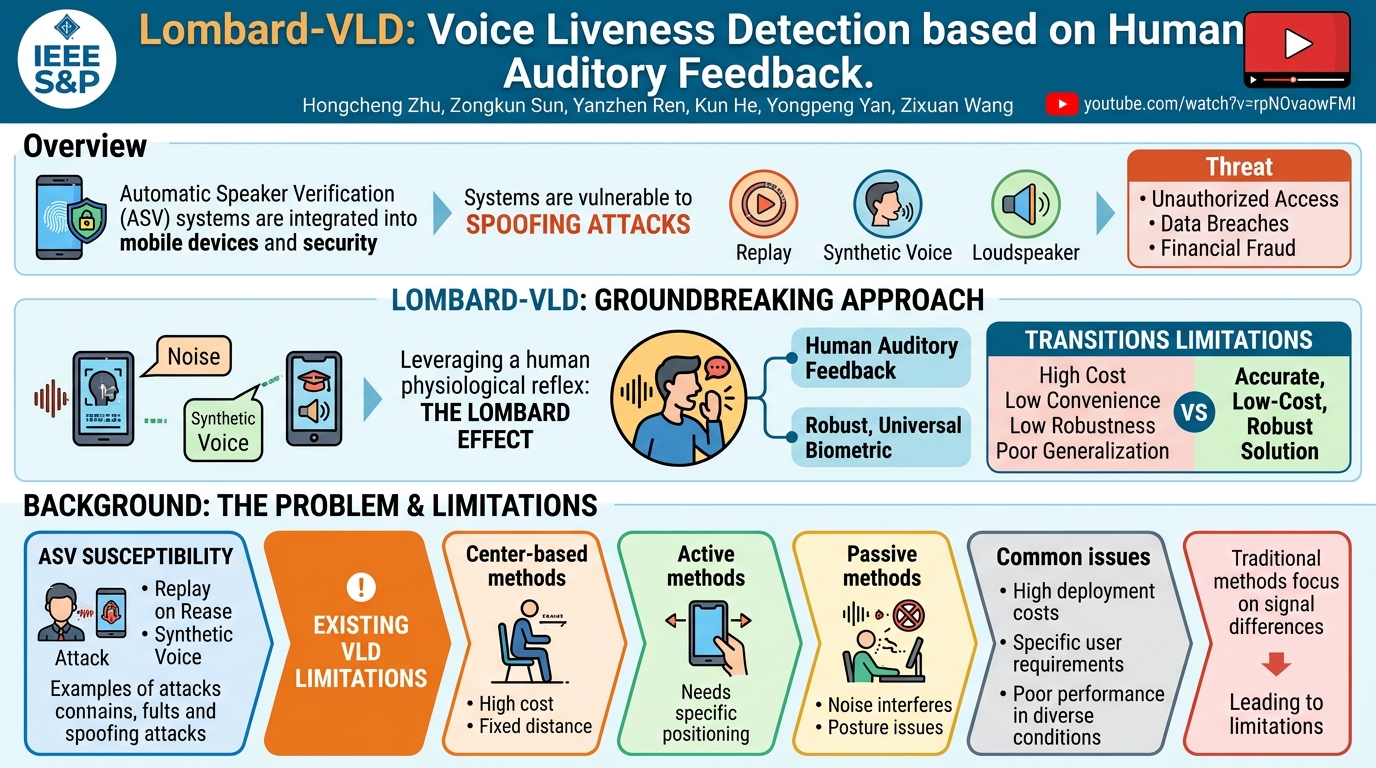
In an era where automatic speaker verification (ASV) systems are increasingly integrated into mobile devices and critical security applications, ensuring the integrity of voice authentication has become paramount. These systems, designed to verify a user's identity based on their unique voice characteristics, are unfortunately highly vulnerable to spoofing attacks. Such attacks typically involve replaying pre-recorded audio, employing sophisticated voice synthesis, or using a loudspeaker to impersonate a legitimate user, thereby bypassing security measures. This vulnerability poses a significant threat, potentially leading to unauthorized access, data breaches, and financial fraud.
Key moments
- 0:00 Introduction, ASV spoofing problem, existing VLD limitations
- 2:00 Novel approach: Lombard effect for voice liveness detection
- 3:20 Acoustic analysis reveals Lombard effect's universal features
- 4:10 Proposed Lombard-VLD framework extracts differential features
- 6:00 Datasets and experimental setup for Lombard-VLD evaluation
- 7:00 Key results: performance, robustness, and generalization
- 8:00 Defending against conventional and advanced spoofing attacks
Lombard-VLD: Voice Liveness Detection based on Human Auditory Feedback
Speakers: Hongcheng Zhu; Zongkun Sun; Yanzhen Ren; Kun He; Yongpeng Yan; Zixuan Wang
Conference: IEEE S&P
YouTube: https://www.youtube.com/watch?v=rpNOvaowFMI
Overview
In an era where automatic speaker verification (ASV) systems are increasingly integrated into mobile devices and critical security applications, ensuring the integrity of voice authentication has become paramount. These systems, designed to verify a user's identity based on their unique voice characteristics, are unfortunately highly vulnerable to spoofing attacks. Such attacks typically involve replaying pre-recorded audio, employing sophisticated voice synthesis, or using a loudspeaker to impersonate a legitimate user, thereby bypassing security measures. This vulnerability poses a significant threat, potentially leading to unauthorized access, data breaches, and financial fraud.
"Lombard-VLD: Voice Liveness Detection based on Human Auditory Feedback," presented at IEEE S&P, introduces a groundbreaking approach to combating these voice spoofing threats. The talk, led by Hongcheng Zhu from Wuhan University and co-authored by Zongkun Sun, Yanzhen Ren, Kun He, Yongpeng Yan, and Zixuan Wang, unveils a novel voice liveness detection (VLD) framework that leverages a fundamental, involuntary human physiological reflex: the Lombard effect. This effect, deeply rooted in human auditory feedback mechanisms, provides a robust and universal biometric indicator that live speakers possess but loudspeakers and synthetic voices inherently lack.
The significance of Lombard-VLD lies in its ability to transcend the limitations of existing VLD methods, which often struggle with issues of cost, convenience, robustness against environmental interference, and generalization across diverse conditions. By focusing on the unique acoustic changes induced by the Lombard effect—changes that are independent of speaker identity, gender, or environmental noise—Lombard-VLD offers a highly accurate, low-cost, and robust solution. This work represents a crucial advancement in securing voice-based authentication systems, providing a powerful defense against both conventional and advanced spoofing attempts that seek to mimic human speech.
Background
▶ Watch: Introduction, ASV spoofing problem, existing VLD limitations (0:00)
The proliferation of ASV systems has brought convenience but also exposed a critical security gap: their susceptibility to spoofing attacks. Existing voice liveness detection (VLD) methods, while attempting to address this, suffer from a range of inherent limitations that hinder their widespread and effective deployment. These methods can generally be categorized into center-based, active, and passive approaches, each with its own set of challenges.
Center-based methods often demand high deployment and application costs. They typically require users to maintain a fixed posture and distance relative to the device, making them inconvenient for everyday use. Furthermore, their performance is often compromised by environmental interference, reducing their robustness in real-world scenarios. Active methods share similar restrictions, frequently necessitating specific device positioning—for instance, the device speaker needing to face the live speaker directly. This requirement for precise user interaction or device setup limits their practicality and user acceptance. Passive methods, while seemingly less intrusive, are not exempt from these issues. They too can require specific user postures and are susceptible to environmental noise, which can degrade their detection accuracy.
A common thread among these traditional VLD techniques is their primary focus on detecting subtle differences at the audio signal level. While signal-level analysis can identify some artifacts of synthetic or replayed speech, these methods often fall short in terms of cost-effectiveness, user convenience, robustness against varying conditions, and generalization to unseen attack vectors or environments. Attackers are continually developing more sophisticated spoofing techniques that can closely mimic natural human speech at the signal level, rendering purely signal-based VLD increasingly ineffective. This constant arms race highlights the need for a fundamentally different approach—one that exploits an inherent, unreplicable characteristic of live human speech. The problem, therefore, is to find a universal and robust physiological mechanism present in live speakers that is entirely absent in artificial reproductions, offering a definitive differentiator for liveness detection.
Key Findings
▶ Watch: Acoustic analysis reveals Lombard effect's universal features (3:20)
The core innovation of Lombard-VLD stems from the identification and exploitation of the Lombard effect, a fascinating and involuntary physiological reflex unique to live human speakers. This effect, controlled by the cortical networks of the human brain, causes individuals to automatically and unconsciously adjust their speaking patterns in noisy environments. The primary purpose of this adjustment is to enhance vocal clarity and ensure intelligibility when background noise levels increase. Crucially, since loudspeakers and synthetic voice generators lack biological cortical brain networks, they are fundamentally incapable of replicating this adaptive vocal response. This inherent difference forms the bedrock of Lombard-VLD's liveness detection mechanism.
The research conducted by Zhu et al. involved extensive acoustic analysis of speech produced both without and with the Lombard effect. Their findings revealed significant and consistent acoustic feature changes when the Lombard effect was triggered. Specifically, they observed:
- Increased Pitch: Live speakers tend to raise their fundamental frequency, or pitch, when speaking in noisy conditions. This elevation helps their voice stand out against background noise.
- Increased Energy at the First Formant (F1): The first formant (F1), a resonant frequency in the vocal tract, showed increased energy. F1 is crucial for distinguishing vowel sounds, and its amplification contributes to clearer speech perception.
- Shift in Energy Distribution Towards Higher Frequencies: Beyond pitch and F1, the overall energy distribution of the speech signal shifted significantly towards higher frequency bands. This spectral tilt makes speech more "bright" and perceptible in noisy environments.
These observed acoustic modifications are not merely incidental; they are distinct, measurable, and indicative of a live human speaker's adaptive response to their auditory environment. The researchers further extracted these differential features across a diverse dataset and compared their distributions with those of loudspeakers. The results were compelling: the acoustic feature changes induced by the Lombard effect in live speakers were found to be largely independent of individual speaker identity and gender. This universality implies that the effect is a fundamental human trait, not a characteristic unique to certain individuals. More importantly, these changes clearly differed from the acoustic outputs of loudspeakers, which, regardless of input, cannot physiologically adapt their sound production. This robust differentiation strongly suggests that the Lombard effect provides a universal and highly reliable biometric marker for distinguishing live human speech from artificial renditions.
Technical Deep Dive
▶ Watch: Proposed Lombard-VLD framework extracts differential features (4:10)
The Lombard-VLD framework is ingeniously designed to leverage these unique acoustic changes. It operates on the principle of extracting differential features from speech produced under two distinct noise conditions to detect liveness. The system's architecture builds upon EAPA TDLM, a recognized top speaker clarification framework, but introduces a critical innovation: the differential enhancement module.
To trigger the Lombard effect in a controlled manner, the system utilizes speech-shaped noise (SFM). This noise is designed to mimic the spectral characteristics of human speech, making it an effective masker. The process involves two phases of speech recording from the user:
- Plain Speech: Speech produced under a relatively low-noise condition, specifically at 30 dB. This serves as the baseline, representing normal vocalization without significant Lombard effect activation.
- Lombard Speech: Speech produced under a high-noise condition, specifically at 80 dB. The significant increase in background noise at this level is designed to involuntarily trigger the Lombard effect in a live speaker.
The core of Lombard-VLD's detection mechanism resides in its differential enhancement module. This module is responsible for computing the differences between the acoustic features of the plain speech and the Lombard speech. By taking the plain speech features as a reference, the module calculates band-level differences features. These features are not static; they encompass both temporal and frequency domain changes, effectively capturing the dynamic vocal adjustments made by a live speaker under the influence of the Lombard effect. This differential approach is crucial because it filters out individual speaker characteristics that might otherwise complicate liveness detection, focusing instead on the physiological response to noise.
To evaluate the efficacy and robustness of Lombard-VLD, the researchers employed two distinct datasets:
- DBMLC: An existing open-source dataset. While valuable, it was noted to have a limitation: it does not adequately account for diverse environmental interference factors that are common in real-world applications.
- DBMMCL: To address the limitations of DBMLC, the research team constructed this novel dataset. DBMMLC was meticulously designed to include a wide array of diverse environmental interference conditions, making it significantly more representative of practical application scenarios. This dataset was built using a candidate word list for generating grid-like Mandarin sentences, ensuring linguistic diversity.
The creation of DBMMLC involved a dedicated recording website and a carefully documented recording environment (as depicted in Figure 9 of their paper), utilizing various recording devices. These rigorous data collection measures ensured that DBMMLC accurately reflected the complexities and challenges of real-world environments, providing a robust testbed for evaluating Lombard-VLD's performance. The experimental results, assessed across five aspects including basic detection performance, robustness, and generalization, consistently demonstrated Lombard-VLD's satisfactory performance, independence from speaker identity/gender, and suitability for real-world applications, even against advanced spoofing attempts.
Demo / Proof of Concept
▶ Watch: Key results: performance, robustness, and generalization (7:00)
While the presentation did not feature a live "hack and patch" demonstration typical of some security talks, the researchers provided a robust demonstration of their methodological rigor and the practical applicability of their data collection process. This effectively served as a proof-of-concept for their evaluation framework, crucial for validating the real-world effectiveness of Lombard-VLD.
The team developed a dedicated recording website specifically designed to facilitate the collection of the DBMMLC dataset. This platform allowed for standardized and controlled recording of speech samples under varying noise conditions (30 dB for plain speech and 80 dB for Lombard speech) from numerous participants. The recording environment itself was meticulously documented, with details provided in Figure 9 of their full paper, showcasing the setup used to introduce controlled speech-shaped noise (SFM) and capture audio. Furthermore, the researchers documented the recording process with different devices, including various types of microphones and recording equipment, to simulate the diverse array of hardware users might employ in real-world ASV scenarios. This multi-device approach was critical for assessing the system's robustness and generalization capabilities across different input sources.
This comprehensive approach to data collection and environment setup served as a practical demonstration of how Lombard-VLD was evaluated. It underscored the team's commitment to creating a dataset that truly "reflect[s] practical applications galleries," allowing them to rigorously test and prove the effectiveness of their framework in conditions that closely mimic real-world usage, rather than relying solely on idealized laboratory settings. The results from this meticulously collected dataset then formed the basis for their compelling performance, robustness, and generalization evaluations, validating Lombard-VLD's claims of practical utility.
Defensive Implications
▶ Watch: Defending against conventional and advanced spoofing attacks (8:00)
The introduction of Lombard-VLD represents a significant paradigm shift in voice liveness detection (VLD) and offers profound defensive implications for the security of automatic speaker verification (ASV) systems. By leveraging the Lombard effect, an involuntary human physiological response, Lombard-VLD provides a robust and inherently difficult-to-circumvent defense mechanism against a wide spectrum of spoofing attacks.
For developers of ASV systems, integrating Lombard-VLD means enhancing their systems with a layer of security that operates beyond mere audio signal analysis. Current ASV systems, even those with existing VLD components, are often vulnerable because advanced spoofing techniques can generate audio signals that are acoustically very similar to genuine human speech. Lombard-VLD, however, does not primarily analyze the content or quality of the speech but rather the manner in which it is produced in response to environmental stimuli. This makes it exceptionally difficult for attackers to bypass.
Specifically, defenders should:
- Adopt Physiological-Based VLD: Transition from purely signal-based or posture-dependent VLD methods to those leveraging fundamental human physiological responses like the Lombard effect. This provides a more reliable and universal indicator of liveness.
- Implement Differential Feature Extraction: Integrate modules capable of eliciting a Lombard response (e.g., through controlled noise injection) and then analyzing the differential acoustic features. This involves capturing speech under both low (e.g., 30 dB) and high (e.g., 80 dB) noise conditions and computing the differences in pitch, F1 energy, and spectral distribution.
- Enhance Robustness Against Advanced Spoofing: Lombard-VLD has shown strong performance against conventional spoofing attacks that simply replay or synthesize speech. More importantly, it demonstrates resilience even against "advanced spoofing attacks" that might attempt to simulate the Lombard effect. The research indicates that such simulations pose only a minor threat due to the limited capability of current artificial intelligence or audio manipulation techniques to accurately replicate the complex, involuntary physiological changes of the Lombard effect. This provides a crucial line of defense against future, more sophisticated attacks.
- Improve Generalization: The universality of the Lombard effect, independent of speaker identity or gender, means that ASV systems incorporating Lombard-VLD will be more generalizable. This reduces the need for extensive retraining or adaptation for new users or diverse populations, making deployment more efficient and effective.
- Consider Low-Cost and Convenient Integration: The Lombard-VLD framework is presented as having low cost and high convenience, avoiding the fixed posture or distance requirements of many existing VLD methods. This makes it suitable for integration into a wide range of mobile and embedded devices without significant user friction.
In essence, Lombard-VLD empowers defenders to move beyond reactive countermeasures against specific spoofing techniques and instead establish a proactive, biologically-rooted defense that is inherently challenging for any non-living entity to mimic. By focusing on how speech is produced under stress, rather than just what is produced, ASV systems can achieve a significantly higher level of security and trustworthiness.
Key Takeaways
- Novel Physiological Mechanism: Lombard-VLD introduces the Lombard effect, an involuntary human auditory feedback mechanism, as a robust and universal indicator for voice liveness detection (VLD).
- Unique Acoustic Fingerprint: Live speakers exhibit specific acoustic changes (increased pitch, higher F1 energy, shift to higher frequencies) when the Lombard effect is triggered by noise, which are absent in loudspeakers or synthetic voices.
- Differential Feature Analysis: The framework precisely extracts differential features by comparing speech produced under low (plain speech at 30 dB) and high (Lombard speech at 80 dB) speech-shaped noise (SFM) conditions, effectively isolating the liveness indicator.
- High Performance and Robustness: Lombard-VLD achieves satisfactory detection performance, demonstrating high accuracy, robustness against environmental interference, device types, and user postures, and strong generalization to unseen speakers and data.
- Defense Against Advanced Spoofing: The system effectively thwarts both conventional and advanced spoofing attacks, as artificial means struggle to replicate the complex, involuntary physiological adjustments of the Lombard effect.
- Low Cost and High Convenience: Unlike many existing VLD methods, Lombard-VLD offers a solution with low deployment cost and high user convenience, making it practical for widespread integration into automatic speaker verification (ASV) systems.
About the Speaker(s)
Hongcheng Zhu is the primary presenter of this work and is affiliated with the School of Cyber Science and Engineering at Wuhan University. His research focuses on advancing the security of voice-based authentication systems. The talk "Lombard-VLD: Voice Liveness Detection based on Human Auditory Feedback" is a collaborative effort with co-authors Zongkun Sun, Yanzhen Ren, Kun He, Yongpeng Yan, and Zixuan Wang, who all contributed to the development and research presented in this significant publication.