Analyzing Ad Prevalence, Characteristics, and Compliance in Alexa Skills
Aafaq Sabir, Abhinaya S.B., Dilawer Ahmed, Anupam DasNorth Carolina State
IEEE Symposium on Security and Privacy 2025 · Day 3 · Mobile and Smarthome Security
Overview
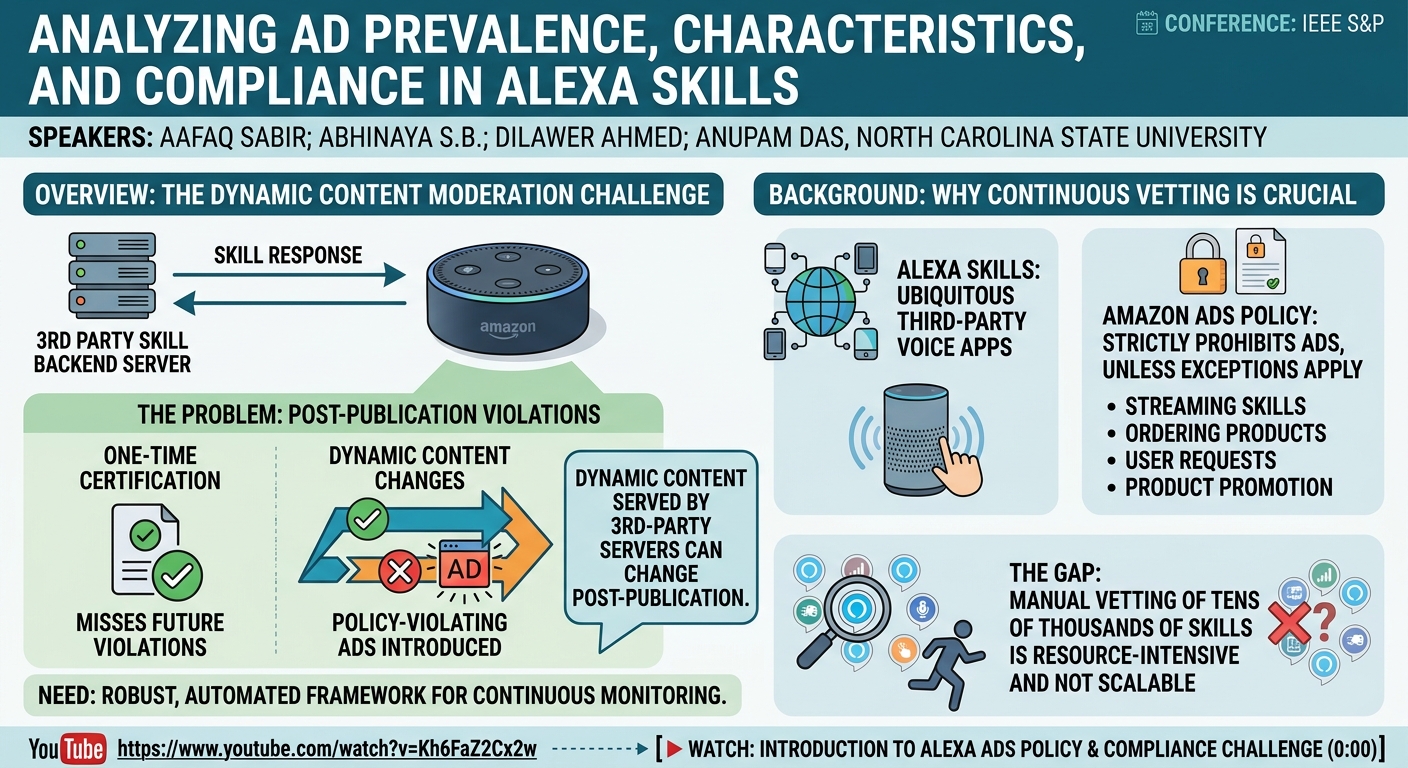
The proliferation of smart voice assistants like Amazon Alexa has opened new avenues for third-party applications, known as "skills." While these skills enhance functionality, they also introduce complex challenges related to content moderation and policy compliance, particularly concerning advertisements. This talk, presented by Aafaq Sabir from North Carolina State University, delves into the critical issue of ad prevalence, characteristics, and compliance within the Amazon Alexa skill ecosystem. The core problem addressed is the dynamic nature of content served by third-party skill backend servers, which can change post-publication, potentially introducing policy-violating advertisements that Amazon's initial certification process misses.
Key moments
- 0:00 Introduction to Alexa ads policy and compliance challenge
- 2:00 Dynamic content makes post-publication compliance difficult
- 2:50 Four key research questions addressed in the paper
- 3:20 Automated LLM-based ad detection and compliance framework
- 4:50 LLM performance and accuracy (GPT40, 88-94%)
- 5:25 Large-scale analysis: 11% ads, 29% policy violations
- 6:20 Example of policy-violating ad and bug bounty
- 7:00 Key contributions and open-sourcing code/datasets
Analyzing Ad Prevalence, Characteristics, and Compliance in Alexa Skills
Speakers: Aafaq Sabir; Abhinaya S.B.; Dilawer Ahmed; Anupam Das, North Carolina State University
Conference: IEEE S&P
YouTube: https://www.youtube.com/watch?v=Kh6FaZ2Cx2w
Overview
The proliferation of smart voice assistants like Amazon Alexa has opened new avenues for third-party applications, known as "skills." While these skills enhance functionality, they also introduce complex challenges related to content moderation and policy compliance, particularly concerning advertisements. This talk, presented by Aafaq Sabir from North Carolina State University, delves into the critical issue of ad prevalence, characteristics, and compliance within the Amazon Alexa skill ecosystem. The core problem addressed is the dynamic nature of content served by third-party skill backend servers, which can change post-publication, potentially introducing policy-violating advertisements that Amazon's initial certification process misses.
The research introduces an innovative, automated, and scalable framework designed to detect advertisements and verify their compliance with Alexa's stringent ad policies. By leveraging Large Language Models (LLMs), chain of thought prompting, and model fine-tuning, the framework offers a robust solution to continuously monitor skills for policy violations. This work is significant because it highlights a substantial gap in existing content moderation strategies for voice assistant platforms and demonstrates the practical applicability of advanced AI techniques in addressing real-world security and compliance challenges at scale. The findings reveal a considerable number of policy-violating advertisements, underscoring the urgent need for automated, post-publication vetting mechanisms.
Background
▶ Watch: Introduction to Alexa ads policy and compliance challenge (0:00)
Smart voice assistants have become ubiquitous, deeply integrated into smart speakers, car infotainment systems, and various IoT devices, with Amazon Alexa leading the market. A key feature of these platforms is the ability for third parties to develop and publish voice apps or skills, which extend the native functionality of the assistant. These skills are managed by their respective developers, who are also responsible for the content they deliver.
Amazon, like other platform providers, maintains a comprehensive set of policies governing the content allowed within skill responses. A particularly critical policy pertains to advertisements: Alexa generally does not permit ads within skill responses unless specific exception criteria are met. These exceptions include ads in streaming skills, skills facilitating product orders, responses to explicit user requests for promotions, or skills explicitly designed to promote a specific product or service. Violations of this policy can lead to skill suspension.
The challenge arises from the current vetting process. When a skill developer submits a skill for publication, it undergoes a certification process to ensure policy compliance. If violations are found, the skill is rejected. However, this vetting is primarily a one-time event at the point of publication. The fundamental flaw in this approach lies in the dynamic nature of third-party skill content. The actual content delivered by a skill often originates from a third-party server, which acts as a "black box" to the platform once the skill is published. There is no guarantee that content will remain compliant after initial certification. Dynamic content can easily become non-compliant over time, necessitating continuous and periodic vetting. Manually performing such widespread, ongoing checks across tens of thousands of skills is resource-intensive, impractical, and not scalable. This critical gap underscores the need for an automated and scalable vetting mechanism to ensure continuous compliance post-publication.
Against this backdrop, the researchers posed four key questions:
- How can advertisements be effectively detected within Alexa skill responses?
- What is the prevalence of advertisements in Alexa skills?
- What are the characteristics of promotional content found?
- What proportion of detected ads violate Alexa's policies?
Key Findings
▶ Watch: Four key research questions addressed in the paper (2:50)
The research involved a large-scale analysis of over 45,000 live Alexa skills, interacting with them using an automated tool to collect a substantial dataset of responses. This extensive analysis yielded several critical findings regarding the landscape of advertising within the Alexa skill ecosystem:
- Significant Ad Prevalence: Out of 83,000 unique skill responses collected, the framework identified that 11% of these responses contained some form of advertisement or promotional material. This indicates that ads are a non-trivial component of the user experience in a notable proportion of Alexa skill interactions.
- High Rate of Policy Violations: A substantial portion of the detected advertisements were found to be in violation of Alexa's ad policies. Specifically, the framework determined that approximately 29% of the identified promotional material potentially violates Alexa's ads policy. This highlights a significant compliance gap that is currently unaddressed by the platform's initial vetting process.
- Categorization of Violating Ad Intents: The policy-violating ads were categorized into four distinct types based on their promotional intent:
- Unrelated Product/Company Promotion: Skills promoting products or companies that had no discernible relation to the skill's stated purpose, its developer, or its core functionality. This category represents a clear deviation from the user's expected interaction with the skill.
- Mismatch with Skill Functionality: Advertisements that did not align with the primary function or purpose of the skill itself. For example, a skill designed for healthy recipes promoting an unrelated financial service.
- Promotion of External Websites/Media Platforms: Skills directing users to external websites, social media platforms, or other media channels, often without a clear functional link to the skill's primary utility.
- Cross-Promotion of Other Alexa Skills: Skills promoting other Alexa skills, which, depending on the context and explicit user request, might also fall outside the permitted exceptions for advertising.
These findings collectively paint a picture of an ecosystem where ad policies are frequently circumvented post-publication, creating a potentially negative user experience and raising questions about platform integrity.
Technical Deep Dive
▶ Watch: LLM performance and accuracy (GPT40, 88-94%) (4:50)
The researchers developed an automated and scalable ad detection and compliance verification framework to address the challenges of dynamic content vetting in Alexa skills. This framework leverages Large Language Models (LLMs) in a sophisticated two-step process, enhanced by chain of thought prompting and model fine-tuning, to achieve high accuracy in both identifying ads and assessing their policy compliance.
The overall pipeline of the framework is structured as follows:
- Data Collection and Ground Truth Creation:
- The first step involved collecting a substantial dataset of real-world skill interactions. The team utilized a specialized tool called Skill Detective for automated interaction with Alexa skills via Amazon's developer console. This tool enabled the collection of over 83,000 unique skill responses from more than 45,000 live skills on the Alexa skill store.
- A critical component was the creation of a ground truth dataset. A subset of these collected skill responses was manually labeled by human annotators to identify whether they contained advertisements and, if so, whether those ads complied with Alexa's policies. This ground truth served as both a benchmark for evaluating the LLMs and as a dataset for model fine-tuning.
- Two-Step LLM-based Analysis: The core of the framework is a two-phase LLM pipeline:
- Phase 1: Ad Detection:
- An LLM is employed to determine if a given skill response contains an advertisement. The researchers experimented with both open-source LLMs (such as Lava) and proprietary models (specifically GPT-4o from OpenAI). Their evaluation showed that GPT-4o consistently delivered the best performance.
- To optimize performance, the team utilized chain of thought prompting, a technique where the LLM is instructed to articulate its reasoning process step-by-step before arriving at a final decision. This not only improves accuracy but also provides valuable insights into why a particular decision was made.
- The LLM was further enhanced through model fine-tuning using a small chunk of the manually labeled ground truth data. This process allowed the LLM to learn specific patterns and nuances related to advertising within Alexa skill responses.
- The output of this phase is a binary classification (ad detected/not detected) along with the LLM's reasoning for that classification. The ad detection accuracy achieved was approximately 88%.
- Phase 2: Compliance Verification:
- If an advertisement is detected in Phase 1, the skill response is forwarded to the second phase, where another LLM (or the same LLM with a different prompt) is tasked with verifying its compliance with Alexa's ad policies.
- This LLM is provided with crucial contextual information:
- The specific Alexa ads policy guidelines.
- The skill's metadata, including developer information and the skill's official description. This context is vital for determining if an ad falls under any of the permissible exceptions (e.g., if the skill is designed to promote a specific product).
- The previous context from the ad detection phase, leveraging the chain of thought to maintain consistency and depth in reasoning.
- The output of this phase is a compliance verdict (compliant/non-compliant) along with the LLM's detailed reasoning. The compliance validation accuracy reached approximately 94%.
The empirical evaluation of prompts and subsequent fine-tuning were crucial for maximizing the performance of the LLMs. The combined high accuracy rates for both ad detection and compliance verification demonstrate the effectiveness of this LLM-centric approach for automated content moderation in dynamic, voice-based ecosystems. The framework's ability to provide reasoning for its decisions is particularly valuable, offering transparency and aiding in potential manual reviews or developer feedback loops.
Demo / Proof of Concept
▶ Watch: Large-scale analysis: 11% ads, 29% policy violations (5:25)
During the talk, the researchers provided a concrete example of a policy-violating advertisement detected by their framework, serving as a compelling proof of concept for their system's efficacy in real-world scenarios.
The example focused on a skill named "Healthy Cooking." As its name suggests, this skill is designed to narrate healthy cooking recipes to users, providing a utility-focused experience. However, the automated framework identified a clear violation: the "Healthy Cooking" skill was found to be promoting a company entirely unrelated to its core functionality, its developer, or the recipes it provides. The LLM's reasoning explicitly stated this mismatch, highlighting that the promotional content did not align with the skill's stated purpose or its associated entities.
This discovery was not merely an academic exercise; it represented a genuine policy violation in a live skill on the Alexa Skill Store. The researchers reported their findings to Amazon via their bug bounty platform, and their report was validated, leading to them winning a bug bounty. This successful bug bounty payout serves as strong external validation of the framework's ability to identify genuine security and compliance issues that Amazon's existing vetting processes had missed. It underscores the practical impact of their research and the immediate value their automated system could bring to platform security.
Defensive Implications
▶ Watch: Key contributions and open-sourcing code/datasets (7:00)
The findings from this research carry significant implications for both platform providers like Amazon and individual skill developers, highlighting critical areas for improved defense against policy violations, particularly concerning advertisements.
For Platform Providers (e.g., Amazon):
- Implement Automated Post-Publication Vetting: The most critical implication is the urgent need for platform providers to move beyond one-time certification. Amazon must implement robust, automated, and continuous monitoring systems for skills after they are published. The demonstrated success of the LLM-based framework provides a clear blueprint for how such a system could be deployed at scale. This would involve regularly interacting with live skills, collecting responses, and running them through a detection and compliance pipeline similar to the one proposed.
- Leverage Advanced AI for Content Moderation: The research unequivocally demonstrates the effectiveness of Large Language Models (LLMs), particularly when combined with techniques like chain of thought prompting and fine-tuning, for complex content moderation tasks. Platforms should invest in integrating such AI capabilities into their security and compliance workflows. LLMs can interpret context, policy nuances, and developer intent more effectively than traditional keyword-based or rule-based systems, which are easily circumvented by dynamic and evolving content.
- Enhance Policy Enforcement Mechanisms: Beyond detection, platforms need to streamline their enforcement mechanisms. When violations are detected by automated systems, there should be clear and efficient processes for notifying developers, requesting remediation, and if necessary, suspending non-compliant skills. The bug bounty success indicates that Amazon acknowledges these gaps, but a systemic solution is required.
- Transparency and Feedback Loops: While not explicitly discussed in the talk, an automated system could provide developers with more detailed and actionable feedback when their skills are flagged. The LLM's reasoning output could be invaluable in helping developers understand why their content is non-compliant, fostering quicker resolution and a more compliant ecosystem.
For Skill Developers:
- Understand and Adhere to Policies Continuously: Developers must not view policy compliance as a one-time hurdle during submission. They need to understand that the content delivered by their skill, especially dynamic content pulled from external servers, must always remain compliant with platform policies. This requires ongoing vigilance and internal checks.
- Scrutinize Dynamic Content Sources: If a skill pulls content from third-party APIs, ad networks, or other dynamic sources, developers must exercise extreme caution. They should ensure that these sources do not inadvertently introduce advertisements or promotional material that violates platform policies. Regular audits of content sources and their outputs are recommended.
- Design for Compliance: Developers should design their skills with compliance in mind, especially when it comes to any form of monetization or promotion. If an ad is intended, it must strictly adhere to the defined exceptions and be clearly distinguishable or contextually appropriate.
- Proactive Testing: Developers could consider implementing their own automated testing to simulate user interactions and detect potential policy violations before they are flagged by the platform. This proactive approach can prevent suspensions and maintain a good standing with the platform.
In essence, the research highlights that the "black box" nature of third-party skill content necessitates a paradigm shift from reactive, one-time vetting to proactive, continuous, and AI-driven monitoring to maintain the integrity and trustworthiness of voice assistant platforms.
Key Takeaways
- Automated Vetting is Crucial: The dynamic nature of third-party Alexa skill content renders one-time, manual certification insufficient. Automated, continuous vetting is essential to ensure ongoing policy compliance, especially regarding advertisements.
- LLMs are Effective for Ad Detection and Compliance: Large Language Models, particularly GPT-4o, combined with chain of thought prompting and model fine-tuning, demonstrate high accuracy (88% for ad detection, 94% for compliance verification) in identifying and assessing policy-violating advertisements in voice assistant responses.
- Significant Ad Prevalence and Policy Violations: A large-scale analysis of over 45,000 live Alexa skills revealed that 11% of skill responses contain promotional material, and a substantial 29% of these ads potentially violate Alexa's policies.
- Categorized Violation Types: Policy-violating ads were categorized into distinct intents, including promoting unrelated products/companies, mismatching skill functionality, directing to external media, and cross-promoting other skills, providing insights into common developer missteps or malicious activities.
- Real-World Impact and Validation: The framework successfully identified a policy-violating ad in a live "Healthy Cooking" skill and earned a bug bounty from Amazon, validating its practical utility and the existence of real-world vulnerabilities.
- Call for Platform Evolution: Platform providers like Amazon must adopt advanced AI-driven, post-publication monitoring systems to maintain platform integrity, protect user experience, and ensure continuous adherence to content policies.
About the Speaker(s)
Aafaq Sabir is a PhD student at North Carolina State University, where he conducts research under the advisement of Dr. Anupam Das. His work focuses on analyzing security and privacy aspects of emerging technologies, as demonstrated by this detailed study on advertisement prevalence and compliance in Amazon Alexa skills. The co-authors, Abhinaya S.B., Dilawer Ahmed, and Anupam Das, are also affiliated with North Carolina State University, contributing to the research presented.