Extended Diffie-Hellman Encryption for Secure and Efficient Real-Time Beacon Notifications
Liron David, Omer Berkman, Avinatan Hassidim, David Lazarov, Yossi Matias, Moti Yung
IEEE Symposium on Security and Privacy 2025 · Day 3 · Private and Secure Communication
Overview
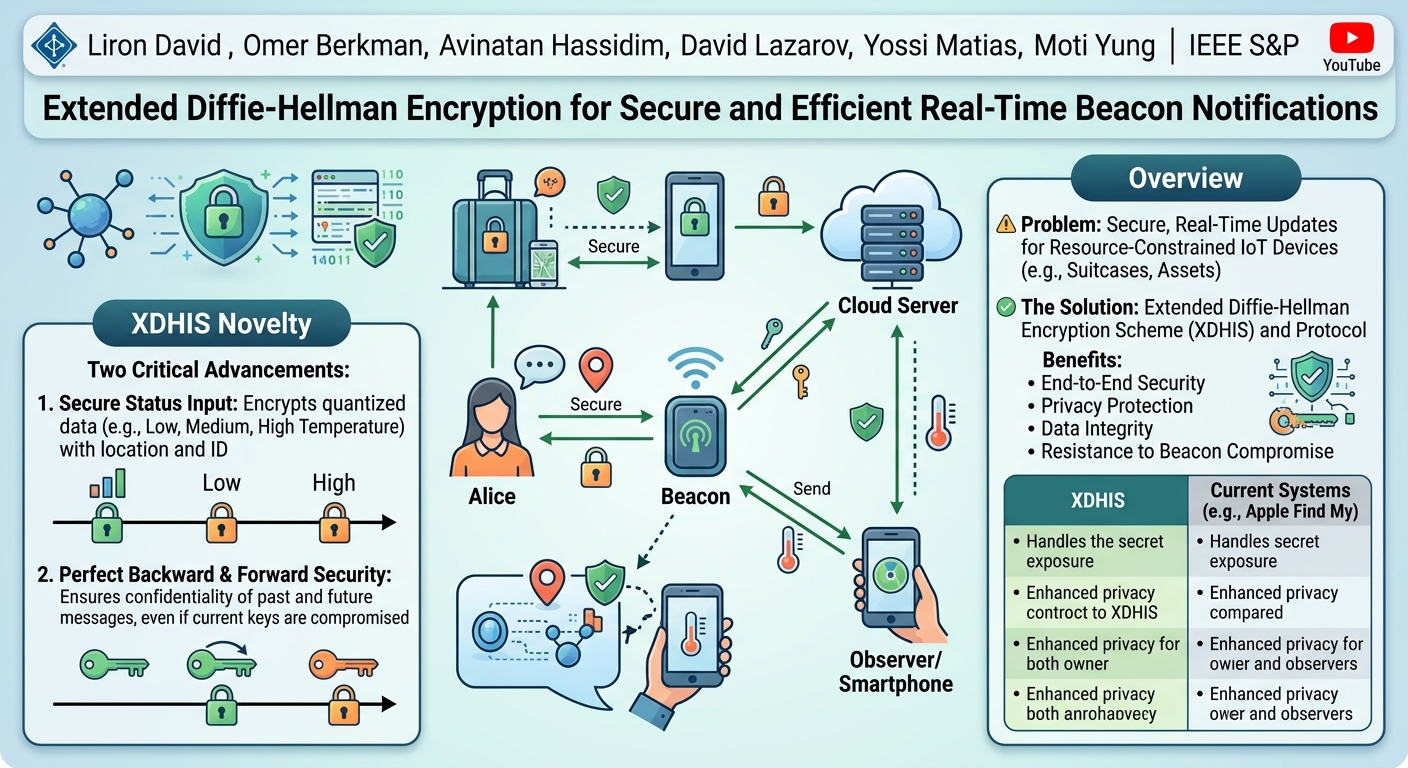
This article delves into a presentation by Liron David and collaborators at IEEE S&P, introducing a novel cryptographic protocol designed to address the complex security and efficiency challenges inherent in real-time beacon notifications for resource-constrained Internet of Things (IoT) devices. The talk, titled "Extended Diffie-Hellman Encryption for Secure and Efficient Real-Time Beacon Notifications," outlines a new cryptographic primitive called Extended Diffie-Hellman Encryption Scheme (XDHIS) and a subsequent protocol built upon it. The core problem tackled is how an owner, such as Alice, can receive secure, real-time updates about her possessions (e.g., a suitcase with no internet connection or GPS) from nearby observers, ensuring end-to-end security, privacy, and integrity, even if the beacon itself is physically compromised.
Key moments
- 0:00 Introduction and the beacon notification problem
- 1:30 Key security and system requirements
- 3:30 Limitations of existing PRDHIS protocols
- 4:00 Introducing XDHIS: supporting secure status input
- 4:50 XDHIS: perfect backward and forward security
- 6:00 Proposed beacon notification protocol flow and guarantees
- 7:00 Conclusion and summary of contributions
Extended Diffie-Hellman Encryption for Secure and Efficient Real-Time Beacon Notifications
Speakers: Liron David, Omer Berkman, Avinatan Hassidim, David Lazarov, Yossi Matias, Moti Yung
Conference: IEEE S&P
YouTube: https://www.youtube.com/watch?v=nCZ-MmlBVsk
Overview
This article delves into a presentation by Liron David and collaborators at IEEE S&P, introducing a novel cryptographic protocol designed to address the complex security and efficiency challenges inherent in real-time beacon notifications for resource-constrained Internet of Things (IoT) devices. The talk, titled "Extended Diffie-Hellman Encryption for Secure and Efficient Real-Time Beacon Notifications," outlines a new cryptographic primitive called Extended Diffie-Hellman Encryption Scheme (XDHIS) and a subsequent protocol built upon it. The core problem tackled is how an owner, such as Alice, can receive secure, real-time updates about her possessions (e.g., a suitcase with no internet connection or GPS) from nearby observers, ensuring end-to-end security, privacy, and integrity, even if the beacon itself is physically compromised.
The proposed XDHIS scheme significantly advances existing approaches by incorporating two critical features: secure status input and perfect backward and forward security. These capabilities are crucial for scenarios where beacons need to broadcast not only identifiers but also sensitive contextual data like temperature, while maintaining confidentiality over time. The research presents a rigorous solution to a prevalent IoT security problem, offering a robust framework that goes beyond the capabilities of current widely deployed systems like Apple's Find My protocol, particularly in its handling of secret exposure and privacy.
The work is highly relevant for the evolving landscape of IoT security, where countless devices operate without direct internet connectivity or robust processing power, yet handle data critical for asset tracking, environmental monitoring, and personal security. By formalizing the "beacon notification problem" and providing a provably secure cryptographic solution, the speakers offer a foundational contribution that could influence the design of future secure, low-power communication protocols, ensuring data integrity and user privacy in an increasingly interconnected, yet vulnerable, physical world.
Background
▶ Watch: Introduction and the beacon notification problem (0:00)
The "beacon notification problem" emerges from the need for owners to receive real-time, secure updates from their personal items that lack direct internet connectivity or GPS capabilities. A common illustrative scenario involves Alice, who owns a suitcase without an IP connection, yet desires notifications about its location and temperature. The temperature, for instance, might be crucial for contents sensitive to extreme conditions, requiring only a quantized status (e.g., low, medium, high) rather than precise readings. To facilitate this, Alice attaches a small, broadcasting device—a beacon—equipped with a temperature sensor.
These beacons are inherently resource-constrained: they lack IP connectivity, preventing direct communication with cloud servers, and do not possess GPS, necessitating reliance on external location data. The operational model involves observers, typically smartphones with IP and GPS capabilities, that happen to be in the beacon's vicinity. These observers detect the beacon's broadcast, piggyback their own GPS location data, and forward this aggregated information to a cloud server. Alice then retrieves notifications from this cloud server.
For such a system to be truly useful and trustworthy, several stringent security and privacy requirements must be met:
- End-to-End Security for Quantized Temperature: The temperature status, originating from the beacon, must remain confidential and verifiable all the way to Alice.
- End-to-End Security for Location: The observer's GPS location, which becomes the beacon's reported location, must also be securely transmitted from the observer to Alice.
- Perfect Backward and Forward Security: This is a critical requirement given that beacons often operate unsupervised and are susceptible to physical compromise. If a beacon's secret keys are exposed at some point, Alice must still be assured that all past and future location data remains confidential. This prevents an adversary who compromises a beacon today from decrypting messages from yesterday or tomorrow.
- Privacy: To prevent unauthorized tracking, beacon broadcasts must be pseudo-random and ephemeral, making it difficult for third parties to link broadcasts over time or identify specific beacons.
- Integrity: Observers should be able to verify the validity of beacon broadcasts before forwarding them, preventing the relay of spoofed or malicious data.
- Real-Time Communication: Alice needs to be notified as soon as data becomes available on the cloud server.
Crucially, all these requirements must be met while maintaining a short beacon broadcast length, as these devices often operate on limited power and bandwidth.
Prior to this work, the Apple Find My protocol was the primary solution achieving end-to-end secure beacon location tracking. Apple's protocol is built upon a cryptographic primitive referred to by the authors as Pseudo-Random Diffie-Hellman Encryption Scheme (PRDHIS). PRDHIS typically involves three algorithms:
- Key Generation: Uses a shared secret key
Xto generate an ephemeral private key and its corresponding public key. - Encryption: Encrypts a message
Musing this public key. - Decryption: Uses the shared secret
X(to derive the ephemeral private key) to decrypt the ciphertext.
However, the speakers highlight two significant limitations of PRDHIS that make it insufficient for the full beacon notification problem:
- Lack of Status Input Support: PRDHIS does not inherently support embedding a status input directly into the encryption scheme in a secure, efficient, and pseudo-random manner. This means it cannot guarantee end-to-end security for beacon-generated data like quantized temperature.
- Absence of Perfect Backward and Forward Security: In PRDHIS, if the shared secret key
Xis compromised, all ephemeral private keys derived from it can be reconstructed. Consequently, all messagesMencrypted with public keys generated from thatXbecome exposed, regardless of when they were transmitted. This vulnerability directly contradicts the need for perfect backward and forward security, leaving owners exposed if their beacon is compromised.
These limitations underscored the need for a more advanced cryptographic scheme, leading to the development of XDHIS.
Key Findings
▶ Watch: Limitations of existing PRDHIS protocols (3:30)
The central contribution of this research is the introduction of a novel cryptographic scheme, the Extended Diffie-Hellman Encryption Scheme (XDHIS), specifically designed to overcome the limitations of existing solutions like PRDHIS in the context of real-time beacon notifications. XDHIS addresses the complex security and privacy requirements of resource-constrained IoT devices by offering two primary, interdependent advancements: secure status input support and perfect backward and forward security.
Firstly, XDHIS introduces the capability to securely embed a status input (s) into the public key without increasing its size, while maintaining end-to-end security for this status and ensuring the public key remains pseudo-random. This is a critical innovation for beacons that need to convey contextual information, such as quantized temperature (e.g., low, medium, high). The scheme allows the status to be incorporated as an additional input to the pseudo-random function during key generation. Given that the number of distinct status messages is typically small, the encryption of this beacon status can be efficiently achieved either through brute-force enumeration or by maintaining a small lookup table. This ensures that the owner can securely receive and interpret the beacon's status directly from the public key, authenticated implicitly.
Secondly, and perhaps most significantly, XDHIS guarantees perfect backward and forward security for encrypted messages. This is a crucial defense against physical compromise of the beacon. The scheme achieves this by fundamentally separating the secrets required for the key generation algorithm from those needed for the decryption algorithm. Unlike PRDHIS, where a single shared secret X is used for both, XDHIS employs a more sophisticated key management strategy. Specifically, the decryption algorithm is provided with two random values, X and R. In contrast, the key generation algorithm (run by the beacon) is provided with X and G^R (where G is a generator for a cyclic group). Even if an adversary gains access to the beacon's key generation secrets (X and G^R), they cannot derive R. Without R, the adversary cannot reconstruct the private key necessary for decryption, thereby ensuring that all past and future messages encrypted using public keys derived from G^R remain confidential. This robust separation of secrets provides an unprecedented level of resilience against compromise for low-power IoT devices.
Building upon XDHIS, the speakers propose a new beacon notification protocol. This protocol leverages the unique properties of XDHIS to ensure efficient real-time communication, integrity for the public keys used by observers, end-to-end security for the beacon's quantized temperature, and end-to-end security for any past or future observer's location, even if the beacon's secrets are compromised. Furthermore, the protocol ensures pseudo-random and ephemeral beacon broadcasts, enhancing privacy by preventing unauthorized tracking. The paper provides formal proofs demonstrating that this resulting protocol successfully achieves all the formalized security, privacy, and integrity requirements.
Technical Deep Dive
▶ Watch: Introducing XDHIS: supporting secure status input (4:00)
To understand XDHIS, it's helpful to first review the foundational principles of Diffie-Hellman Key Exchange and how it's adapted for encryption schemes like PRDHIS, and then see how XDHIS extends it.
At its core, Diffie-Hellman (DH) is a method for two parties to establish a shared secret over an insecure communication channel. It relies on the mathematical difficulty of computing discrete logarithms. In a group G with generator g, if Alice chooses a secret a and sends g^a (mod p) to Bob, and Bob chooses a secret b and sends g^b (mod p) to Alice, they can both compute the shared secret (g^b)^a = (g^a)^b = g^(ab) (mod p). An eavesdropper sees g^a and g^b but cannot easily compute g^(ab).
Pseudo-Random Diffie-Hellman Encryption Scheme (PRDHIS), as a precursor, adapts this for encryption. It can be conceptualized as follows:
- Shared Secret: Both the key generator (e.g., beacon) and the decryptor (e.g., owner) possess a shared secret
X. - Key Generation (Beacon): The beacon uses
Xand a pseudo-random function (PRF) to deterministically generate an ephemeral private keysk_e. Fromsk_e, it derives a corresponding ephemeral public keypk_e = g^(sk_e). - Encryption (Observer): An observer, receiving
pk_e, uses it to encrypt a messageM. This might involve deriving a shared secretK = (pk_e)^X(or similar DH-derived key) and using a symmetric cipher. - Decryption (Owner): The owner uses their shared secret
Xto re-derivesk_e(via the same PRF) and then decrypts the messageMusingsk_e.
The critical vulnerability in PRDHIS lies in the single shared secret X. If X is compromised, an adversary can perform the same key generation process as the beacon, deriving any sk_e that has ever been or will be generated, thereby decrypting all past and future messages.
Extended Diffie-Hellman Encryption Scheme (XDHIS) addresses these limitations with two key innovations:
- Secure Status Input (s) Embedding:
XDHIS allows a small, quantized status s (e.g., temperature categories) to be securely integrated into the public key. The mechanism involves incorporating s as an additional input to the pseudo-random function that generates the ephemeral keys.
- Instead of just
PRF(X, nonce)for key generation, it becomesPRF(X, nonce, s). - The public key
PKis then derived from the output of this modified PRF. - The crucial aspect is that the public key size does not increase, and it still appears pseudo-random to an external observer, preventing easy inference of
s. - For the owner to decrypt and retrieve
s, they might perform a brute-force check over the small set of possible status values. For example, ifscan below,medium, orhigh, the owner would attempt to decrypt using keys generated for each status until a valid decryption is achieved. This is feasible because the status space is deliberately small. This design ensures end-to-end security forsfrom the beacon to Alice.
- Perfect Backward and Forward Security:
This is achieved by decoupling the secrets used for key generation from those used for decryption.
- Owner's Secrets (for Decryption): Alice holds two truly random values:
XandR.Racts as a master ephemeral private key, andXis a long-term secret. - Beacon's Secrets (for Key Generation): The beacon is provided with
XandG^R. Crucially, the beacon does not possessR. - Key Generation Process (Beacon):
- The beacon uses
XandG^R(along with a nonce and the statussif applicable) to generate an ephemeral public keyPK. The exact mathematical construction is more complex but relies on the properties of DH. One way to conceptualize this is thatG^Racts as a public component that allows the beacon, combined withX, to derive a new, ephemeral public keyPKwithout ever knowing the discrete logarithmR. - The generated
PKis broadcast.
- Encryption Process (Observer): An observer in the beacon's vicinity encrypts its data (e.g., GPS location
M) using the receivedPK. This typically involves deriving a shared symmetric key fromPKand the observer's own ephemeral private key, then encryptingMwith this shared key. - Decryption Process (Owner): Alice, possessing
XandR, can use these to re-derive the corresponding ephemeral private key forPKand decrypt the messageMand extracts. The key insight is thatRis essential for this decryption.
Why this provides perfect backward and forward security:
If an adversary compromises the beacon, they will obtain X and G^R. However, because R is a large random number and G^R is its public representation, computing R from G^R is the discrete logarithm problem, which is computationally infeasible. Without R, the adversary cannot reconstruct the ephemeral private keys corresponding to any PK generated by the beacon. This means:
- Forward Security: Future messages encrypted with new
PKs generated by the beacon (usingXandG^R) cannot be decrypted by the adversary because they still lackR. - Backward Security: Past messages encrypted with
PKs generated before the compromise also remain secure, asRwas never exposed to the beacon (and thus not to the adversary).
This separation ensures that even a full compromise of the beacon's secrets only reveals X and G^R, not the decryption capability, thereby providing robust long-term confidentiality.
The XDHIS-based Beacon Notification Protocol Flow:
- Beacon Action: The beacon, using its secrets (
X,G^R, and optionallys), runs the XDHIS key generation algorithm. It computes and broadcasts a unique public key (PK). ThisPKis pseudo-random and ephemeral, ensuring privacy. - Observer Action: An observer detecting the
PKvalidates its integrity (e.g., by checking cryptographic properties or a signature). If valid, the observer encrypts its messageM(e.g., GPS location) using thePKvia the XDHIS encryption algorithm. The resulting secure data (ciphertext) is then forwarded, along with the observer's own metadata, to the cloud server. - Cloud Server Action: The cloud server acts as a relay, simply forwarding the received secure data to the designated owner (Alice). It does not need to decrypt or understand the content, thus minimizing its trust requirements.
- Owner Action: Alice, upon receiving the secure data, runs the XDHIS decryption algorithm using her master secrets (
X,R). This allows her to decrypt the messageM(observer's location) and simultaneously extract the embedded statuss(beacon's temperature).
This protocol guarantees efficient real-time communication by leveraging existing observer networks and cloud infrastructure, while its cryptographic underpinnings provide integrity for the public key (observers can verify it), end-to-end security for both the beacon's quantized temperature (via s in PK) and the observer's location (M), and ensures privacy through pseudo-random, ephemeral broadcasts. The formal proofs presented in the paper validate that this architecture truly achieves all the stated requirements.
Demo / Proof of Concept
▶ Watch: Proposed beacon notification protocol flow and guarantees (6:00)
The conference talk focused primarily on the theoretical framework, cryptographic definitions, and formal proofs of the proposed XDHIS scheme and its associated beacon notification protocol. While the presentation detailed the algorithmic components and their security guarantees, it did not include a live demonstration or a specific discussion of a proof-of-concept implementation. The speakers indicated that further technical details and proofs are provided in the full paper.
Defensive Implications
▶ Watch: Conclusion and summary of contributions (7:00)
The introduction of XDHIS and its accompanying protocol offers profound defensive implications for individuals, organizations, and the broader IoT ecosystem, particularly concerning the security and privacy of resource-constrained devices.
For owners like Alice, the primary beneficiary, the protocol provides an unprecedented level of assurance. The end-to-end security for quantized temperature originating from the beacon means that critical environmental data (e.g., "low battery," "high temperature") can be securely transmitted and received without risk of interception or tampering by intermediate parties, including the observer or the cloud server. This is vital for monitoring sensitive items or conditions where data integrity is paramount. Similarly, the end-to-end security for observer-provided location ensures that Alice receives confidential location updates, protecting her privacy against unauthorized tracking or surveillance by malicious actors who might compromise observers or cloud infrastructure.
The most significant defensive gain is perfect backward and forward security. This feature fundamentally changes the risk landscape for IoT beacons. In a world where physical access to devices is often unavoidable, the threat of device compromise is ever-present. With XDHIS, even if an adversary physically compromises a beacon and extracts its secrets (X and G^R), they are unable to decrypt any past or future location data. This prevents the adversary from building a historical tracking profile of the beacon or monitoring its movements going forward. This resilience against compromise is a critical advancement, mitigating a common and severe vulnerability in existing IoT tracking solutions.
Privacy is also significantly enhanced. The requirement for pseudo-random and ephemeral beacon broadcasts ensures that beacons do not emit static, identifiable signals. This makes it exceedingly difficult for unauthorized third parties to track a beacon's movements over time or link multiple broadcasts to the same device, thereby protecting the owner's privacy and preventing widespread surveillance.
For observers, the protocol incorporates integrity checks for public keys. This means an observer can verify if a beacon's broadcast is legitimate and valid before expending resources to encrypt and forward data. This helps prevent observers from being unwitting participants in relaying spoofed or malicious beacon signals, contributing to the overall health and trustworthiness of the network.
From an IoT ecosystem perspective, XDHIS provides a robust cryptographic primitive tailored for the unique constraints of low-power, non-IP devices. It establishes a new benchmark for security in such environments, demonstrating that strong cryptographic guarantees, including perfect forward secrecy, are achievable even with limited computational and communication resources. This work encourages developers and manufacturers to adopt more secure designs for their IoT products, moving beyond solutions that might sacrifice security for simplicity or efficiency. It offers a blueprint for building more resilient and privacy-respecting IoT applications, particularly in areas like asset tracking, supply chain monitoring, and personal safety devices. The formal proofs of security provide a high degree of confidence in the protocol's ability to withstand various attacks, making it a strong candidate for standardization and widespread adoption.
Key Takeaways
- XDHIS Addresses Critical IoT Security Gaps: The Extended Diffie-Hellman Encryption Scheme (XDHIS) provides a novel cryptographic solution for secure and efficient real-time notifications from resource-constrained IoT beacons lacking internet or GPS connectivity.
- Secure Status Embedding: XDHIS uniquely supports embedding a small, quantized status (e.g., temperature) directly into the public key without increasing its size, guaranteeing end-to-end security for this beacon-generated information.
- Perfect Backward and Forward Security: The scheme ensures that even if a beacon's secrets are physically compromised, an adversary cannot decrypt any past or future messages, a critical feature for long-term data confidentiality.
- Decoupled Secrets for Enhanced Security: Perfect backward and forward security is achieved by separating the secrets required for key generation (beacon:
X,G^R) from those needed for decryption (owner:X,R), preventing an adversary from derivingRfrom compromised beacon secrets. - Comprehensive End-to-End Protection: The proposed protocol built on XDHIS guarantees end-to-end security for both beacon-generated status (e.g., temperature) and observer-generated location data, along with privacy through pseudo-random, ephemeral broadcasts, and integrity verification.
- Advancement Over Existing Solutions: XDHIS significantly improves upon existing protocols like Apple's Find My (based on PRDHIS) by addressing its limitations in status input support and the lack of perfect backward and forward security, setting a new standard for IoT device security.
About the Speaker(s)
The talk was presented by Liron David, and the paper was co-authored by Omer Berkman, Avinatan Hassidim, David Lazarov, Yossi Matias, and Moti Yung. Their affiliations are not explicitly stated in the provided transcript, but their collaboration on this work indicates a strong background in cryptography, security, and distributed systems, likely within academic or industrial research settings given the IEEE S&P conference context.