Homeland Security in the Age of Artificial Intelligence
RSA Conference 2024 · South Stage Keynote
Overview
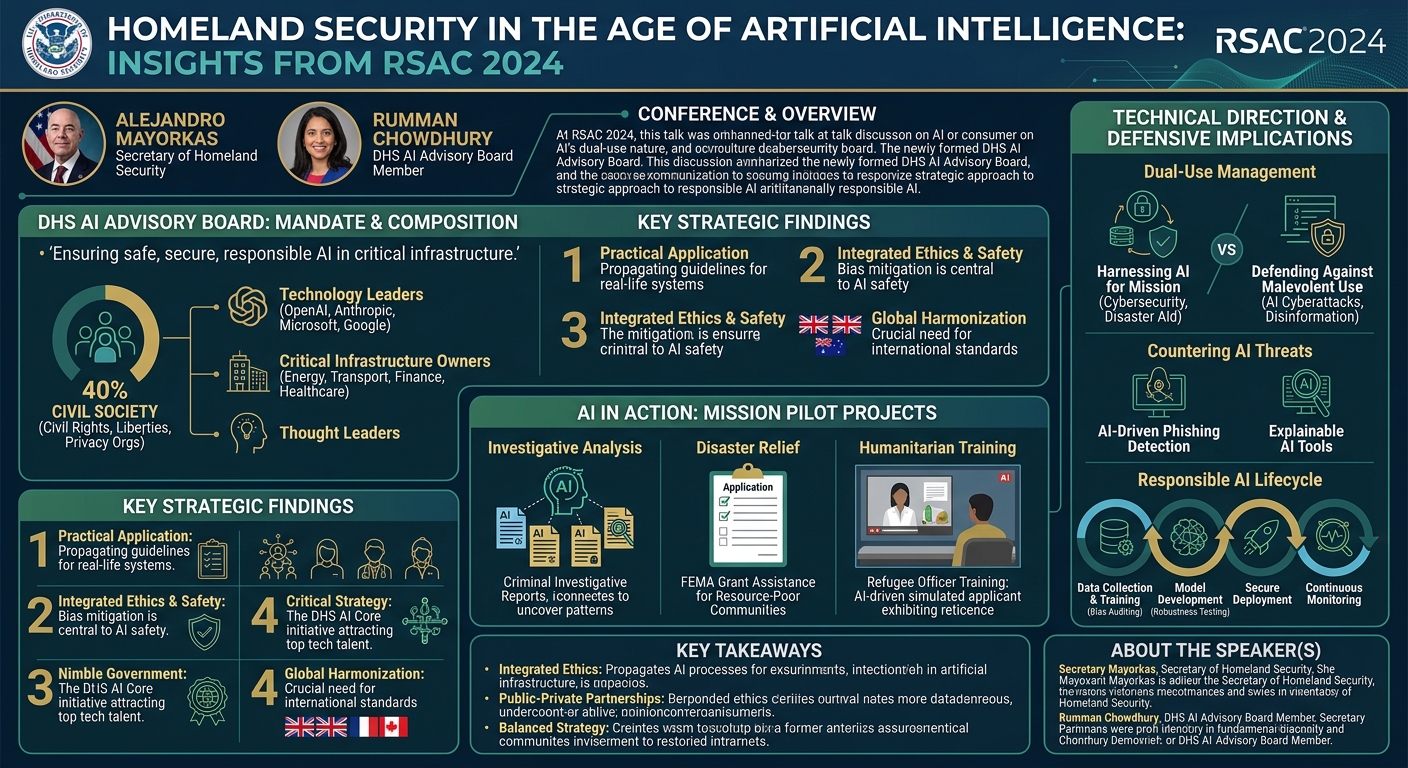
This talk features an insightful discussion between Secretary of Homeland Security Alejandro Mayorkas and Rumman Chowdhury, a member of the newly formed DHS AI Advisory Board, on the profound implications of artificial intelligence for national security. The conversation, held at RSAC 2024, delves into the dual-use nature of AI—its immense potential for both advancing critical missions and posing significant threats to national infrastructure and civil liberties. Secretary Mayorkas articulates the Department of Homeland Security's (DHS) strategic approach to harnessing AI responsibly, defending against its malicious use, and fostering a nimble, dynamic government posture in this rapidly evolving technological landscape.
Key moments
- 2:00 AI Advisory Board's mandate: critical infrastructure security
- 3:30 Defining 'safe' AI: includes civil rights and liberties
- 4:00 Balancing AI security with privacy and implicit bias
- 4:50 Diverse composition of the AI Advisory Board
- 6:00 Board's focus: practical guidelines and national AI plan
- 6:40 Introduction to the DHS AI Corps initiative
- 7:30 The unique impact and rewards of public service in AI
Homeland Security in the Age of Artificial Intelligence
Speakers: Alejandro Mayorkas, Secretary of Homeland Security; Rumman Chowdhury, Member of the DHS AI Advisory Board
Conference: RSAC 2024
YouTube: https://www.youtube.com/watch?v=1vN8Hz-WmHs
Overview
This talk features an insightful discussion between Secretary of Homeland Security Alejandro Mayorkas and Rumman Chowdhury, a member of the newly formed DHS AI Advisory Board, on the profound implications of artificial intelligence for national security. The conversation, held at RSAC 2024, delves into the dual-use nature of AI—its immense potential for both advancing critical missions and posing significant threats to national infrastructure and civil liberties. Secretary Mayorkas articulates the Department of Homeland Security's (DHS) strategic approach to harnessing AI responsibly, defending against its malicious use, and fostering a nimble, dynamic government posture in this rapidly evolving technological landscape.
The core of the discussion revolves around the DHS AI Advisory Board, commissioned by the President's AI executive order, which is tasked with ensuring the safe, secure, and responsible implementation of AI within the nation's critical infrastructure. The talk highlights the board's diverse composition, including leaders from technology, civil society, and critical infrastructure sectors, emphasizing a holistic approach that balances security imperatives with privacy and civil rights considerations. Secretary Mayorkas underscores the urgency of developing practical guidelines and a national plan for AI governance, positioning DHS at the forefront of this crucial endeavor.
The significance of this talk lies in its direct address of the challenges and opportunities presented by AI from the highest levels of U.S. homeland security. It offers a rare glimpse into the government's proactive efforts to understand, regulate, and deploy AI, not just as a tool for enforcement but also for humanitarian aid and disaster response. By emphasizing public-private partnerships, international harmonization, and talent recruitment through initiatives like the AI Core, DHS aims to navigate the complexities of AI, ensuring it serves to strengthen national security while upholding foundational democratic values.
Background
▶ Watch: AI Advisory Board's mandate: critical infrastructure security (2:00)
The proliferation of Artificial Intelligence (AI) has introduced a new paradigm for national security, presenting both unprecedented opportunities and significant risks. Recognizing this transformative potential, the U.S. government, under a Presidential AI executive order, established the DHS AI Advisory Board. This board is specifically tasked with focusing on the safe, secure, and responsible implementation of AI within the nation's critical infrastructure—the systems and services upon which Americans rely daily, spanning sectors from energy and transportation to finance and healthcare.
Prior to the formalization of the AI Advisory Board, DHS had already laid foundational groundwork for considering ethical and societal impacts of technology. The department boasts statutorily created Offices of Civil Rights, Civil Liberties, and Privacy, reflecting an institutional commitment to these interests. This existing framework provides a crucial lens through which AI's development and deployment are evaluated, particularly regarding issues such as implicit bias and the potential for disproportionate surveillance or impact on marginalized communities.
The problem AI presents is inherently complex due to its dual-use nature. As Secretary Mayorkas explains, AI can be a powerful tool for advancing cybersecurity and various DHS missions, but it can equally be exploited by malevolent actors for sophisticated attacks or harmful purposes. This duality necessitates a balanced approach: one that harnesses AI's capabilities for defense and public good while simultaneously developing robust strategies to guard against its misuse and unintended consequences. The challenge is compounded by the rapid pace of AI innovation, which often outstrips traditional regulatory and policy development cycles, creating an urgent need for agile and informed governance.
Furthermore, the talk implicitly draws upon the broader context of evolving cybersecurity threats, where agencies like CISA (Cybersecurity and Infrastructure Security Agency) have been instrumental. CISA's work, including initiatives like the Joint Cyber Defense Collaborative (JCDC) and the "Shields Up" campaign, has emphasized public-private partnerships and international collaboration in securing digital environments. These precedents inform DHS's current approach to AI, recognizing that effective governance and defense in the age of AI require a concerted effort across government, industry, civil society, and international partners. The experiences from CISA's efforts, such as supporting Ukraine's cyber resilience, underscore the importance of robust, inclusive security communities in confronting emerging threats.
Key Findings
▶ Watch: Balancing AI security with privacy and implicit bias (4:00)
The discussion at RSAC 2024 revealed several critical findings and strategic directions from the Department of Homeland Security regarding AI:
- DHS AI Advisory Board's Mandate: The newly formed AI Advisory Board, established under the President's AI executive order, is explicitly focused on the safe, secure, and responsible implementation of AI in the nation's critical infrastructure. Its primary objective is to move beyond theoretical discussions to the practical application of AI, with the goal of propagating concrete guidelines that have real-life implications for essential systems and services. This hands-on approach aims to develop a comprehensive national plan for AI integration.
- Diverse and Action-Oriented Board Composition: Secretary Mayorkas highlighted the board's uniquely broad and inclusive membership, designed to foster robust and honest dialogue. The board comprises luminaries from technology (including companies like OpenAI, Anthropic, Microsoft, and Google), critical infrastructure owners and operators (such. as Northrop Grumman, Occidental Petroleum, and Delta Airlines), civil rights and civil liberties organizations (with prominent leaders like Maya Wiley, Damon Williams, Nicole Turner Lee, and Alex Gibbons), and other thought leaders. Notably, 40% of the membership is drawn from civil society, underscoring DHS's commitment to integrating ethical and societal considerations directly into AI governance. The board's work is not merely advisory; it is intended to produce tangible output, meeting quarterly and conversing daily to drive progress.
- Integration of Civil Rights and Safety: A pivotal finding from the board's initial discussions is the articulation that civil liberties and civil rights implications are an integral part of AI safety. The board rejects the notion that the safe implementation of AI can disregard the potential for perpetuating issues like implicit bias. This perspective fundamentally reframes the concept of AI safety, embedding ethical considerations directly within technical and operational guidelines.
- DHS AI Core Initiative for Talent Recruitment: DHS is actively working to prove that government can be as nimble and dynamic as the private sector, particularly in the AI domain. To achieve this, the department has launched the AI Core, an initiative focused on recruiting top talent. Despite not competing on monetary compensation, DHS emphasizes the unique, impactful compensation of public service—the opportunity to make decisions that affect millions of lives and contribute to a greater mission. This initiative has already garnered thousands of applications, indicating a significant interest among tech professionals in government roles.
- Vision for DHS's AI Future: Secretary Mayorkas shared an ambitious vision for DHS within the next five years: to be perceived by the public and industry as a leader in leveraging AI to advance its mission, thereby redefining the perception of government from "slothful and labyrinthian" to nimble, dynamic, and pioneering. This forward-looking goal reflects a strategic intent to integrate AI deeply and effectively across the department's diverse operations.
- Critical Need for International Harmonization: The talk stressed the absolute necessity for harmonization of standards, regulations, and terminology in AI governance on a global scale. This is not exclusive to AI but extends to cybersecurity reporting regimes as well. The DHS AI Advisory Board, given its diverse membership, is seen as having a significant role in driving this international harmonization, working closely with international partners, especially the Five Eyes alliance, to foster interoperability and a unified global narrative on AI governance.
Technical Deep Dive
▶ Watch: Diverse composition of the AI Advisory Board (4:50)
While the talk primarily focused on policy, strategy, and governance rather than intricate algorithmic details or code, it provided a clear strategic technical direction for DHS's engagement with AI. The technical deep dive here will elaborate on the types of AI applications and the foundational principles guiding their implementation within the Department of Homeland Security.
DHS's approach to AI is characterized by its recognition of AI as a dual-use technology. This means that the same underlying AI capabilities can be leveraged for both beneficial and malicious purposes. Consequently, DHS is developing capabilities to harness AI for its mission objectives while simultaneously building defenses against its malevolent use and mitigating unintended consequences.
On the offensive (mission-advancing) side, DHS is exploring and implementing AI across a spectrum of critical operations:
- Cybersecurity Enhancement: AI is being harnessed to advance the department's existing cybersecurity efforts. This likely involves using AI for threat detection, anomaly identification, predictive analytics for attack vectors, and automated response mechanisms within critical infrastructure. The goal is to leverage AI's processing power to analyze vast datasets of network traffic and system logs, identifying patterns indicative of sophisticated cyber threats that human analysts might miss.
- Refugee Programs and Disaster Relief: AI is applied in humanitarian contexts to ensure efficiency and equity. In refugee programs, AI can assist in processing applications, identifying vulnerable populations, and streamlining support. For disaster relief, AI tools can help resource-poor, target-rich communities navigate complex grant application processes, ensuring they are not disenfranchised due to lack of resources or expertise. This involves AI-driven intelligent forms, natural language processing for document analysis, and potentially geospatial AI for resource allocation.
- Combating Online Child Sexual Exploitation and Abuse (OCSEA): This is a particularly impactful application where AI demonstrates its unique capabilities. Secretary Mayorkas cited a compelling example: using AI to perform age progression on photographs of child victims. If a child was last seen at age seven and images of their exploitation surface years later, AI can extrapolate what that child would look like at, say, age fifteen. The precision of such AI-generated extrapolations can be instrumental in identifying, locating, and rescuing victims, showcasing AI's potential in critical law enforcement investigations.
On the defensive side, the technical focus is on building resilience against AI-driven threats and ensuring responsible deployment:
- Defense Against Malicious AI: DHS, through offices like the Office of Strategy, Policy and Plans, CISA, and the Office of Science and Technology, is actively developing and advancing defenses against the malicious use of AI. This includes anticipating AI-powered cyberattacks (e.g., AI-driven phishing, autonomous malware), disinformation campaigns leveraging generative AI, and other emerging threats. The technical work here would involve developing AI safety mechanisms, AI explainability tools, and AI-powered threat intelligence systems capable of detecting and neutralizing AI-generated attacks.
- Guarding Against Unintended Consequences: A significant technical and ethical challenge is preventing unintended consequences, particularly the perpetuation of implicit bias. This requires rigorous AI model auditing, bias detection algorithms, and fairness metrics throughout the AI development lifecycle. The goal is to ensure that AI systems deployed by DHS do not inadvertently discriminate or disadvantage specific communities. This extends to the careful design of data collection, model training, and decision-making processes to embed civil rights and civil liberties considerations from the outset.
- Open Source AI: DHS acknowledges the dual nature of open source AI. While recognizing its potential as an enabler for malicious actors, the department also sees the open-source community as a vital force for defense and innovation. Many companies on the AI Advisory Board leverage open source. Therefore, DHS's technical strategy involves actively participating in and leveraging open-source developments while simultaneously dedicating resources to mitigate the downsides, such as identifying vulnerabilities in open-source models or frameworks that could be exploited.
In essence, the technical strategy articulated by DHS is not about specific algorithms but about creating a robust framework for AI lifecycle management—from responsible development and rigorous testing to secure deployment and continuous monitoring—all while maintaining a proactive stance against evolving threats and upholding societal values.
Demo / Proof of Concept
▶ Watch: Introduction to the DHS AI Corps initiative (6:40)
While the talk did not feature live demonstrations or detailed proofs of concept in the traditional sense, Secretary Mayorkas outlined three pilot projects currently underway at DHS that exemplify the practical application of AI in their mission:
- Criminal Investigative Reports Analysis: One pilot project involves ingesting criminal investigative reports from various Homeland Security investigations into a central database. Historically, different task forces (e.g., a narcotics case on the West Coast and an international money laundering scheme on the East Coast) might operate without perceiving any connectivity between their cases. AI is being used to analyze these vast datasets of reports to identify hidden connections and patterns that human investigators would otherwise miss. This capability enhances intelligence gathering, allows for the uncovering of broader criminal networks, and improves the efficiency of investigations by connecting seemingly disparate activities. This represents a significant leap in investigative capabilities, moving beyond siloed information to a more holistic, AI-assisted understanding of criminal operations.
- FEMA Grant Application Assistance: Another pilot project is being implemented at the Federal Emergency Management Agency (FEMA). This initiative leverages AI to assist resource-poor, target-rich communities in the complex process of applying for FEMA grants. These communities often lack the administrative capacity, legal expertise, or personnel to navigate intricate government grant applications effectively, leading to disenfranchisement. AI-powered tools are designed to streamline this process, potentially by simplifying forms, providing guidance, or even auto-filling sections based on available data, ensuring that aid reaches those who need it most without bureaucratic hurdles. This directly addresses equity in disaster recovery and resilience efforts.
- Refugee Officer Training Simulation: A fascinating pilot project focuses on training refugee officers. DHS is using AI to create a machine that has been trained to act as a refugee applicant for training purposes. This AI simulation replicates not only the substantive answers a refugee applicant might provide but also their stylistic responses. Crucially, the machine is trained to exhibit the reticence often displayed by individuals who have experienced trauma, making the training scenario more realistic. This allows refugee officers in training to practice their interviewing skills, learn to navigate sensitive conversations, and develop empathy in a controlled, safe environment before interacting with real applicants. This innovative application enhances the preparedness and effectiveness of officers dealing with highly sensitive and emotionally charged situations.
These pilot projects demonstrate DHS's tangible efforts to integrate AI into its operations, moving from conceptual discussions to real-world applications that enhance law enforcement, improve humanitarian aid delivery, and refine personnel training, all while navigating the complexities of AI's capabilities and ethical considerations.
Defensive Implications
▶ Watch: The unique impact and rewards of public service in AI (7:30)
The Department of Homeland Security's proactive engagement with AI, as articulated by Secretary Mayorkas, carries several crucial defensive implications for organizations, governments, and individuals in the cybersecurity landscape.
- Proactive AI Governance and Guidelines: The establishment of the DHS AI Advisory Board signals a clear governmental intent to develop and enforce AI governance frameworks. Defenders should anticipate future guidelines, standards, and potentially regulations concerning the safe and secure implementation of AI, especially within critical infrastructure. Organizations should proactively engage with these emerging frameworks, participate in their development where possible, and begin assessing their internal AI systems against potential future compliance requirements. This includes evaluating AI models for bias, transparency, and robustness against adversarial attacks.
- Addressing AI's Dual-Use Threat: The recognition of AI as a dual-use technology means that malicious actors will undoubtedly leverage AI for more sophisticated and scalable attacks. Defenders must evolve their strategies to counter AI-powered cyber threats, such as advanced phishing, autonomous malware, and deepfake-driven social engineering. This necessitates investing in AI-driven security tools for threat detection, anomaly analysis, and automated response. Furthermore, understanding the capabilities of generative AI is critical for identifying and mitigating the spread of AI-generated disinformation and propaganda that could undermine public trust or incite unrest.
- Prioritizing Ethical AI and Bias Mitigation: DHS's emphasis on integrating civil liberties and civil rights implications directly into the definition of AI safety is a significant defensive posture. For organizations deploying AI, this means that merely achieving operational efficiency is insufficient; ensuring fairness, accountability, and transparency (FAT) in AI systems is paramount. Defenders must implement robust processes for AI ethics auditing, bias detection, and mitigation strategies to prevent unintended harm or discrimination, which can lead to legal, reputational, and social consequences. The conversation highlights that ignoring implicit bias perpetuates unsafe AI.
- Investing in Human Capital and AI Literacy: The DHS AI Core initiative underscores the critical need for AI talent within security organizations. Defenders should prioritize upskilling their workforce in AI fundamentals, machine learning operations (MLOps), and AI security. Developing internal expertise will be crucial for both effectively deploying AI defensively and understanding the mechanisms of AI-driven attacks. This includes fostering a culture of continuous learning and interdisciplinary collaboration between AI specialists, cybersecurity experts, and legal/ethical advisors.
- Strengthening Public-Private Partnerships: The diverse composition of the AI Advisory Board, including critical infrastructure owners and tech companies, reinforces the importance of public-private partnerships in AI security. Defenders in the private sector should actively seek collaboration with government agencies like DHS and CISA to share threat intelligence, best practices, and contribute to the development of national AI security strategies. This collective defense approach, mirroring CISA's JCDC model, is essential for addressing complex, cross-sector AI challenges.
- Harmonization of International Standards: The call for international harmonization of AI standards and regulations has direct defensive implications. Organizations operating globally will benefit from, and indeed require, consistent frameworks across jurisdictions. Defenders should advocate for and contribute to the development of such harmonized standards, as a fragmented regulatory landscape can create vulnerabilities and hinder effective global defense against AI threats. Engaging with international bodies and alliances like the Five Eyes, as DHS does, can help shape a more secure global AI ecosystem.
In summary, the defensive implications require a multi-faceted approach: proactive engagement with evolving governance, advanced technical capabilities to counter AI threats, a deep commitment to ethical AI, continuous investment in human talent, robust public-private collaboration, and a push for international regulatory alignment.
Key Takeaways
- Holistic AI Governance: DHS is actively shaping AI governance through its AI Advisory Board, focusing on the safe, secure, and responsible implementation of AI within critical infrastructure, with a strong emphasis on practical application and guideline development.
- Integrated Ethics and Safety: The department firmly believes that civil liberties and civil rights implications, including the prevention of implicit bias, are fundamental components of AI safety, not separate considerations.
- Government as a Nimble Innovator: DHS is committed to demonstrating that government can be dynamic and innovative in AI adoption, actively recruiting top talent through its AI Core by emphasizing the profound impact of public service.
- AI for Diverse Missions: AI is being leveraged across DHS's broad mandate, from enhancing cybersecurity and fighting online child exploitation (e.g., age progression for rescue) to improving humanitarian aid (e.g., FEMA grant assistance) and refining training (e.g., refugee applicant simulation).
- International Harmonization is Crucial: There is a dire need for global harmonization of AI standards, regulations, and terminology, with the DHS AI Advisory Board poised to play a significant role in driving this international collaboration.
- Dual-Use Requires Balanced Strategy: Recognizing AI as a dual-use technology, DHS is developing strategies to both harness its potential for good and defend against its malicious use and unintended consequences, including responsible engagement with open-source AI.
About the Speaker(s)
Alejandro Mayorkas serves as the Secretary of Homeland Security. In this role, he is at the forefront of the U.S. government's efforts to address complex national security challenges, including the integration and regulation of emerging technologies like Artificial Intelligence. His insights in this talk reflect the department's strategic vision for leveraging AI to advance its diverse missions while safeguarding civil liberties and critical infrastructure.
Rumman Chowdhury is a distinguished expert in responsible AI and a member of the DHS AI Advisory Board. In this capacity, she actively contributes to shaping the ethical and practical guidelines for AI implementation within U.S. homeland security. Her role as an interviewer in this session underscores her focus on civil society, responsible use, and ensuring that AI development considers privacy and equity, particularly for vulnerable communities.