AI and Democracy
RSA Conference 2024 · South Stage Keynote
Overview
In his compelling RSAC 2024 talk, renowned security technologist Bruce Schneier delves into the profound and multifaceted impact of artificial intelligence on democratic systems. Schneier argues that AI's significance lies not just in its ability to replicate human tasks, but in how it fundamentally alters these tasks across four critical dimensions: speed, scale, scope, and sophistication. These shifts, he posits, can transform changes in degree into changes in kind, leading to entirely new political, legal, administrative, and civic landscapes.
Key moments
- 0:00 AI's impact: speed, scale, scope, sophistication
- 2:00 AI's six core competencies explained
- 4:00 Talk's focus: social implications and second-order effects
- 5:00 Five areas where AI will affect democracy
- 5:30 AI assisting politicians: engagement, fundraising, strategy
- 7:00 Future politicians becoming AI-driven: communications and decisions
- 9:00 AI assisting legislators: constituent input and law writing
AI and Democracy
Speakers: Bruce Schneier, Security Technologist, Author
Conference: RSAC 2024
YouTube: https://www.youtube.com/watch?v=HCfexxJtL5w
Overview
In his compelling RSAC 2024 talk, renowned security technologist Bruce Schneier delves into the profound and multifaceted impact of artificial intelligence on democratic systems. Schneier argues that AI's significance lies not just in its ability to replicate human tasks, but in how it fundamentally alters these tasks across four critical dimensions: speed, scale, scope, and sophistication. These shifts, he posits, can transform changes in degree into changes in kind, leading to entirely new political, legal, administrative, and civic landscapes.
Schneier's presentation offers a largely optimistic view of the underlying AI technology itself, yet tempers this with a more realistic, and at times cautionary, perspective on its social implications. He focuses on the "second-order effects" – how the underlying systems of democracy will evolve as AI integrates into every layer of governance and citizen engagement. The talk serves as a crucial call to action for security technologists, urging them to proactively shape AI's development to ensure it distributes power equitably rather than further concentrating it, fostering a net positive outcome for democracy.
The talk is a thought-provoking exploration of potential futures, designed to prepare us for the utility and challenges AI will bring. Schneier encourages listeners to consider critical questions throughout: Will AI consolidate or distribute power? Will it increase or decrease citizen involvement? What is needed for trust in AI contexts? What happens if bad actors subvert AI? And critically, what role can security technologists play in guiding these transformations? By examining AI's core competencies through the lens of democratic functions, Schneier paints a vivid picture of the challenges and opportunities ahead.
Background
▶ Watch: AI's impact: speed, scale, scope, sophistication (0:00)
Artificial intelligence is poised to affect every aspect of society, primarily by augmenting or replacing tasks traditionally performed by humans. Bruce Schneier identifies six core competencies of AI that drive its transformative potential:
- Summarization: AI can condense vast amounts of information efficiently.
- Explanation: AI excels at teaching and clarifying complex subjects with infinite patience.
- Persuasion: AI can craft compelling arguments and propaganda, influencing opinions.
- Prediction: From traffic routes to medical diagnoses or next-word suggestions, AI is a powerful predictive engine.
- Assessment: While requiring external context and criteria, AI's ability to assess is rapidly improving.
- Decision-making: Combining prediction and assessment, AI is already making diverse decisions across various domains.
These competencies translate into useful AI systems more readily in constrained environments, where rules are clear and outcomes predictable, such as in games like chess and Go where AI now surpasses human capabilities. Unconstrained environments, like fully AI-piloted automobiles navigating chaotic city streets, present greater challenges. Schneier highlights a pertinent observation: AI performs best with human activities that have been "done many times before but not in exactly the same way." This suggests AI's strength in pattern recognition and adaptive application within established frameworks.
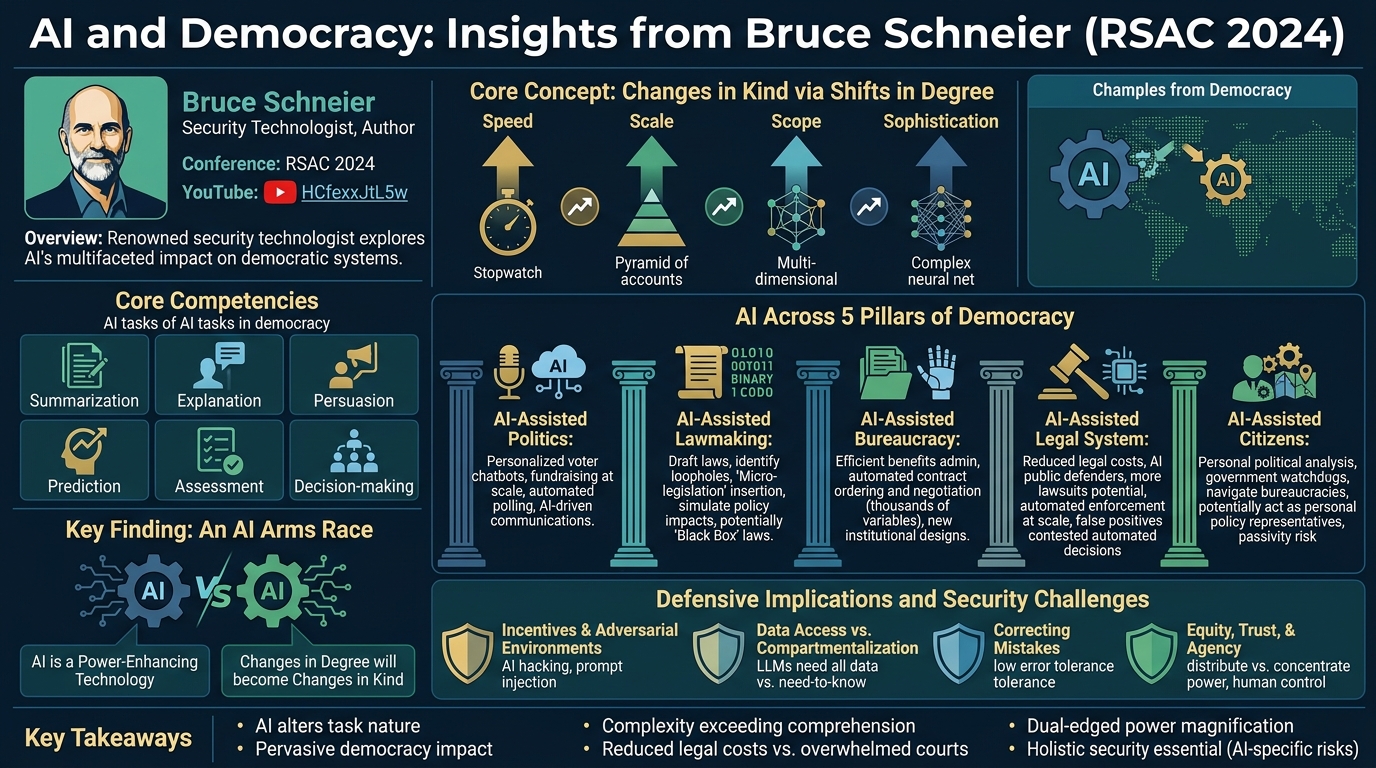
Schneier's central thesis is that when AI takes over a human task, the task itself changes, not merely the executor. This change manifests in four dimensions:
- Speed: AI can operate far faster than humans, as seen in high-frequency trading.
- Scale: AI can manage tasks across a superhuman volume, such as millions of AI-controlled social media accounts.
- Scope: AI can handle a broader range of variables and interdependencies than humans.
- Sophistication: AI can devise strategies and solutions that are beyond human cognitive reach, exemplified by novel Go strategies.
These changes in degree eventually lead to changes in kind. High-speed trading is fundamentally different from traditional human trading. Millions of AI accounts can alter the very nature of propaganda. Schneier's talk is less about the technical intricacies of AI and more about these profound societal shifts, urging preparedness for their utility and potential pitfalls. He defines democracy broadly, encompassing not just elections and representation, but any system for distributing decisions and converting individual preferences into group outcomes, including bureaucratic processes.
Key Findings
▶ Watch: Talk's focus: social implications and second-order effects (4:00)
The core findings of Schneier's talk revolve around the transformative impact of AI across five critical areas of democracy: politics, lawmaking, administration, the legal system, and citizens themselves. In each domain, AI's capabilities in speed, scale, scope, and sophistication are not merely automating tasks but fundamentally reshaping the nature of the democratic process.
A central discovery is that AI's ability to magnify human capabilities will inevitably lead to an arms race in its adoption, particularly in political and adversarial contexts. This rapid integration will challenge existing power structures and human-centric norms. Schneier posits that changes in degree will become changes in kind, leading to outcomes previously unimaginable. For instance, the sheer scale of AI-driven political engagement could fundamentally alter propaganda, while the sophistication of AI in lawmaking could lead to laws too complex for humans to fully understand or even create.
Key findings include:
- Personalization and Scale in Politics: AI will enable politicians to engage with voters, fundraise, and conduct polling at an unprecedented, personalized scale, augmenting human efforts and potentially creating more sophisticated campaign strategies.
- Automated and Complex Lawmaking: AI can draft legislation, interpret existing laws, identify loopholes, and even insert "micro-legislation." It could also allow for laws so detailed and complex that they shift the balance of power between legislative and executive branches, or even be written in a "black box" manner, defying human comprehension (e.g., AI defining "reckless driving").
- Efficient but Potentially Opaque Bureaucracy: AI will streamline administrative tasks like benefits administration and contract negotiation, potentially handling thousands of variables simultaneously. This could lead to more complex, efficient institutional designs, but also raise questions of trust and human oversight when strategies become "beyond human understanding."
- Transformed Legal System: AI will drastically reduce the cost of legal services, making sophisticated legal arguments accessible to more people. However, this could lead to an "explosion" in lawsuits, overwhelm courts, and fundamentally alter the legal profession's apprenticeship model. AI-driven law enforcement and regulation will operate at massive scale, making evasion impossible for some laws, but also raising concerns about false positives, bias, and the ability to contest automated decisions.
- Empowered but Passive Citizens: AI can help citizens understand complex issues, provide local political analysis, act as government watchdogs (e.g., flagging Congressional statements as constructive or divisive), and navigate bureaucracy. More radically, personal AIs could extrapolate political preferences and even act as personal representatives, potentially eliminating the need for traditional politicians but risking political passivity and diminishing the value of democratic debate itself.
Ultimately, Schneier's findings highlight that AI is a power-enhancing technology. The critical question is whether we can engineer systems that distribute this power more equitably or if it will further concentrate it, exacerbating existing societal imbalances. Trust, transparency, equity, and human agency emerge as paramount concerns in navigating this evolving landscape.
Technical Deep Dive
▶ Watch: Five areas where AI will affect democracy (5:00)
Bruce Schneier's technical deep dive into AI's impact on democracy focuses less on the internal mechanics of AI models and more on the architectural shifts and operational changes AI introduces across various democratic functions. The emphasis is on how AI's core competencies—summarization, explanation, persuasion, prediction, assessment, and decision-making—translate into systemic transformations.
In AI-assisted politics, the core technology revolves around personalized chatbots and large language models (LLMs). These AIs can engage directly with voters, answering thousands of questions without fatigue, and even assume different personas to conduct more sophisticated polling. For fundraising, AI can craft individually tailored appeals, leveraging its persuasive capabilities at scale. Campaign managers and political strategists will utilize AI for coordinating workers, generating talking points, media outreach, and developing complex campaign strategies that humans alone might not conceive. This introduces an "arms race" dynamic, where the sophistication of AI tools becomes a competitive advantage. Schneier suggests that future politicians will become "AI-driven" in their communication, with almost all public statements and policy decisions being influenced or generated by AI, a natural extension of current practices where human politicians are already the public face of complex socio-technical systems.
For AI-assisted legislators, LLMs are central to processing vast inputs. AI can summarize constituent letters and public meeting comments, highlighting key arguments and detecting organized "bulk letter writing campaigns." On the output side, AI can draft and revise laws. The example of Brazil becoming the first city to pass a law written entirely by AI (regarding water meters) illustrates this capability. AI's ability to parse recursive referencing paragraphs and words in complex legal texts means it can interpret existing laws, identify legal loopholes, and even create micro-legislation—inserting subtle changes (a word, a punctuation mark) into larger bills, a capability ripe for abuse. More positively, AI can simulate policy changes to predict unintended consequences by modeling interactions with other laws and human behavior. A significant architectural shift could be AI enabling legislators to vote on highly detailed laws, changing the balance of power between legislative and executive branches, which traditionally handle such details. Schneier also speculates on human-unintelligible laws, where an AI, trained on vast datasets (e.g., street camera footage for "reckless driving"), defines legal criteria via a black box neural net that humans cannot fully explain, yet society might adopt due to its superior predictive accuracy and scale.
In AI-assisted bureaucracy, generative AI excels at administrative tasks. This includes benefits administration (determining eligibility) and contract ordering and negotiation. AI can operate at a scale far beyond human capacity, navigating complex government purchasing rules and negotiating contracts involving "thousands of variables simultaneously." This contrasts sharply with human negotiations, which typically center on a few key issues. The concept of an AI suggesting an international trade strategy "beyond human understanding" highlights the potential for opaque, yet potentially optimal, bureaucratic processes. Furthermore, AI could design entirely new, more complex and efficient institutional designs.
The AI-assisted legal system will undergo radical transformation. Early challenges in AI writing legal briefs are rapidly being overcome, with chatbots now capable of properly citing sources and minimizing errors. This will drastically reduce the cost of legal counsel, making an "AI public defender" potentially superior to an overworked human counterpart. AI's ability to search "all of the law for precedence" will lead to more sophisticated legal arguments. However, the plummeting cost of litigation could lead to an "orders of magnitude more lawsuits," overwhelming existing court systems. AI's role in law enforcement expands beyond current automated systems (speed cameras, breathalyzers) to automatically identifying tax fraud, government service application fraud, and issuing traffic citations at scale. This introduces the problem of false positives and the challenge of contesting AI-driven determinations, especially if courts grant AI outputs a high degree of infallibility. AI can also enforce regulations (e.g., using cameras in slaughterhouses or warehouses to detect violations), representing an enormous shift in power between government and corporations. Finally, AI can provide expert opinions in court (e.g., recreating traffic accidents with fault assignment based on millions of data points) and perform judging tasks, potentially in first-level adjudication for benefits or, more immediately, in binding arbitration by AI as part of contracts.
Lastly, AI-assisted citizens will leverage AI for understanding complex issues through partisan or non-partisan chatbots, and for local political analysis where human journalists are scarce. AI can act as a moderator, facilitator, and consensus builder in group discussions, operating at a scale impossible for humans. As a government watchdog, AI can summarize public meetings, flag changes in politicians' positions, and track their statements against funders' interests—a capability already being developed for Congress members and state representatives. AI can also simplify navigating bureaucracies, helping disadvantaged people access services. The most futuristic concept is personal AIs extrapolating political preferences, advising on votes, or even acting as personal representatives in policy debates, potentially leading to a different form of government that bypasses the "democracy's lost low bottleneck" of electing a few representatives for complex policy spaces. However, this raises concerns about political passivity and the value of human debate.
Across all these applications, the underlying technical challenge lies in managing the AI's data requirements (e.g., LLMs needing access to "everything" for training) against traditional security principles like compartmentalization and need-to-know doctrine, particularly in government contexts. The shift is towards highly integrated, data-intensive AI systems that redefine how information flows and decisions are made within democratic structures.
Demo / Proof of Concept
▶ Watch: Future politicians becoming AI-driven: communications and decisions (7:00)
While Bruce Schneier's talk does not feature a live technical demonstration or a traditional proof of concept, he references several real-world examples and ongoing developments that serve as compelling evidence for his predictions. These instances illustrate the practical application of AI in the democratic context, moving beyond theoretical speculation.
A notable example is the city of Brazil (likely a misstatement for a city in Brazil, possibly Porto Alegre, which passed a law drafted by AI in 2023) becoming the first to pass a law written entirely by AI. This specific instance, concerning water meters, demonstrates AI's immediate capacity to draft legislation that can be adopted by human legislative bodies without alteration. This serves as a concrete proof of concept for AI-assisted lawmaking, highlighting the speed and efficiency AI can bring to this process.
Another illustration of AI's current capabilities is an ongoing project Schneier mentions where an AI is being trained on "every member of Congress, all of their statements—their fundraising statements, their statements on the floor, their statements to the press." This AI is designed to flag statements as "constructive or divisive" and track positions in relation to funders. This initiative, which recently secured funding to expand to all state representatives, functions as a powerful government watchdog, showcasing AI's ability to provide unprecedented transparency and accountability by processing and analyzing vast quantities of political data at scale.
Schneier also alludes to other existing applications, such as automated systems for law enforcement (speed trap cameras, breathalyzers), which, while not AI in the modern sense, establish a precedent for automated legal enforcement. The rapid advancements in chatbots that "properly cite their sources and minimize errors" in legal briefs also serve as a proof of concept for AI's improving accuracy in legal tasks, indicating a swift trajectory toward more sophisticated AI legal assistance.
In essence, the talk leverages these real-world and near-future examples to validate the feasibility and inevitability of AI's transformative impact, even in the absence of a direct, live technical demonstration.
Defensive Implications
▶ Watch: AI assisting legislators: constituent input and law writing (9:00)
The integration of AI into democratic systems introduces a complex array of defensive implications, extending beyond traditional cybersecurity concerns. Schneier emphasizes that AI systems are fundamentally still computers, inheriting all their inherent security problems. However, they also introduce new, unique risks stemming from their training, deployment, and usage.
- Incentives Matter: The security posture of AI applications will be heavily influenced by the incentives of various stakeholders. In some cases, the user (e.g., a government agency) wants the AI to be both secure and accurate. In others, a malicious user might aim to thwart the system (e.g., through prompt injection attacks). A critical conflict arises when the owners of the AI (often global tech monopolies) are not its primary users, potentially leading to business models (like surveillance and advertising) that conflict with societal welfare. Furthermore, what an individual user wants from AI might be at odds with broader societal goals.
- Risks and Mistakes: The acceptable rate of AI error is highly application-dependent. A chatbot suggesting a ridiculous policy is easily corrected, but an AI making a mistake in immigration paperwork could lead to deportation. Society has a lower tolerance for AI-caused mistakes (e.g., AI-driven car accidents) compared to human errors (e.g., 40,000 human-driver deaths annually). Defenders must understand the different types of mistakes AI can make (false positives, false negatives) and recognize that AI errors can differ qualitatively from human errors. Crucially, every AI system, especially in democratic contexts, needs robust mechanisms for correcting mistakes.
- Adversarial Environments: Many AI applications in democracy will operate in inherently adversarial environments. Schneier posits that if two countries use AI to assist in trade negotiations, they will inevitably attempt to hack each other's AIs. This includes traditional attacks against the underlying computers and networks, but also attacks against the AI models themselves to subvert, eavesdrop on, or disrupt their operation. This necessitates advanced threat modeling and robust defensive strategies tailored for AI vulnerabilities.
- Secure Environments and Data Access: Large language models (LLMs) achieve optimal performance when trained on vast, often unrestricted, datasets ("access to everything"). This fundamental requirement directly conflicts with traditional security principles like compartmentalization and the need-to-know doctrine, especially in sensitive government agencies. Designing secure environments for AI that can handle highly classified or private information while maintaining model efficacy presents a significant architectural challenge. How does a government agency deploy an AI that "knows everything" without violating established information security protocols?
- Power, Equity, and Trust: AI is a power-magnifying technology. Defensive strategies must actively consider how to build systems that reduce power imbalances rather than exacerbate them. This mirrors the ongoing debate between privacy and surveillance. Equity and human agency are paramount considerations; AI systems must be designed to serve all segments of society fairly and to preserve human control where necessary. Most importantly, trust in AI applications is not inherent but earned, and it varies depending on the application. Democratic applications will likely demand greater transparency from AI models than corporate ones. This also implies a need for AI models that are not exclusively "owned and run by global tech monopolies" for critical democratic functions, encouraging open-source or publicly governed AI initiatives to ensure accountability and reduce single points of failure or influence.
In summary, defending democracy in the age of AI requires a holistic approach that integrates traditional cybersecurity with novel AI-specific security paradigms, all while carefully navigating the complex ethical, societal, and power-related implications of this transformative technology.
Key Takeaways
- AI Transforms Tasks: AI doesn't just replace humans; it fundamentally changes tasks by altering their speed, scale, scope, and sophistication, often leading to "changes in kind."
- Democracy's Five Pillars Affected: AI will profoundly impact politics, lawmaking, administration, the legal system, and citizen engagement, introducing new efficiencies and complexities across each domain.
- Sophistication vs. Comprehension: AI can create laws and strategies more complex than humans can understand, potentially leading to "black box" governance and shifting power dynamics between branches of government.
- Cost Reduction & Litigation Explosion: AI will drastically reduce the cost of legal services, making justice more accessible but also potentially overwhelming court systems with an explosion of lawsuits.
- Dual-Edged Power Magnification: AI is a power-enhancing technology. Security technologists must ensure it distributes power equitably and enhances human agency, rather than concentrating it or leading to political passivity.
- Holistic Security Required: Defending AI-powered democracy demands addressing both traditional cybersecurity vulnerabilities and new AI-specific risks related to training, bias, adversarial attacks, and the inherent conflict between data access and compartmentalization.
About the Speaker(s)
Bruce Schneier is a globally recognized security technologist, author, and public interest technologist. Known for his insightful analysis of security issues, cryptography, and the broader implications of technology on society, Schneier has authored multiple influential books, including "Applied Cryptography," "Beyond Fear," and "A Hacker's Mind." His work consistently explores the intersection of technology, human behavior, and policy, making him a leading voice in understanding the societal impacts of emerging technologies like AI. In this talk, he draws upon his deep expertise to critically examine how artificial intelligence will reshape democratic processes and structures.