Don't Worry About Your Toilet...I'm Just Hacking It
RSA Conference 2024 · Track Session
Overview
In a presentation that was as provocative as it was insightful, Ben Smerler, a security expert from Independent Security Evaluators (ISE), delivered the inaugural "toilet talk" at RSAC 2024. Titled "Don't Worry About Your Toilet...I'm Just Hacking It," the talk used the seemingly absurd premise of hacking a smart toilet seat to illustrate profound and often overlooked security vulnerabilities inherent in the rapidly expanding landscape of Internet of Things (IoT) devices. This session served as a crucial wake-up call, demonstrating how easily consumer-grade smart devices can be compromised and, more importantly, how the underlying principles of these exploits apply to far more critical infrastructure, from medical devices to industrial controls.
Key moments
- 0:00 Introduction to the 'toilet talk' and speaker
- 2:00 Speaker introduction, company, and ethical hacking approach
- 3:15 Introducing 'Tim the Toilet' and the project origin
- 4:00 Audience reactions and why hack a toilet
- 5:00 Technical details: reverse engineering and compromising devices
- 6:00 Broader implications of IoT device vulnerability
- 7:00 Defining IoT and providing diverse examples
Don't Worry About Your Toilet...I'm Just Hacking It
Speakers: Ben Smerler, Independent Security Evaluators; Laura Herman, Co-founder of Apic Village
Conference: RSAC 2024
YouTube: https://www.youtube.com/watch?v=Fv5vEAoUgCM
Overview
In a presentation that was as provocative as it was insightful, Ben Smerler, a security expert from Independent Security Evaluators (ISE), delivered the inaugural "toilet talk" at RSAC 2024. Titled "Don't Worry About Your Toilet...I'm Just Hacking It," the talk used the seemingly absurd premise of hacking a smart toilet seat to illustrate profound and often overlooked security vulnerabilities inherent in the rapidly expanding landscape of Internet of Things (IoT) devices. This session served as a crucial wake-up call, demonstrating how easily consumer-grade smart devices can be compromised and, more importantly, how the underlying principles of these exploits apply to far more critical infrastructure, from medical devices to industrial controls.
Smerler’s core message was a call to look beyond the immediate, often trivial, function of individual smart gadgets and recognize the systemic risks posed by their proliferation. By showcasing the straightforward methods used to manipulate a smart toilet seat, he powerfully conveyed that the ease of compromise for one device often translates to others, regardless of their perceived importance. The talk urged attendees—whether consumers, IT professionals, or developers—to adopt a proactive "culture of security" that questions trust, prioritizes diligence, and builds resilience against an ever-evolving threat landscape.
Background
▶ Watch: Introduction to the 'toilet talk' and speaker (0:00)
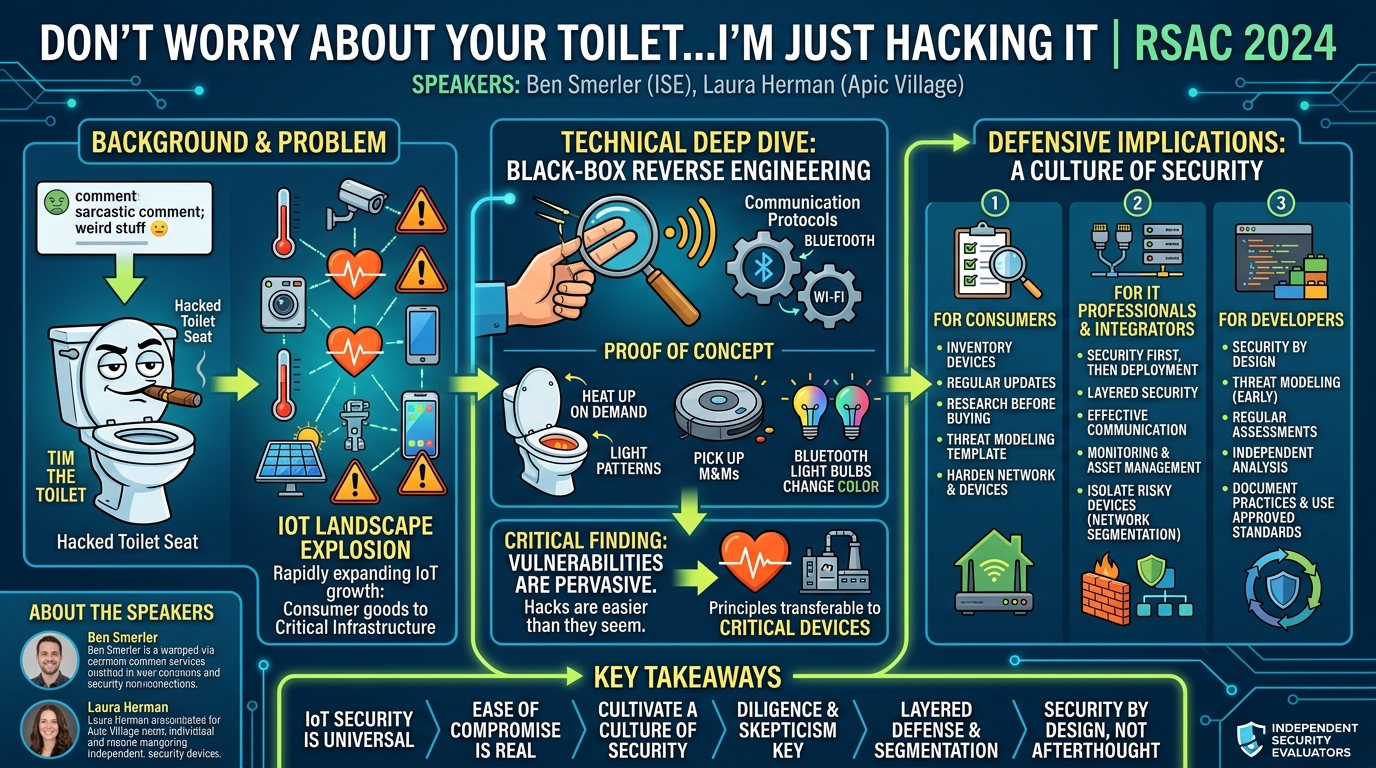
The genesis of this unconventional demonstration dates back to RSAC 2023, where ISE first introduced "Tim the toilet," a hacked toilet seat, at the sandbox area. This initiative stemmed from a sarcastic comment that quickly escalated into a full-fledged research project, embodying ISE's penchant for "weird stuff" that challenges conventional security perceptions. The primary motivation was to create a highly visible and memorable demonstration that would engage a broad audience, including those less technical, and spark conversations about IoT security that might otherwise be overlooked. The question "Why is there a toilet here?" was precisely the reaction Smerler sought, providing an entry point to discuss serious security implications through a humorous, relatable lens.
The problem this talk addresses is the exponential growth of IoT devices across every sector of life, from smart homes to critical infrastructure. As Smerler highlighted, if something isn't digital, adding communication or digital connectivity instantly transforms it into an IoT device. This includes everything from smart thermostats and cameras to plumbing instruments, heart monitors, solar panels, and even wearable technology. Despite their diverse functions, many of these devices share common underlying technologies like Wi-Fi and Bluetooth, meaning vulnerabilities discovered in one device type can often be replicated or adapted to others. The pervasive belief that a product is "100% secure" is a dangerous fallacy; security is a continuous state of being, not a destination. This talk aimed to dispel such complacency and highlight the hidden risks in our increasingly connected world.
Key Findings
▶ Watch: Introducing 'Tim the Toilet' and the project origin (3:15)
The central finding of Smerler's research is the relative ease with which many IoT devices can be compromised, even those considered "immature targets" like a smart toilet seat. Through black-box reverse engineering, ISE was able to understand and manipulate the communication protocols of several devices, including the toilet seat, a robotic vacuum, and Bluetooth light bulbs. This process revealed that the exploits were "not that complicated" to develop, requiring only a few hours to devise methods for sending custom instructions.
A critical takeaway is that vulnerabilities are inherent and pervasive. Smerler emphasized that if vulnerabilities could be found on a toilet seat, they exist across the entire spectrum of IoT, from consumer gadgets to highly sensitive medical and industrial equipment. He pointed out that the same Bluetooth connection used to control a toilet seat could potentially be exploited to manipulate a plumbing sensor or even a heart monitor. This directly challenges the notion that less critical devices are unworthy of security scrutiny, demonstrating that their exploitation can serve as a blueprint for attacking more valuable targets. The talk underscored that security is not a binary state; rather, it’s about making systems "very difficult to break," acknowledging that "nothing is ever 100% secure."
Technical Deep Dive
▶ Watch: Audience reactions and why hack a toilet (4:00)
The technical core of ISE's demonstration involved black-box reverse engineering of several IoT devices that communicated wirelessly. This methodology means that the team analyzed the devices' external behavior and communication patterns without access to their internal schematics, source code, or design specifications. The primary wireless spectra targeted were Bluetooth and Wi-Fi, two ubiquitous protocols found in a vast array of smart devices.
For the smart toilet seat, the ISE team observed its interactions and then crafted their own applications to mimic and manipulate these communications. This allowed them to issue arbitrary commands, such as making the toilet seat heat up on demand or initiating specific light patterns. Similarly, a robotic vacuum was reverse-engineered to respond to custom instructions, enabling attendees at the RSA sandbox to make it pick up M&Ms scattered on the carpet. Bluetooth light bulbs were also brought under control, demonstrating manipulation of colors and other functions.
Smerler highlighted that the principles applied to these consumer devices are directly transferable to more critical systems. The commonality of Wi-Fi and Bluetooth across diverse IoT applications—from simple home automation to complex medical equipment like heart monitors (which ISE had previously researched and found vulnerabilities in)—means that a successful reverse engineering technique for one device can often be adapted to another. The "not that complicated" nature of these exploits underscores a fundamental flaw in many IoT device designs: a lack of robust security considerations from the outset, often relying on obscurity or the perceived low value of the device as a deterrent. The ability to create custom applications to control these devices effectively means gaining complete compromise over their intended functionality.
Demo / Proof of Concept
▶ Watch: Broader implications of IoT device vulnerability (6:00)
The cornerstone of Smerler's presentation was the interactive demonstration featuring "Tim the toilet," a smart toilet seat that ISE had famously hacked and exhibited at the RSAC 2023 sandbox. This physical artifact, complete with eyes and a cigar, served as a tangible and memorable Proof of Concept. Visitors to the sandbox could interact directly with Tim, witnessing firsthand the capabilities of a compromised smart device. The specific functionalities demonstrated included making the toilet seat heat up—a feature often touted for comfort in luxury smart toilets—and initiating various light patterns, which Smerler humorously suggested could be made to "swirl like water going down a toilet."
Beyond the toilet, ISE also showcased other hacked devices, such as a robotic vacuum that could be commanded to pick up M&Ms scattered across a carpet, and Bluetooth light bulbs that had their color and intensity manipulated. These demonstrations were not merely for entertainment; they served a critical educational purpose. By allowing non-technical attendees to directly interact with compromised devices and observe their manipulation, Smerler aimed to demystify the concept of hacking and make the abstract threat of IoT vulnerabilities concrete and immediate. The goal was to provoke questions like "Why is there a toilet here?" and then pivot to the more serious discussion of what these exploits mean for the broader landscape of connected devices, emphasizing that the ease of compromising a toilet translates directly to other, more critical IoT applications. The interactive nature of the demo made the security implications undeniably real for the audience.
Defensive Implications
▶ Watch: Defining IoT and providing diverse examples (7:00)
Smerler outlined comprehensive defensive strategies tailored for three primary audiences: consumers, IT integrators, and developers. His advice underscores the necessity of a holistic "culture of security" to mitigate the pervasive risks of IoT devices.
For Consumers, the first step is inventory management: knowing exactly what smart devices are connected to their home network and understanding their maintenance requirements. Smerler stressed that while hardware remains fixed, firmware and software evolve, necessitating regular updates. Consumers should research products before buying them, scrutinizing manufacturers' security diligence, data handling policies, and documented testing methodologies. Asking "what kind of data these things receive and how it can communicate" is crucial. Smerler also introduced threat modeling for consumers, suggesting a "template modeling" approach to identify assets, protections, threats, and maintenance needs. Finally, hardening the rest of your devices and networks creates a layered defense, making it harder for a compromised IoT device to impact other systems. Staying informed about major vulnerabilities like Log4J and regulatory initiatives like the FCC Cyber Trustmark program is also vital.
Integrators and IT Professionals, who manage IoT devices within corporate or organizational networks, must focus on security first, then deployment. This means rigorous scrutiny and proper configuration before introducing new devices. Layered security is essential; IT should not assume a single firewall feature is sufficient, but rather implement multiple defensive mechanisms. Effective communication with end-users is paramount to avoid Shadow IT, where employees bypass IT to deploy devices, creating unmanaged risks. IT should act as an ally, providing transparency and clear timelines for integrating devices securely. Adequate monitoring and asset management are critical, as many bleeding-edge IoT devices may not appear on traditional network scans, requiring broader visibility tools like EDR systems or SIMS. Lastly, for highly risky devices, such as legacy medical equipment running on Windows XP (e.g., MRI machines), isolating the device on the network through network segmentation can prevent lateral movement by attackers, even if the device itself cannot be patched.
For Developers building IoT products and applications, security must be built into the design, not added after building. This includes threat modeling from the earliest stages, which significantly reduces the cost and complexity of securing a product compared to retrofitting security measures. Developers should regularly assess their products and not take initial results for granted, integrating security assessments into the Software Development Life Cycle (SDLC). Seeking independent analysis from third parties is crucial to identify blind spots that internal teams might miss. Thorough documentation of security practices and adherence to approved standards are non-negotiable, particularly avoiding unvetted third-party libraries that can introduce unknown vulnerabilities. Smerler emphasized that while speed to market is important, a product compromised by a major data breach will destroy brand trust and business viability.
Key Takeaways
- IoT security is a universal concern: The principles of hacking a smart toilet seat apply directly to critical infrastructure, medical devices, and other sensitive IoT applications.
- Ease of compromise: Many IoT devices, even those deemed "immature targets," can be easily reverse-engineered and compromised using common wireless protocols like Bluetooth and Wi-Fi.
- Cultivate a "culture of security": Consumers, IT professionals, and developers must proactively integrate security considerations into daily decisions and product lifecycles.
- Diligence and skepticism are key: Always question the security claims of manufacturers, research products thoroughly, and understand how devices collect and transmit data.
- Layered defense and network segmentation: Implement multiple security controls and isolate risky devices on networks to limit the impact of potential vulnerabilities.
- Security by design, not afterthought: For developers, building security into the initial design phase is more effective and cost-efficient than attempting to patch vulnerabilities post-deployment.
About the Speaker(s)
Ben Smerler is a security expert at Independent Security Evaluators (ISE), a cybersecurity consultancy based in Baltimore, Maryland, with a global presence. ISE specializes in white-box application security assessments, network penetration testing, and design consulting, focusing on ethical hacking techniques to uncover real vulnerabilities beyond what automated scanners can find. Ben's role involves advising clients on testing methodologies, scoping, and fostering a positive discourse around security, moving beyond fear-based narratives. He is known for engaging in unique projects, such as hacking a toilet seat, to raise awareness about broader security implications.
Laura Herman is the co-founder of Apic Village, a non-profit organization dedicated to application security education and community building. She introduced Ben Smerler at RSAC 2024, highlighting their shared commitment to advancing security knowledge and practices.