Why Source Code Exfiltration Is the Biggest Blind Spot in Insider Threat
RSA Conference 2024 · Track Session
Overview
In this compelling talk at RSAC 2024, Joe Payne, President and CEO of Code 42, tackles a critical yet often overlooked aspect of enterprise security: source code exfiltration as the "biggest blind spot" in insider threat. Payne argues that while organizations are increasingly aware of external cyber threats like malware and ransomware, the subtle, often accidental, but highly damaging loss of intellectual property through internal channels remains inadequately addressed. His presentation is a call to action for security professionals to re-evaluate their strategies, moving beyond traditional blocking mechanisms to adopt a more nuanced, visibility-driven, and educational approach to protecting their most valuable digital assets.
Key moments
- 0:00 Introduction and why source code exfiltration matters
- 2:04 Talk agenda: IP protection, source code challenges, next steps
- 3:00 Senior engineer reveals source code exfiltration blind spot
- 5:12 Insider threat context: hackers don't hack in, they log in
- 6:00 Key differences: external bad actors vs. internal colleagues
Why Source Code Exfiltration Is the Biggest Blind Spot in Insider Threat
Speakers: Joe Payne, President and CEO, Code 42
Conference: RSAC 2024
YouTube: https://www.youtube.com/watch?v=_VFudPePxp4
Overview
In this compelling talk at RSAC 2024, Joe Payne, President and CEO of Code 42, tackles a critical yet often overlooked aspect of enterprise security: source code exfiltration as the "biggest blind spot" in insider threat. Payne argues that while organizations are increasingly aware of external cyber threats like malware and ransomware, the subtle, often accidental, but highly damaging loss of intellectual property through internal channels remains inadequately addressed. His presentation is a call to action for security professionals to re-evaluate their strategies, moving beyond traditional blocking mechanisms to adopt a more nuanced, visibility-driven, and educational approach to protecting their most valuable digital assets.
Payne's personal journey to this topic, having faced repeated rejections from RSA for "uninteresting" submissions until focusing on this real-world problem, underscores the pervasive nature and often-underestimated significance of insider risk. He highlights that the very employees entrusted with developing and managing source code—engineers, developers, and even sales personnel—represent the primary vector for its unauthorized departure. The talk delves into the unique challenges of monitoring and securing source code without impeding the productivity of development teams, offering practical recommendations for immediate and short-term implementation.
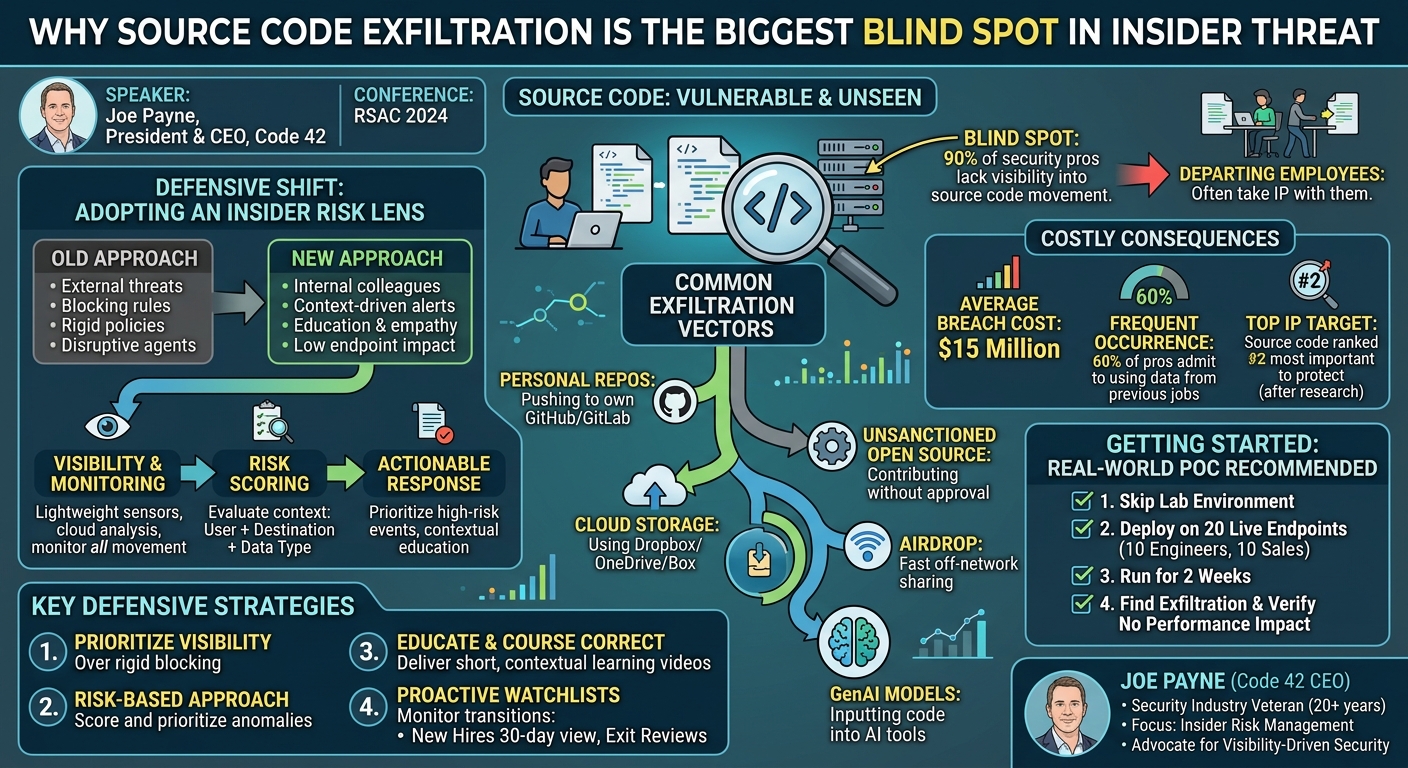
The core message is that traditional security paradigms, designed to combat external adversaries, are ill-suited for the complexities of insider risk, particularly when it comes to source code. Given that 1 in 3 breaches involves an insider and can cost an estimated $15 million, and with 60% of professionals admitting to using data from previous jobs, the problem is frequent and costly. Payne emphasizes that protecting source code is paramount, ranking second only to research data in perceived importance, yet 9 out of 10 security professionals report insufficient visibility into its movement. This talk serves as a vital guide for organizations seeking to fortify their defenses against this pervasive and potent form of intellectual property theft.
Background
▶ Watch: Introduction and why source code exfiltration matters (0:00)
The landscape of cybersecurity is often dominated by the narrative of external threats: sophisticated malware, relentless ransomware campaigns, and state-sponsored hacking groups. However, Joe Payne redirects the spotlight to a more insidious and complex challenge: insider threat. He succinctly captures this paradigm shift with the adage, "hackers don't hack in, they log in." This fundamental difference necessitates a complete reorientation of security strategy. Unlike external attackers, who are clear adversaries, insider threats originate from within – from a "friend," a "colleague," someone "who works down the hall." This distinction is crucial because it dictates a vastly different response methodology.
Traditional security responses to external threats are rapid and decisive: isolate, disconnect, quarantine. Malware, by its nature, is fast-moving and propagates quickly, demanding immediate containment. Insider risk, however, does not operate with the same viral urgency. The speaker illustrates this with a story of a large financial institution whose security team, treating an insider incident like a malware outbreak, immediately cut off and interrogated a vice president found exfiltrating data to a personal Dropbox account. It turned out the VP was merely trying to work over the weekend and found it the "easiest way" to access files, not a malicious act. This overreaction resulted in the security team, not the VP, getting into trouble, highlighting the need for a more empathetic, inquisitive approach. Approximately 55% of insider data exfiltration incidents are accidental, not malicious, making education and understanding paramount over punitive action.
The legal and ethical implications further complicate insider threat management. While legal action against external hackers is straightforward, insider cases often involve HR and legal departments, with "legal issues all over the map." Furthermore, the modern enterprise environment, characterized by ubiquitous collaboration tools like Slack, Box, and OneDrive, and the prevalence of remote work, has blurred the lines of data ownership and movement. Employees are encouraged to share and collaborate, inadvertently creating new exfiltration vectors that traditional security controls struggle to monitor. Payne argues that security professionals, accustomed to established practices, must "rethink how much experience we think we actually have" in this evolving landscape.
The scale of the problem is significant, backed by Code 42's research involving 700 security professionals. A staggering 60% admitted to currently using data taken from a previous job, demonstrating the frequency of data leakage. The financial impact is dire, with an estimated average cost of $15 million per significant breach involving exfiltrated data. While only "one in three breaches today involves an insider," these are often the "most devastating" because the insider possesses intimate knowledge of the data's value and utility, enabling them to effectively leverage it, whether by standing up a competitor or joining a rival. This foundational understanding sets the stage for why source code, the very blueprint of an organization's innovation, represents such a critical and vulnerable asset.
Key Findings
▶ Watch: Talk agenda: IP protection, source code challenges, next steps (2:04)
The research conducted by Code 42, based on a survey of 700 security professionals and analysis of 180 billion data points, reveals several critical insights into the state of source code protection and insider threat. Foremost among these findings is that protecting source code is cited as the number two reason for concern, only trailing research data. This underscores the profound value organizations place on their proprietary codebases, recognizing them as core intellectual property and competitive differentiators.
Despite this high perceived value, a significant blind spot exists: nine out of ten security professionals report insufficient visibility into source code movement. This lack of insight is particularly acute when developers push code to unsanctioned repositories or open-source projects. The speaker shared a telling anecdote from Code 42's own experience: while expecting to find developers pushing code to personal GitLab accounts, they were surprised to discover widespread contributions to open-source projects that were not approved or monitored by the company. This "shadow IT" for open-source contributions represents a substantial and often unrecognized exfiltration vector.
The impact of insider risk events, particularly those involving source code, is escalating. From 2022 to 2023, concerns regarding damage to reputation, business continuity, company culture, ability to compete, and employee retention all increased. The sole exception was compliance, which remained stable. Payne interprets this as a positive shift, indicating that security professionals are moving beyond merely meeting compliance checkboxes to genuinely addressing the underlying security problem. They are seeking to solve the actual risk, not just satisfy regulatory requirements.
The prevalence of source code exfiltration is alarming. Data from Code 42's customer base indicates that a striking 75% of their customers have experienced source code leaving their premises within the last 30 days. This figure highlights that source code leakage is not an infrequent occurrence but a persistent, ongoing challenge for the vast majority of organizations engaged in software development. Furthermore, while 83% of Chief Information Security Officers (CISOs) acknowledge direct accountability for source code loss, only 56% feel responsible for broader insider threat incidents. This disparity suggests that source code is universally recognized as a critical security domain, forcing a consensus among security leadership that often eludes other aspects of insider risk.
In summary, the key findings paint a picture of an undervalued and under-monitored asset. Source code is highly valued but frequently exfiltrated, often through channels that security teams cannot see. The impact of such losses is growing, and while CISOs recognize their accountability, many lack the necessary visibility and tools to effectively manage this pervasive risk.
Technical Deep Dive
▶ Watch: Senior engineer reveals source code exfiltration blind spot (3:00)
The technical challenges in securing source code against insider threat are multifaceted, primarily stemming from the nature of software development workflows and the limitations of traditional security tools. Payne emphasizes that the primary hurdle is the breadth of tools and libraries developers employ. From Git commands like pull, clone, fetch, and push to various Integrated Development Environments (IDEs) and collaborative platforms, developers utilize a diverse ecosystem. Monitoring this complex environment requires an equally broad and sophisticated approach.
A paramount technical constraint is the absolute necessity of zero endpoint impact. Developers are highly sensitive to any performance degradation on their machines. As Payne colorfully puts it, slowing down even "one developer's machine, it is a shit show." This instantly leads to developers uninstalling or circumventing security agents, creating immediate blind spots and undermining the entire security program. The speaker notes that this historical issue with resource-intensive Data Loss Prevention (DLP) agents 15 years ago is a primary reason for the industry's skepticism towards endpoint agents. Modern solutions must be cloud-native, employing lightweight sensors on the endpoint to gather information, with the bulk of the analysis offloaded to the cloud. This architectural shift is crucial for maintaining developer productivity while ensuring comprehensive monitoring.
Traditional DLP, with its reliance on rigid rules and blocking mechanisms, is fundamentally ill-suited for source code protection. Payne explains that attempting to "lock down source code movement" with explicit rules (e.g., "cannot move source code to an untrusted repo") is destined to fail within days. Development teams constantly create new repositories, collaborate with partners requiring specific code pushes, and adapt their workflows. A blocking rule will inevitably interfere with legitimate activity, leading to program shutdown. Instead, the proposed solution is a visibility-first, risk-scoring model. This approach involves monitoring all source code movement across all vectors—whether it's pushing to personal GitHub or GitLab accounts, contributing to unsanctioned open-source projects, or even using Airdrop when off-network.
The core of this technical solution is to score every data movement event. This scoring considers multiple contextual factors: where the data originated, its destination, who is moving it, and the type of data involved. By aggregating and analyzing this metadata in the cloud, security teams can identify "super risky events" without directly impeding developer workflows. This proactive risk assessment allows security personnel to engage in targeted, educational conversations with employees, rather than resorting to disruptive blocking. For instance, if a developer moves code to a personal GitHub, the system flags it, allowing security to inquire and educate, as demonstrated in the "Jenny" anecdote.
Furthermore, the solution must be client, ID, and library agnostic, capable of monitoring diverse processes beyond just standard Git protocol (e.g., watching git.exe commands is insufficient). The increasing use of GenAI models for development, data exfiltration from platforms like Salesforce, and the surprising rise of Airdrop as an exfiltration vector (with users "figured out how to use airdrop" in the last two years) necessitate broad coverage. The architecture must support 30+ integrations to ingest data from various sources, including existing Microsoft Information Protection (MIP) tags, to build a comprehensive risk model. This holistic, non-blocking, and context-aware approach is the technical foundation for effectively addressing the insider threat of source code exfiltration.
Demo / Proof of Concept
▶ Watch: Insider threat context: hackers don't hack in, they log in (5:12)
While the talk itself did not feature a live product demonstration, Joe Payne strongly advocated for a specific and highly effective approach to evaluating solutions for source code protection: a Proof of Concept (POC) that mirrors real-world conditions. He explicitly warns against relying solely on vendor claims, especially from large companies like Microsoft, which he describes as the "ultimate example of like Pay no attention to the man behind the curtain" regarding their integrated product capabilities.
Payne's recommendation for a successful POC is critically different from traditional security testing:
- Avoid the Lab Environment: The speaker stresses that security professionals often make the mistake of conducting POCs exclusively "in your lab." This is ineffective for insider risk solutions because "you guys aren't the ones exfiltrating all the data." A lab environment cannot accurately simulate the diverse and often unintentional ways employees move data in the wild.
- Real-World Deployment: Instead, he advises deploying the solution on a minimum of 20 endpoints in a live production environment.
- Targeted User Groups: Specifically, he recommends installing the agent on 10 software engineers' machines and 10 sales people's machines. This dual approach covers both the primary target (developers and their source code) and another high-risk group (salespeople and customer data from platforms like Salesforce).
- Duration: Run the POC for at least two weeks.
- Expected Outcome: Payne confidently predicts that within this short period, organizations "will find exfiltration" from both sales people and software engineers. Crucially, this POC also serves to verify that the solution "doesn't disrupt any of their machines," addressing the critical concern of endpoint performance impact, especially for developers.
This recommended POC methodology is designed to provide immediate, tangible evidence of a solution's effectiveness in uncovering hidden data exfiltration and confirming its low-impact operation. The speaker also mentioned that Code 42's booth at the conference provided live demonstrations of their product, showcasing "how easy it is to identify where the source code is going and where it's coming from," reinforcing the core message of enhanced visibility. This practical, real-world testing approach is presented as the definitive way for organizations to validate claims and choose an effective insider risk solution.
Defensive Implications
▶ Watch: Key differences: external bad actors vs. internal colleagues (6:00)
The insights shared by Joe Payne offer clear and actionable defensive implications for organizations grappling with source code exfiltration and broader insider threats. The core shift required is from a reactive, blocking-centric approach to a proactive, visibility-driven, and educational strategy.
- Prioritize Low-Impact, Broad Monitoring Solutions: The absolute necessity of a low endpoint impact solution cannot be overstated. Any agent or tool that slows down developers will be circumvented, rendering it useless. Organizations should seek cloud-native agents that act as lightweight sensors, offloading heavy analysis to the cloud. The monitoring capabilities must be broad, covering all clients, IDs, and libraries, and agnostic to specific Git commands (
pull,clone,fetch,push) and other exfiltration vectors like Airdrop, cloud storage services (Dropbox, OneDrive), personal repositories (GitHub, GitLab), and even new risks like GenAI models and data from Salesforce. This comprehensive visibility is crucial to uncover the "blind spots."
- Embrace Risk Scoring Over Rigid Blocking Policies: Traditional DLP rules are ineffective for source code due to the dynamic nature of development workflows. Instead of attempting to write exhaustive rules that inevitably interfere with legitimate activities, security teams should implement a risk-scoring model. This model continuously monitors and scores all data movement based on context (source, destination, user, data type), highlighting genuinely risky events without blocking legitimate operations. This approach allows security to focus resources on the highest-risk activities, rather than chasing false positives or dealing with developer backlash.
- Implement Contextual Education and Course Correction: Given that approximately 55% of insider exfiltration is accidental, education is a powerful defensive tool. Organizations should move beyond annual, generic training videos and adopt automated, contextual, and short educational modules. Joe Payne highlights Code 42's "Instructor" product, which delivers "one-minute short videos" via platforms like Slack when a rule is broken (e.g., uploading corporate data to Dropbox). This immediate, non-punitive feedback mechanism, as demonstrated by CrowdStrike reducing incidents by 32% with a single video, is highly effective in raising awareness and correcting behavior. It positions security as a supportive, educational function rather than an adversarial one.
- Proactive Monitoring for Employee Transitions: Two critical proactive measures can significantly mitigate risk:
- Exit Reviews: Before an employee departs, organizations should review all data movements to identify any unauthorized exfiltration, as exemplified by the Valeo/Nvidia case where a departing engineer took complete source code. Modern tools can facilitate this review.
- New Employee Watchlists: Implement a process to monitor new employees for approximately 30 days. During this period, new hires should generally not be moving large volumes of data from personal devices or cloud accounts to corporate systems. Anomalous activity can signal the transfer of intellectual property from previous employers, allowing for early intervention and preventing multi-million dollar lawsuits.
- Engage and Understand Developer Workflows: Security professionals must actively engage with their development teams. "Ask one of your developer what they're doing," Payne advises. Understanding their tools, workflows, and how they "move data around" is fundamental to designing effective security controls that don't impede productivity. Developers, often unaware of the implications, are usually willing to share this information, creating an opportunity for education and collaboration.
By adopting these defensive strategies, organizations can transform their approach to insider threat, particularly concerning source code, moving from a position of blind spots and reactive measures to one of informed visibility, proactive risk management, and collaborative security culture.
Key Takeaways
- Source code exfiltration is a critical, yet often unseen, insider threat. It represents a significant blind spot, with 9 out of 10 security professionals lacking adequate visibility into its movement, especially to unsanctioned repositories or open-source projects.
- Traditional security approaches, particularly rule-based DLP, are ineffective and detrimental for source code protection. They disrupt developer productivity, leading to circumvention and program failure. A low endpoint impact solution is non-negotiable for developer adoption.
- A visibility-first, risk-scoring model is essential. Instead of blocking, monitor all data movement across all vectors (Git commands, Airdrop, cloud storage, personal accounts, GenAI models) and score events based on contextual risk, allowing security teams to prioritize and investigate anomalies without impeding legitimate work.
- Education and course-correction are highly effective for mitigating accidental insider risk. Automated, short (e.g., 1-minute videos), and contextual educational interventions can significantly reduce incidents (e.g., 32% reduction seen by CrowdStrike) and foster a supportive security culture.
- Proactive measures are crucial for managing employee transitions. Implementing new employee watchlists (30 days of monitoring) and conducting thorough exit reviews for departing employees can prevent the unauthorized transfer of intellectual property, as demonstrated by the Valeo/Nvidia case.
- Engaging with developers to understand their actual workflows is fundamental. Security teams must ask developers how they move code to gain insights into potential exfiltration vectors and build security solutions that align with, rather than obstruct, development processes.
About the Speaker(s)
Joe Payne is the President and CEO of Code 42, a company specializing in insider risk management and data protection. With a distinguished career in the security industry spanning over two decades, Payne first attended the RSA Conference in 2003 and has been actively involved in the field ever since. He once held a top-secret clearance, indicating a strong background in sensitive information protection, though he no longer holds that clearance today.
Payne's passion for the topic of insider threat, particularly source code exfiltration, is evident. He recounts a personal anecdote about repeatedly submitting talk proposals to RSA on various topics, only to be rejected for not being "interesting enough." It was only when he focused on the real-world, pervasive problem of source code leakage – a core area of Code 42's expertise – that his submission was accepted. This personal drive underscores his commitment to addressing critical, often overlooked, security challenges that impact businesses in tangible ways. His leadership at Code 42 is focused on developing solutions that provide visibility and control over data movement without hindering productivity, especially for development teams.