How to Take Cookies from the Cookie Monster: Genesis Market Takedown
RSA Conference 2024 · Track Session
Overview
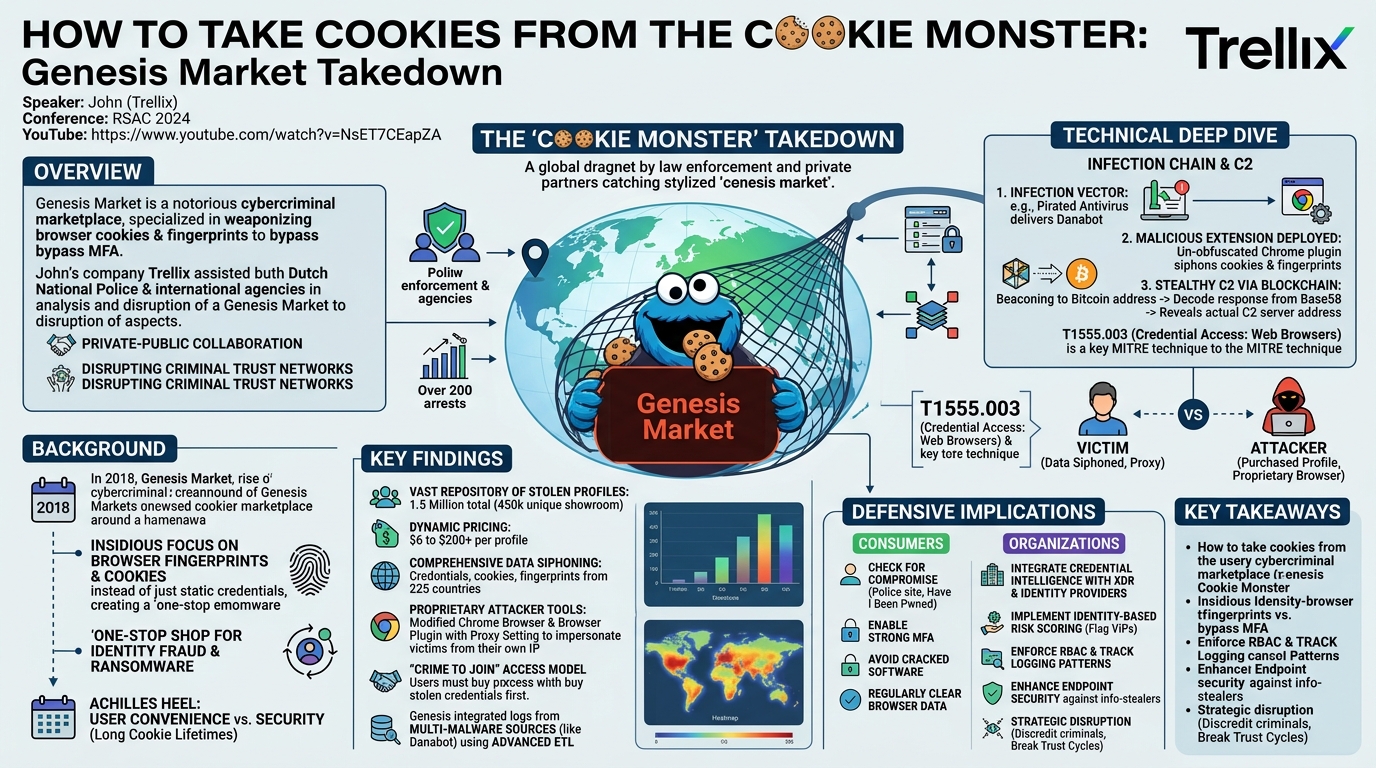
This talk, "How to Take Cookies from the Cookie Monster: Genesis Market Takedown," presented at RSAC 2024, delves into the intricate details of Genesis Market, a notorious cybercriminal marketplace, and the global law enforcement operation that led to its disruption. The speaker, John from Trellix, recounts his company's pivotal role in assisting the Dutch National Police and other international agencies in analyzing the market's unique modus operandi, its underlying malware, and ultimately contributing to its takedown. The presentation offers a deep dive into how Genesis Market weaponized browser cookies and fingerprints to bypass multi-factor authentication (MFA) and facilitate widespread identity fraud and ransomware attacks.
Key moments
- 1:25 Unexpected police call: Genesis Market takedown begins
- 2:02 Law enforcement reveals Genesis Market takedown plan
- 2:50 Understanding Genesis Market's browser fingerprinting and cookies
- 3:30 Genesis Market's MFA bypass and ransomware capabilities
- 4:30 Exploiting security's Achilles heel: Usability vs. Security
- 5:23 Inside Genesis Market: Scale and scope of profiles
- 6:00 Factors determining Genesis Market profile pricing
How to Take Cookies from the Cookie Monster: Genesis Market Takedown
Speakers: John (Trellix)
Conference: RSAC 2024
YouTube: https://www.youtube.com/watch?v=NsET7CEapZA
Overview
This talk, "How to Take Cookies from the Cookie Monster: Genesis Market Takedown," presented at RSAC 2024, delves into the intricate details of Genesis Market, a notorious cybercriminal marketplace, and the global law enforcement operation that led to its disruption. The speaker, John from Trellix, recounts his company's pivotal role in assisting the Dutch National Police and other international agencies in analyzing the market's unique modus operandi, its underlying malware, and ultimately contributing to its takedown. The presentation offers a deep dive into how Genesis Market weaponized browser cookies and fingerprints to bypass multi-factor authentication (MFA) and facilitate widespread identity fraud and ransomware attacks.
The talk highlights the critical collaboration between the private sector and law enforcement in dismantling sophisticated cybercriminal enterprises. John shares insights into the technical mechanisms employed by Genesis Market, including its proprietary browser plugin and the malicious Chrome extension used to siphon off sensitive user data. Beyond the technical specifics, the presentation also explores the broader implications for cybersecurity, emphasizing the ongoing struggle between convenience and security, and the evolving strategies for disrupting the trust networks that underpin the cyber underground.
The significance of this talk lies in its comprehensive dissection of a major cybercrime ecosystem and its practical lessons for both individual users and large organizations. It underscores the pervasive threat of info-stealers and the necessity of robust defensive measures, particularly around identity management and browser security. Furthermore, it provides a compelling case study on the effectiveness of coordinated international efforts and intelligence sharing in combating global cyber threats, illustrating how even seemingly resilient criminal operations can be severely impacted by strategic disruptions.
Background
▶ Watch: Unexpected police call: Genesis Market takedown begins (1:25)
Genesis Market emerged in 2018, a period predominantly characterized by credit card fraud and marketplaces selling basic username and password credentials. What set Genesis Market apart was its innovative and insidious focus on browser fingerprints and cookies. Rather than just selling static credentials, Genesis Market offered a comprehensive package that could effectively impersonate a victim online by replaying their unique browser environment. This made it significantly more potent in an era where multi-factor authentication (MFA) was becoming increasingly common.
The market operated on an invite-only basis, creating an air of exclusivity and making it harder for security researchers to gain access. However, Trellix, among others, managed to infiltrate the market to monitor its activities. The unique selling proposition of Genesis Market was its ability to bypass stringent anti-fraud controls and MFA, providing a "one-stop shop" for criminals to engage in various forms of fraud, gain access to systems, and ultimately deploy ransomware. The danger was profound: even if initial malware was removed, the real-time siphoning of browser data meant attackers retained access, rendering traditional malware removal insufficient.
The marketplace exploited a fundamental tension in cybersecurity: the balance between user convenience and robust security. Many online services, in an effort to enhance user experience, implement long cookie lifetimes (e.g., two days), allowing users to remain authenticated without frequent re-logins. While convenient, this practice creates a significant vulnerability, as stolen cookies can be replayed to grant unauthorized access, effectively circumventing MFA. Genesis Market masterfully capitalized on this "Achilles heel" of modern security, making it a highly attractive platform for cybercriminals seeking to exploit valid credentials and bypass common security layers. The global takedown operation, involving over 200 arrests, was a direct response to the escalating threat posed by this sophisticated market.
Key Findings
▶ Watch: Understanding Genesis Market's browser fingerprinting and cookies (2:50)
The investigation into Genesis Market revealed an operation of staggering scale and sophistication, demonstrating its pervasive reach and the depth of its illicit offerings.
- Vast Repository of Stolen Profiles: At the time of the takedown, Genesis Market's "showroom" featured approximately 450,000 unique profiles for sale. However, the true inventory was far larger, with an estimated 1.5 million profiles stored in total. These profiles represented infected machines from 225 different countries, illustrating the global impact of the market.
- Dynamic Pricing Model: The price of a stolen profile varied significantly, ranging from as low as $6 to upwards of $200. This pricing was determined by several factors: the victim's geographical location (Western societies commanded higher prices), and the number and type of associated online accounts (e.g., Google, LinkedIn, Yahoo, Facebook, PayPal, Netflix). Profiles with access to valuable services or corporate credentials fetched premium prices.
- Comprehensive Data Siphoning: Genesis Market's malware was designed to extract a wide array of sensitive data. This included not only stored usernames and passwords from web browsers but also all types of cookies and browser fingerprints. Crucially, the platform also listed corporate accounts, indicating a direct threat to organizational networks and potentially leading to ransomware deployments.
- Proprietary Attacker Tools: To facilitate the exploitation of stolen data, Genesis Market provided its criminal clientele with specialized tools:
- A proprietary browser plugin that could be added to an attacker's own browser, allowing them to easily load purchased profiles and impersonate victims.
- A specifically modified Chrome browser that came pre-configured to utilize the stolen data.
- These tools included a proxy setting that routed traffic through the victim's infected machine, making the attacker's activities appear authentic to online services by matching the victim's IP address.
- "Crime to Join" Access Model: To deter security researchers, Genesis Market implemented a unique access control measure: users were required to purchase stolen credentials before they could obtain the proprietary browser or plugin. This tactic, observed in other criminal forums (e.g., child exploitation), forced potential users to commit a crime to gain access to the market's full capabilities.
- Multi-Malware Sourcing: Genesis Market did not rely on a single type of info-stealer. Instead, it actively advertised on underground forums (like Exploit), soliciting logs and data from various malware vendors. This indicated a sophisticated backend operation capable of normalizing and integrating data from diverse malware outputs into its standardized storefront, suggesting advanced ETL (Extract, Transform, Load) tooling.
- DaNaBot as a Primary Infection Vector: Through forensic analysis of a victim's machine, obtained via an undercover police operation, Trellix identified DaNaBot as a key initial infection vector. DaNaBot, a well-known botnet, served as the entry point, subsequently deploying Genesis Market's custom Chrome extension onto the victim's system.
- Stealthy Chrome Extension: The malicious Chrome extension, surprisingly, was not obfuscated, appearing as a generic, legitimate-looking plugin. It bypassed traditional AV detections because it wasn't overtly "weird" in its initial appearance. However, deep analysis of its JavaScript revealed highly intrusive functionality, including siphoning cookies, screen size, and other sensitive browser elements. Its C2 (Command and Control) communication was ingeniously hidden, relying on a base58-encoded Bitcoin address that, when decoded from the blockchain response, revealed the actual C2 server.
These findings underscore Genesis Market's advanced operational model, its innovative use of browser-based exploitation, and the sophisticated technical infrastructure that supported its illicit activities.
Technical Deep Dive
▶ Watch: Genesis Market's MFA bypass and ransomware capabilities (3:30)
The technical architecture of Genesis Market was designed to efficiently harvest, categorize, and monetize stolen browser data, enabling sophisticated identity fraud. The core of their operation revolved around two primary components: the info-stealer malware on victim machines and the proprietary tools provided to threat actors.
The infection chain often began with commodity malware like DaNaBot. In one specific instance analyzed by Trellix, DaNaBot was delivered via a pirated version of an antivirus software. Users seeking free, illicit software unknowingly downloaded DaNaBot, which then acted as a dropper. Once established on a victim's system, DaNaBot would open the door for Genesis Market's custom-developed payload: a malicious Chrome extension.
This Chrome extension was the true "Cookie Monster" of the operation. Unlike many sophisticated malware components, it was not obfuscated, meaning its JavaScript code was in clear text. This seemingly counterintuitive design allowed it to fly under the radar of many traditional antivirus solutions, as it didn't exhibit typical signs of malicious obfuscation or packing. However, its functionality was deeply intrusive. The extension was designed to:
- Collect all cookies stored in the browser.
- Gather browser fingerprints, including screen size and other unique identifying elements.
- Siphon off all stored credentials, including those for online services and potentially corporate networks.
A particularly clever aspect of the extension was its C2 (Command and Control) communication mechanism. Instead of directly hardcoding or dynamically resolving a C2 domain, the extension would beacon out to a specific Bitcoin address. It would then listen for a response on the blockchain associated with that address. This response, which appeared as a non-Bitcoin string, was actually base58-encoded. Upon decoding, it would reveal the actual C2 server address. This method provided a resilient and stealthy C2 channel, making it harder for network defenders to block or trace. The MITRE ATT&CK framework techniques observed included T1555.003 (Credential Access: Credentials from Web Browsers), highlighting the primary objective of credential harvesting.
For the threat actors purchasing profiles, Genesis Market provided two key tools: a proprietary browser plugin and a modified Chrome browser. These tools were designed for ease of use, allowing even less technically proficient criminals to leverage the stolen data. Once a profile was purchased, the attacker could load it into their specialized browser or plugin. This process effectively recreated the victim's browser environment, including all their cookies and fingerprints.
Crucially, these tools incorporated a proxy setting. This feature ensured that when the attacker accessed an online service using the stolen profile, their network traffic was routed through the victim's infected machine. This meant the requests originated from the victim's actual IP address and network environment, making the activity appear legitimate to anti-fraud systems that often check IP consistency. This sophisticated proxying mechanism was a significant factor in Genesis Market's ability to bypass MFA and other fraud detection systems, making the impersonation highly effective. The "crime to join" model further underscored the market's operational security, requiring users to demonstrate criminal intent before gaining access to these powerful tools.
Demo / Proof of Concept
▶ Watch: Inside Genesis Market: Scale and scope of profiles (5:23)
While the talk did not feature a live hacking demonstration, John from Trellix effectively illustrated the capabilities of Genesis Market and the impact of its takedown through compelling visual evidence and detailed explanations of how the market's tools functioned.
The "showroom" of Genesis Market itself served as a chilling proof of concept for its criminal efficacy. John presented screenshots taken directly from the Genesis Market showroom, showcasing the vast number of profiles available for sale (450,000 at the time of the takedown, with 1.5 million total in the backend). These screenshots detailed the types of information available for each victim, including lists of online services for which credentials were stolen (e.g., Google, LinkedIn, PayPal, even Dutch government identity services like DGD). This visual evidence underscored the granular detail and comprehensive nature of the stolen data, demonstrating the market's ability to provide attackers with a full digital identity to exploit.
The speaker also elaborated on the functionality of the proprietary browser plugin and the modified Chrome browser offered by Genesis Market. While not a live demo, his description of how these tools allowed attackers to "load" a purchased profile, complete with cookies and browser fingerprints, and route traffic through the victim's machine (via a proxy setting) painted a clear picture of the market's user-friendly interface for criminals. This explanation served as a conceptual demonstration of how easily attackers could bypass MFA and impersonate victims using Genesis Market's offerings.
A powerful visual demonstration of the takedown's impact was presented through global heatmaps of DaNaBot detections. John showed a map depicting widespread DaNaBot activity before the Genesis Market takedown in April of the previous year. He then contrasted this with a map showing a significant "lighting up" of detections on the day of the takedown, indicating the immediate effect of Trellix and other vendors pushing out new signatures and intelligence. Crucially, subsequent maps showed a progressive regression in DaNaBot detections globally. This visual evidence provided a concrete, measurable outcome of the public-private collaboration, demonstrating that sharing samples and writing new signatures could effectively render the underlying malware obsolete and reduce new infections, thereby "locking up" the Cookie Monster. This sequence of maps served as a direct proof of concept for the effectiveness of coordinated disruption efforts.
Defensive Implications
▶ Watch: Factors determining Genesis Market profile pricing (6:00)
The Genesis Market takedown provides crucial lessons for both individual users and organizations on how to defend against sophisticated info-stealers and identity abuse.
For individual users (consumers), the remediation advice is foundational yet critical:
- Check for Compromise: Utilize resources like the Dutch police website or Troy Hunt's "Have I Been Pwned" (which received the full dataset from the FBI) to check if your email address or data was part of the Genesis Market breach.
- Enable Strong MFA: This is paramount. While Genesis Market aimed to bypass MFA via cookie replay, strong MFA mechanisms, especially those that require re-authentication after browser changes or on suspicious activity, remain a vital defense layer.
- Avoid Cracked Software: The talk highlighted that a common infection vector was users installing pirated software (e.g., cracked antivirus) which came bundled with DaNaBot. This "extra present" is a consistent entry point for malware, emphasizing the need to only download software from legitimate sources.
- Regularly Clear Browser Data: While not explicitly stated, regularly clearing browser cookies and session data can reduce the window of opportunity for replayed cookies.
For organizations, the implications are more strategic and require integration across security stacks:
- Integrate Credential Intelligence: Organizations must integrate credential intelligence feeds with their XDR (Extended Detection and Response) platforms and identity providers (e.g., Okta). This allows for early notification if corporate accounts are detected in info-stealer logs or dark web marketplaces, potentially before they are abused. This proactive approach enables organizations to take immediate action, such as forced password resets or account suspension.
- Implement Identity-Based Scoring and Flag VIP Users: Not all users carry the same risk. Organizations should develop identity-based risk scoring models and specifically flag VIP users (e.g., executives, system administrators) who have access to critical systems. Compromise of these accounts carries a higher impact, warranting stricter guardrails and immediate, high-priority incident response.
- Enforce Role-Based Access Control (RBAC) and Track Logging Patterns: Adhering to the principle of least privilege through RBAC minimizes the impact of a compromised account. Additionally, continuously tracking and analyzing logging patterns can help detect anomalous behavior indicative of account takeover, even with valid credentials.
- Enhance Endpoint Security:
- Deploy robust malware prevention signatures and exploit prevention rules on endpoints to specifically target info-stealers and protect browser-stored credentials.
- Utilize logon trackers and monitor Windows event streams for suspicious login activities or changes in browser configurations.
- Focus on Discrediting Criminals and Breaking Trust Cycles: Beyond technical defenses, law enforcement and the private sector recognize the strategic value of disrupting the trust networks within cybercriminal communities. Tactics like de-anonymizing individuals (as seen with LockBit), publicly exposing their operations, and sowing distrust among criminals (e.g., by suggesting informants) can severely hamper their ability to conduct business, rebuild reputation, and recruit new members. If criminals cannot trust their partners or their platforms, their "empires will crumble," even if arrests are not immediately possible. This long-term strategy aims to make cybercrime less lucrative and riskier for perpetrators.
The Genesis Market takedown underscores that defending against modern cyber threats requires a multi-layered approach combining strong technical controls, proactive intelligence, and strategic disruption efforts aimed at the criminal ecosystem itself.
Key Takeaways
- Browser Cookies and Fingerprints are High-Value Targets: Genesis Market demonstrated that siphoning browser cookies and fingerprints is a highly effective method for bypassing multi-factor authentication (MFA) and enabling comprehensive identity fraud, making them critical assets for cybercriminals.
- Proprietary Tools Lower the Bar for Criminals: The market's provision of specialized browser plugins and modified Chrome browsers—complete with proxy settings to mimic victim IP addresses—significantly simplified the process of exploiting stolen data, making sophisticated fraud accessible to a broader range of threat actors.
- Stealthy Malware Leverages Clever C2: The Genesis Market Chrome extension utilized an ingenious, un-obfuscated design with base58-encoded Bitcoin addresses for C2 (Command and Control) communication, highlighting the need for deeper analysis beyond typical malware signatures, especially for browser-based threats.
- Public-Private Collaboration is Essential for Takedowns: The success of the Genesis Market takedown was a direct result of strong collaboration between law enforcement (e.g., Dutch National Police, FBI, NCA) and the private sector (e.g., Trellix), emphasizing the critical role of intelligence sharing, malware analysis, and coordinated remediation efforts.
- Disrupting Trust is a Potent Defensive Tactic: Beyond arrests, strategic disruptions that expose criminal identities, compromise their operations, and sow distrust within cybercriminal communities (as seen with LockBit and Genesis Market) are highly effective in making illicit activities less viable and harder to rebuild.
- Proactive Identity Management and Endpoint Security are Crucial: Organizations must integrate credential intelligence with XDR and identity providers for early warning of compromised accounts. Strong MFA, avoiding pirated software, and robust endpoint protections against info-stealers are non-negotiable for both individuals and enterprises.
About the Speaker(s)
The speaker for this insightful talk is John, an expert from Trellix. John shared that he has a background in law enforcement, having previously worked with the Dutch National Police. This experience provides him with a unique perspective on cybercrime operations and the challenges of combating them, informing his understanding of criminal tactics and the importance of public-private partnerships. At Trellix, John's work involves analyzing sophisticated malware operations like Genesis Market and contributing to broader cybersecurity defense strategies.