Techniques for Automatic Device Identification and Network Assignment
RSA Conference 2024 · Track Session
Overview
This talk, delivered at RSAC 2024, delves into the critical challenges organizations face in managing an ever-expanding landscape of connected devices, particularly within complex network infrastructures and burgeoning Internet of Things (IoT) ecosystems. The speaker, an expert in network and infrastructure security from Microsoft, passionately articulates the difficulties in discovering, identifying, and effectively assigning network policies to devices, many of which remain unknown or poorly managed.
Key moments
- 0:00 Introduction to device identification and network assignment
- 1:30 The challenge of identifying unknown connected devices
- 2:15 Prioritizing inventory and overcoming siloed data management
- 3:15 Managing device inventory and compliance at massive scale
- 4:30 Overcoming SIEM overwhelm and lack of device identity
- 5:00 The unavoidable growth and security risks of IoT
- 5:45 Addressing physical security and access controls for IoT
Techniques for Automatic Device Identification and Network Assignment
Speakers: Name not provided, Microsoft
Conference: RSAC 2024
YouTube: https://www.youtube.com/watch?v=DnwXD4xUi-k
Overview
This talk, delivered at RSAC 2024, delves into the critical challenges organizations face in managing an ever-expanding landscape of connected devices, particularly within complex network infrastructures and burgeoning Internet of Things (IoT) ecosystems. The speaker, an expert in network and infrastructure security from Microsoft, passionately articulates the difficulties in discovering, identifying, and effectively assigning network policies to devices, many of which remain unknown or poorly managed.
The core message revolves around the urgent need for robust, automated processes to gain comprehensive visibility and control over all assets. The speaker highlights how current, often fragmented, inventory management practices, coupled with the sheer volume of data from Security Information and Event Management (SIEM) systems, leave organizations vulnerable. The talk aims to provide actionable strategies and conceptual frameworks for implementing a more mature, AI-driven approach to device identification, risk assessment, and policy enforcement, ultimately enhancing an organization's overall security posture and Zero Trust maturity.
This discussion is particularly pertinent in an era where digital transformation drives an exponential increase in connected devices—from traditional endpoints and servers to a vast array of IoT sensors and operational technology. Without automated, integrated systems, organizations struggle to identify compromised assets, apply timely patches, enforce governance, and allocate security resources effectively, making them prime targets for sophisticated adversaries.
Background
▶ Watch: Introduction to device identification and network assignment (0:00)
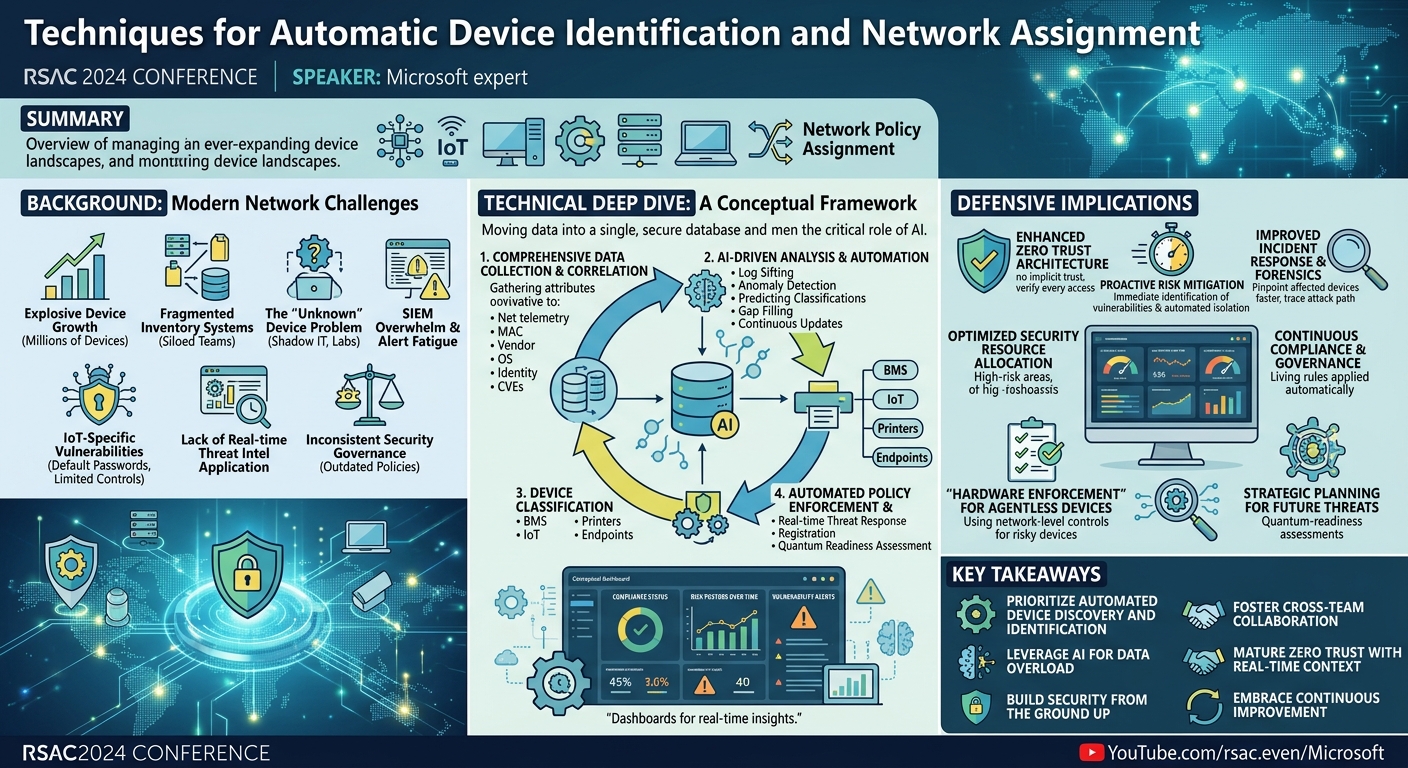
The proliferation of connected devices has introduced unprecedented complexity into modern enterprise networks. The speaker identifies several foundational challenges that contribute to a significant security gap:
- Explosive Device Growth: Organizations, from small businesses to tech giants like Microsoft, are grappling with hundreds of thousands, if not millions, of devices. This scale makes manual inventory and management utterly impractical. The speaker notes, "I work for Microsoft. I mean we got millions of devices. So, how do you manage all of that?"
- Fragmented Inventory Management: A common issue is the existence of disparate inventory systems across different teams. "This team has a good inventory. This team has a good inventory, this team has a good inventory. None of them were talking to each other. Why why is that?" This lack of consolidation leads to inconsistent data, varied reporting, and a fractured understanding of the network's true state.
- The "Unknown" Device Problem: Many devices, particularly in labs, IoT deployments, or shadow IT scenarios, remain unmanaged or completely invisible to security teams. These "unknown systems" represent significant blind spots and potential entry points for attackers.
- SIEM Overwhelm and Alert Fatigue: While SIEMs are ubiquitous, their effectiveness is often hampered by the sheer volume of logs, leading to an overwhelming number of false positives and false negatives. Organizations struggle to correlate this data with device identities and assign accurate threat risk ratings, forcing them to make "choices" about what to prioritize based on incomplete information.
- IoT-Specific Vulnerabilities: The rapid adoption of IoT devices, from smart building systems to industrial sensors, introduces unique security challenges. These devices often have limited processing power, making it difficult to implement robust security controls like endpoint protection or quantum-agile encryption. Furthermore, physical security is often overlooked, and default or weak passwords ("default or password or ABC 123") remain a pervasive issue, creating "bees to the honey" opportunities for hackers.
- Lack of Real-time Threat Intelligence Application: While many organizations follow frameworks like MITRE ATT&CK (referred to as "maker framework" in the talk), monitor CVEs, and subscribe to threat intelligence feeds, the ability to automatically apply this intelligence to their connected devices in real-time for isolation or remediation is often lacking.
- Inconsistent Security Governance: Outdated policies (some "six years old," "four years old") and a reliance on individual knowledge rather than documented, automated processes lead to inconsistencies and significant costs when staff turnover occurs. "Starting over is extremely expensive," the speaker emphasizes.
These challenges collectively highlight a critical need for a paradigm shift from reactive, manual security practices to proactive, automated, and intelligence-driven device management.
Key Findings
▶ Watch: Prioritizing inventory and overcoming siloed data management (2:15)
The talk presents several key findings and foundational principles necessary to overcome the challenges of modern device management and enhance network security:
- Automated, Consolidated Device Identification is Paramount: The speaker unequivocally states that identifying every connected device—knowing its type, vendor, OS, owner, and connection method—is the first and most critical step. This identification must be automatic and feed into a single, unified database to eliminate blind spots and provide a comprehensive view of the environment.
- AI is Essential for Data Correlation and Policy Enforcement: Manual sifting through "petabytes of information" from logs, scans, and inventory is impossible. Artificial Intelligence (AI) is identified as the indispensable tool for correlating vast datasets, applying governance policies in real-time, predicting device classifications, and automating risk assessments.
- Security Must Be Built-in, Not Bolted-on: Rather than being an afterthought, security policies and configurations must be integrated "from the ground up" at the design and deployment phases of any device or system. This includes pre-defined checklists and automated policy application that transcends individual teams or employees.
- Cross-Functional Collaboration is Non-Negotiable: Effective device identification and network assignment require continuous consultation and data sharing across multiple teams—networking, security operations, procurement, and even vendors. A unified view of risk and compliance can only be achieved if everyone "pulls stats from the same information."
- Zero Trust Requires Mature Device Identification: A robust Zero Trust strategy, which assumes no implicit trust and verifies every access attempt, cannot be fully realized without a mature system for identifying, classifying, and assessing the risk posture of every device attempting to connect or communicate.
- Continuous Improvement and Measurable Outcomes: Security is not a "done" state. Organizations must establish processes for continuous improvement, regularly updating policies, assessing program capabilities, and tracking progress against measurable goals such as compliance rates, risk reduction, and the effective allocation of resources.
Technical Deep Dive
▶ Watch: Managing device inventory and compliance at massive scale (3:15)
The technical depth of the talk focuses less on specific tool implementations and more on the architectural and process-oriented components required for effective automated device identification and network assignment. The speaker outlines a conceptual framework centered around data aggregation, classification, AI-driven analysis, and policy automation.
Data Collection and Correlation
The foundation of the proposed system is the comprehensive collection and correlation of diverse data points from across the network infrastructure. This goes beyond simple IP and MAC address collection. The speaker highlights the need to gather a rich set of attributes for each device, citing that some telemetry reports he uses contain "120 columns of information." Key data points include:
- Network Telemetry: IP addresses, MAC addresses, connection types (wired, wireless, VPN), access point identifiers, and switch port information from routers and firewalls.
- Device Attributes: Vendor identification, Operating System (OS), installed software, and hardware specifications.
- Identity Information: Who installed the device, who owns it, and user identity when connecting via AP or VPN. For IoT devices, this extends to understanding their aggregator and communication patterns, even during periods of dormancy.
- Threat Intelligence: Real-time feeds on CVEs (Common Vulnerabilities and Exposures), known compromises, and alignment with threat frameworks like MITRE ATT&CK (referred to as "maker framework").
All this information must be aggregated into a "single place that you can secure" – a robust database that serves as the "overall database of information." This database must be updated "in real time as much as real time as you can do" to ensure policy decisions are based on the most current state.
Device Classification and Categorization
Once data is collected, devices must be classified and categorized to enable risk-based decision-making. This involves grouping similar devices to apply appropriate security postures. Examples given include:
- Building Management Systems (BMS)
- General IoT devices
- Connected printers
- Endpoints (distinguishing those with MDE - likely Microsoft Defender for Endpoint - from those without).
This classification allows for nuanced risk assessments. For instance, a compromised IoT sensor might carry a different risk profile and require different isolation procedures than a compromised corporate laptop.
AI-Driven Automation and Policy Enforcement
The speaker emphasizes that manual analysis of "millions and millions of logs" or "petabytes of information" is impossible. AI is presented as the critical enabler for automation:
- Log Sifting and Anomaly Detection: AI systems can process vast amounts of log data from SIEMs, identifying patterns, anomalies, and potential threats that human analysts would miss or be overwhelmed by.
- Automated Policy Application: AI can automatically apply pre-defined governance policies. The idea is to "just modify the policies and then it automatically updates your telemetry." This ensures that security controls are consistently enforced across the ecosystem, transcending individual teams or employees.
- Predictive Classification and Gap Filling: For devices with incomplete information (e.g., "60 of those columns are blank"), AI can infer missing classifications or attributes by comparing them to similar, known devices deployed at similar times. This helps "fill some of those gaps" in the inventory database.
- Real-time Threat Response: AI can pull CVE information and apply it "in real time" to identify vulnerable devices. This enables immediate decision-making, such as isolating a device if it's running compromised code from a known vendor vulnerability.
- Automated Registration: Once a device is identified and its context understood, AI can facilitate automatic registration and onboarding into the network, assigning appropriate policies and security levels.
- Quantum Readiness Assessment: Looking to the future, AI can help identify which devices are "quantum ready" and using "quantum-agile algorithms" for encryption, and which are not. This allows organizations to plan for cryptographic upgrades on resource-constrained devices.
Security Governance and Custom Configurations
The technical system must be flexible enough to incorporate an organization's specific security governance documents and "custom configurations." This means the AI and automation frameworks need to be trainable and adaptable to bespoke policies, rather than relying solely on generic rules. The goal is for the system to make "good decisions for you in real time" based on your organization's unique risk appetite and operational requirements.
In essence, the technical deep dive describes a future state where a unified, intelligent system automatically ingests, correlates, classifies, and acts upon device data, transforming security operations from a reactive, manual effort into a proactive, automated, and continuously improving process.
Demo / Proof of Concept
▶ Watch: The unavoidable growth and security risks of IoT (5:00)
The speaker did not present a live demonstration or a specific proof of concept during the talk. Instead, the "Demo / Proof of Concept" section of the presentation focused on conceptual dashboards. These dashboards illustrated the desired outcome of implementing the discussed strategies, showcasing how aggregated and analyzed data could be visualized to provide real-time insights into device compliance, risk posture, and overall security status. The speaker emphasized that such dashboards would allow for quick assessment of "how many devices are potentially compromised," "which areas I have risk the most," and tracking progress on security initiatives over time. While no specific tools were demonstrated, the speaker noted that "There's companies out there, first party, third party companies that that can help you with this," implying that the capabilities described are achievable with existing or emerging technologies.
Defensive Implications
▶ Watch: Addressing physical security and access controls for IoT (5:45)
The strategies outlined in this talk have profound implications for defensive security postures, enabling organizations to move from a reactive stance to a proactive, intelligence-driven approach.
- Enhanced Zero Trust Architecture: A fully realized Zero Trust strategy hinges on knowing precisely what is connecting to the network, who owns it, and its current risk posture. By implementing automated device identification and network assignment, organizations can enforce granular access controls. Devices with high-risk scores or non-compliant statuses can be automatically isolated or subjected to stricter policies, ensuring that only trusted entities with verifiable identities and appropriate security postures can access resources. This allows for a "complete" Zero Trust strategy, extending beyond traditional endpoints to include all IoT and unknown devices.
- Proactive Risk Mitigation: Real-time correlation of device data with threat intelligence feeds (CVEs, MITRE ATT&CK) allows for immediate identification of vulnerable or compromised devices. Instead of waiting for an incident, the system can automatically flag devices running outdated software, using weak credentials, or exhibiting suspicious behavior. This enables rapid remediation, such as automated isolation, patching, or policy updates, before an exploit can spread.
- Improved Incident Response and Forensics: In the event of a compromise, having a consolidated, real-time database of all devices, their attributes, and their historical activity drastically reduces incident response times. Security Operations Center (SOC) teams can quickly pinpoint affected devices, understand their context ("who installed a device, we don't know when it was installed"), and trace the attack path, rather than struggling with "I can't click on and and and get the owner of that device."
- Optimized Security Resource Allocation: With clear visibility into the risk posture of all devices, security teams can prioritize their efforts and allocate resources more effectively. Dashboards showing "which areas I have risk the most" allow for targeted interventions, focusing on the most critical vulnerabilities or non-compliant segments of the network. This ensures that security investments yield the highest possible return.
- Continuous Compliance and Governance: Automated policy enforcement ensures that security governance documents are not just static papers but living rules applied across the entire network. The system can continuously monitor for non-compliance, automatically flagging devices that deviate from established baselines and initiating remediation workflows. This provides real-time reporting on compliance status, enabling organizations to meet regulatory requirements more consistently.
- "Hardware Enforcement" for Agentless Devices: Even for devices that cannot run traditional security agents (common in many IoT and OT environments), the system can still provide "hardware enforcement." By leveraging network telemetry, device fingerprinting, and behavioral analysis, the system can understand if a device is "risky," when it was last updated, or if it's running compromised code, allowing for network-level controls like micro-segmentation or blocking.
- Strategic Planning for Future Threats: The ability to assess "quantum readiness" of devices, for example, allows organizations to proactively plan for the transition to post-quantum cryptography, ensuring that even resource-constrained IoT devices can communicate securely in a future quantum computing landscape.
By leveraging these defensive implications, organizations can build more resilient, agile, and intelligent security infrastructures capable of defending against the evolving threat landscape.
Key Takeaways
- Prioritize Automated Device Discovery and Identification: Organizations must implement systems to automatically identify and classify every connected device, moving beyond manual inventories to a unified, real-time database that provides comprehensive visibility.
- Leverage AI for Data Overload: AI is indispensable for sifting through petabytes of logs, correlating disparate data points, and applying security policies automatically, enabling proactive risk management that human efforts alone cannot achieve.
- Build Security from the Ground Up: Integrate security policies and configurations into the design and deployment phases of all devices and systems, ensuring that security is proactive and consistent across the entire ecosystem.
- Foster Cross-Team Collaboration: Break down silos between networking, security, procurement, and even vendors to ensure a shared understanding of device inventory, risk profiles, and governance, leading to more effective and unified security outcomes.
- Mature Zero Trust with Real-time Context: A robust Zero Trust strategy relies on granular, real-time understanding of device identity and risk. Automated identification and assignment mechanisms are critical to achieving a mature Zero Trust posture and enforcing adaptive access controls.
- Embrace Continuous Improvement: Security is an ongoing journey. Regularly assess, update, and automate policies, track progress with dashboards, and allocate resources based on continuous risk assessments to ensure the security program remains effective and adapts to new threats and technologies.
About the Speaker(s)
The speaker, whose name was not provided in the talk metadata or transcript, is an individual with a strong background in network and infrastructure security. They are employed by Microsoft, a company with "millions of devices" which provides them with extensive experience in managing large-scale, complex environments. Their professional passions include inventory management, IoT implementations, and Zero Trust strategies. Throughout the talk, the speaker demonstrates deep expertise in the challenges of device connectivity and the strategic approaches required to secure modern digital infrastructures.