Ransomware Resilience: Holistic Defense for SOC Leaders
RSA Conference 2024 · Track Session
Overview
In an era defined by escalating cyber threats, ransomware continues to be a formidable challenge for organizations globally. This talk, presented by Neelima, VP Products for Cybersecurity, and Jithin Nair, Senior Manager for the Security Research team, both from Zscaler, delivers a critical examination of the evolving ransomware landscape and offers a holistic defense strategy tailored for Security Operations Center (SOC) leaders and security practitioners. The speakers dissect the sophisticated tactics employed by modern ransomware groups, highlighting the inadequacy of traditional security measures and emphasizing the imperative for a multi-layered, adaptive defense.
Key moments
- 0:00 Introduction and 2023 Ransomware Trends
- 2:00 Impact of SEC Disclosure Rule on Ransomware
- 3:50 Ransomware Actor Rebranding and Sanctions
- 5:00 Emerging Programming Languages in Ransomware Development
- 6:00 Understanding Ransomware Attacks via Bank Robbery Analogy
- 6:50 Ransomware Attack Lifecycle: Fingerprinting & Compromise
- 8:00 Ransomware Attack Lifecycle: Lateral Movement
Ransomware Resilience: Holistic Defense for SOC Leaders
Speakers: Neelima, VP Products for Cybersecurity at Zscaler; Jithin Nair, Senior Manager for the Security Research team with Zscaler
Conference: RSAC 2024
YouTube: https://www.youtube.com/watch?v=g5uKGVznoEY
Overview
In an era defined by escalating cyber threats, ransomware continues to be a formidable challenge for organizations globally. This talk, presented by Neelima, VP Products for Cybersecurity, and Jithin Nair, Senior Manager for the Security Research team, both from Zscaler, delivers a critical examination of the evolving ransomware landscape and offers a holistic defense strategy tailored for Security Operations Center (SOC) leaders and security practitioners. The speakers dissect the sophisticated tactics employed by modern ransomware groups, highlighting the inadequacy of traditional security measures and emphasizing the imperative for a multi-layered, adaptive defense.
The presentation provides a comprehensive analysis of 2023 ransomware trends, including the significant surge in attacks, the prevalence of Ransomware-as-a-Service (RaaS) models, and the emergence of new extortion techniques. It underscores the profound impact on critical sectors like healthcare and manufacturing, and the strategic shifts in attacker methodologies, such as encryptionless extortion and the leveraging of GenAI. By detailing the full ransomware kill chain through the lens of a prominent threat actor, Scattered Spider, the talk offers actionable insights into bolstering an organization's resilience against these persistent and increasingly complex threats.
Background
▶ Watch: Introduction and 2023 Ransomware Trends (0:00)
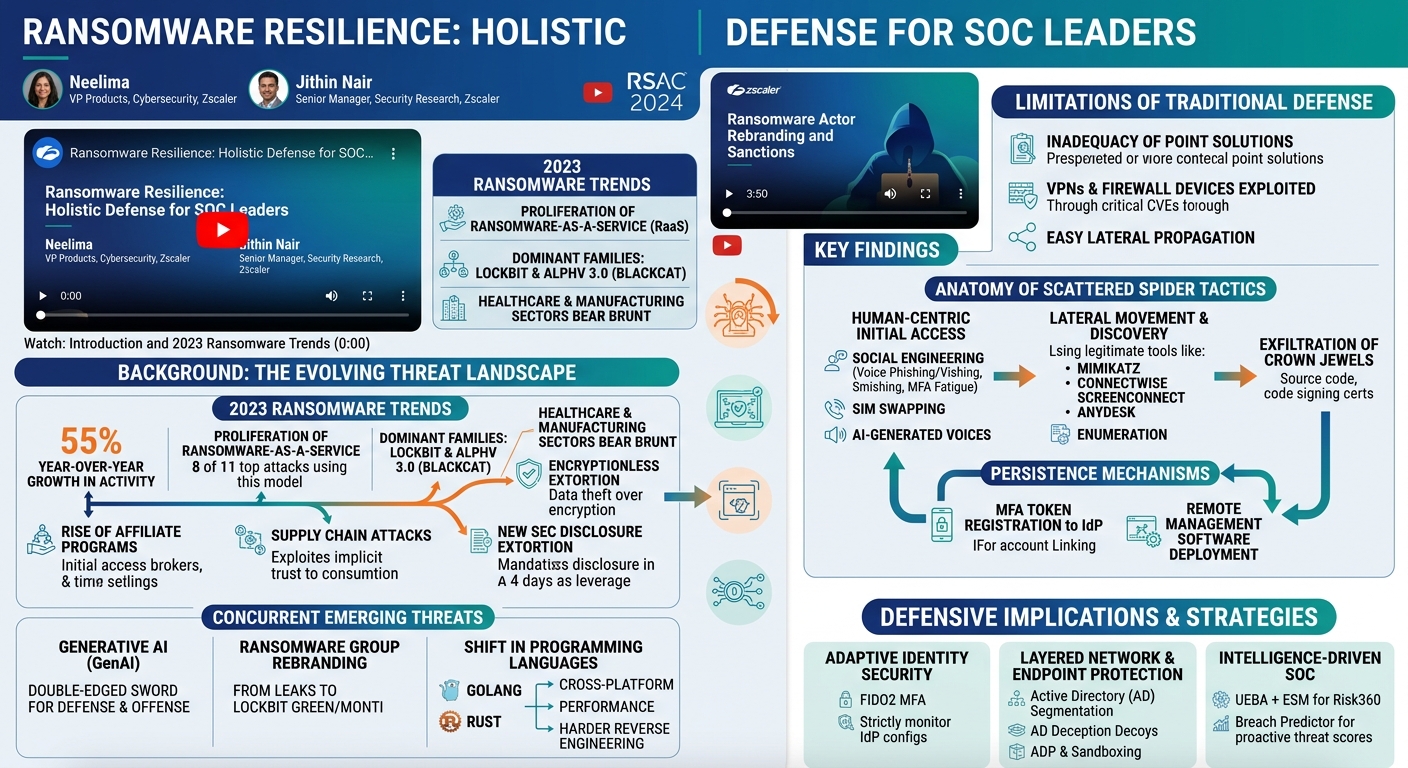
The ransomware landscape underwent significant transformations in 2023, exhibiting a 55% year-over-year growth in activity compared to 2022. This surge was largely driven by the proliferation of Ransomware-as-a-Service (RaaS) models, with eight of the eleven top ransomware attacks leveraging this structure. The health and manufacturing sectors bore the brunt of these attacks, highlighting their critical vulnerabilities. Dominant ransomware families like LockBit and ALPHV 3.0 (also known as BlackCat) were responsible for a substantial portion of these incidents, with LockBit alone impacting over 2,500 companies and extorting more than $500 million.
Several concurrent trends further complicated the threat landscape. The rise of affiliate programs saw initial access brokers selling validated access to target organizations for a commission, bypassing the need for direct infiltration. Supply chain attacks gained prominence due to their broader impact and ability to circumvent traditional security layers by exploiting implicit trust in third-party vendors. A significant shift was observed in encryptionless extortion, where attackers pivoted from encrypting data to simply stealing massive datasets and leveraging the threat of public disclosure for financial gain, often in conjunction with the new SEC disclosure rule. This rule, effective December 18, 2023, mandates public companies to disclose material breaches within four days, providing attackers with a powerful new leverage point for fear-mongering and extortion, as exemplified by BlackCat's reported SEC complaint against a healthcare vendor.
The emergence of Generative AI (GenAI) also presented a double-edged sword. While security vendors harness GenAI to enhance protective layers, threat actors exploit it to generate variations of attack sequences that easily bypass behavioral signature patterns. Furthermore, the practice of ransomware groups rebranding themselves intensified. Following the 2022 leak of Conti ransomware infrastructure, many new strains like Akira, LockBit Green, and Monti emerged from its source code. More recently, groups have moved away from Conti, adopting builders like LockBit Black. Rebranding also serves to evade government sanctions, allowing groups to dissolve, spin up new infrastructure, and resurface under a new name to continue illicit operations.
Finally, there has been a notable shift in the programming languages used for ransomware development. Traditionally, low-level languages like C and C++ were favored. However, advanced languages such as Golang and Rust are increasingly being adopted. These languages offer significant advantages to attackers, including cross-platform compatibility, performance optimization, robust third-party library support, and the creation of binaries that are more time-consuming and difficult to reverse engineer, thereby complicating detection and analysis efforts.
Key Findings
▶ Watch: Ransomware Actor Rebranding and Sanctions (3:50)
The talk's key findings revolve around the evolving sophistication of ransomware attacks and the critical need for a holistic, adaptive defense strategy. Traditional security layers are proving insufficient against these advanced threats, necessitating a fundamental shift in how organizations approach ransomware resilience.
Firstly, the analysis of 2023 trends revealed a significant escalation in attack volume and complexity, driven by RaaS models, affiliate programs, and the strategic exploitation of supply chains and encryptionless extortion. The new SEC disclosure rule has inadvertently provided a potent new vector for attackers to pressure victims. The dual impact of GenAI, enhancing both defensive and offensive capabilities, further underscores the rapidly changing threat landscape.
Secondly, the talk highlighted the inherent vulnerabilities in traditional security architectures, particularly concerning VPNs and firewall devices, which are frequently exploited through high-criticality CVEs. These vulnerabilities often allow attackers to bypass perimeter defenses and achieve easy lateral propagation within corporate networks. The speakers emphasized that even with numerous security software deployments, zero-day exploits can render these defenses ineffective.
A central finding was the detailed breakdown of the Scattered Spider threat actor's methodology, which exemplifies modern, advanced ransomware tactics. Their reliance on sophisticated social engineering (voice-based phishing, smishing, vishing), SIM swapping, and MFA fatigue attacks to gain initial access to high-privilege accounts, particularly targeting administrators, represents a significant shift from purely technical exploits. Once inside, they leverage legitimate tools like Mimikatz, ConnectWise ScreenConnect, and AnyDesk for lateral movement and discovery of crown jewels. Their persistence mechanisms, including registering their own MFA token to federated identity providers for account linking and deploying remote management software, demonstrate a deep understanding of identity and endpoint environments.
Finally, the talk proposed an "art of possible" for defense, advocating for a holistic 360-degree risk view. This includes solutions like UEBA (User and Entity Behavior Analytics) combined with ESM (External Security Management) for comprehensive user risk scoring (Risk360). It also champions FIDO2-based and hardware token-based MFA as superior alternatives to bypassable MFA methods, the implementation of Active Directory (AD) segmentation and deception decoys for lateral movement prevention, and advanced tools like Breach Predictor to generate forward-looking threat scores and enhance proactive defense. These findings collectively underscore that effective ransomware resilience requires moving beyond point solutions to an integrated, intelligence-driven, and human-aware security posture.
Technical Deep Dive
▶ Watch: Emerging Programming Languages in Ransomware Development (5:00)
The talk dissects the ransomware infection chain using a bank robbery analogy, outlining five distinct stages: fingerprinting, initial compromise, lateral propagation, data exfiltration, and persistence. Each stage is characterized by sophisticated techniques that often bypass traditional security measures.
1. Fingerprinting the Victim (Reconnaissance):
This initial phase involves attackers gathering intelligence on potential targets. Unlike traditional network scanning, modern threat actors heavily rely on Open Source Intelligence (OSINT). They leverage platforms like LinkedIn and Google searches to identify employees with high-level access to production systems or administrative privileges. The goal is to pinpoint individuals whose compromise would yield maximum profit or access to critical assets. This stage often lies beyond the visibility of an organization's internal security tools, as the reconnaissance occurs on external platforms.
2. Initial Compromise:
Once a target is identified, attackers employ various vectors to gain initial access. These include:
- Spear Phishing and Social Engineering: Highly targeted emails or messages with organization-specific banners and content, designed to trick employees into revealing credentials or executing malicious files.
- Zero-Day Vulnerability Exploitation: Attackers actively exploit unknown or unpatched vulnerabilities in software or tools used by the organization. The speakers highlighted high-criticality CVEs in VPNs and firewall devices, which, if exploited, can grant attackers a direct foothold into the corporate network. These vulnerabilities often encompass remote code execution, command injection, authentication bypass, and privilege escalation. CISA advisories on some of these zero-days even recommended disconnecting affected products due to the lack of immediate patches.
The talk used Scattered Spider as a prime example for this stage. This group excels in social engineering tactics, going beyond simple email phishing. Their methods include:
- Voice-based Phishing (Vishing): Highly persuasive phone calls to trick users into divulging usernames and passwords.
- SMS Phishing (Smishing): Text messages designed to elicit sensitive information.
- SIM Swapping: Persuading cellular carriers to transfer a victim's phone number to an attacker-controlled SIM card, granting access to PII, security question answers, and MFA codes.
- MFA Fatigue Attacks: Repeatedly sending MFA prompts to a victim, hoping they will eventually approve one out of frustration or confusion.
- AI-Generated Voices: Utilizing AI to mimic the voice of a CEO or other authority figures to increase the persuasiveness of vishing attacks.
- Impersonation: Posing as IT help desk staff or other employees to request the execution of remote assistance tools or to persuade IT to reset credentials, claiming lost phone access for MFA.
3. Lateral Propagation (Internal Movement):
After initial compromise, the objective is to move deeper into the network. Attackers seek Active Directory (AD) domain controllers or other crown jewels that hold the most valuable data. Scattered Spider, for instance, leverages legitimate remote assistance tools and other utilities for this phase:
- Mimikatz: A well-known post-exploitation tool used to extract passwords, hash, PINs, and Kerberos tickets from memory.
- ConnectWise ScreenConnect and AnyDesk: Legitimate remote control software often abused by attackers to maintain persistent access and move between systems.
The main purpose here is to enumerate the victim's environment, discover critical assets, and locate valuable data such as code repositories, code signing certificates, and source code.
4. Data Exfiltration:
Once valuable data is located, attackers focus on extracting it from the organization's network. Common methods include:
- Telegram Channels: Direct upload of stolen data.
- Encrypting/Archiving and Uploading to File Sharing Platforms: Compressing and encrypting data, then uploading it to services like Mega or Google Drive, from where it can be retrieved and used for ransom demands.
5. Persistence:
Maintaining access is crucial for attackers. Scattered Spider demonstrates creative persistence techniques:
- MFA Token Registration: They register their own MFA token to the organization's federated identity provider (IdP) to activate account linking. This allows them to retain access to the compromised account even if the victim changes their password.
- Endpoint Remote Shell Capabilities: Utilizing remote shell access to install remote management software, establishing a backdoor and ensuring continued access to the endpoint.
These dual pathways (identity layer and endpoint layer) make it extremely difficult to dislodge the threat actor, especially when they can disable endpoint protection, as observed in some cases.
The ransomware kill chain, as demonstrated by Scattered Spider, highlights a sophisticated blend of human-centric social engineering and technical exploitation, making detection and prevention a multi-faceted challenge.
Demo / Proof of Concept
▶ Watch: Ransomware Attack Lifecycle: Fingerprinting & Compromise (6:50)
The talk focused on a detailed exposition of ransomware tactics and defensive strategies rather than a live demonstration or proof-of-concept during the presentation. While the speakers outlined the "art of possible" for various stages of an attack, including specific tools and methodologies for detection and prevention, they did not describe an actual real-time or recorded demo of these concepts in action. The emphasis was on illustrating how threat actors like Scattered Spider operate and what theoretical and architectural solutions organizations should consider.
Defensive Implications
▶ Watch: Ransomware Attack Lifecycle: Lateral Movement (8:00)
Defending against modern ransomware, particularly sophisticated actors like Scattered Spider, requires a holistic and layered strategy that moves beyond traditional perimeter-based security. SOC leaders must adopt an adaptive approach, integrating technologies and processes across identity, network, and endpoint security.
For the Fingerprinting/Discovery Stage:
- Zero Trust Network Access (ZTNA) and External Security Management (ESM): Deploying ZTNA helps hide users and applications from the public internet, reducing the attack surface. ESM solutions can identify what assets are exposed externally, allowing organizations to implement compensatory controls.
- User and Entity Behavior Analytics (UEBA) + ESM: A combined approach, exemplified by Zscaler's Risk360 concept, can provide a holistic risk view by correlating internal user behavior with external exposures, enabling better hardening of the enterprise security posture.
- Employee Awareness: Emphasize caution regarding information shared on social media and strict policies against providing credentials over the phone.
For the Initial Compromise Stage:
- Robust Employee Training: Regular, simulated phishing and social engineering attacks are crucial to raise employee awareness and train them to recognize and report sophisticated vishing, smishing, and AI-generated voice attacks. The "social engineered radar" must always be on.
- Strong Multi-Factor Authentication (MFA): Implement FIDO2-based and hardware token-based MFA mechanisms. These are significantly more resistant to SIM swapping, phishing, and MFA fatigue attacks compared to SMS or app-based push notifications.
- Strict IT Help Desk Protocols: Establish stringent verification processes for password resets and MFA changes, especially when dealing with requests claiming lost phone access.
For the Lateral Propagation Stage:
- Layered Strategy for Network Segmentation: Design a robust network segmentation strategy, particularly for Active Directory (AD). This makes it significantly harder for threat actors, even if they breach the perimeter, to move laterally and reach critical AD domain controllers or crown jewels.
- Active Directory Deception Decoys: Deploy deception decoys within the AD environment. If an attacker attempts lateral movement, they are likely to inadvertently interact with these decoys, triggering alerts and generating signals for the SOC. This provides early warning of threat actor activity.
- Identity Threat Detection and Response (ITDR) and Application Protection: Implement ITDR solutions to detect and respond to identity-based threats, combined with strong application protection to secure access to critical applications.
- Continuous Log Review: Regularly review logs for any unauthorized remote assistance tools (e.g., ConnectWise ScreenConnect, AnyDesk) or other remote access software activity within the network.
For the Persistence Stage:
- Advanced Endpoint Protection (ADP) and Sandboxing: Utilize ADP solutions with sandboxing capabilities to detect and prevent the installation of unauthorized remote management software.
- Identity Provider (IdP) Monitoring: Implement stringent monitoring and auditing of IdP configurations to detect unauthorized MFA token registrations or account linking attempts.
- Zero Trust Principles: Apply Zero Trust principles to ensure that every access request, even from within the network, is authenticated, authorized, and continuously verified.
Overall Holistic Approach:
- Breach Predictor Tools: Leverage tools like Breach Predictor (as mentioned by Zscaler) that can generate threat scores based on observed attack stages and even predict forward-looking activities. This enables SOC teams to add proactive coverage for later stages of the attack kill chain.
- Integrated Risk View: Consolidate security telemetry to achieve a holistic 360-degree view of user and asset risk, allowing for more informed and proactive security posture management.
By integrating these defensive strategies, organizations can build a more resilient defense against the evolving tactics of ransomware groups, transforming their SOC from a reactive incident response center to a proactive threat prevention and prediction hub.
Key Takeaways
- Ransomware is Evolving Rapidly: 2023 saw a 55% growth in ransomware, driven by RaaS, affiliate programs, supply chain attacks, and encryptionless extortion, often leveraging the new SEC disclosure rule for added pressure.
- Social Engineering is the Primary Initial Access Vector: Sophisticated threat actors like Scattered Spider heavily rely on voice phishing, SIM swapping, and MFA fatigue attacks, sometimes enhanced by GenAI, to compromise high-privilege accounts.
- Traditional Defenses Are Insufficient: Perimeter security, basic antivirus, and common MFA methods are easily bypassed by modern attackers who exploit zero-days in VPNs/firewalls and abuse legitimate tools for lateral movement and persistence.
- Holistic Defense is Essential: A multi-layered strategy is crucial, combining strong identity security (FIDO2 MFA, IdP monitoring), network segmentation (AD segmentation, ZTNA), endpoint protection (ADP, sandboxing), and proactive threat intelligence.
- Proactive Monitoring and Deception: Implementing UEBA+ESM (Risk360) for a 360-degree risk view, deploying AD deception decoys, and utilizing "Breach Predictor" tools can provide early warnings and predict future attack stages, enabling proactive mitigation.
- Employee Training is a Critical Layer: Regular, simulated social engineering exercises are vital to educate staff, making them the first line of defense against human-centric attack techniques.
About the Speaker(s)
Neelima is the VP Products for Cybersecurity at Zscaler. In her role, she focuses on developing and overseeing product strategies within the cybersecurity domain, bringing a deep understanding of market trends and defensive technologies to address contemporary threats like ransomware.
Jithin Nair is the Senior Manager for the Security Research team with Zscaler. His work involves in-depth analysis of emerging cyber threats and attacker methodologies, providing critical insights into the technical nuances of ransomware campaigns and the vulnerabilities they exploit.