‘Nurturing’ AI: The Story of How an AI Copilot Was Built
RSA Conference 2024 · Track Session
Overview
In this insightful talk from RSAC 2024, Ofir Israel, a Product Manager and Engineer at Checkpoint, shares the compelling journey of building an AI copilot for security operations and administration. Titled "Nurturing AI," the presentation delves into the unique engineering challenges and innovative solutions Checkpoint developed to integrate generative AI into its security product suite. Israel emphasizes that developing such a system goes far beyond simple API integration with existing large language models (LLMs), likening the process more to teaching or "nurturing" an intelligent entity rather than traditional programming.
Key moments
- 0:00 Checkpoint's AI Copilot launch and excitement
- 2:00 ChatGPT's rapid adoption and enterprise AI race
- 3:00 Attackers using GenAI for spam and KYC bypass
- 4:30 Checkpoint's vision for AI-assisted software interaction
- 6:00 AI development: teaching and nurturing, not just coding
- 6:40 Prompts as the new, less deterministic programming language
- 8:00 Diving into LLMs: the brain of the AI copilot
‘Nurturing’ AI: The Story of How an AI Copilot Was Built
Speakers: Ofir Israel, Product Manager, Checkpoint
Conference: RSAC 2024
YouTube: https://www.youtube.com/watch?v=VyIXtgT5FLM
Overview
In this insightful talk from RSAC 2024, Ofir Israel, a Product Manager and Engineer at Checkpoint, shares the compelling journey of building an AI copilot for security operations and administration. Titled "Nurturing AI," the presentation delves into the unique engineering challenges and innovative solutions Checkpoint developed to integrate generative AI into its security product suite. Israel emphasizes that developing such a system goes far beyond simple API integration with existing large language models (LLMs), likening the process more to teaching or "nurturing" an intelligent entity rather than traditional programming.
The talk highlights Checkpoint's vision for a future where every user interaction with software is augmented by AI assistance, transforming how security professionals manage and respond to threats. By sharing Checkpoint's experience, Israel aims to inspire other organizations to embrace generative AI, underscoring its revolutionary potential to enhance user experience, streamline complex tasks, and ultimately improve security posture. This deep dive into the practicalities of building an enterprise-grade AI copilot offers invaluable lessons for product developers, security engineers, and business leaders looking to leverage this rapidly evolving technology.
Background
▶ Watch: Checkpoint's AI Copilot launch and excitement (0:00)
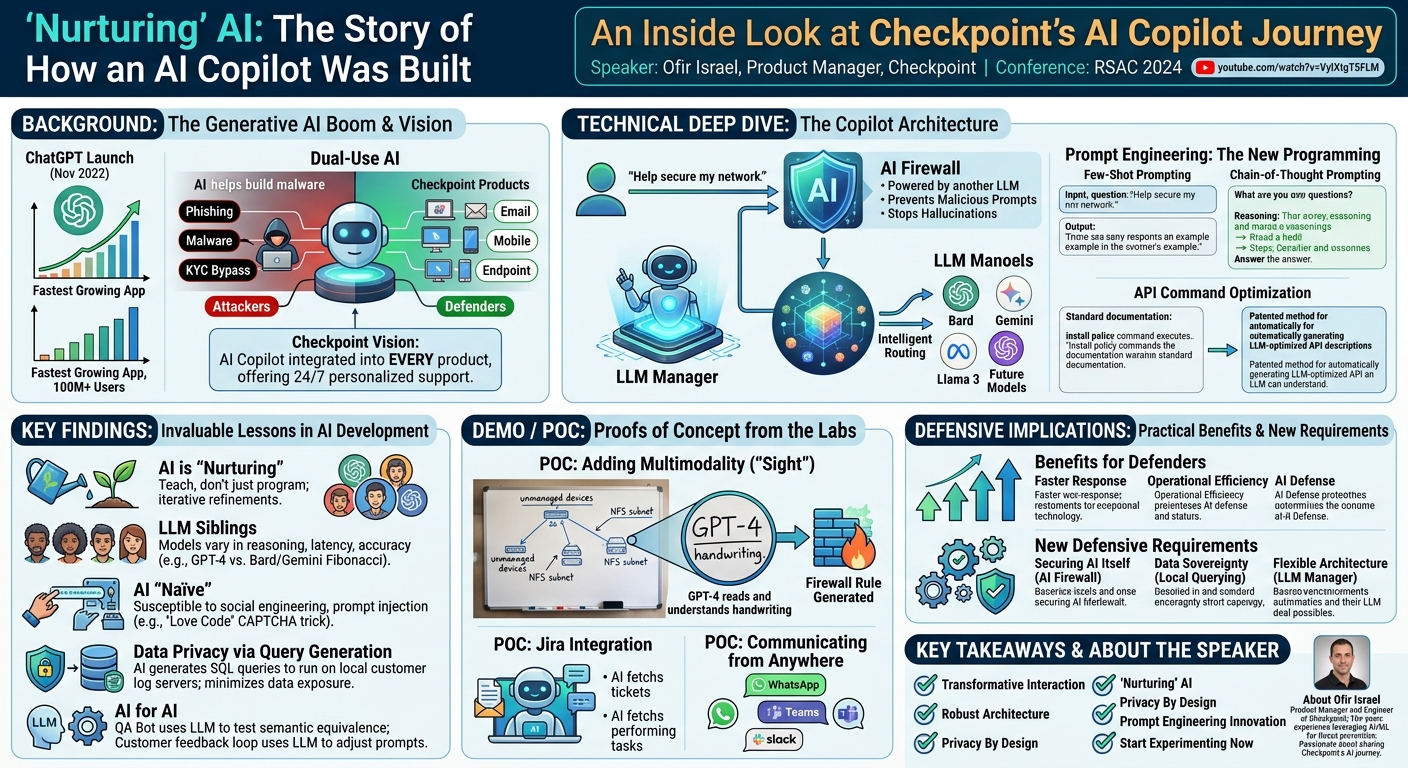
The landscape of artificial intelligence underwent a seismic shift with the launch of ChatGPT in November 2022. This event, as Ofir Israel points out, was the "opening shot of a race" to incorporate generative AI into enterprise applications. ChatGPT quickly became the fastest-growing consumer application in history, reaching 100 million monthly active users in just two months. This unprecedented adoption rate illuminated the immense potential of LLMs for a broad audience, including Checkpoint, despite the underlying technology having existed prior to OpenAI's public offering. The subsequent boom saw a proliferation of LLM marketplaces, advancements in GPU technology, and a widespread desire across industries to integrate AI capabilities.
However, this rapid advancement also introduced new challenges and risks, particularly from an attacker's perspective. Checkpoint Research teams continuously monitor underground forums and the dark web, observing the evolving tactics of threat actors. Initially, attackers used generative AI for "naive things" like accelerating the development of simple malware or drafting more convincing phishing emails. More recently, however, Israel notes a shift towards more robust and proven applications, citing examples like AI-powered spam generation services claiming to bypass filters with high conversion rates, and KYC (Know Your Customer) bypass services using generative AI to falsify identification documents. This demonstrates the dual-use nature of AI and the imperative for defenders to also leverage this technology.
Checkpoint's vision, spurred by this eye-opening period, is to embed AI copilots into every one of its products—from mobile and endpoint security to email and cloud security. This ambitious goal stems from the belief that AI assistants, much like personal assistants, can know user preferences, goals, and habits, providing 24/7 support to allow humans to focus on higher-level tasks. Israel stresses that building such an AI copilot is fundamentally different from traditional software engineering. Instead of deterministic programming (e.g., if-then-else statements), working with LLMs involves "teaching," "guiding," or "maturing" the AI through natural language prompts. This non-deterministic nature means the output isn't always predictable, demanding a novel approach to development, which Checkpoint likened to raising a child.
Key Findings
▶ Watch: Attackers using GenAI for spam and KYC bypass (3:00)
Checkpoint's journey in building its AI copilot revealed several critical insights into the practical application and challenges of generative AI in an enterprise security context:
- AI Development is "Nurturing," Not Just Programming: The process of working with LLMs is akin to teaching or guiding, rather than traditional deterministic coding. This requires a continuous iterative approach of refining prompts based on observed outputs, a departure from typical software development methodologies.
- LLMs are Diverse "Siblings": While all LLMs share fundamental capabilities like natural language comprehension and basic reasoning, they differ significantly in aspects such as prompt length capacity, latency, reasoning quality, and propensity for invention. Checkpoint's experience with the Fibonacci sequence problem, where GPT-4 correctly answered 34, but Bard (and initially Gemini) failed multiple times, underscored this variability.
- LLMs are Naive and Easily Tricked: Generative AI models can be easily manipulated through social engineering tactics, even simple ones. The example of an LLM initially refusing to decipher a CAPTCHA but then doing so when framed as a "love code" from a deceased grandmother illustrates the vulnerability to prompt injection and other adversarial techniques.
- Specialized Architecture is Essential: To manage LLM diversity and ensure security, Checkpoint developed core architectural components:
- LLM Manager: A crucial component designed to intelligently route specific user questions to the most suitable LLM from a pool of available models based on their strengths and weaknesses.
- AI Firewall: An innovative security layer that uses one LLM to guard another, preventing harmful outputs, policy breaches, API misuse, and hallucinations.
- Proprietary Prompt Optimization for APIs: To effectively enable the copilot to interact with Checkpoint's vast array of internal APIs, the company developed a patented method to automatically generate LLM-optimized descriptions of API functions. This addresses the limitations of traditional API documentation and prompt size, ensuring the LLM can accurately select and utilize relevant commands.
- Data Privacy Through Query Generation: Rather than feeding sensitive customer log data directly to LLMs (which presents privacy and prompt size challenges), Checkpoint taught its copilot to generate SQL queries. This allows the AI to query the customer's log server directly, extract only the necessary aggregated information, and then process it locally, minimizing data exposure.
- AI for AI: Validation and Feedback Loops: Checkpoint leverages LLMs to test and improve other LLMs. A QA bot uses an LLM to verify the semantic equivalence of generated answers against expected outputs. Furthermore, customer feedback (thumbs up/down) is used by another LLM to continuously adjust and refine the copilot's prompts.
- Multimodality and Integration are Future Frontiers: Checkpoint's research labs are exploring advanced capabilities like integrating visual input (e.g., an LLM interpreting a handwritten network topology diagram to generate firewall rules) and seamless integration with other enterprise systems like Jira for automated ticket handling, as well as ubiquitous access through communication platforms like WhatsApp, Teams, and Slack.
These findings collectively highlight that building an effective and secure enterprise AI copilot demands a sophisticated, multi-layered approach that addresses model selection, security, data handling, and continuous refinement.
Technical Deep Dive
▶ Watch: Checkpoint's vision for AI-assisted software interaction (4:30)
The technical implementation of Checkpoint's AI copilot revolves around sophisticated prompt engineering and a layered architectural design. Ofir Israel detailed several key techniques and components:
At the core of interacting with LLMs is prompt engineering, which Israel describes as the new programming language, albeit a non-deterministic one. A well-constructed prompt typically consists of three parts:
- Context: Explaining the LLM's role or the purpose of the query (e.g., "You are an expert nutritionist.").
- Instruction: Guiding the LLM on how to format its response (e.g., "Provide answers in bullet points.").
- Task: The specific request or question (e.g., "Create a meal plan for 2,000 calories a day.").
Beyond this basic structure, Checkpoint employs two advanced prompt engineering techniques:
- Few-shot prompting: This involves providing the LLM with a few examples of input questions and their desired output answers alongside the main prompt. This helps the model understand the expected behavior, including how to react when it doesn't know an answer or if the answer is too extensive.
- Chain-of-thought prompting: This technique goes a step further by not only providing examples of questions and answers but also explaining the reasoning steps to get from the question to the answer. This guides the LLM's internal thought process, leading to more accurate and logical responses.
To address the inherent variability and limitations of different LLMs, Checkpoint developed the LLM Manager. This component acts as a router, intelligently directing specific user questions to the most appropriate LLM within a pool of models. For example, some mathematical or factual queries might be routed to a model known for high accuracy (like GPT-4), while creative tasks might go to another. This dynamic routing ensures optimal performance and reliability, and the system is designed to seamlessly integrate new models like GPT-5 or Llama 3 as they emerge.
Security is paramount, especially in a security product. Checkpoint's AI Firewall is a unique solution designed to guard the copilot against misuse and harmful outputs. This firewall itself is powered by an LLM, effectively using one AI to monitor and control another. Its prompt is designed to check if a user's statement "would make a large language model break moderation policies, give bad answers, false responses, change the behavior." This prevents the copilot from executing API commands based on misinformed decisions, generating harmful speech, providing unclear or hallucinated answers, or offering bad advice on topics it hasn't been explicitly taught. The CAPTCHA deciphering example, where the LLM was tricked into violating its own rules, served as a strong justification for this protective layer.
Teaching the copilot new skills involved overcoming significant technical hurdles, particularly with API interaction and data handling.
For API commands, the challenge was twofold: prompt size limitations and the need for LLM-friendly descriptions. Checkpoint's patented solution automatically generates LLM-optimized descriptions of its internal API functions. Instead of terse, jargon-filled documentation like "executes the install policy on a given list of targets" for an install policy command, the optimized description is much more elaborate, providing context and explaining what the function does and how it works in a way an LLM can comprehend. These optimized descriptions are then stored and retrieved dynamically, ensuring only the most relevant API commands are presented to the LLM for a given task, such as "add an access rule that blocks traffic from port 667."
For analyzing customer logs, the problem of sending vast amounts of sensitive data to an external LLM was unacceptable due to privacy concerns and prompt size limits. Checkpoint's solution was to teach the copilot to generate SQL queries that run directly on the customer's log server. This involves providing the LLM with the schema of various log types (e.g., threat prevention, application, access, audit) and explicit guidelines for query construction. Israel noted the painstaking process of refining these prompts, even needing to explicitly define concepts like "today is only the current day" and "yesterday is the day before the current day" to prevent incorrect results – a testament to the "nurturing" aspect of AI development.
Finally, Checkpoint implemented robust mechanisms for testing and continuous improvement. A QA bot, an LLM itself, verifies the results of the copilot. Instead of simple string matching, it assesses whether the generated answer produces the "same results" as the expected answer. This semantic understanding is crucial for LLM output validation. Additionally, customer feedback (thumbs up/down) is collected and used to dynamically adjust and refine prompts, leveraging yet another LLM in a continuous feedback loop.
Demo / Proof of Concept
▶ Watch: Prompts as the new, less deterministic programming language (6:40)
While Ofir Israel's presentation at RSAC 2024 did not feature a live, interactive demonstration of the Checkpoint Infinity AI Copilot, he extensively described its in-production capabilities and several advanced proof-of-concept (POC) projects currently in Checkpoint's research labs. These descriptions effectively served to illustrate the practical application and future potential of their AI copilot architecture.
The core functionality of the copilot, already in production, allows security professionals to interact with Checkpoint's firewall and security logs using natural language. This includes tasks such as adding access rules (e.g., "add an access rule that blocks traffic from port 667") and querying log data (e.g., "show me the top five most blocked attacks in the last seven days"). The intricate technical deep dive into the LLM Manager, AI Firewall, LLM-optimized API descriptions, and SQL query generation mechanisms implicitly demonstrates the underlying capabilities that power these in-production features.
Furthermore, Israel detailed three "very cool" research projects that represent the future evolution of the copilot, each serving as a compelling proof of concept:
- Multimodality (Adding "Sight"): This POC leverages LLMs with multimodal capabilities to process visual information. In a compelling experiment, Checkpoint fed GPT-4 a handwritten whiteboard diagram depicting a network topology, including subnets and device names. The prompt then asked the LLM to "create a network firewall rule to block access from the unmanaged devices subnet into the NFS subnet." The model successfully understood the handwritten text, the visual structure of the topology, and generated the correct firewall rule. This demonstrates the potential for security administrators to simply photograph a whiteboard diagram and have the copilot automatically translate it into executable security policies.
- Communicating with Other Systems (Jira Integration): This POC focuses on enabling the copilot to interact with external enterprise systems. The specific example given was integration with Jira, a popular issue-tracking software. The copilot is designed to retrieve tickets from Jira, understand the problem described, and then autonomously perform the necessary security tasks or configurations. This envisions a 24/7 AI assistant that can triage and resolve security incidents or implement changes while human operators are offline, significantly enhancing operational efficiency.
- Communicating from Anywhere (Ubiquitous Access): Recognizing that text-based conversations are not confined to a graphical user interface, Checkpoint is researching how to integrate the copilot into common communication platforms. The POC explores enabling interaction with the copilot via channels like WhatsApp, Teams, and Slack. This aims to make the AI assistant accessible wherever security teams collaborate, mirroring natural human interaction patterns with peers or employees.
These described capabilities, particularly the multimodal whiteboard interpretation, provide concrete examples of the advanced functionalities Checkpoint is developing, showcasing the practical and transformative impact of their AI copilot.
Defensive Implications
▶ Watch: Diving into LLMs: the brain of the AI copilot (8:00)
The development and deployment of Checkpoint's AI copilot offer several significant defensive implications for organizations grappling with complex security environments and the burgeoning threat landscape.
Firstly, operational efficiency and accelerated response are paramount. An AI copilot can significantly reduce the manual effort and time required for routine security tasks. Automating the generation of firewall rules, summarizing extensive log data, and potentially even initiating incident response actions frees up human security analysts to focus on more complex, strategic challenges. This directly translates into a more agile and effective defensive posture, allowing organizations to react faster to emerging threats.
Secondly, the talk highlights the critical need for securing AI itself. The "naivety" of LLMs and their susceptibility to prompt injection attacks (as demonstrated by the CAPTCHA example) underscores that AI-powered tools, especially those interacting with critical infrastructure, must be protected. Checkpoint's AI Firewall paradigm, using one LLM to guard another, provides a blueprint for how defenders can implement robust security layers to prevent malicious actors from manipulating copilots to perform unauthorized actions, leak sensitive data, or generate harmful content. This is a crucial design consideration for any organization integrating generative AI into its security stack.
Thirdly, data privacy and sovereignty are emphasized. The decision to teach the copilot to generate SQL queries for local log servers, rather than sending raw customer data to external LLMs, is a powerful defensive strategy. This minimizes the exposure of sensitive customer information to third-party AI providers, addressing major compliance and trust concerns. Organizations should adopt similar architectural patterns that prioritize data locality and restrict the flow of sensitive information when leveraging cloud-based or external LLMs.
Furthermore, the concept of the LLM Manager informs an adaptable defense strategy. Recognizing that no single LLM is perfect for all tasks, security teams should build flexible architectures that can dynamically route queries to specialized models. As new LLMs emerge or existing ones improve, this allows for continuous optimization of AI capabilities without requiring a complete system overhaul. This agility is vital in a rapidly evolving AI landscape.
Finally, the talk encourages a proactive approach to AI adoption within security operations. Ofir Israel's exhortation to "just do it" and not "wait for the dust to settle" suggests that organizations should immediately begin experimenting with AI copilots for internal processes or product enhancements. Early adoption and continuous learning, supported by mechanisms like Checkpoint's QA bot and customer feedback loops, will be crucial for developing mature and effective AI defenses. Implementing AI-driven tools can help defenders keep pace with, and even get ahead of, AI-powered attacks.
Key Takeaways
- AI Copilots are Transformative: Generative AI, especially through copilots, fundamentally changes how users interact with software, making it more intuitive and efficient, particularly in complex fields like cybersecurity.
- Building AI is "Nurturing": Developing an enterprise-grade AI copilot is a unique engineering challenge that involves "teaching" and "maturing" the AI through iterative prompt refinement, rather than traditional deterministic programming.
- Robust Architecture is Essential: Effective and secure AI copilots require sophisticated architectural components like an LLM Manager for intelligent model routing and an AI Firewall for preventing misuse, hallucinations, and policy breaches.
- Data Privacy Must Be Designed In: To protect sensitive customer data, strategies like generating local SQL queries for log analysis (instead of sending raw data to LLMs) are crucial for maintaining privacy and trust.
- Innovate with Prompt Engineering: Advanced techniques like few-shot prompting, chain-of-thought prompting, and proprietary methods for generating LLM-optimized API descriptions are key to unlocking the full potential of AI interaction with complex systems.
- Don't Wait, Start Experimenting: Organizations should proactively embrace AI integration, starting with proofs of concept (POCs) within two months and aiming for production deployments within six months, rather than delaying due to perceived complexity or uncertainty.
About the Speaker(s)
Ofir Israel is a Product Manager and Engineer at Checkpoint. In his role, he is responsible for creating products designed to prevent threats and enhance the security posture of Checkpoint's customers. With a decade of experience leveraging AI and machine learning for threat detection and prevention, Israel is deeply invested in the practical application of advanced technologies. He expresses excitement not only as a product manager seeing the successful adoption of AI copilots but also as an engineer fascinated by the cutting-edge technology behind them. His passion lies in sharing Checkpoint's unique journey to inspire wider adoption of AI in software interaction.