Secrets Management - Falling into the Pit of Success
RSA Conference 2024 · Track Session
Overview
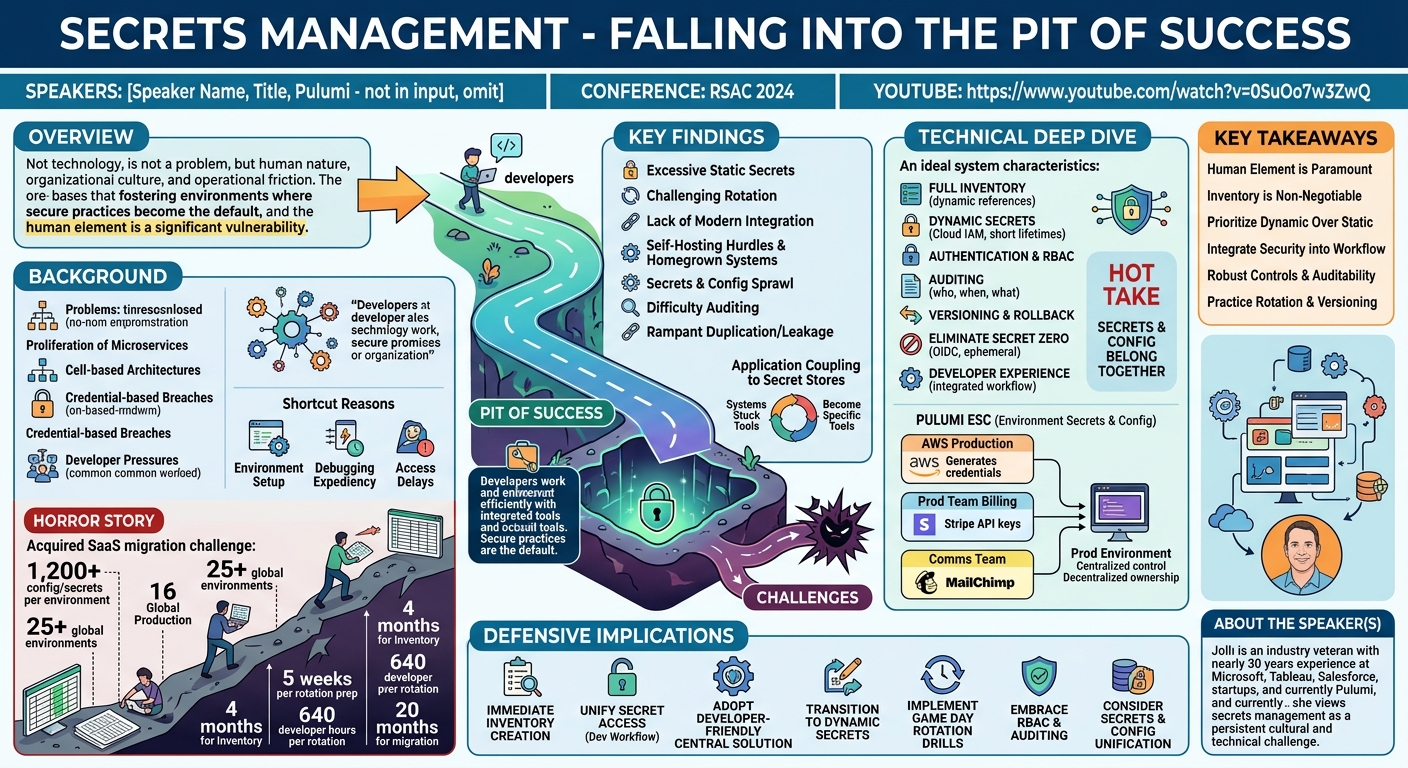
This talk, "Secrets Management - Falling into the Pit of Success," delivers a compelling and pragmatic examination of the pervasive challenges surrounding secrets management in modern software development and operations. While the title suggests a technical deep dive, the speaker emphasizes that the core of the problem often lies not in technology, but in human nature, organizational culture, and the operational friction experienced by developers. The presentation aims to shift the perspective from merely implementing tools to fostering environments where secure practices become the default, almost unavoidable path – a "pit of success."
Key moments
- 0:00 Introduction and the human element in breaches
- 2:40 Reasons why developers bypass security measures
- 4:00 A real-world horror story: Acquired SaaS challenges
- 5:00 Inventorying secrets took four months in Excel
- 5:50 640 dev hours for a single secret rotation
- 6:40 20 months (and counting) for central secrets migration
- 7:30 Identifying a core problem: too many static secrets
Secrets Management - Falling into the Pit of Success
Speakers: [Speaker's Name - not provided in input, will omit], [Speaker's Title - not provided in input, will omit], [Speaker's Company - not provided in input, will omit, but Pulumi is mentioned as current employer]
Conference: RSAC 2024
YouTube: https://www.youtube.com/watch?v=0SuOo7w3ZwQ
Overview
This talk, "Secrets Management - Falling into the Pit of Success," delivers a compelling and pragmatic examination of the pervasive challenges surrounding secrets management in modern software development and operations. While the title suggests a technical deep dive, the speaker emphasizes that the core of the problem often lies not in technology, but in human nature, organizational culture, and the operational friction experienced by developers. The presentation aims to shift the perspective from merely implementing tools to fostering environments where secure practices become the default, almost unavoidable path – a "pit of success."
The speaker, drawing upon nearly 30 years of experience across diverse companies like Microsoft, Tableau, Salesforce, and numerous startups, shares insights derived from firsthand struggles and successes with secrets management. The talk highlights that despite continuous advancements in security tools and processes, the "human element" remains a significant vulnerability, with a substantial portion of data breaches directly involving compromised credentials. The critical message is that effective secrets management requires not just robust technical solutions but also an understanding of developer workflows, pressures, and the inherent human tendency to seek the path of least resistance.
Ultimately, this presentation matters because it addresses a fundamental and persistent security vulnerability that impacts organizations of all sizes. By focusing on the intersection of technology, process, and human behavior, it offers a holistic framework for building more resilient systems. The speaker's call to action is clear: reduce the operational burden on developers, integrate security into their daily workflows, and make the secure way the easiest way, thereby minimizing the risk of accidental or intentional secret exposure and subsequent breaches.
Background
▶ Watch: Introduction and the human element in breaches (0:00)
The problem of secrets management is deeply entrenched in the modern software development landscape, exacerbated by the proliferation of microservices, complex production cell-based architectures, and the constant pressure on development teams to deliver rapidly. As the speaker highlights, a significant percentage of data breaches involve compromised credentials, underscoring the critical nature of this challenge. Despite continuous efforts to improve tools and training, the "human element" remains a primary vector for secret exposure.
Common misconceptions often attribute secret leakage to junior developers or laziness. However, the speaker contends that even experienced developers, operating under tight deadlines or during urgent incidents (like a 2 AM pager duty call), can inadvertently make mistakes. The sheer complexity of managing numerous systems and configurations makes it easy to overlook security best practices. Furthermore, generic corporate security training is often ineffective, failing to resonate with developers or integrate meaningfully into their daily work.
Secrets are routinely found embedded in source code, configuration files, documentation, and scripts. Once committed, they become exposed. The core issue, as the speaker explains, is that if secure processes are too arduous, developers will find ways around them. This "breaking free" can be subconscious or deliberate, driven by immediate needs:
- Environment Setup: The perceived difficulty of setting up a development environment, sometimes requiring production secrets, leads to shortcuts.
- Debugging Expediency: The temptation to copy production secrets for a quick debug session, with the intention of deleting them later (which often doesn't happen).
- Production Access: Direct connection to production databases for debugging, leaving secrets lingering.
- Configuration Files: A false sense of security that
.envfiles or similar local configurations won't be accidentally committed or leaked. - Access Delays: The most "onerous" reason: needing a secret for an urgent deadline but being unable to obtain it in time through official channels, leading to ad-hoc copying and pasting into local or less secure stores.
The speaker illustrates this with a compelling horror story from a large SaaS company that acquired a medium SaaS firm. The acquiring company mandated a 90-day secret rotation policy and migration to a central secrets management system. The acquired company presented a formidable challenge:
- Scale: 1,200+ lines of config and secrets per environment, with roughly 25% being actual secrets.
- Environments: 16 global production, 10 staging, and 20+ development environments.
- Sources: Secrets originating from 25 different internal, third-party, and customer-owned sources.
- Teams/Developers: Over 40 teams and 350 developers involved.
The speaker recounts the arduous process:
- Inventory: It took four months just to get an initial inventory of all secrets, tracked painstakingly in an Excel spreadsheet that was still 10% out of date at any given time.
- First Rotation Prep: Preparing for the first 90-day rotation took five weeks of "all hands on deck" effort.
- Rotation Execution: Performing a single rotation across just the production environments consumed 640 developer hours. This involved dry runs and dedicating 2-3 hours per environment on a Saturday, with every involved team sending a representative. Services often had to be booted in specific, non-obvious orders because they were never designed for rotation.
- Migration to Central System: Moving all secrets to a central secrets management platform took a staggering 20 months, and the process was still ongoing when the speaker left the company. This highlights a cyclical problem for companies that frequently acquire others, restarting the same challenges with each new integration.
This anecdote vividly demonstrates the operational complexity, time investment, and human effort required when secrets management is not baked into the architecture and culture from the outset. It underscores why developers often resort to insecure practices, as the "pit of success" is far from where they find themselves.
Key Findings
▶ Watch: A real-world horror story: Acquired SaaS challenges (4:00)
The talk identifies several pervasive and critical issues that contribute to the ongoing challenges in secrets management:
- Excessive Static Secrets: Organizations heavily rely on long-lived static credentials even in systems where dynamic secrets could be used. When these static secrets are leaked, the operational burden of identification, inventory, and rotation becomes immense, especially if no proper inventory exists.
- Challenging Key Management and Rotation: The process of managing and rotating keys is often operationally complex, leading to it being overlooked entirely. The speaker cited an instance of a system where passwords hadn't been changed in four years, illustrating a dangerous complacency.
- Lack of Modern Integration: Many existing secrets management solutions lack native integration with modern authentication systems like OIDC (OpenID Connect) and other dynamic secrets provisioning systems. This forces continued reliance on long-lived static secrets, even when a secret manager is in place.
- Operational Complexity and Self-Hosting Hurdles: A significant number of secret managers are operationally complex to deploy and maintain. While some are self-hostable, they are often "a pain in the butt to set up." Many are also coupled to bespoke storage and authentication systems, limiting flexibility and increasing vendor lock-in. The prevalence of homegrown systems further complicates standardization and security.
- Secrets and Configuration Sprawl: Especially in large enterprises or those undergoing acquisitions, secrets and configuration data are scattered across numerous systems. This sprawl often includes unencrypted data, or data secured with application-specific logic, leading to a fragmented and inconsistent approach to security. This makes it incredibly difficult to secure and audit access comprehensively. The speaker notes that infrastructure as code tools like Pulumi (the speaker's company) also have their own secure config mechanisms, further adding to the potential for disparate systems if not managed holistically.
- Difficulty in Securing and Auditing Access: The fragmented nature of secrets storage makes it challenging to establish consistent security policies and conduct thorough audits. Often, audit teams are siloed (e.g., infrastructure vs. application), leading to gaps in oversight.
- Rampant Duplication and Leakage: Secrets are frequently duplicated and reused across an organization, amplifying the damage when a single secret is leaked. The "set it and forget it" mentality means leaked secrets can persist for extended periods, especially in infrequently run processes or when the original creator has left the company. The example of a single GitHub access token being copied and pasted across numerous bots, some running only quarterly, highlights the long tail of such issues.
- Application Coupling to Secret Stores: Applications are often tightly coupled to their chosen secrets management store. This makes it difficult to centralize policies, enforce consistent access controls, and migrate to new systems without significant refactoring. The lack of a comprehensive, auditable inventory across all secret locations is a critical vulnerability. The speaker's poll revealing that most organizations would take months or even over a year to achieve a full inventory underscores the severity of this issue.
These findings collectively paint a picture of a security landscape where the technical solutions exist, but their implementation is hampered by operational friction, cultural resistance, and a lack of integrated, developer-centric approaches.
Technical Deep Dive
▶ Watch: Inventorying secrets took four months in Excel (5:00)
The speaker outlines the ideal characteristics of a robust and developer-friendly secrets management system, emphasizing features that reduce friction and promote secure practices by default. This vision moves beyond mere storage to a comprehensive lifecycle management approach.
Central to this ideal system is the concept of a full inventory. Organizations must know where all their secrets reside, their purpose, and who owns them. This inventory should ideally be dynamic, capable of referencing secrets even if they are stored in external systems (e.g., a Vault secret referenced in Google Secrets Manager). The speaker stresses that "the time to start is now" for building this inventory, even if it begins with a humble spreadsheet.
The transition from static secrets to dynamic secrets with short lifetimes is a paramount technical goal. Modern cloud providers offer capabilities like IAM (Identity and Access Management) roles that can dynamically generate temporary credentials for databases or other services, eliminating the need for long-lived static API keys or passwords. Dedicated secret management tools also support generating dynamic secrets for various integrations. This approach significantly reduces the blast radius if a temporary credential is ever compromised.
Robust authentication and Rback (Role-Based Access Control) are essential. A system should allow granular control over who can access which secret, under what conditions, and from which context. This prevents the common scenario where liberal permissions lead to secrets "getting out of control" as developers copy them for various needs. For instance, a billing team should be able to control access to a Stripe API key, even when other teams need to consume it for specific purposes, ensuring both security and auditability.
Every action related to secrets must be auditable. The system needs to log who accessed what, when, and from where, providing a clear trail for security investigations and compliance requirements. This visibility is crucial for accountability and detecting anomalous behavior.
A more advanced concept discussed is the elimination of secret zero. In many secret management systems, there's a "master password" or initial credential required to access the entire store. By leveraging dynamic secrets and OIDC for authentication, it's possible to design systems where this "secret zero" is ephemeral or derived from established identity providers, removing a single, long-lived point of failure.
Versioning is another critical feature. Beyond simply tracking who changed what and when for audit purposes, versioning enables control over the blast radius of changes. The ability to roll out secret changes gradually and, crucially, to roll back to a previous version in case of an issue, is vital for maintaining system stability and preventing widespread outages, as seen in past incidents traced to misconfigured secrets or config files.
Crucially, the speaker emphasizes the dev experience. A secure secrets management system must be integrated into developers' day-to-day workflow. If it's cumbersome, requires switching contexts, or is only used for production secrets (leading to developers forgetting how to use it), it will be bypassed. The system should offer consumption via various interfaces: a console, UI, SDKs, or push mechanisms like webhooks, making secrets accessible where and when needed, without being "locked in a box."
A "hot take" from the speaker, informed by their company's product philosophy, is that secrets and configuration often belong together. Treating them as entirely separate entities can introduce friction. Configuration files frequently reference specific versions of secrets, and both often need to be deployed in tandem for applications to function correctly. Developers working on configuration might need to access or modify related secrets, and forcing them to switch to a different system for this task creates an unnecessary cognitive load and encourages circumvention. By combining them, the system can ensure a unified workflow, consistent versioning, and integrated access control.
The speaker introduces Pulumi ESC (Environment Secrets and Config) as an example of a system aiming to address these challenges. ESC allows for the creation of "environments" that are not just dev/test/prod but can represent any meaningful unit (e.g., a production microservice, a specific team's infrastructure). Each environment can compose secrets and configuration, acting as a unit of control for Rback and auditing. For example, an "AWS Production" environment owned by a platform team could dynamically generate AWS credentials. A "Prod Team Billing" environment could hold a Stripe API key with specific Rback rules controlled by the billing team, and a "Comms Team" environment could manage MailChimp credentials. These individual environments can then be imported and composed into larger, overarching environments (like a "Prod" environment), allowing for centralized management, inherited policies, and consolidated auditing while maintaining granular control at the source. This compositional approach aims to integrate secrets and config management seamlessly into the developer's workflow, making the secure path the easiest path.
Demo / Proof of Concept
▶ Watch: 20 months (and counting) for central secrets migration (6:40)
The speaker provided a brief demonstration of the Pulumi ESC (Environment Secrets and Config) product, illustrating how the concepts discussed in the talk are being implemented. While a direct, interactive demonstration is not possible in this article, the key elements and their operational implications can be described.
The demo aimed to showcase how Pulumi ESC facilitates the management and composition of secrets and configuration within a unified framework. The core concept is the "environment," which is a logical grouping of related secrets and configuration settings. These environments are highly flexible and can represent anything meaningful to an organization, not just traditional "dev," "staging," or "production" stages. Examples given included a "prod microservice" or a specific team's operational context.
In the demo, the speaker highlighted how different environments could be created and composed:
- AWS Production Environment: This environment, owned by a "platform team" (a common structure in platform engineering organizations), was configured to log into AWS and dynamically generate temporary credentials (a dynamic secret). This directly addresses the problem of static secrets by ensuring that access tokens are short-lived and automatically provisioned.
- Prod Team Billing Environment: This environment contained the API key for a service like Stripe. Crucially, it was demonstrated that this environment could have specific Rback policies defined and controlled by the "prod team," allowing them to manage who within their team, or other authorized teams, could access this sensitive billing secret. This exemplifies granular access control and ownership.
- Comms Team Environment: Similarly, an environment for the communications team might hold credentials for an email service like MailChimp.
The power of Pulumi ESC, as demonstrated, lies in its ability to compose these individual, self-contained environments into larger, overarching ones. For instance, the "AWS Production," "Prod Team Billing," and "Comms Team" environments could all be imported into a master "Prod" environment. This composition allows for:
- Centralized Control with Decentralized Ownership: Each team or platform can own and manage its specific secrets and configurations within its defined environment, while a higher-level environment can aggregate and apply broader policies.
- Unified Rback and Auditing: Each environment acts as a distinct unit of control for Rback and auditing. When environments are composed, the access policies and audit trails can be viewed holistically, providing a comprehensive security posture.
- Simplified Developer Workflow: By integrating secrets and configuration, and allowing for their logical grouping and composition, the system aims to make the secure acquisition and use of secrets a natural part of a developer's daily workflow, rather than an arduous, separate process.
The demonstration, while specific to Pulumi's product, served as a tangible example of the principles advocated in the talk: moving towards dynamic secrets, integrating security into developer workflows, providing granular access control, and unifying the management of secrets and configuration. The speaker also acknowledged that other solutions, like Vault, offer similar capabilities in specific areas, particularly concerning certificate lifecycle management, which Pulumi ESC does not currently address.
Defensive Implications
▶ Watch: Identifying a core problem: too many static secrets (7:30)
The insights shared in this talk provide critical guidance for security teams and developers seeking to strengthen their organization's secrets management posture. The overarching theme is to create a "pit of success" where secure practices are the default and easiest path.
- Immediate Inventory Creation: Defenders must prioritize creating a comprehensive inventory of all secrets within their organization. As the speaker's anecdote showed, this can be a daunting, multi-month task, but it is foundational. Even starting with a spreadsheet is better than nothing. Knowing what secrets exist, where they are stored, who owns them, and what they grant access to is the first step towards control. This includes identifying secrets in source code, configuration files, documentation, and scripts.
- Unify Secret Access as Part of Development Workflow: Security teams need to work closely with development teams to integrate secrets management directly into their day-to-day workflows. If developers have to context-switch or use cumbersome tools, they will find workarounds. Solutions should offer SDKs, CLIs, and UIs that are intuitive and readily available from a developer's usual environment. The goal is to make accessing a secret securely as easy, if not easier, than copying it from an insecure location.
- Adopt a Central Secret Management Solution (Developer-Friendly): Invest in a central secrets management platform that is not only robust but also genuinely liked and used by developers. Evaluate solutions based on their ease of setup, operational complexity, integration capabilities (especially with OIDC and dynamic secrets), and developer experience. Avoid homegrown systems unless absolutely necessary, as they often lack the maturity, auditability, and maintenance rigor of commercial or open-source solutions.
- Transition from Static to Dynamic Secrets: Actively work to eliminate long-lived static credentials wherever possible. Leverage cloud provider IAM roles for dynamic access to resources like databases. Implement secret managers that can generate dynamic secrets with short lifetimes for applications and services. This significantly reduces the blast radius of any potential compromise.
- Implement Game Day Rotation Drills: Regular, simulated "game day" exercises for rotating secrets are essential. These drills should involve all relevant teams and identify operational challenges before a real incident. As the speaker's story highlighted, rotation can be complex and time-consuming, requiring specific boot orders or inter-team coordination. Practicing these rotations helps refine processes, automate where possible, and ensure readiness.
- Embrace Rback and Auditing: Ensure that any secrets management system provides granular Rback capabilities, allowing precise control over who can access which secret. Every secret access, modification, and deletion must be logged and auditable. These audit trails are critical for compliance, incident response, and detecting insider threats or unauthorized access.
- Consider Secrets and Config Unification: Evaluate solutions that manage both secrets and configuration holistically. The speaker's "hot take" suggests that separating these can introduce friction. A unified approach can ensure that configuration references the correct secret versions, and that both are deployed and managed together, reducing inconsistencies and improving the developer experience.
- Eliminate Secret Zero: Where feasible, design systems to eliminate the need for a secret zero (a master password or key to access the secret store). Leveraging advanced authentication mechanisms like OIDC can help achieve this, reducing a single point of failure.
- Implement Versioning with Rollback Capability: Utilize secret management systems that support versioning. This not only provides an audit history but, more importantly, enables controlled rollout and rapid rollback of secret changes, mitigating the impact of misconfigurations or accidental deployments.
By focusing on these defensive implications, organizations can move from a reactive posture to a proactive one, building systems and cultures where secret exposure is significantly less likely and easier to mitigate when it does occur.
Key Takeaways
- Human Element is Paramount: Effective secrets management is as much about understanding developer workflows and human nature as it is about technology. Friction in security processes leads to circumvention.
- Inventory is Non-Negotiable: The first, most crucial step is to create a comprehensive inventory of all secrets, their locations, ownership, and purpose, however arduous the initial effort.
- Prioritize Dynamic Over Static: Migrate from long-lived static credentials to dynamic secrets with short lifetimes, leveraging cloud IAM or dedicated secret managers to reduce the blast radius of compromises.
- Integrate Security into Workflow: Adopt secrets management solutions that are user-friendly, integrate seamlessly into developers' daily work, and unify the management of both secrets and configuration.
- Robust Controls and Auditability: Implement strong Rback and ensure all secret access and changes are fully auditable to maintain control, accountability, and compliance.
- Practice Rotation and Versioning: Regularly practice secret rotation through "game day" drills and utilize versioning capabilities for controlled rollouts and rapid rollbacks to minimize operational risk.
About the Speaker(s)
The speaker, whose name was not provided in the transcript, shared a rich professional background spanning nearly 30 years in the technology industry. Despite his relatively younger appearance, he has amassed extensive experience across various prominent companies and startups. His career includes significant stints at Microsoft, Tableau, and Salesforce, alongside numerous smaller startups where he has also served as a consultant. He explicitly stated his current affiliation with Pulumi, an infrastructure as code company. Throughout his diverse career, secrets management has been a consistent challenge and passion, as nearly every team he has been a part of has either successfully overcome its difficulties or remained in a perpetual struggle, depending on the organizational culture. This deep, firsthand experience underpins his pragmatic and human-centric approach to tackling the complex problem of secrets management.