Prevention vs. Response - Cybersec Economics in the Modern Era
RSA Conference 2024 · Track Session
Overview
In a compelling talk at RSAC 2024, the presenter challenged the prevailing mindset in cybersecurity, arguing for a fundamental shift from an almost exclusive focus on prevention to a more robust and economically sound investment in response. Drawing parallels between physical world security and the digital realm, the speaker posited that while we instinctively prioritize preventing incidents, the unique characteristics of cyberspace – particularly the absence of effective global deterrence and the rise of state-sponsored attackers – render prevention an inherently insufficient strategy. The core message is that breaches are inevitable, and organizations must therefore pivot their resources towards minimizing the impact of these breaches through superior detection and response capabilities.
Key moments
- 0:30 Shocking stat: Most breaches discovered externally
- 2:50 Speaker's journey: From prevention to response
- 4:15 Physical world analogy: Why homes aren't broken into
- 5:30 Debunking myths: Locks and cameras don't secure us
- 7:00 The true deterrent: Fear of law, not physical security
- 8:00 Stark budget contrast: Physical security vs. deterrence
- 9:00 Core cyber problem: No global law enforcement
Prevention vs. Response - Cybersec Economics in the Modern Era
Speakers: The presenter (name not provided in transcript), 30 years in cybersecurity, most recently founder of a cloud incident response company.
Conference: RSAC 2024
YouTube: https://www.youtube.com/watch?v=SOBP6Vy05r0
Overview
In a compelling talk at RSAC 2024, the presenter challenged the prevailing mindset in cybersecurity, arguing for a fundamental shift from an almost exclusive focus on prevention to a more robust and economically sound investment in response. Drawing parallels between physical world security and the digital realm, the speaker posited that while we instinctively prioritize preventing incidents, the unique characteristics of cyberspace – particularly the absence of effective global deterrence and the rise of state-sponsored attackers – render prevention an inherently insufficient strategy. The core message is that breaches are inevitable, and organizations must therefore pivot their resources towards minimizing the impact of these breaches through superior detection and response capabilities.
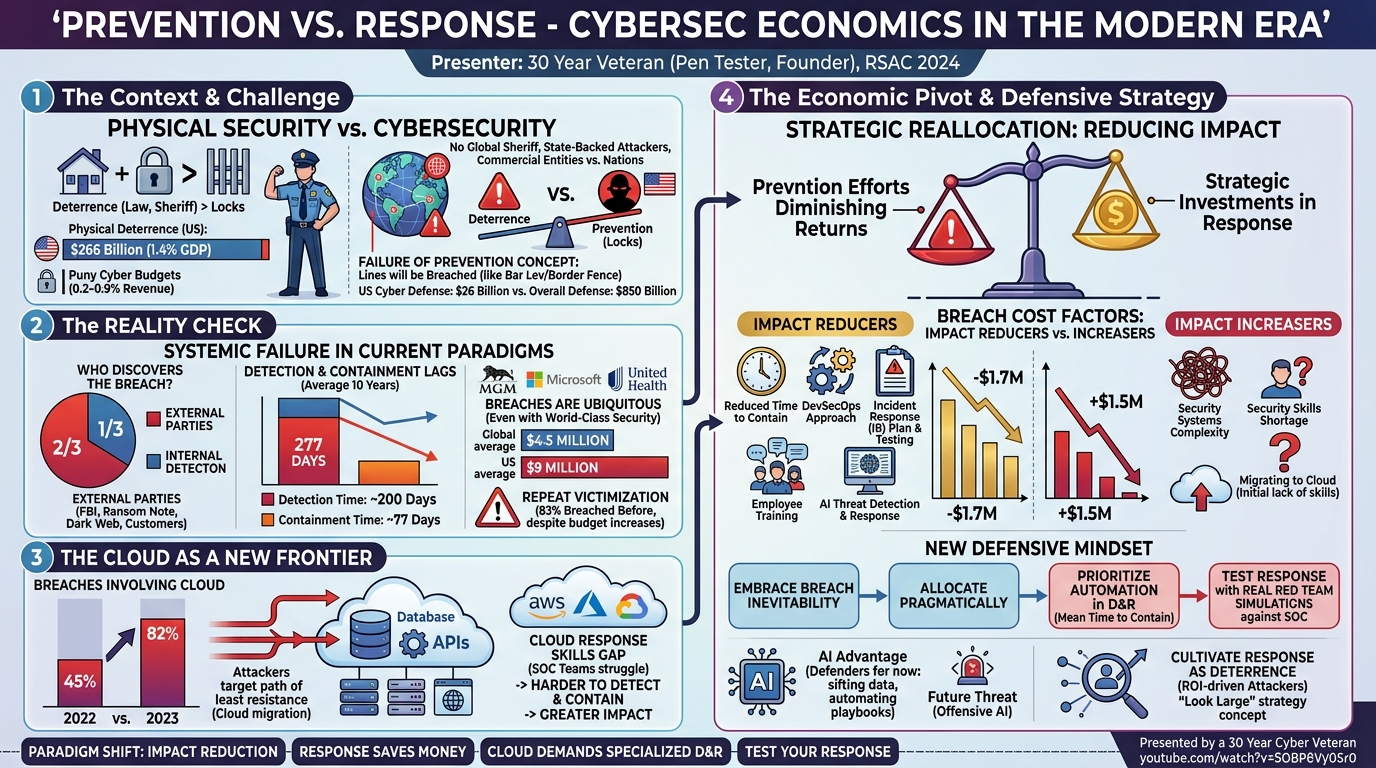
The talk highlighted startling statistics from reports like IBM's Cost of Data Breach, revealing that two-thirds of major cyber incidents are discovered by external parties, not by the victim organizations themselves. This sobering reality underscores a systemic failure in current security paradigms. With over 30 years of experience in cybersecurity, including 25 years in application security and prevention (as a pen tester, red teamer, and product builder), followed by five years dedicated to incident response, the speaker shared a personal epiphany: despite continuous efforts and increasing budgets, organizations keep getting breached. This realization drove the speaker to advocate for a re-evaluation of cybersecurity economics, emphasizing that while prevention has its place, it offers diminishing returns compared to strategic investments in swift and effective response.
The implications of this perspective are profound for security leaders and practitioners. It calls for a pragmatic acceptance of the "when, not if" reality of cyberattacks and a strategic reallocation of resources to build resilient response capabilities. By dissecting the economics of both physical and cyber security, the talk provided a critical framework for understanding why traditional prevention-heavy models are failing and offered actionable insights into how organizations can better prepare for and mitigate the inevitable cyber threats in an increasingly complex and interconnected world.
Background
▶ Watch: Shocking stat: Most breaches discovered externally (0:30)
The foundational premise of the talk rests on a crucial distinction between the mechanics of security in the physical world versus the cyber world. In our physical lives, security is often perceived through the lens of locks, bars, and surveillance cameras. However, the speaker argued that these preventative measures are surprisingly weak. He illustrated this by noting that most common locks can be picked by an amateur in minutes, and even advanced, expensive locks succumb to skilled locksmiths in under two minutes. Physical barriers like window bars are easily defeated with basic equipment. The true deterrent in the physical world, particularly in countries with strong rule of law, is deterrence—the fear of legal consequences, apprehension, and incarceration. The US, for example, spends a staggering $266 billion annually on deterrence (law enforcement), which represents 5% of its budget or 1.4% of its GDP, far outweighing the $13 billion spent on home physical security and $41 billion on corporate physical security.
This model of deterrence, however, breaks down completely in cyberspace. The internet is inherently global, and national borders hold little meaning for attackers. The speaker emphasized that there is "no sheriff" in cyberland, as many nation-states, including Russia, China, North Korea, and Iran, actively support or tolerate malicious hacking groups that target commercial organizations globally. This creates a unique "point of singularity" in the modern era: commercial entities are pitted against state-supported criminals possessing state-level capabilities, operating in an environment devoid of traditional deterrence. This fundamental asymmetry means that relying solely on preventative measures, akin to putting better locks on a door when there's no law to enforce their sanctity, is an inherently losing battle.
Historically, the cybersecurity industry has largely evolved with a strong emphasis on prevention. The speaker, with 25 years in AppSec, pen testing, and red teaming, recounted his own journey rooted in this paradigm. However, the persistent reality of breaches, even for organizations with sophisticated defenses, led him to recognize the limitations of this approach. He drew a powerful military analogy, citing Israel's experiences in the Yom Kippur War (1973) and a more recent conflict. In both instances, highly fortified "lines of defense" – the Bar Lev Line and a modern electronic border fence – were seen as impenetrable preventative measures. Yet, they were ultimately breached by dynamic, determined attackers, leading to costly surprises. These "failures of prevention conception" serve as a stark warning for cybersecurity: static defenses, no matter how strong, will eventually be circumvented by dynamic adversaries who constantly seek new attack vectors. This historical and conceptual backdrop sets the stage for the speaker's urgent call to re-evaluate cybersecurity investments through an economic lens, shifting focus from a futile quest for perfect prevention to the measurable benefits of robust response.
Key Findings
▶ Watch: Physical world analogy: Why homes aren't broken into (4:15)
The presentation unveiled several critical findings, primarily sourced from IBM's annual Cost of Data Breach report, that collectively challenge conventional cybersecurity wisdom and advocate for a paradigm shift:
- External Breach Discovery Dominance: A staggering two-thirds of major cyber breaches are not discovered by the victim organizations themselves but by external sources. These can range from a ransom note appearing on systems, a call from the FBI, or customer data surfacing on the dark web. This statistic alone highlights a significant gap in internal detection capabilities, suggesting that many organizations are operating under a false sense of security regarding their preventative controls.
- Paltry Cyber Budgets vs. Physical Security: While the US spends 5% of its national budget on physical deterrence, commercial organizations typically allocate a mere 0.2% to 0.9% of their company revenues to cybersecurity. Even when compared to IT budgets (around 10% of revenue), security's slice is disproportionately small. This underinvestment, particularly in an environment lacking deterrence, sets up organizations for failure. Even significant government initiatives, like the US cyber defense budget of $26 billion, pale in comparison to the $850 billion overall defense budget or the $266 billion spent on physical deterrence.
- Ubiquitous and Costly Breaches: Breaches are not isolated incidents affecting only smaller, less secure entities. Major organizations with world-class security, such as MGM (suffering $100 million in damages), Microsoft, and United Health, have all fallen victim to significant attacks. This underscores the futility of relying solely on prevention. The average cost of a cyber breach globally stands at $4.5 million, nearly doubling to $9 million in the US due to stricter regulations and higher economic impact.
- Persistent Detection and Response Lags: Despite advancements in security technologies like XDR and SOAR, the average time to detect and contain a breach has remained stubbornly high, hovering around 277 days for the past decade (approximately 200 days for detection and 77 for containment). This metric is crucial because, as the data consistently shows, a longer time to contain directly correlates with a higher financial impact.
- Prevention's Diminishing Returns and Repeat Victimization: While 51% of organizations increase their security budget after a breach, a disheartening 83% of companies that experience a breach have been breached before. This lack of correlation between increased spending (often on prevention) and improved security outcomes suggests that simply "doing more of the same" isn't effective. The speaker argued that prevention efforts reach a point of diminishing returns, where additional investment yields minimal improvement.
- The Cloud as a New Attack Vector: The shift to cloud environments has dramatically impacted the threat landscape. The percentage of breaches involving a cloud component jumped from 45% in 2022 to an alarming 82% in 2023. This rapid increase is attributed not to attacker sophistication but to their pragmatic approach: they target the path of least resistance, and as organizations migrate to the cloud, attackers follow. Cloud breaches are also harder to detect and contain, leading to greater financial impact, largely due to a widespread skills gap in cloud security within SOC teams.
- Impact Reduction as the New Frontier: Given the inevitability of breaches, the speaker advocated for shifting focus from reducing probability (prevention) to reducing impact. Key factors that dramatically reduce breach costs include:
- Reduced Time to Contain: The most significant factor.
- DevSecOps Approach: Reduces breach cost by an average of $1.7 million, by enabling faster remediation through automation.
- Incident Response (IR) Plan and Testing: Reduces cost by $1.5 million, highlighting the value of preparedness.
- Employee Training: Enhances early detection.
- AI Threat Detection and Response: Significantly aids in sifting through vast data for faster detection and response.
Conversely, factors that increase breach costs include:
- Security Systems Complexity: Adds $1.5 million to breach costs, as complex systems are harder to manage and respond to during an incident.
- Security Skills Shortage: Hinders effective response.
- Migrating to the Cloud: Initially increases impact due to skill gaps and unfamiliarity with cloud-native security.
- The Response Maturity Gap: A Gartner survey cited by the speaker revealed a significant gap between the perceived importance of response and recovery and the actual maturity levels of organizations in these areas. CISOs rate prevention and protection maturity much higher, despite the data pointing to the critical need for improved response capabilities. This reflects a human tendency to avoid dealing with a breach rather than preparing effectively for it.
Technical Deep Dive
▶ Watch: Debunking myths: Locks and cameras don't secure us (5:30)
The technical deep dive of the talk wasn't about a specific exploit or tool, but rather a granular examination of the architectural and operational elements that either exacerbate or mitigate breach impact, particularly in the context of modern cloud environments and emerging technologies like AI.
The speaker emphasized that security systems complexity is a significant detriment to effective response. While sophisticated prevention tools might seem beneficial on paper, an overly intricate security stack can become a liability during an incident. When a breach occurs, security teams struggle to navigate disparate, complex systems, understand their interdependencies, and extract the necessary context and data for rapid investigation and containment. This complexity directly contributes to longer mean time to detect (MTTD) and mean time to contain (MTTC), which, as highlighted, are the most critical factors in reducing financial impact. Simpler, more integrated security architectures, even if they don't promise 100% prevention, are crucial for agile response.
A key technical solution presented for impact reduction is the DevSecOps approach. This methodology, by integrating security practices throughout the software development lifecycle, emphasizes automation and rapid iteration. In the context of response, a mature DevSecOps pipeline means that an organization has the automation and processes in place to quickly identify vulnerabilities, remediate misconfigurations, and deploy fixes across their cloud environment. This agility is vital for containing breaches, as it allows security teams to move at "machine speed" to address issues, significantly reducing the window of opportunity for attackers and the overall impact cost (reducing it by an average of $1.7 million).
The discussion then shifted to the challenges and technical requirements for cloud security response. The rapid migration of organizations to cloud platforms has created a new frontier for attackers and, critically, a significant gap in defensive capabilities. The speaker noted that many traditional Security Operations Center (SOC) teams lack the requisite skills and tools for effective cloud incident response. Cloud environments generate vast, complex logs and telemetry data that are fundamentally different from on-premises systems. Existing Security Information and Event Management (SIEM) solutions and SOC processes often struggle to ingest, parse, and contextualize this data effectively. This leads to:
- Increased difficulty in detection: Identifying anomalous behavior or malicious activity within the noise of cloud logs is a specialized skill.
- Longer response times: Understanding the blast radius, identifying compromised cloud resources, and implementing containment measures requires deep knowledge of cloud APIs, identity and access management (IAM), network configurations, and specific cloud provider services.
- Need for Cloud-Native Tools: Effective cloud response demands tools that are purpose-built for cloud environments, offering deeper visibility, automated remediation capabilities, and integration with cloud provider security services.
Finally, the talk touched upon the role of Artificial Intelligence (AI) in threat detection and response. In the short term, AI is seen as a significant advantage for defenders. Security practitioners and vendors are rapidly adopting AI-driven solutions to:
- Sift through massive datasets: AI excels at analyzing the petabytes of logs, network traffic, and endpoint data generated daily, identifying subtle indicators of compromise (IOCs) that human analysts might miss.
- Enhance threat detection: AI/ML models can detect anomalies, predict attacker behavior, and correlate seemingly unrelated events to form a comprehensive picture of an attack.
- Automate response actions: AI can power automated playbooks for initial containment, alert enrichment, and even proactive remediation.
However, the speaker cautioned that this advantage might be fleeting. While attackers are currently using AI for "naive" tasks like crafting better phishing emails or automating business email compromise (BEC) reconnaissance, the potential for sophisticated offensive AI is a growing concern. Should attackers develop AI that can autonomously discover vulnerabilities, generate novel exploits, or adapt attack techniques in real-time, the existing asymmetry in cyber warfare (where defenders need to be right 100% of the time, and attackers only once) would be magnified dramatically. This underscores the urgency for defenders to continue innovating with AI to maintain a competitive edge in the detection and response space.
Demo / Proof of Concept
▶ Watch: Stark budget contrast: Physical security vs. deterrence (8:00)
The talk did not include a live demonstration or a proof of concept of a specific exploit or defensive tool. Instead, the speaker relied heavily on statistical data, real-world breach examples (such as MGM, Microsoft, and United Health), and historical analogies (like physical security and military strategies) to illustrate the core arguments. The evidence presented was primarily empirical, derived from extensive industry reports like IBM's Cost of Data Breach, and the speaker's own 30 years of experience in the cybersecurity field, including five years specifically focused on incident response within cloud environments. The intent was to present a macro-level economic and strategic argument rather than a micro-level technical showcase.
Defensive Implications
▶ Watch: Core cyber problem: No global law enforcement (9:00)
The central defensive implication of this talk is a strategic imperative: organizations must fundamentally re-evaluate their cybersecurity investment portfolios, shifting from a disproportionate focus on prevention to a robust, well-funded emphasis on detection and response. This isn't about abandoning prevention entirely, but rather acknowledging its limitations and understanding where its returns diminish.
Here are the key defensive actions and mindsets proposed:
- Embrace Breach Inevitability: Accept that breaches are not a matter of "if" but "when." This mindset shift is critical for allocating resources pragmatically. The goal should evolve from preventing all breaches to minimizing the impact of the inevitable ones.
- Strategic Budget Reallocation: Instead of pouring more money into prevention with diminishing returns, organizations should divert a portion of their security budget towards enhancing response capabilities. The speaker suggested that taking even 5% from a heavily prevention-focused budget (70-90%) and moving it to an underinvested response area (e.g., 10%) can yield a significantly higher impact on overall security posture and breach cost reduction.
- Invest Heavily in Incident Response (IR) Planning and Testing: This was consistently identified as one of the most impactful factors for reducing breach costs. Organizations must develop comprehensive IR plans, clearly defining roles, responsibilities, and procedures for every stage of an incident (investigation, containment, remediation, recovery). Crucially, these plans must be regularly tested through tabletop exercises and red team engagements that actively simulate real-world attacks against the SOC. The speaker specifically noted that many red teams are instructed to avoid detection by the SOC; this practice must change. Red teams should be used to rigorously test the SOC's ability to detect, analyze, and respond to live threats, treating their activities as real incidents.
- Prioritize Automation in D&R: Automation is key to reducing the critical "time to contain" metric. This includes:
- Automated threat detection: Leveraging AI and machine learning to sift through vast datasets and identify indicators of compromise faster.
- Automated investigation: Tools that enrich alerts with context, correlate events, and streamline forensic data collection.
- Automated remediation: Implementing playbooks that can automatically isolate compromised systems, revoke access, or deploy patches.
- Level Up Cloud Security Operations: Given the dramatic rise in cloud breaches, SOC teams must develop specialized skills and adopt cloud-native tools and processes. This involves training analysts on cloud architectures, security services (e.g., AWS Security Hub, Azure Security Center, GCP Security Command Center), and the unique challenges of ingesting and analyzing cloud logs. Organizations need to invest in solutions that provide deep visibility and context within multi-cloud environments.
- Leverage AI for Defensive Advantage: Actively integrate AI into threat detection and response workflows. This includes using AI-powered SIEMs, XDR platforms, and security analytics tools to enhance visibility, accelerate alert triage, and improve the accuracy of threat identification. While acknowledging the future threat of offensive AI, the immediate defensive advantage offered by AI is significant and should be maximized.
- Cultivate Response as Deterrence: While not a legal deterrence, robust detection and response capabilities can serve as an economic deterrent for ROI-driven attackers. If an organization can detect and respond quickly, making an attack more costly and time-consuming for the adversary, it becomes a less attractive target. This "look large" strategy involves not only having strong D&R but also, in some cases, communicating this capability (without revealing specific defenses) to the broader threat landscape through CISO interviews or public statements about incident readiness.
- Invest in Employee Training: Well-trained employees can act as an early warning system. By recognizing suspicious activities (e.g., phishing attempts, unusual system behavior), they can significantly reduce the time to detection, thereby reducing overall breach impact.
In essence, the defensive strategy advocated is one of pragmatic resilience: build capabilities not just to keep attackers out, but to quickly find them when they get in, contain the damage, and recover efficiently. This approach recognizes the economic realities of cyber warfare and seeks to optimize security investments for maximum impact reduction.
Key Takeaways
- Paradigm Shift Required: Traditional cybersecurity's heavy reliance on prevention is failing due to the absence of deterrence in the global cyber landscape and the dynamic nature of state-backed attackers.
- Focus on Impact Reduction: Given the inevitability of breaches, organizations must shift their primary focus from merely preventing attacks (reducing probability) to building robust capabilities for rapid detection and response (reducing impact).
- Response Saves Money: Investing in strong incident response plans, automation, and skilled teams significantly reduces the financial cost and overall damage of a breach, with factors like DevSecOps and IR preparedness reducing costs by millions.
- Cloud Demands Specialized D&R: The rapid increase in cloud-related breaches necessitates a complete overhaul of cloud security operations, requiring specialized tools, processes, and skills within SOC teams to effectively detect and respond to threats in these complex environments.
- AI is a Defender's Ally (For Now): AI is currently providing a substantial advantage to defenders in sifting through vast data, enhancing threat detection, and automating response, but organizations must prepare for the potential future emergence of sophisticated offensive AI.
- Test Your Response: Red team exercises should be explicitly designed to test the SOC's ability to detect and respond to live threats, treating them as real incidents, rather than merely evaluating preventative posture.
About the Speaker(s)
The presenter, whose name was not specified in the provided transcript, brought a wealth of experience to the discussion, spanning approximately 30 years in the cybersecurity industry. For the initial 25 years of his career, he focused predominantly on AppSec and prevention, working as a pen tester, red teamer, and being involved in building and selling multiple companies. This extensive background provided him with deep insights into the challenges and limitations of traditional preventative security measures.
More recently, over the last five years, the speaker pivoted his focus entirely to the response space, founding a new company dedicated to incident response, detection, and response, particularly around cloud environments. This shift was motivated by a profound realization that despite continuous efforts in prevention, organizations were still consistently getting breached, and the industry was generally performing poorly in its response capabilities. His unique perspective, having operated on both the prevention and response sides of cybersecurity, lent significant credibility to his argument for a re-evaluation of security economics.