Client-Side Chaos: What Security Pros Must Know About Modern Front-Ends
Jayton Birch (Software Engineer)
SAINTCON 2025 · Day 1 · Main Track 3
Overview
In the rapidly evolving landscape of web development, the front end often presents a deceptive simplicity. Behind the user-friendly interfaces of buttons, colors, and images lies a complex and increasingly perilous attack surface, a reality explored by Jayton Birch in his SAINTCON talk, "Client-Side Chaos." Birch, a software engineer, addresses security professionals, aiming to demystify the intricacies of modern front-end technologies and their often-overlooked security implications. His primary goal is to equip security teams with a high-level understanding of emerging trends like React Server Components and server-side rendering so they can proactively secure their enterprises without needing to delve into the exhaustive technical minutiae front-end developers navigate daily.
Key moments
- 0:00 Introduction: Front-end vulnerabilities persist in OWASP Top 10
- 2:00 Challenging the myth: Front-end validation is 'nice to have'
- 3:20 The 'conveyor belt' security model explained
- 4:30 Initial cross-site scripting (XSS) demo
- 5:55 Backend sanitization attempt: Deleting the malicious URL
- 7:00 The reveal: Vulnerability still exploitable via URL parameters
- 7:30 Common occurrence of URL-based reflected XSS
Client-Side Chaos: What Security Pros Must Know About Modern Front-Ends
Speakers: Jayton Birch (Software Engineer)
Conference: SAINTCON
YouTube: https://www.youtube.com/watch?v=-d12hA_Tpuk
Overview
In the rapidly evolving landscape of web development, the front end often presents a deceptive simplicity. Behind the user-friendly interfaces of buttons, colors, and images lies a complex and increasingly perilous attack surface, a reality explored by Jayton Birch in his SAINTCON talk, "Client-Side Chaos." Birch, a software engineer, addresses security professionals, aiming to demystify the intricacies of modern front-end technologies and their often-overlooked security implications. His primary goal is to equip security teams with a high-level understanding of emerging trends like React Server Components and server-side rendering so they can proactively secure their enterprises without needing to delve into the exhaustive technical minutiae front-end developers navigate daily.
The talk challenges a long-standing misconception within the security community: that client-side validation and sanitization are merely "nice-to-haves" for user experience, with the heavy lifting of security relegated solely to the backend. Birch emphatically argues that the front end is an independent and critical attack surface, capable of facilitating exploits irrespective of robust backend defenses. He highlights how the continuous evolution of front-end frameworks and paradigms, while offering significant development benefits, concurrently introduces new vectors for vulnerabilities, making it imperative for security professionals to understand these shifts and adapt their defense strategies.
Birch underscores the persistent nature of front-end vulnerabilities, noting their consistent presence at the top of lists like the OWASP Top 10 (2021). Despite decades of browser development and security advancements, issues such as injections and Cross-Site Scripting (XSS) remain prevalent. The talk dissects how modern development patterns, particularly those blurring the lines between server and client execution, can inadvertently create new security loopholes, expose sensitive data, and generate implicit API endpoints that bypass traditional security scrutiny. This article will delve into Birch's arguments, technical demonstrations, and crucial takeaways for securing contemporary web applications.
Background
▶ Watch: Introduction: Front-end vulnerabilities persist in OWASP Top 10 (0:00)
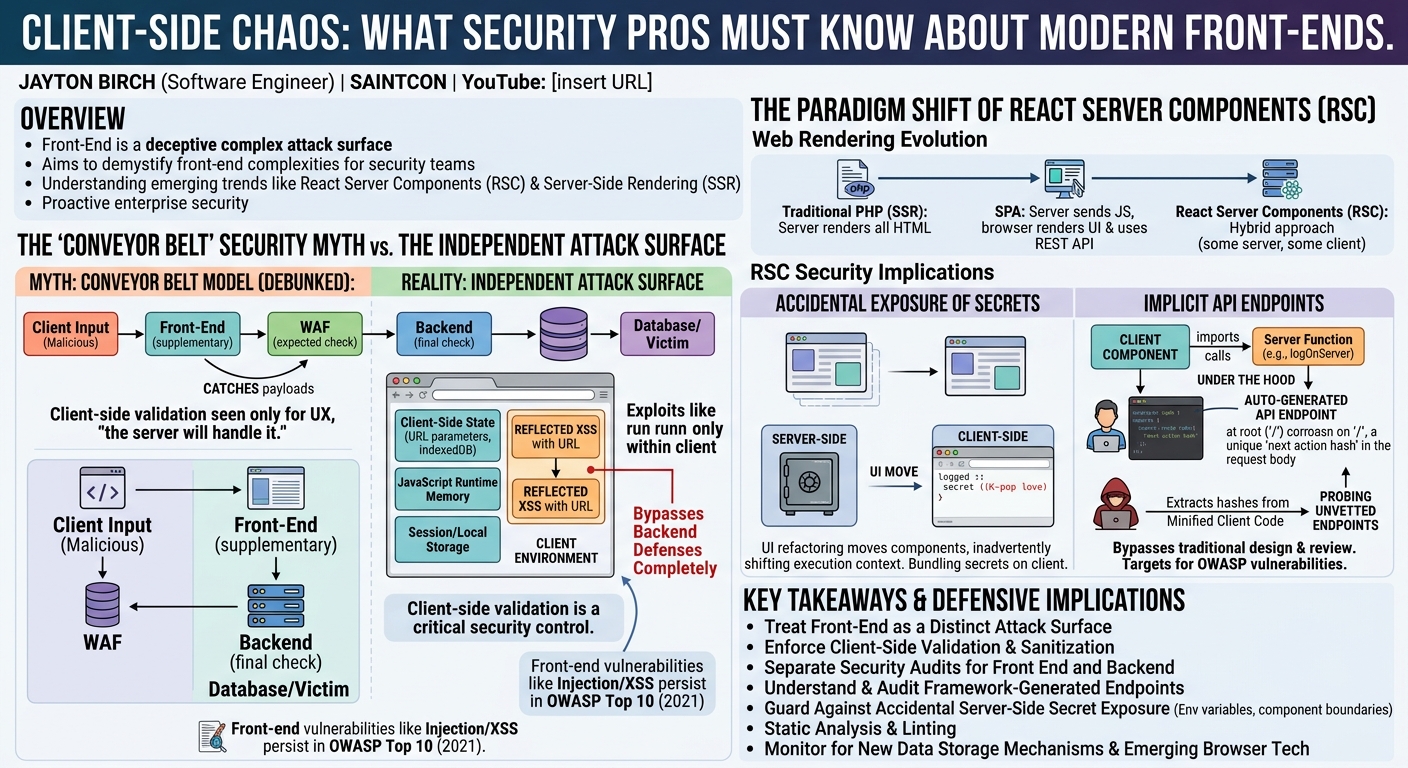
The foundational premise of Birch's talk revolves around a critical shift in perspective regarding web application security. For years, a common, yet flawed, mental model has prevailed: that security operates like a "conveyor belt." In this model, a malicious payload might originate from the client, but it's expected to be caught at various stages – by client-side JavaScript, a Web Application Firewall (WAF), or the backend web server – before it ever reaches sensitive data stores like a database or affects an innocent victim. Within this framework, front-end validation and sanitization are often considered supplementary features, primarily for improving user experience (e.g., preventing lost form data) rather than being fundamental security controls. The prevailing wisdom has been that "the server will handle it," making client-side security a "nice to have."
Birch challenges this deeply ingrained myth by asserting that the front end is not merely a passive input mechanism on a conveyor belt; it is an independent attack surface. He points out that the OWASP Top 10, even in its latest 2021 iteration, consistently features vulnerabilities heavily related to or exclusive to the front end, such as Injection and Cross-Site Scripting. These vulnerabilities, he notes, "will not go away" despite the continuous evolution of web technologies. The problem is exacerbated by the increasing complexity and rapid innovation in front-end development. New frameworks, rendering paradigms (like server-side rendering), data storage mechanisms (e.g., IndexedDB), and even emerging browser capabilities (like AI agents) are constantly expanding the attack surface in ways that traditional security models struggle to encompass.
The historical distinction between server and client has been fundamental to web security. Developers and security teams traditionally exercised extreme deliberation when crossing this boundary, explicitly designing, naming, and securing REST API endpoints with committee approvals and rigorous access controls. However, modern front-end frameworks are increasingly blurring these lines, abstracting away the complexities of server-client communication for developer convenience. This abstraction, while boosting productivity, can inadvertently introduce vulnerabilities by creating implicit endpoints or exposing server-side logic and data without the traditional layers of security review, a core concern that Birch explores in detail.
Key Findings
▶ Watch: The 'conveyor belt' security model explained (3:20)
Jayton Birch's talk highlights several critical findings that redefine how security professionals should approach modern front-end applications:
- The Front End is an Independent Attack Surface: The most significant finding is the emphatic debunking of the "conveyor belt" security myth. Birch demonstrates that client-side exploits can bypass backend defenses entirely, operating solely within the user's browser environment. This means that even with perfect backend sanitization and WAF protection, vulnerabilities can persist and be exploited if the front end is not treated as a distinct and critical security boundary.
- Client-Side Validation and Sanitization are Essential Security Controls: Contrary to popular belief, front-end validation is not just for user experience. Birch's XSS demo illustrates how a malicious payload, even if stripped by the backend, can still be delivered and executed via client-side mechanisms (like URL parameters) if the front end itself doesn't properly sanitize or validate user-controlled input before rendering.
- New Front-End Paradigms Blur Server-Client Boundaries with Security Implications: Modern frameworks, particularly those implementing React Server Components (RSC), abstract the server-client distinction to a degree previously unseen. This abstraction, while beneficial for developers, means that components or data that were intended to remain server-side can inadvertently be rendered or exposed on the client without explicit developer intent or awareness.
- Implicit API Endpoints are a New Attack Vector: RSCs allow developers to import and call server-side functions directly from client-side code. While convenient, this process automatically generates unnamed API endpoints managed by the build server. These implicitly created endpoints often bypass traditional security design and review processes, becoming targets for attackers who can discover their "hashes" in client-side code and probe them for classic OWASP vulnerabilities.
- Sensitive Data Exposure Can Occur Through UI Refactoring: The act of simply moving a UI element (a component) within a React application configured with RSCs can inadvertently change its rendering context from server-side to client-side. This can lead to the exposure of server-side secrets (e.g., API keys, sensitive logs) that were never intended to leave the trusted server environment.
These findings collectively underscore the need for a paradigm shift in security audits and development practices, emphasizing a holistic approach that acknowledges and actively secures the front end as a primary line of defense.
Technical Deep Dive
▶ Watch: Initial cross-site scripting (XSS) demo (4:30)
Birch's talk delves into two main technical areas to illustrate his points: the persistence of classic front-end vulnerabilities like XSS despite backend efforts, and the novel security challenges introduced by modern frameworks, specifically React Server Components (RSC).
The Enduring Challenge of Client-Side XSS
Birch first tackles the common misconception about front-end security through a vivid demonstration of Cross-Site Scripting (XSS). He uses a simple "memories" web application where users can save an image and a link. His initial exploit involves embedding a JavaScript payload (javascript:alert(document.cookie)) into the URL field. When this link is rendered and clicked, it executes the JavaScript, demonstrating a classic reflected XSS vulnerability.
The crucial part of this demonstration comes when he introduces a backend "fix": the server is configured to delete the URL from the incoming request body, ensuring that no malicious URL ever reaches the database. The assumption, according to the "conveyor belt" model, would be that this completely mitigates the risk. However, Birch reveals the flaw in this assumption. He points out that the application, like many modern web apps, stores the state of the form (including the malicious URL) within the URL parameters of the browser's address bar.
Even though the backend strips the URL, the initial malicious payload is still present in the browser's URL bar after the form submission. An attacker can simply copy this URL and send it to a victim. When the victim opens this URL, the front-end application renders the content based on the URL parameters, executing the XSS payload purely client-side, completely bypassing the backend's sanitization efforts. This highlights that client-side state management (e.g., using URL parameters, IndexedDB, session storage, or even just JavaScript runtime memory) can be an independent vector for exploitation. Birch notes that such "reflected XSS with URI/URL" vulnerabilities are alarmingly common on platforms like HackerOne.
The Paradigm Shift of React Server Components (RSC)
Birch then pivots to the complexities of modern front-end frameworks, specifically focusing on React Server Components (RSC), which he identifies as the "new default paradigm" for frameworks like Next.js. He explains the evolution of web rendering:
- Traditional PHP/Server-Side Rendering (SSR): The server renders a complete HTML page with all data and sends it to the browser. The browser displays it as static HTML.
- Single Page Applications (SPAs): The server sends primarily JavaScript to the browser. The JavaScript then renders the UI on the client and makes REST API requests to fetch data as needed.
- React Server Components (RSC): This hybrid approach combines both. Some components are rendered on the server, leveraging server-side capabilities (like direct database access or secret handling), while others are rendered on the client, providing interactivity.
The core technical challenge with RSCs, as Birch explains, is that the build server (not the developer) often determines whether a component runs on the server or the client. This abstraction, while simplifying development, blurs the historically deliberate boundary between server and client, leading to two significant security implications:
1. Accidental Exposure of Server-Side Secrets
Birch demonstrates this by having a server component that logs a "dark secret" (his love for K-pop) on the server, ensuring it remains in a trusted environment. A client component, on the other hand, logs a message on the client. The "vulnerability" arises when a developer, perhaps driven by a product manager's request to "move some UI around," refactors the application to render the server component within the client component.
After a production build, the seemingly innocuous UI change results in the server component's "secret" being logged directly to the client's browser console. This happens because the build server, in its optimization process, determined that since the server component was now part of a client-side component tree, it needed to be bundled and executed on the client. The developer made no explicit configuration change to expose the secret; it was an unintended side effect of a UI refactoring combined with the framework's automatic rendering decisions. This highlights a critical risk: server-side secrets (like API keys, database credentials, or sensitive business logic) can inadvertently leak to the client if not meticulously isolated and guarded.
2. Implicit API Endpoints
The second major technical concern with RSCs is the concept of server functions. React allows developers to import a function defined on the server directly into a client component and call it as if it were a local client-side function. From a developer's perspective, this is highly convenient for prototyping and building interactive features that require server-side logic.
However, Birch reveals what happens "under the hood." When a client component calls a server function, the build server automatically generates an API endpoint to facilitate this communication. Unlike traditional REST endpoints that are explicitly designed, named, and secured, these implicitly generated endpoints are often unnamed and unreviewed. In his demo, Birch shows that the network request made by the client to call a server function targets the root path (/) and uses a unique next action hash in the request body to identify which server function to execute.
While some might mistakenly believe this hash provides security through obscurity (i.e., it's mathematically impossible to guess), Birch clarifies that these endpoints are public. The client-side JavaScript must know this hash to call the server function, meaning the hash is present and discoverable in the minified production client-side code (e.g., by searching for createServerReference). Attackers can extract these hashes, identify the corresponding server functions, and then "poke and prod at these endpoints" just like any other API, looking for classic OWASP vulnerabilities like injection, improper access control, or business logic flaws. This effectively expands the application's attack surface with unvetted, implicitly created API endpoints.
These technical details underscore Birch's central thesis: the front end is not a trivial layer. Its evolving complexity, coupled with abstractions designed for developer convenience, creates new and often subtle security challenges that demand a deeper understanding from security professionals.
Demo / Proof of Concept
▶ Watch: The reveal: Vulnerability still exploitable via URL parameters (7:00)
Jayton Birch effectively uses two distinct demonstrations to underscore his core arguments about client-side chaos.
Demo 1: XSS via URL Parameters (Bypassing Backend Sanitization)
Scenario: Birch created a simple web application designed to "save memories," featuring an image and a link.
Initial Exploit:
- Input: An attacker (Birch) enters a malicious JavaScript payload (
javascript:alert(document.cookie)) into the "link" field when creating a new memory. - Preview: The application immediately renders a preview of the memory, and upon clicking the generated link, the JavaScript executes, displaying the user's cookies. This confirms a basic reflected XSS vulnerability.
- Persistence: The memory is saved to a "database" (simulated), meaning the malicious link persists and could potentially be shared with other users.
Backend "Fix" and Bypass:
- Mitigation Attempt: Birch then implements a backend "fix" by modifying the server code to explicitly delete the
URLparameter from the incoming request body before saving it. The intent is to prevent any malicious URL from ever reaching the database or being processed by the backend. - The Bypass: Despite this robust backend sanitization, Birch demonstrates that the XSS payload can still be exploited. When the form is submitted, even though the backend strips the URL, the malicious payload remains present in the browser's address bar as a URL parameter.
- Independent Client-Side Attack: An attacker can simply copy this URL (containing the
javascript:payload in the parameters) and send it directly to a victim. When the victim opens this URL, the front-end JavaScript renders the page based on the URL parameters, leading to the execution of the XSS payload in the victim's browser.
Key Takeaway from Demo 1: This demonstration powerfully illustrates that front-end state management (in this case, via URL parameters) can act as an independent attack vector. Even with a perfectly secure backend that sanitizes all incoming data, the front end can still be exploited if it doesn't adequately handle or re-validate user-controlled input that persists client-side, proving that client-side validation is a critical security layer, not just a UX enhancement.
Demo 2: React Server Components - Accidental Secret Exposure and Implicit Endpoints
Scenario: Birch sets up a React application using React Server Components (RSC), featuring two distinct components: a ClientComponent and a ServerComponent.
Part A: Accidental Secret Exposure
- Initial Setup:
- The
ServerComponentis configured to log a "secret" message (My secret here, I listen to K-pop demon hunters even without my kids.) to the server console. This simulates sensitive data or logic that should remain server-side. - The
ClientComponentlogs a generic message to the browser console.
- UI Refactoring: Birch then simulates a common development task: moving the
ServerComponentto be rendered inside theClientComponent. He simply comments it out from its original server-side layout and embeds it within the client component's rendering logic. - Result: After a production build, the "secret" message that was previously logged only on the server now appears in the client's browser console.
Key Takeaway from Demo 2A: This highlights how the automatic rendering decisions of RSC frameworks can inadvertently expose server-side secrets. A developer might simply refactor the UI, unaware that this change alters the component's execution environment from server to client, leading to sensitive data leakage without any explicit configuration for exposure.
Part B: Implicit API Endpoints
- Server Function Definition: Birch defines a
logOnServerfunction on the server. - Client-Side Call: He then imports this
logOnServerfunction directly into hisClientComponentand attaches it to a button click event. From the developer's perspective, it's a seamless call to a server function from the client. - Network Analysis: Birch opens the browser's developer tools to inspect the network requests. When the "Log on Server" button is clicked, he reveals:
- A network request is made to the root path (
/) of the application. - The request body contains a unique
next actionhash. This hash, generated by the build server, identifies which specific server function (e.g.,logOnServer) is being invoked.
- Security Implication: Birch explains that while the hash might seem to provide obscurity, it is publicly available within the minified client-side JavaScript bundle (e.g., by searching for
createServerReference). An attacker can easily extract these hashes, identify the server functions they map to, and then craft their own requests to these implicitly created and often unreviewed API endpoints.
Key Takeaway from Demo 2B: This demonstrates that RSCs generate numerous, unnamed API endpoints on behalf of developers. These endpoints, created for convenience, bypass traditional security design, naming, and review processes, becoming new targets for attackers to probe for common OWASP vulnerabilities.
Together, these demos provide concrete, actionable insights into the "chaos" introduced by both classic and modern front-end development, urging security professionals to look beyond traditional backend-centric security models.
Defensive Implications
▶ Watch: Common occurrence of URL-based reflected XSS (7:30)
Jayton Birch's talk provides crucial insights for security professionals, necessitating a shift in defensive strategies to address the evolving front-end landscape.
- Treat the Front End as a Distinct Attack Surface: The most paramount defensive implication is to abandon the "conveyor belt" mentality. Security teams must recognize the front end as an independent and critical attack surface, capable of facilitating exploits regardless of backend defenses. This means dedicated security assessments and controls for client-side code are no longer optional.
- Enforce Robust Client-Side Validation and Sanitization: Client-side validation is not merely a user experience enhancement; it is a fundamental security control. Implement comprehensive sanitization and validation on the client side for all user inputs, especially before rendering data or storing it in client-side mechanisms (like URL parameters, local storage, or IndexedDB). This acts as a crucial first line of defense against attacks like XSS, even if the backend ultimately also sanitizes the data.
- Separate Security Audits for Front End and Backend: Incorporate distinct security checklists and audit processes for front-end applications, similar to existing production readiness or security checklists for backend services. These audits should specifically look for client-side vulnerabilities, data leakage, and the implications of modern framework usage.
- Understand and Audit Framework-Generated Endpoints: For applications using frameworks like Next.js with React Server Components, security teams must understand how server functions are exposed as implicit API endpoints.
- Developer Education: Educate developers about the security implications of
importing and calling server functions from the client. They must be aware that each such call generates a public API endpoint. - Endpoint Discovery and Review: Develop processes to discover these implicitly generated endpoints (e.g., by analyzing production client-side bundles for
createServerReferenceand associated hashes). These endpoints should then undergo the same security scrutiny as explicitly designed REST API endpoints, including checks for authentication, authorization, input validation, and business logic flaws. Do not rely on the hash for security through obscurity.
- Guard Against Accidental Server-Side Secret Exposure: Implement strict controls and architectural patterns to prevent server-side secrets (API keys, database credentials, sensitive environment variables) from ever being inadvertently bundled or logged client-side.
- Clear Component Boundaries: Enforce clear distinctions between server-only and client-only components.
- Static Analysis & Linting: Utilize static analysis tools and custom linting rules to identify potential leakage points when components containing sensitive server-side logic are moved or rendered in client contexts.
- Environment Variable Best Practices: Ensure that sensitive environment variables are only accessible in server-side contexts and are never passed directly or indirectly to client-side bundles.
- Monitor for New Data Storage Mechanisms: Be aware of new ways browsers store data (e.g., IndexedDB, Web SQL, local storage) and ensure that sensitive information is not being stored insecurely on the client side. Data in these stores can be accessed by malicious client-side scripts.
- Stay Informed on Emerging Browser Technologies: The talk briefly mentions browser AI agents. Security professionals need to monitor the evolving capabilities of browsers and how these new features (e.g., AI executing actions on behalf of the user) might introduce novel attack vectors or privacy concerns.
By proactively adopting these defensive postures, security professionals can better secure their organizations against the "client-side chaos" introduced by the rapid advancements in front-end development.
Key Takeaways
- The Front End is a Primary Attack Surface: Dispel the myth that client-side security is merely a "nice-to-have." The front end is an independent attack surface, and exploits can occur purely client-side, bypassing even robust backend defenses.
- Client-Side Validation is a Critical Security Control: Implement comprehensive client-side validation and sanitization for all user inputs. This is a vital first line of defense, preventing malicious payloads from being rendered or persisting in client-side storage, regardless of backend processing.
- Modern Frameworks Blur Server-Client Boundaries: Technologies like React Server Components abstract away the traditional distinction between server and client execution, leading to new and subtle security challenges.
- Beware of Accidental Secret Exposure: Refactoring UI components in RSC-based applications can inadvertently shift server-side components to the client, leading to the leakage of sensitive data (e.g., API keys, internal logs) that was intended to remain on the server.
- Implicit API Endpoints are a New Attack Vector: RSCs automatically generate unnamed API endpoints for server functions called from the client. These endpoints, identifiable by discoverable "next action" hashes in client-side code, often bypass traditional security reviews and are ripe for probing for OWASP vulnerabilities.
- Implement Separate Front-End Security Audits: Organizations must develop and enforce distinct security checklists and audit processes specifically for front-end applications, addressing client-side vulnerabilities, data flow, and the unique risks introduced by modern frameworks.
About the Speaker(s)
Jayton Birch is a Software Engineer who delivered the "Client-Side Chaos" talk at SAINTCON. His presentation underscores his expertise in modern front-end development and his commitment to bridging the knowledge gap between rapidly evolving client-side technologies and the needs of security professionals. He has also spoken at other conferences, such as UtahJS, demonstrating his engagement with the developer community. Birch aims to provide high-level, actionable insights into front-end security, enabling security teams to understand and mitigate risks without needing to become front-end development experts.