The Evolving Standard of Trust: A History of Broken Trust in Authentication (1980 - 2025)
Nathan Cooper (Director of Information Security)
SAINTCON 2025 · Day 1 · Main Track 3
Overview
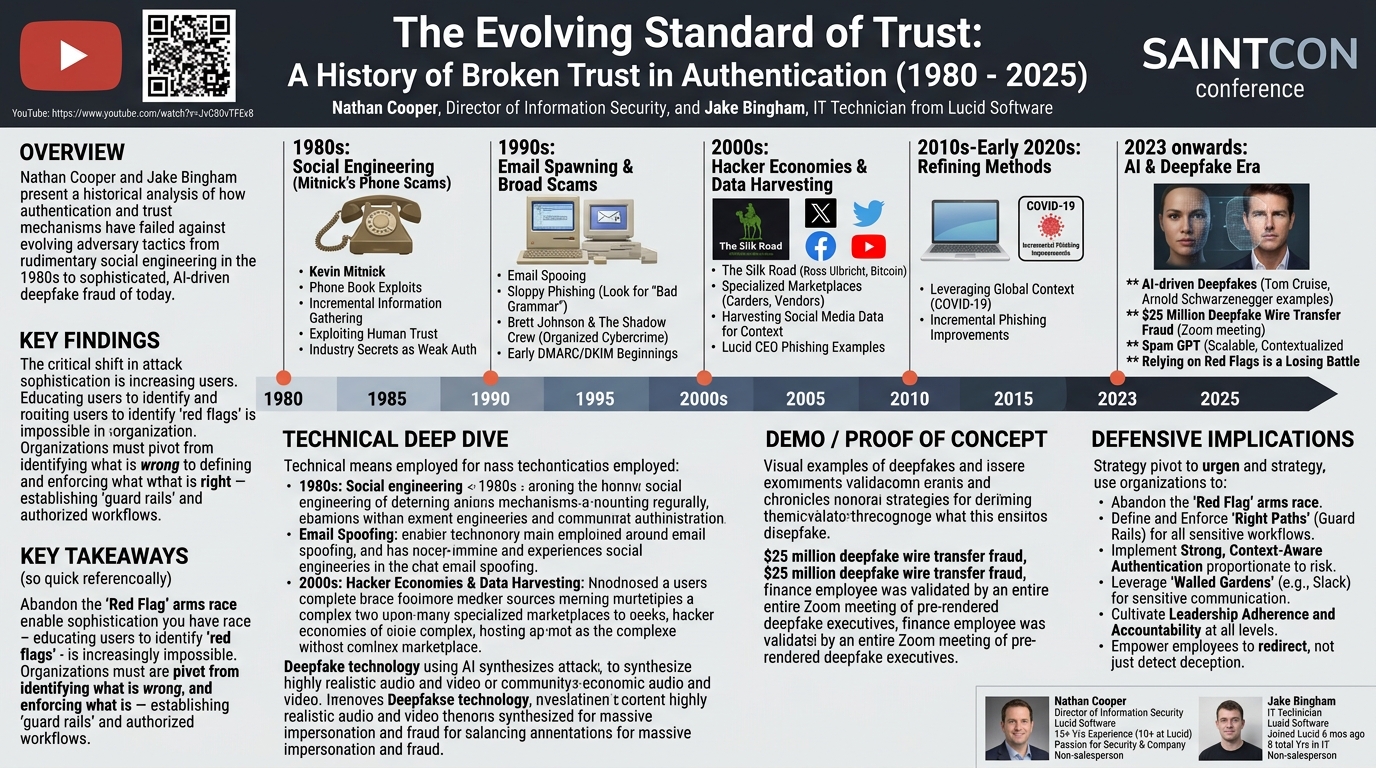
In "The Evolving Standard of Trust: A History of Broken Trust in Authentication (1980 - 2025)," Nathan Cooper, Director of Information Security, and Jake Bingham, an IT Technician, both from Lucid Software, present a compelling historical analysis of how authentication and trust mechanisms have consistently failed against evolving adversary tactics. Delivered at SAINTCON, this talk traces the trajectory of cyberattacks from rudimentary social engineering in the 1980s to the sophisticated, AI-driven deepfake frauds of today, illustrating a recurring theme: the inherent fragility of human trust and the futility of relying solely on "red flag" detection.
Key moments
- 0:00 Speakers introduce talk theme: history of authentication trust failures
- 1:00 Little Rascals analogy defining authentication and authorization
- 3:05 1980s: Kevin Mitnick's social engineering exploits via phone
- 5:00 1990s: Broad email scams exploit trust in communication
- 7:00 Brett Johnson forms Shadow Crew, pioneering organized cybercrime
- 8:00 2000s: Emergence of hacker economies and the Silk Road
The Evolving Standard of Trust: A History of Broken Trust in Authentication (1980 - 2025)
Speakers: Nathan Cooper, Director of Information Security; Jake Bingham, IT Technician, Lucid Software
Conference: SAINTCON
YouTube: https://www.youtube.com/watch?v=JxC80vTFEv8
Overview
In "The Evolving Standard of Trust: A History of Broken Trust in Authentication (1980 - 2025)," Nathan Cooper, Director of Information Security, and Jake Bingham, an IT Technician, both from Lucid Software, present a compelling historical analysis of how authentication and trust mechanisms have consistently failed against evolving adversary tactics. Delivered at SAINTCON, this talk traces the trajectory of cyberattacks from rudimentary social engineering in the 1980s to the sophisticated, AI-driven deepfake frauds of today, illustrating a recurring theme: the inherent fragility of human trust and the futility of relying solely on "red flag" detection.
The core message of Cooper and Bingham's presentation is a critical re-evaluation of defensive strategies. They argue that attempting to educate users on every potential deceptive tactic is an unwinnable "arms race." Instead, organizations must shift their focus from identifying what is wrong to explicitly defining and enforcing what is right – establishing robust "guard rails" and authorized workflows for sensitive operations. This paradigm shift is particularly pertinent in an era where artificial intelligence (AI) and deepfake technology enable attackers to craft highly contextualized, convincing, and scalable attacks, rendering traditional security awareness training increasingly ineffective. The talk serves as a stark warning and a practical guide for organizations seeking to establish more resilient security postures against an ever-adapting threat landscape.
Background
▶ Watch: Speakers introduce talk theme: history of authentication trust failures (0:00)
The journey into the history of broken trust begins with a foundational understanding of authentication and authorization, aptly illustrated by a scene from "The Little Rascals." Just as the children's clubhouse required a method to identify members and determine their right to enter, organizations need mechanisms to verify identities and grant appropriate access. Historically, human authentication has been intrinsic to daily life; we constantly evaluate the identity and behavior of those around us. However, when applied to digital or organizational contexts, this innate human tendency to trust can be easily exploited.
The 1980s marked a pivotal era, seeing the birth of the internet and the widespread adoption of passwords as a primary authentication factor. While understood to have weaknesses, passwords were considered strong for their time. However, a more insidious vulnerability lay in the reliance on industry secrets and perceived knowledge to establish trust. This weakness was masterfully exploited by Kevin Mitnick, who, as a teenager, demonstrated the power of social engineering. Mitnick didn't use sophisticated technical exploits; his primary tool was a phone book. He would incrementally gather information from various employees of companies like DEEC, leveraging details from prior conversations to build credibility and convince subsequent targets that he belonged. This enabled him to bypass security protocols by exploiting human trust, proving that strong authentication factors were useless if people could be convinced to divulge "secret knowledge."
Moving into the 1990s, the landscape evolved with the rise of email. Initially perceived as a "mysterious black box," many users didn't understand that email was essentially a text file, allowing attackers to easily spoof sender identities. This led to a proliferation of broad, "sloppy" phishing attacks. Security professionals responded by advising users to look for "bad grammar" as a red flag, a strategy that proved inadequate as not all malicious messages contained errors. A significant organizational shift also occurred with individuals like Brett Johnson, dubbed the "original godfather of the internet." Johnson recognized the power of collaboration, forming The Shadow Crew by uniting hackers with diverse skill sets. This collective approach allowed them to share knowledge, level up their capabilities, and execute more effective, organized cybercrime.
The 2000s witnessed a further evolution with the emergence of hacker economies and specialized marketplaces. Ross Ulbricht, known as the Dread Pirate Roberts, established The Silk Road, a dark web marketplace that facilitated the anonymous buying and selling of illicit goods using Bitcoin. This platform enabled a highly organized criminal ecosystem where specialized roles emerged: credit card acquirers, validators, and money mules, creating an entire illicit supply chain. Concurrently, the explosion of social media led to individuals publicly sharing vast amounts of personal data. Attackers quickly learned to harvest this information, adding context to their attacks, making them appear significantly more valid and effective. The speakers shared examples of spoofed emails purporting to be from Lucid Software's CEO, Dave Gro, and even a humorous instance from Peter Rollinsson, CEO of Lucid Motors, demonstrating hackers' occasional sloppiness but also their increasing reliance on contextualized deception.
The 2010s and early 2020s saw incremental improvements in these broad attack methodologies. Events like COVID-19 provided a global context that attackers leveraged to gain attention and urgency, knowing individuals were more likely to click on messages related to health or warnings. However, the true game-changer arrived in 2023.
Key Findings
▶ Watch: 1980s: Kevin Mitnick's social engineering exploits via phone (3:05)
The central revelation of the talk is the accelerating sophistication of attacks, particularly with the advent of AI-powered deepfake technology, which fundamentally alters the trust landscape. The speakers emphasize that the traditional approach of educating users to identify "red flags" in deceptive communications is a losing battle. As attack methods become more nuanced and convincing, the human capacity to discern subtle cues of deception is overwhelmed.
The presentation highlights a critical shift in attacker capabilities:
- AI-driven High-FFidelity Deception: The era of deepfakes, exemplified by the convincing digital rendering of actors like Tom Cruise and Arnold Schwarzenegger over others' faces, marks a new frontier. While initially requiring significant processing power, the technology has advanced to a point where it is practically deployable in malicious contexts. This was starkly illustrated by the $25 million deepfake wire transfer fraud where a finance employee was instructed to make 11 wire transfers totalling $25 million after participating in a Zoom meeting populated entirely by pre-rendered deepfake versions of his senior management and board members. The victim, despite prior security awareness training, received what appeared to be irrefutable validation, demonstrating the profound impact of this technology on human trust.
- Scalable, Contextualized Attacks: The speakers introduce Spam GPT as a hypothetical (or emerging) product that embodies the next generation of attack tools. This AI-powered marketing email tool can generate highly customized, malicious attacks against a mass audience. By leveraging publicly available data from social media, LinkedIn, and company websites, Spam GPT can create perfectly contextualized phishing or social engineering attempts that appear legitimate and personally relevant to each target. This capability merges the "spray and pray" breadth of early email scams with the "surgical precision" of Kevin Mitnick's focused attacks, creating an unprecedented threat.
- The Futility of "Red Flag" Education: Cooper and Bingham unequivocally state that it is "humanly impossible" to educate individuals on all the different ways they can be attacked or deceived. This continuous "arms race" against evolving deception is one that defenders cannot win. Adversaries are constantly innovating, and any new "red flag" identified by security teams will inevitably be bypassed or integrated into more sophisticated attacks.
- The Imperative of "Guard Rails": The talk's most significant contribution is the advocacy for a paradigm shift in defensive strategy. Instead of focusing on what is wrong, organizations must establish and enforce "guard rails" – clearly defined, authorized methods and workflows for sensitive actions. This involves identifying the "one authorized method" for critical operations (e.g., a $25 million wire transfer) and ensuring employees understand that this is the only legitimate path. This proactive approach shifts the burden from constant vigilance against deception to adherence to trusted processes.
In essence, the key findings underscore that the human element, once the weakest link, is now facing unprecedented, technologically advanced forms of manipulation. The only viable defense is to abstract trust away from individual judgment in ambiguous situations and embed it into hardened, transparent, and strictly enforced procedural "guard rails."
Technical Deep Dive
▶ Watch: 1990s: Broad email scams exploit trust in communication (5:00)
The historical narrative presented by Cooper and Bingham effectively charts the evolution of attack vectors and the corresponding technical (or non-technical) means employed by adversaries, culminating in the sophisticated threats of today.
In the 1980s, the technical landscape was comparatively rudimentary. Passwords formed the bedrock of digital access control. However, the most potent "technical" tool for attackers like Kevin Mitnick was not code but the human phone network, facilitating social engineering. Mitnick exploited the reliance on industry secrets as a form of weak authentication. His technique involved a multi-stage process of information gathering, where each piece of data gained from one employee served as an authentication token to gain more trust and information from the next. This demonstrated a fundamental flaw: if a system relies on human judgment of "secret knowledge" for authentication, a skilled social engineer can bypass it without ever touching a keyboard.
The 1990s introduced email as a widespread communication medium, but its underlying technical simplicity was a vulnerability. Email, at its core, is a plain text file transmitted over the internet, lacking inherent mechanisms for sender verification. This allowed attackers to easily spoof sender addresses. The initial defensive strategy, urging users to look for "bad grammar," was a non-technical and ultimately ineffective approach to authenticate messages. As the decade progressed, some rudimentary security controls like DKIM (DomainKeys Identified Mail) began to be "bolted on" to email protocols. While DKIM provides a cryptographic method to verify the sender's domain, its adoption was gradual, and its effectiveness relies on proper implementation and user awareness, which was still nascent. The formation of groups like The Shadow Crew marked a shift from individual technical exploits to collective organizational hacking, where diverse technical skills were pooled to achieve more complex objectives.
The 2000s saw the technical infrastructure of cybercrime mature significantly. The rise of hacker economies like The Silk Road, facilitated by anonymous digital currencies like Bitcoin, created sophisticated marketplaces for illicit goods and services. This allowed for the specialization of technical roles within criminal organizations, such as credit card acquirers who used various technical means (e.g., malware, phishing) to steal card data, and validators who might employ automated scripts to check card validity. Concurrently, the proliferation of social media platforms led to an explosion of publicly available personal data. Attackers developed techniques for data harvesting and contextualization, using automated tools to scrape information that could then be woven into highly personalized social engineering attacks. The examples of spoofed emails purporting to be from Lucid's CEO, Dave Gro, or even the humorous Peter Rollinsson incident, highlight the use of company-specific details harvested from public sources to lend credibility to phishing attempts.
The 2020s brought the truly transformative technical development: Deepfake technology. This involves using artificial intelligence and machine learning models (e.g., Generative Adversarial Networks or GANs) to synthesize highly realistic images, audio, and video. The talk demonstrated this with examples of actors' faces being digitally rendered onto others with "very high fidelity." The technical implications are profound:
- Realistic Impersonation: Deepfakes allow attackers to create convincing visual and auditory representations of individuals, bypassing traditional methods of identity verification that rely on visual or vocal recognition.
- Pre-rendered Interactions: The $25 million fraud case illustrates the technical capability of creating entire pre-rendered Zoom meetings. This implies sophisticated video and audio manipulation, potentially involving real-time synthesis or carefully choreographed pre-recorded segments, to create a seemingly live and interactive environment where all participants except the victim are AI-generated.
- Scalability with AI Tools: The concept of Spam GPT showcases the technical convergence of AI-driven content generation with data harvesting. Such a tool would leverage natural language processing (NLP) and machine learning to analyze vast amounts of target data (from social media, LinkedIn, company websites) and then automatically generate highly personalized, grammatically perfect, and contextually relevant malicious emails or messages. This tool effectively automates and scales the most challenging aspects of social engineering, blending "spray and pray" with "surgical precision" through algorithmic customization.
The proposed defensive strategy also has significant technical components. Establishing guard rails involves defining and enforcing authorized communication channels and workflows. For instance, Lucid Software's policy to conduct sensitive requests only via Slack implies a reliance on Slack's inherent security features, such as multi-factor authentication (MFA) for login, encrypted communication, and audit logs. This transforms Slack into a "walled garden" where the underlying authentication and authorization processes are significantly more robust than, for example, a spoofed SMS message. Furthermore, the use of heavy factors of authentication for sensitive workflows (e.g., password and MFA resets) suggests the implementation of strong, layered MFA solutions (e.g., hardware tokens, biometric authentication, FIDO2 keys) that are difficult to compromise even with sophisticated social engineering. The technical implementation of these guard rails requires careful configuration of access controls, robust identity management systems, and continuous monitoring to ensure adherence and detect potential bypass attempts.
Demo / Proof of Concept
▶ Watch: Brett Johnson forms Shadow Crew, pioneering organized cybercrime (7:00)
While the talk did not feature a live, interactive demonstration or a proof of concept developed by the speakers themselves, it effectively leveraged compelling examples of the technologies and attacks being discussed to illustrate their impact and practical implications.
The core of this section revolved around showcasing the capabilities of deepfake technology. The speakers presented two highly impactful visual examples:
- Tom Cruise Deepfake: An image or video clip (implied to be video, given the description of "digital facial") was shown where an actor, not Tom Cruise, was able to render Tom Cruise's face with "very high fidelity" over his own. This served to visually convey the astonishing realism achievable with current deepfake technology, emphasizing its potential for convincing impersonation.
- Arnold Schwarzenegger as Uncle Rico: A clip from "Napoleon Dynamite" was shown, digitally altered to feature Arnold Schwarzenegger's face and voice over the character of Uncle Rico. This example further solidified the concept of high-fidelity digital rendering and voice synthesis, making the abstract idea of deepfakes tangible and even humorously terrifying.
Following these technological demonstrations, the speakers described a real-world incident that served as a chilling proof of concept for the malicious application of deepfakes: the $25 million wire transfer fraud. This detailed account served as a narrative demonstration of how sophisticated attackers are already leveraging this technology:
- A finance employee received a call from their manager requesting a $20 million transfer.
- Following security awareness training, the employee requested additional validation.
- The employee was then invited to a Zoom meeting where all participants – the manager, board members, and other senior executives – were pre-rendered deepfake personas.
- These deepfake characters provided the necessary "validation," leading the employee to execute 11 wire transfers totaling $25 million.
- The fraud was only discovered a week later, confirming that the victim was the "only real person" on the call.
This incident, though not a live demo by the speakers, functions as the ultimate proof of concept: deepfake technology is no longer theoretical but a potent tool in the arsenal of advanced persistent threats, capable of bypassing traditional human-centric security controls and inflicting massive financial damage. The mention of Spam GPT further extends this, describing it as a product that can perform mass-scale, contextualized attacks, leveraging the underlying AI capabilities demonstrated by the deepfakes, even if the speakers did not present a functional demo of Spam GPT itself.
Defensive Implications
▶ Watch: 2000s: Emergence of hacker economies and the Silk Road (8:00)
The most crucial aspect of this talk lies in its definitive guidance for defenders. Cooper and Bingham adamantly argue for a fundamental shift away from reactive "red flag" education towards a proactive "guard rail" strategy. This change in philosophy has several profound defensive implications:
- Abandon the "Red Flag" Arms Race: Defenders must acknowledge that attempting to educate employees on every possible deceptive tactic is an unwinnable battle. The sheer volume and sophistication of modern attacks, particularly with AI augmentation, make it "humanly impossible" for individuals to consistently identify all avenues of deception. This means security awareness training needs to evolve beyond simply spotting phishing emails or suspicious links.
- Define and Enforce "Right Paths" (Guard Rails): Instead of focusing on what not to do, organizations must clearly define the only authorized methods for sensitive operations. This involves identifying critical workflows, such as approving large wire transfers, resetting passwords, or handling sensitive data requests, and then establishing rigid, transparent "guard rails" for these actions. For example, if a $25 million wire transfer requires a specific, multi-step, in-person or highly authenticated digital process, that process becomes the "one authorized method."
- Implement Strong, Context-Dependent Authentication: The strength of authentication factors should be commensurate with the sensitivity of the workflow. For high-risk actions like an MFA reset or a password reset, organizations should implement "heavy factors of authentication." This could include hardware security keys (FIDO2), biometric verification, or multi-channel approvals that are significantly harder to spoof than a phone call or SMS. For lower-risk actions, like locking a laptop, a simpler method like a verified phone call might be an "acceptable risk."
- Leverage "Walled Gardens" for Sensitive Communications: Organizations should direct sensitive requests to secure, controlled environments – "walled gardens" – that have robust inherent authentication and authorization mechanisms. Lucid Software's example of requiring executives to direct sensitive requests to Slack (rather than SMS or phone calls) is a prime illustration. Slack, as an enterprise communication platform, typically has stronger access controls, audit trails, and requires more complex authentication (often including MFA) to compromise than a simple spoofed phone number. This forces attackers to compromise a much more secure ecosystem.
- Cultivate a Culture of Process Adherence, Starting with Leadership: The speakers highlight that executives are often the "largest offenders" of bypassing established security protocols due to convenience. A critical defensive implication is that leadership must not only understand but actively champion and adhere to these guard rails. Cooper's anecdote about "berating" executive teams for trying to force employees to act on SMS messages underscores the necessity of strong internal enforcement and accountability at all levels to make these guard rails effective.
- Empower Employees to Redirect and Verify: Instead of expecting employees to detect deception, the new approach empowers them to redirect requests to the official "guard rail" channel. An employee receiving a suspicious SMS from an executive should not try to discern if it's fake, but rather respond, "Please send that request via Slack," knowing that Slack is the authorized channel. This simplifies the decision-making process for employees and places the burden of security on robust systems and processes, rather than fallible human judgment.
In summary, the defensive implications necessitate a strategic pivot: from a reactive, human-centric "spot the fake" model to a proactive, process-centric "follow the authorized path" model, reinforced by strong authentication and organizational buy-in.
Key Takeaways
- The "Red Flag" Approach is Obsolete: Relying on security awareness training that teaches employees to spot "red flags" in deceptive communications is an unwinnable battle against increasingly sophisticated, AI-powered attacks like deepfakes and contextualized phishing.
- Social Engineering is Amplified by AI: Attackers consistently exploit human trust through social engineering. With the advent of deepfake technology and tools like Spam GPT, these attacks can now be highly realistic, personalized, and scalable, making traditional human validation unreliable.
- Deepfakes Pose a Critical Threat to Authentication: The $25 million deepfake wire transfer fraud demonstrates that AI-generated audio and video can create entirely convincing, pre-rendered interactions that bypass even trained employees' skepticism, rendering visual and auditory verification ineffective for critical transactions.
- Shift to "Guard Rails" for Critical Workflows: Organizations must transition from trying to identify what is wrong to explicitly defining and enforcing "guard rails" – the only authorized methods and channels for sensitive operations (e.g., wire transfers, password resets).
- Implement Strong, Context-Aware Authentication: Authentication strength should be proportionate to risk. High-risk actions require "heavy factors of authentication" (e.g., robust MFA), while all sensitive communications should be confined to secure, "walled garden" platforms with strong underlying controls.
- Leadership Adherence and Cultural Reinforcement are Paramount: The success of "guard rail" strategies hinges on consistent adherence, especially from executive leadership. A strong security culture must enforce these authorized workflows at all organizational levels to prevent bypasses and maintain trust.
About the Speaker(s)
Nathan Cooper is the Director of Information Security at Lucid Software. With over 15 years of experience in the security industry, including more than 10 years at Lucid Software, he brings a wealth of practical knowledge to the field. Cooper emphasizes his passion for both security and his company, a rare feat in an often demanding industry. He identifies himself as a "non-salesperson," indicating a focus on practical, technical insights rather than marketing.
Jake Bingham serves as an IT Technician at Lucid Software. Having joined Lucid six months prior to the talk, with a total of eight years in IT, Bingham expresses his enjoyment of his role at Lucid and the opportunity to work alongside colleagues like Nathan Cooper. Like Cooper, he identifies as a "non-salesperson," reinforcing their shared commitment to delivering unvarnished, practical security advice.