Modern Cryptography 101
Thomas Rose (Security Analyst, 70y8047 · Solutionreach)
SAINTCON 2025 · Day 2 · Main Track 2
Overview
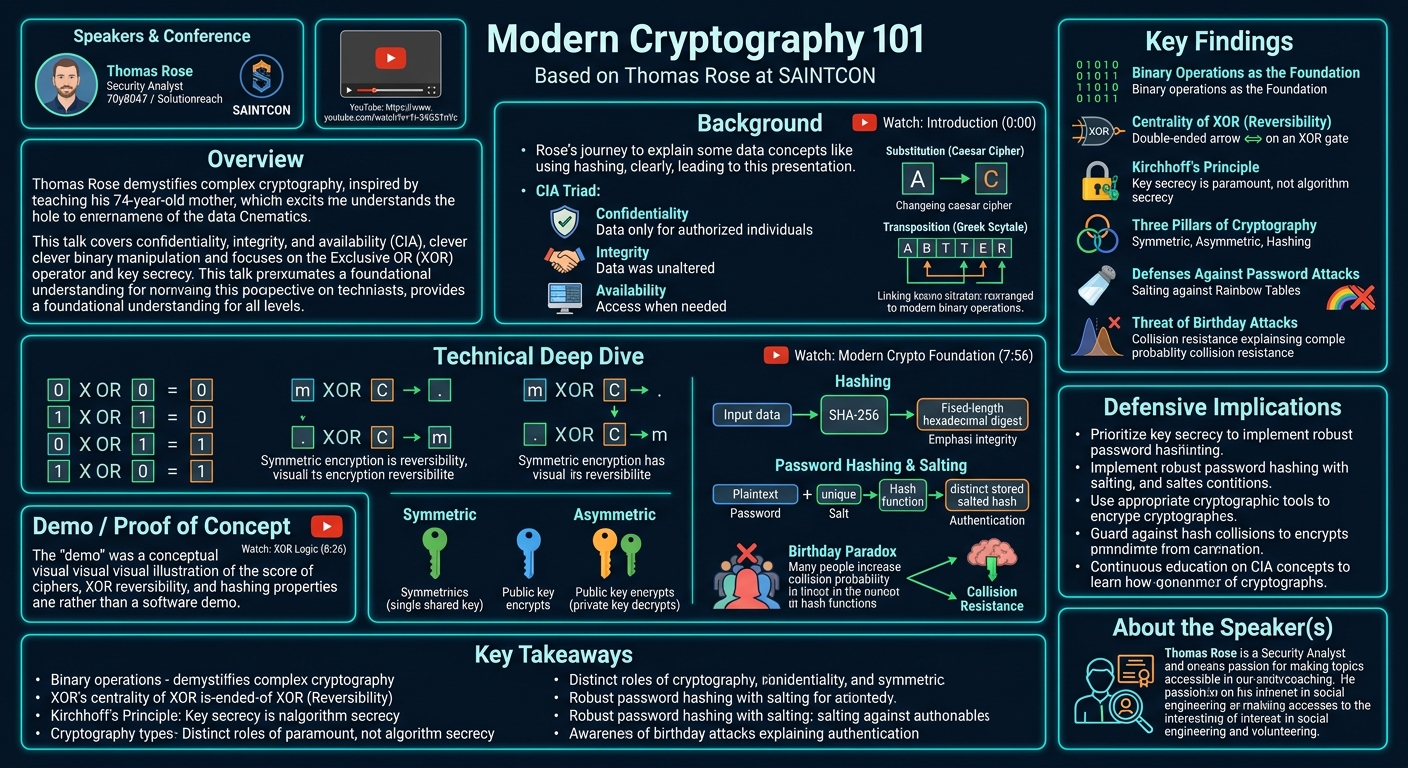
In "Modern Cryptography 101," Thomas Rose, a Security Analyst at 70y8047 (Solutionreach), demystifies the fundamental principles underpinning modern cryptographic systems. Rose delivers an accessible yet technically robust exploration of concepts often perceived as arcane, making them understandable for a broad audience ranging from beginners to seasoned professionals seeking a refresher on core mechanics. His unique approach, inspired by teaching his 74-year-old mother, emphasizes clarity and practical relevance, successfully breaking down complex ideas into digestible components.
Key moments
- 0:00 Introduction, speaker's journey, and talk goals
- 4:10 Understanding the CIA triad: Confidentiality, Integrity, Availability
- 5:58 Historical ciphers: Caesar, Transposition, Greek Saitel
- 7:56 Modern crypto's foundation: Binary, Boolean algebra, XOR
- 8:26 Exclusive OR (XOR) logic, crucial for modern cryptography
Modern Cryptography 101
Speakers: Thomas Rose, Security Analyst, 70y8047, Solutionreach
Conference: SAINTCON
YouTube: https://www.youtube.com/watch?v=Yr-3XGSTnYc
Overview
In "Modern Cryptography 101," Thomas Rose, a Security Analyst at 70y8047 (Solutionreach), demystifies the fundamental principles underpinning modern cryptographic systems. Rose delivers an accessible yet technically robust exploration of concepts often perceived as arcane, making them understandable for a broad audience ranging from beginners to seasoned professionals seeking a refresher on core mechanics. His unique approach, inspired by teaching his 74-year-old mother, emphasizes clarity and practical relevance, successfully breaking down complex ideas into digestible components.
The talk addresses a common gap in foundational security knowledge, moving beyond mere memorization of algorithms to foster a genuine understanding of "what it all means." Rose meticulously explains how modern cryptography achieves its security goals—confidentiality, integrity, and availability—through the clever manipulation of binary data, highlighting the critical role of the Exclusive OR (XOR) operator and the paramount importance of key secrecy. This presentation is crucial for anyone looking to solidify their grasp on the cryptographic bedrock of digital security, providing the conceptual tools necessary to engage with more advanced topics.
Rose's presentation stands out for its commitment to fundamental comprehension. By dissecting the underlying mathematical and logical operations, he equips attendees with a foundational understanding that transcends specific algorithms. This talk is not merely an introduction to cryptography but a deep dive into its essential building blocks, empowering security practitioners to better understand, implement, and defend against threats in an increasingly encrypted world.
Background
▶ Watch: Introduction, speaker's journey, and talk goals (0:00)
Thomas Rose's motivation for this talk stemmed from a personal realization: despite holding security certifications like Security+, he found himself struggling to explain core cryptographic concepts, particularly hashing, with true clarity. He aimed to bridge this gap, designing a presentation that could convey a fundamental understanding of cryptography to anyone, regardless of their technical background, drawing inspiration from his month-long endeavor to teach his own mother the subject. This pedagogical goal underscores the talk's emphasis on breaking down complexity into intuitive components.
Before delving into modern techniques, Rose establishes the foundational pillars of information security: Confidentiality, Integrity, and Availability (the CIA triad). He notes that a surprising number of security professionals struggle to articulate these basic principles. Confidentiality ensures that data is accessible only to authorized individuals, integrity guarantees that data remains unaltered and trustworthy, and availability ensures that authorized users can access information and systems when needed. Cryptography, as Rose explains, directly contributes to achieving these three objectives.
The talk provides a brief but illustrative historical context, beginning with early ciphers. The Caesar cipher exemplifies substitution, where one character is replaced by another (e.g., 'A' becomes 'C'). The Greek Scytale demonstrates transposition, where characters are rearranged within the message. More advanced mechanical ciphers like the Enigma and Lorenz machines combined dynamic substitution and transposition, representing precursors to the complex operations of modern cryptography. These historical examples serve to illustrate that the core mechanisms of changing symbols and moving them around remain relevant, albeit at a far more sophisticated, binary level.
Key Findings
▶ Watch: Understanding the CIA triad: Confidentiality, Integrity, Availability (4:10)
Rose's talk distills modern cryptography into several key findings that illuminate its underlying mechanisms and principles:
- Binary Operations as the Foundation: Modern computing, based on Von Neumann architecture, operates on binary (ones and zeros). Consequently, modern cryptography performs its substitution and transposition operations at this fundamental bit level, executing them with incredible speed and scale.
- The Centrality of the Exclusive OR (XOR) Operator: The XOR logical operator is presented as the most crucial element in modern cryptography due to its unique property of reversibility. When data is XORed with a key, XORing the result with the same key again restores the original data. This reversibility is essential for both encryption and decryption.
- Kirchhoff's Principle: A cornerstone of cryptographic design, this principle states that a cryptosystem's security should depend solely on the secrecy of the key, not on the secrecy of the algorithm itself. Openly published algorithms like AES and RSA are considered secure precisely because their operations are public, allowing for peer review and robust analysis, provided the key remains confidential.
- Three Pillars of Modern Cryptography: Rose categorizes modern cryptography into three primary types, each serving distinct security goals:
- Symmetric Cryptography: Uses a single, shared secret key for both encryption and decryption. It is fast but faces challenges in secure key distribution.
- Asymmetric Cryptography: Employs a pair of mathematically linked keys: a public key for encryption and a private key for decryption. This solves the key distribution problem but is computationally more intensive.
- Hashing: A one-way function that transforms data into a fixed-length string (the hash value or digest). Its primary purpose is to ensure data integrity by detecting any unauthorized modifications. Hashes are non-reversible and designed to be collision-resistant.
- Defenses Against Password Attacks: Rose highlights rainbow tables as a common method for cracking hashed passwords. He then introduces salting as a critical defense mechanism, where random data is added to a password before hashing, making pre-computed rainbow tables ineffective and ensuring that identical passwords produce unique hash values.
- The Threat of Birthday Attacks: For hashing algorithms, collision resistance is paramount. Rose explains birthday attacks, which exploit the Birthday Paradox (a higher-than-expected probability of shared birthdays in a small group) to find two different inputs that produce the same hash output (a hash collision). Such collisions can compromise the integrity guarantees of a hash function.
Technical Deep Dive
▶ Watch: Historical ciphers: Caesar, Transposition, Greek Saitel (5:58)
Modern cryptography, as Rose explains, operates fundamentally on the binary system of ones and zeros, reflecting the Von Neumann architecture of contemporary computers. This foundation allows cryptographic operations to be executed with immense speed and scale. The core of these operations lies in Boolean algebra, specifically the logical operators AND, OR, and critically, the Exclusive OR (XOR).
The XOR operator, denoted by ^ or ⊕, is central to modern symmetric encryption. Its logic is straightforward:
0 XOR 0 = 0(False XOR False = False)1 XOR 1 = 0(True XOR True = False)0 XOR 1 = 1(False XOR True = True)1 XOR 0 = 1(True XOR False = True)
The defining characteristic of XOR for cryptography is its reversibility. If you have a plaintext bit P and a key bit K, P XOR K = C (ciphertext bit). To decrypt, C XOR K = P. This property is elegantly demonstrated by Rose using ASCII bit values. For instance, the lowercase 'm' is represented as 01101101 in ASCII. If we XOR it with an uppercase 'C' (01000011), the result is 00101110, which represents a dot ('.') in ASCII. Critically, if we then XOR this dot (00101110) with the uppercase 'C' (01000011) again, we retrieve the original lowercase 'm' (01101101). This bit-level manipulation, performed rapidly across large data blocks, constitutes the modern equivalent of substitution and transposition.
The effectiveness of this reversible operation hinges entirely on the key (or initialization vector). The key is the secret input that determines the specific transformations applied to the data. Different cipher modes (e.g., Electronic Code Book, Cipher Block Chaining, Cipher Feedback Mode) dictate how these keys and previous ciphertext blocks are combined with plaintext to produce the final encrypted output. Rose stresses that while the algorithms can be public, the key must remain absolutely secret, adhering to Kirchhoff's Principle.
Rose then elaborates on the three distinct categories of modern cryptography:
- Symmetric Cryptography: Here, a single secret key is used for both encryption and decryption. Algorithms like AES fall into this category. Its primary advantage is speed, as XOR operations are very efficient. However, its main challenge lies in the secure distribution of this shared secret key between communicating parties.
- Asymmetric Cryptography: This solves the key distribution problem by using a pair of mathematically linked keys: a public key and a private key. Data encrypted with the public key can only be decrypted by the corresponding private key, and vice-versa for digital signatures. While Rose mentions that many asymmetric algorithms, such as RSA, rely on modular arithmetic (like "counting around a clock" and dealing with remainders), he acknowledges that a detailed explanation of its mathematical underpinnings is beyond the scope of a short introductory talk, noting that Public Key Infrastructure (PKI) is a vital concept for managing these keys.
- Hashing: Unlike symmetric and asymmetric cryptography, hashing is a one-way function primarily focused on data integrity, not confidentiality. A hash function takes an input of any size and produces a fixed-length output (the hash value or message digest). Even a single bit change in the input will result in a completely different hash value. Rose demonstrates this using SHA-256: "password" yields a specific 64-character hexadecimal hash, "password1" produces a vastly different hash, and "Password" (with an uppercase 'P') also generates a unique hash. Hashes are designed to be non-reversible (you cannot derive the original input from the hash) and collision-resistant (it should be computationally infeasible to find two different inputs that produce the same hash).
The practical application of hashing in password security is critical. Instead of storing plaintext passwords, systems store their hash values. To authenticate, a user's entered password is hashed, and this new hash is compared to the stored hash. This protects passwords even if the database is compromised. To combat rainbow tables (pre-computed dictionaries of common passwords and their hashes), salting is employed. A unique, random string (the salt) is combined with the password before hashing. This ensures that even two users with the same password will have different stored hashes, rendering rainbow tables ineffective and requiring attackers to compute hashes for each salted password individually.
Finally, Rose touches upon the concept of birthday attacks, which exploit the Birthday Paradox. This paradox states that in a group of just 23 people, there's a greater than 50% chance that two individuals share the same birthday. Applied to hashing, a birthday attack aims to find a hash collision—two different inputs that produce the same hash output. If an attacker can create a malicious message with the same hash as a legitimate message, they could potentially substitute the malicious message without detection, compromising data integrity. This underscores the importance of using robust, collision-resistant hashing algorithms.
Demo / Proof of Concept
▶ Watch: Modern crypto's foundation: Binary, Boolean algebra, XOR (7:56)
While Thomas Rose's talk did not feature a live, interactive software demonstration or a physical proof of concept, he effectively utilized his presentation slides to visually illustrate key cryptographic principles. His "demo" was conceptual and educational, focusing on building understanding rather than showcasing a tool.
Specifically, Rose presented clear visual examples of:
- Historical Ciphers: Showing plaintext, a Caesar cipher substitution, and a transposition cipher to illustrate the basic concepts of character manipulation.
- XOR Reversibility: He meticulously walked through the bit-level operations of the Exclusive OR (XOR) operator using ASCII values, demonstrating how a lowercase 'm' XORed with an uppercase 'C' results in a dot, and then XORing that dot with the uppercase 'C' again recovers the original lowercase 'm'. This served as a powerful conceptual proof of how modern symmetric encryption works at its most fundamental level.
- Hashing Properties: Rose displayed examples of SHA-256 hash values for different inputs like "password," "password1," and "Password." These examples visually reinforced the concepts of fixed length, non-reversibility, and how even minor changes in input drastically alter the hash output, thus illustrating the integrity property of hashing.
These visual explanations served as the "proof of concept" within the context of his educational talk, effectively conveying complex technical details in an understandable format.
Defensive Implications
▶ Watch: Exclusive OR (XOR) logic, crucial for modern cryptography (8:26)
The insights shared by Thomas Rose in "Modern Cryptography 101" carry significant implications for cybersecurity defenders, guiding best practices and strategic approaches:
- Prioritize Key Secrecy Above All Else: Kirchhoff's Principle is paramount. Defenders must understand that the security of cryptographic systems hinges entirely on the secrecy and robust management of keys. Even the most advanced algorithms are rendered useless if the key is compromised. This necessitates strong key management practices, including secure key generation, storage, distribution, and rotation. Rose's "watermelon security" analogy—where an attacker who gets "in the door" can decrypt everything—vividly illustrates this point.
- Implement Robust Password Hashing with Salting: The talk underscores that password security is fundamentally hash security. Defenders must never store plaintext passwords. Instead, passwords should always be hashed using strong, modern, collision-resistant algorithms (e.g., SHA-256 or stronger, or dedicated password hashing functions like Argon2, bcrypt, scrypt). Crucially, salting must be implemented to prevent rainbow table attacks. Each user's password should be combined with a unique, randomly generated salt before hashing, ensuring that identical passwords produce distinct hash values and forcing attackers to crack each password individually.
- Understand Cryptographic Goals for Appropriate Use: Defenders should grasp the distinct purposes of symmetric, asymmetric, and hashing cryptography.
- Symmetric encryption is ideal for bulk data encryption due to its speed, but requires secure channels for key exchange.
- Asymmetric encryption (and PKI) is essential for secure key exchange, digital signatures, and establishing secure communication channels without prior shared secrets.
- Hashing is specifically for data integrity verification (e.g., checking file authenticity, detecting tampering, ensuring log file integrity) and password storage, not for confidentiality. Using the right cryptographic tool for the right job is fundamental.
- Guard Against Hash Collisions and Birthday Attacks: While hashing provides integrity, defenders must be aware of its limitations. Using outdated or weak hashing algorithms (ee.g., MD5, SHA-1) that are known to be vulnerable to collision attacks can compromise data integrity. Modern applications should use strong, current hashing algorithms and understand that the Birthday Paradox can make finding collisions more feasible than brute-forcing the entire hash space. This means even with modern hashes, the probability of collision increases with the number of generated hashes, which can be a concern in large-scale data integrity checks or digital signature schemes.
- Educate on Foundational Security Concepts (CIA Triad): Rose's observation that many security professionals struggle with the CIA triad highlights a critical gap. Defenders should continuously reinforce these fundamental concepts, as they provide the strategic framework for all security decisions, including the application of cryptography. Understanding why confidentiality, integrity, and availability are important helps in making informed choices about how to protect systems and data.
- Continuous Learning and Adaptation: The rapid evolution of cryptography means defenders must stay informed. While the underlying principles like XOR remain constant, specific algorithms and best practices evolve. Understanding the basics from talks like this provides a solid foundation for evaluating new cryptographic standards and mitigating emerging threats.
By internalizing these defensive implications, security teams can build more robust, resilient, and effectively protected systems, moving beyond superficial security measures to address the core vulnerabilities exploited by attackers.
Key Takeaways
- Modern cryptography fundamentally relies on binary operations, performing substitution and transposition at the bit level with incredible speed and scale.
- The Exclusive OR (XOR) operator is a cornerstone of modern symmetric encryption due to its inherent reversibility, allowing for both encryption and decryption with the same key.
- According to Kirchhoff's Principle, the security of a cryptosystem rests entirely on the secrecy of the key, not on the obscurity or secrecy of the algorithm itself.
- Symmetric, asymmetric, and hashing cryptography serve distinct security goals: confidentiality and speed, secure key exchange and digital signatures, and data integrity, respectively.
- For robust password security, passwords must be hashed using strong algorithms, and critically, salted with unique random values to defend against rainbow table attacks.
- Defenders must be aware of birthday attacks and ensure that hashing algorithms used for integrity checks are highly collision-resistant to prevent malicious data substitution.
About the Speaker(s)
Thomas Rose is a Security Analyst at 70y8047, a company associated with Solutionreach. With approximately six years of experience in a dedicated security position, he has accumulated several industry certifications, having achieved at least three of the major ones mentioned in his talk (likely including CISSP). Rose is passionate about making complex technical topics accessible, as evidenced by his unique approach to teaching modern cryptography to his 74-year-old mother. Outside of his professional role, he is involved in volunteering at events like the Octopus game, where he enjoys interacting with attendees and even engaging in "social engineering" challenges.