The Art of Cybersecurity Mastery: From Entry-Level to Staff+
Florian Noeding (Adobe · Principal Security Architect)
SAINTCON 2025 · Day 2 · Main Track 1
Overview
In "The Art of Cybersecurity Mastery: From Entry-Level to Staff+", Florian Noeding, a Principal Security Architect at Adobe, delivers an insightful and pragmatic guide for navigating a career in cybersecurity. Drawing from his extensive experience as both a seasoned practitioner and a hiring manager, Noeding addresses the common questions and challenges faced by individuals at all stages of their professional journey, from recent graduates to those aspiring to staff-plus leadership roles. This talk transcends the typical technical deep dive, offering a strategic blueprint for career development within the ever-evolving security landscape.
Key moments
- 0:00 Talk agenda: background, resumes, interviews, career growth
- 2:10 Florian's early career: physics, software, management
- 4:48 How Florian discovered security and career shift
- 6:10 Rapid career growth to Principal Security Architect
- 8:00 Essential tips for writing impactful resumes
The Art of Cybersecurity Mastery: From Entry-Level to Staff+
Speakers: Florian Noeding, Principal Security Architect, Adobe
Conference: SAINTCON
YouTube: https://www.youtube.com/watch?v=eLQv-qvfzbc
Overview
In "The Art of Cybersecurity Mastery: From Entry-Level to Staff+", Florian Noeding, a Principal Security Architect at Adobe, delivers an insightful and pragmatic guide for navigating a career in cybersecurity. Drawing from his extensive experience as both a seasoned practitioner and a hiring manager, Noeding addresses the common questions and challenges faced by individuals at all stages of their professional journey, from recent graduates to those aspiring to staff-plus leadership roles. This talk transcends the typical technical deep dive, offering a strategic blueprint for career development within the ever-evolving security landscape.
Noeding's presentation is particularly relevant in an industry grappling with talent shortages and rapid technological change. He demystifies the path to career advancement, providing actionable advice on crafting impactful resumes, acing technical interviews, fostering continuous growth, and effectively influencing security strategy at an enterprise level. By sharing his personal career trajectory and the lessons learned, Noeding equips attendees with a toolkit for not only securing their next role but also for achieving sustained mastery and leadership in cybersecurity.
Background
▶ Watch: Talk agenda: background, resumes, interviews, career growth (0:00)
The cybersecurity industry, while booming, often presents a labyrinthine career path for aspiring and even experienced professionals. Common challenges include understanding what hiring managers truly seek, differentiating oneself in a competitive job market, and comprehending the distinct expectations for progression from junior to senior to leadership roles. Many individuals struggle with crafting resumes that stand out, preparing for technical interviews that often feel like trivia contests, and identifying the key skills and contributions necessary to ascend the corporate ladder, particularly into highly influential staff or principal positions.
Florian Noeding's own career trajectory provides a compelling backdrop for his advice. Starting with a degree in economophysics in 2004, he initially pursued a path in C++ software engineering, working at a startup building Linux-based firewall devices. After a stint as a backend team manager, he joined Adobe in 2014 as a software engineer, focusing on developer experience and revolutionizing the deployment process from bi-weekly to multiple times a day. It was through a friend's involvement in bug bounty programs that Noeding discovered his passion for security, initially applying his C++ knowledge to identify memory safety vulnerabilities in a crypto chain and later uncovering a critical cloud key access issue in a crypto exchange's CI system. This hands-on, self-driven exploration eventually led him to a full-time security role at Adobe in 2019, rapidly progressing to Principal Security Architect within three years. His journey underscores the importance of following curiosity, investing deeply in a craft, and leveraging diverse experiences to pivot and grow, directly addressing the "why this problem exists" from the perspective of navigating an unplanned, yet highly successful, career in security.
Key Findings
▶ Watch: Florian's early career: physics, software, management (2:10)
Noeding's talk distills years of experience into several key findings regarding cybersecurity career development:
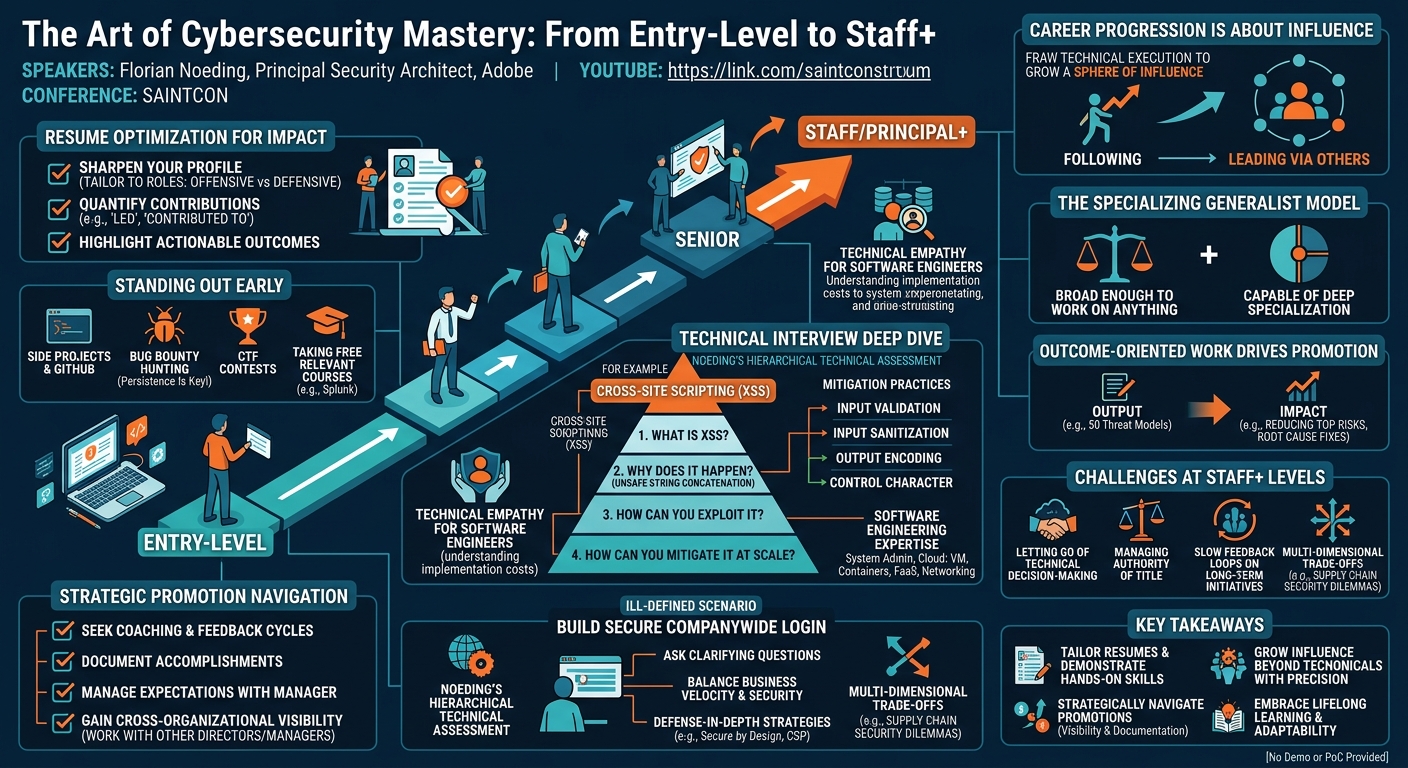
- Resume Optimization for Impact: Generic resumes are ineffective. Candidates, especially early in their careers, must sharpen their profile by tailoring resumes to specific roles (e.g., offensive vs. defensive) and highlighting contributions (e.g., "led," "contributed to," "learned how to"). Quantifying impact is crucial, but must be done credibly (e.g., "sped up time to resolution" rather than unsupported percentage reductions in risk).
- Standing Out Early: For university graduates with limited experience, side projects are paramount. Engaging in bug bounty hunting, participating in Capture the Flag (CTF) contests, taking free courses in relevant tools (e.g., Splunk for incident response), and undertaking personal software projects demonstrate hands-on experience and a genuine interest that generic internships cannot. Noeding shared his personal struggle of spending over a month to find his first accepted bug bounty, emphasizing persistence.
- Interviewers Seek Depth and Empathy: Technical interviews are not trivia. Interviewers, particularly for senior and staff roles, look for technical skill (security basics, software engineering knowledge), empathy for software engineers (understanding the cost and complexity of implementing security controls), precision in communication, curiosity (lifelong learning), and collaborative problem-solving.
- Hierarchical Technical Assessment: Noeding employs a structured approach to technical questions, starting with "What is X?" (e.g., Cross-Site Scripting (XSS)), progressing to "Why does it happen?", "How can you exploit it?", and "How can you mitigate it at scale?". This method rapidly assesses a candidate's depth of understanding and ability to articulate complex concepts precisely, including knowledge of control characters, input sanitization, input validation, and output encoding.
- Career Progression is About Influence, Not Just Technical Skill: As professionals advance from junior to senior, staff, and principal levels, the primary differentiator shifts from raw technical execution to sphere of influence. While senior engineers are the "getters of work done," staff and principal roles involve increasing impact "via others" by guiding, aligning, and coordinating teams across the organization. This transition involves moving from "following" to "leading" and accepting less direct technical impact.
- The "Specializing Generalist" Model: To achieve staff or principal levels, Noeding advocates becoming a specializing generalist – someone broad enough to work on anything, but also capable of deep specialization when necessary. This acknowledges the reality of varied roles across multiple companies throughout a 40+ year career and the limited demand for hyper-specialists (e.g., a crypto expert to build a new crypto library).
- Outcome-Oriented Work Drives Promotion: Focusing on outcome and impact-oriented work (e.g., remediating top security risks, fixing root causes) rather than mere "output" (e.g., 50 threat models a year) is crucial for career advancement. This involves increasing risk visibility, reducing risks, and shifting security responsibilities to platform teams through "secure by design" libraries and frameworks.
- Strategic Promotion Navigation: Gaining promotion, especially to staff-plus, requires building self-feedback cycles, seeking coaching, documenting accomplishments, and managing expectations with managers. Crucially, it involves gaining visibility across the organization by working with directors and managers outside one's direct reporting chain, ensuring they can endorse one's contributions.
- Challenges at Staff+ Levels: Higher-level roles bring new challenges: letting go of technical decision-making, managing the authority of title, actively seeking feedback that tends to "dry up," enduring slow feedback loops on long-term initiatives (years, even decades for efforts like memory safety), and navigating multi-dimensional trade-offs where no clearly "right" solution exists (e.g., supply chain security dilemmas).
Technical Deep Dive
▶ Watch: How Florian discovered security and career shift (4:48)
While not focused on a single exploit, Noeding's talk offers a profound "technical deep dive" into the skills and mindset required to excel technically within cybersecurity and progress through its ranks. He elaborates on how hiring managers assess technical prowess and the specific technical competencies expected at various career stages.
Noeding emphasizes that foundational software engineering expertise is non-negotiable for security professionals, as "our scope is we secure software systems. It's all about software." This includes understanding how software works, how it runs in the cloud (concepts like virtual machines, containers, functions as a service), and underlying system administration and networking principles. Without this, providing pragmatic security suggestions to engineering teams is impossible.
A significant portion of the "technical deep dive" is dedicated to the technical interview process, specifically how Noeding, as a Principal Security Architect, evaluates candidates. He employs a hierarchical questioning technique to probe a candidate's understanding of core security vulnerabilities, moving from general definitions to specific mitigations and edge cases. For instance, when discussing Cross-Site Scripting (XSS):
- "What is XSS?": This assesses basic knowledge.
- "Why does XSS happen?": Noeding looks for an understanding of vulnerable code patterns, specifically "string concatenation basically string building stuff like that" without proper handling.
- "How can you exploit it?": For offensive roles (red teaming, penetration testers), this delves into the practical application of the vulnerability.
- "How can you mitigate it?": For defensive roles, this is critical. Noeding differentiates between input sanitization (removing malicious characters), input validation (ensuring input conforms to expected formats), and output encoding (rendering user-supplied data safely in the context where it's displayed). He stresses the importance of understanding control characters and how to deal with edge cases, such as form fields that must accept all characters, even control characters, within a complex microservices architecture. Mitigating at scale involves collaboration with vulnerability management, bug bounty teams, threat modelers, static analyzers, dynamic analyzers, and platform teams to fix root causes.
Similarly, for SQL Injection, Noeding expects precise language: "a SQL injection vulnerabilities occurs when code and data and user control data are mixed before proper escaping of control characters." This definition allows for follow-up questions about specific control characters and the consequence of exploitation (e.g., "allows an adversary to fully or partially control your database and bypassing the application logic").
Beyond specific vulnerabilities, Noeding tests a candidate's ability to tackle ill-defined, ambiguous problems—a common reality in senior roles. His favorite interview question, "You've been assigned to a team building a new companywide login process. What do you do to make it secure enough?", is designed to assess structured problem-solving, the ability to ask clarifying questions (e.g., "what will I be building?", "what kind of text suggestions to make?"), and the capacity to balance business velocity with security. Candidates are expected to consider defense-in-depth strategies (e.g., recommending a "secure by design" framework for XSS protection, implementing Content Security Policies (CSPs)), rather than immediately listing threats. This scenario-based approach evaluates not just technical knowledge, but also architectural thinking, risk prioritization, and communication skills essential for a security architect.
Finally, Noeding underscores the importance of empathy for software engineers. This technical empathy involves understanding the real-world cost and complexity of implementing security controls. For example, knowing "what it costs the team to implement a content security policy to protect against cross-scripting with defense in depth" or "what it would cost them to fix all memory safety vulnerabilities in their old C++ code." This technical understanding, combined with soft skills, allows security professionals to offer pragmatic and achievable solutions rather than theoretical mandates, fostering better collaboration with engineering teams.
Demo / Proof of Concept
▶ Watch: Rapid career growth to Principal Security Architect (6:10)
This talk does not feature a traditional technical demonstration or proof of concept in the form of code, tools, or exploit walkthroughs. Instead, Florian Noeding's "proof of concept" is implicitly his own career journey and the structured, actionable advice he provides, which has been rigorously tested through his experiences as a Principal Security Architect and hiring manager at Adobe. The efficacy of his methods is demonstrated through the clear, practical guidance offered for navigating the complexities of cybersecurity career progression.
Defensive Implications
▶ Watch: Essential tips for writing impactful resumes (8:00)
The "defensive implications" of Florian Noeding's talk are not about defending systems from attack, but rather about defending and strategically advancing one's cybersecurity career against common pitfalls and accelerating professional growth. This framework provides a robust defense strategy for individual career trajectories and offers insights for organizations to better cultivate their security talent.
For Individuals:
- Proactive Resume Defense: Don't submit generic resumes. Tailor your application to the specific role and company, emphasizing relevant skills and contributions. Actively engage in side projects like bug bounty hunting, CTFs, or personal software development to build a demonstrable portfolio of hands-on experience that defends against the perception of theoretical knowledge.
- Interview Preparedness: Defend against superficial assessments by mastering security fundamentals (XSS, SQL Injection, memory safety). Understand not just "what" but "why" vulnerabilities occur and "how" to mitigate them at scale, including edge cases and the nuances of input validation vs. output encoding. Practice articulating complex concepts precisely, avoiding "wishy-washy" language. Prepare to ask insightful questions and engage in collaborative problem-solving for ill-defined scenarios.
- Continuous Skill Development: Defend against obsolescence by embracing lifelong learning and becoming a "specializing generalist." Invest in a deep understanding of software engineering, cloud architectures (VMs, containers, functions as a service), system administration, and networking. These foundational technical skills are crucial for providing pragmatic security advice.
- Strategic Career Navigation: Defend against stagnation by focusing on outcome-oriented work that demonstrably reduces risk or fixes root causes, rather than just delivering outputs. Actively seek feedback from managers and peers, and build a "promotion package" documenting your impact. Learn to manage expectations with your manager about promotion timelines and requirements.
- Building Influence and Visibility: Defend against being overlooked for promotions by strategically gaining cross-organizational visibility. Work on projects that impact other teams and align with the goals of directors and VPs beyond your direct reporting chain. Become a valuable resource to other teams, building trust through helpfulness, which enables you to "drive change as a staff or principal engineer across the organization" by influencing from the bottom up and aligning from the top down.
- Adapting to Leadership Challenges: For those in or aspiring to staff-plus roles, defend against burnout and ineffectiveness by learning to delegate, manage the authority of your title, actively seek feedback (even when it dries up), and cultivate patience for long-term initiatives that yield slow feedback. Recognize and avoid the trap of reverting to individual contributor work for immediate "dopamine hits" when progress feels slow.
For Organizations and Hiring Managers:
- Optimize Hiring Practices: Implement structured interview processes that move beyond trivia to assess deeper understanding, problem-solving skills, curiosity, and empathy for engineers. This helps "defend" against hiring technically proficient but impractical security professionals.
- Foster Career Growth: Create clear career ladders and provide mechanisms for mentorship and coaching. Support employees in gaining cross-organizational visibility and engaging in outcome-oriented work, which defends against talent attrition due to lack of growth opportunities.
- Encourage Feedback Culture: Build a culture where brutally honest feedback is encouraged, even for senior leaders, to "defend" against blind spots and ensure continuous improvement.
- Value "Specializing Generalists": Recognize the strategic importance of developing professionals who can be both broad and deep, defending against over-reliance on narrow specialists and fostering more adaptable security teams.
Key Takeaways
- Tailor Resumes & Demonstrate Hands-On Skills: Craft specific, impact-oriented resumes. For early careers, actively pursue bug bounties, CTFs, and personal software projects to showcase practical experience.
- Master Technical Fundamentals with Precision: Understand not just what vulnerabilities are, but why they happen, how to exploit them, and how to mitigate them at scale. Articulate technical concepts with nuance and precision in interviews.
- Cultivate Empathy for Engineering Teams: Understand the real-world cost and complexity of implementing security controls. This technical empathy is crucial for providing pragmatic and effective security solutions.
- Grow Influence Beyond Technical Execution: As you advance, career progression shifts from individual technical impact to influencing others and driving change across the organization. Become a "specializing generalist" to achieve broad impact with deep expertise when needed.
- Strategically Navigate Promotions: Actively seek feedback, document your achievements, and manage expectations with your manager. Gain cross-organizational visibility by working on impactful projects that align with broader leadership goals.
- Embrace Lifelong Learning and Adaptability: Cybersecurity is a 40+ year journey. Follow your curiosity, master your craft, and continuously learn new things. This iterative process of deep specialization and broad understanding makes you an "irresistible hire."
About the Speaker(s)
Florian Noeding is a Principal Security Architect at Adobe, where he plays a pivotal role in product security strategy, focusing on areas such as supply chain security and memory safety. His career journey is a testament to following curiosity and continuous learning. He initially studied economophysics and began his professional life as a C++ software engineer at a startup. He later transitioned to Adobe as a software engineer, where he made significant contributions to developer experience by improving continuous integration and continuous delivery processes. Inspired by a friend's success in bug bounty hunting, Noeding delved into security, identifying critical vulnerabilities in crypto projects and cloud systems before moving into a full-time security role at Adobe in 2019. Within three years, he ascended to his current principal architect position, influencing security across the entire enterprise. Beyond his work at Adobe, Florian is an active mentor, a speaker and trainer at conferences, and serves on the program review committee for BSides San Francisco. He also balances his professional life with personal interests, including spending time with his family, making music, rock climbing, and baking.