Jurrasic RFID World!
Iceman (RFID Hacker)
SAINTCON 2025 · Day 3 · Main Track 2
Overview
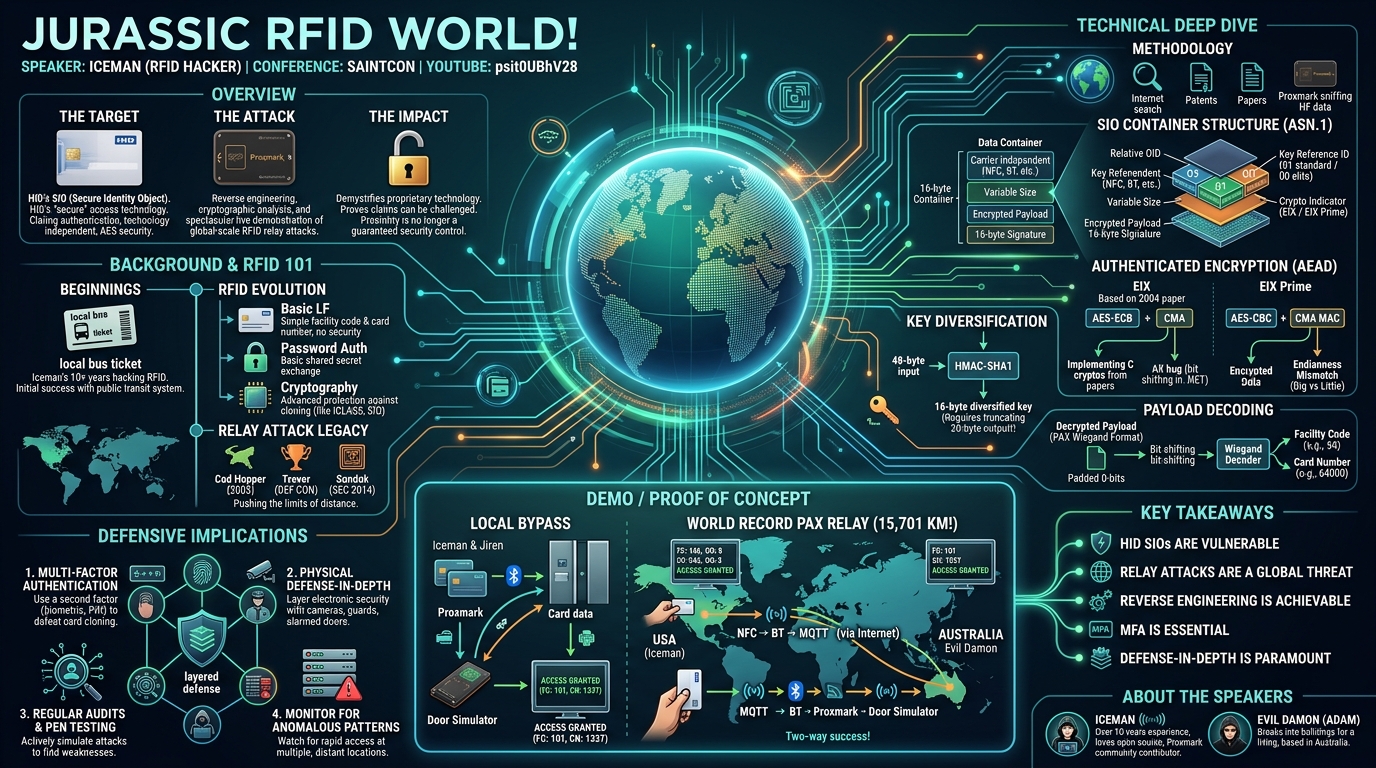
In his captivating talk, "Jurrasic RFID World!", the renowned RFID hacker Iceman delves into the intricacies and vulnerabilities of HID Secure Identity Objects (SIO), HID's flagship "secure" access control technology. Far from being a mere theoretical exploration, the presentation culminates in a spectacular demonstration of global-scale RFID relay attacks, pushing the boundaries of what was previously thought possible in physical access control bypasses. Iceman, known for his decade-long dedication to hacking RFID systems and his contributions to open-source tools like the Proxmark, brings a wealth of practical experience and a hacker's skepticism to the claims of "secure" identity solutions.
Key moments
- 0:00 Introduction and talk teaser
- 2:18 Iceman's personal journey into RFID hacking
- 4:00 First Proxmark experience: disappointment and failure
- 6:00 The triumphant dopamine rush of first RFID hack
- 7:30 Transition to Secure Identity Objects (SIO) deep dive
- 8:30 RFID 101: Basic principles and simple systems
- 10:00 Demonstrating the lack of security in basic RFID
Jurrasic RFID World!
Speakers: Iceman (RFID Hacker)
Conference: SAINTCON
YouTube: https://www.youtube.com/watch?v=psit0UBhV28
Overview
In his captivating talk, "Jurrasic RFID World!", the renowned RFID hacker Iceman delves into the intricacies and vulnerabilities of HID Secure Identity Objects (SIO), HID's flagship "secure" access control technology. Far from being a mere theoretical exploration, the presentation culminates in a spectacular demonstration of global-scale RFID relay attacks, pushing the boundaries of what was previously thought possible in physical access control bypasses. Iceman, known for his decade-long dedication to hacking RFID systems and his contributions to open-source tools like the Proxmark, brings a wealth of practical experience and a hacker's skepticism to the claims of "secure" identity solutions.
The core of Iceman's research reveals that despite HID's marketing of SIOs as offering "strong authentication" and "technology independent security," these systems are susceptible to sophisticated reverse engineering and practical exploitation. The talk meticulously unpacks the complex cryptographic architecture of SIOs, from their ASN.1 container format to their diversified key derivation functions and authenticated encryption schemes. More critically, Iceman demonstrates how the very "technology independent" nature of SIOs can be leveraged to facilitate relay attacks, ultimately showcasing a world-record-breaking live demonstration of an RFID credential being relayed over 15,000 kilometers from the USA to Australia to unlock a door.
This presentation is crucial for anyone involved in physical security, access control, or cybersecurity, as it starkly highlights the persistent vulnerabilities in systems widely considered robust. It serves as a powerful reminder that "secure" claims often warrant deeper investigation and that fundamental attack vectors, like relay attacks, continue to pose significant threats, even to modern cryptographic implementations. Iceman's work not only demystifies a proprietary "secure" technology but also provides actionable insights into how such systems can be bypassed, urging defenders to reconsider their reliance on single-factor authentication mechanisms for critical infrastructure.
Background
▶ Watch: Introduction and talk teaser (0:00)
Iceman's journey into RFID hacking began over a decade ago, stemming from a deeply personal period in his life. He found solace and renewed purpose in the challenge of hacking, particularly drawn to the Proxmark, an open-source RFID research and development tool. His initial foray involved compromising a local bus transport ticket system, a success that ignited a passion for reversing and exploiting RFID technologies that continues to drive his work today. This personal connection to the craft underscores the persistence and dedication required to unravel complex security protocols.
To set the stage for understanding SIOs, Iceman provides a concise RFID 101. He explains the fundamental operation of RFID systems, starting with basic Low-Frequency (LF) tags where a reader simply requests a facility code and card number, and the tag responds without any security. This inherent lack of authentication allows for easy cloning and emulation. The evolution of RFID security then moves to systems incorporating password authentications, where a shared secret is exchanged, offering a basic layer of defense. The next step in this progression is the integration of cryptography, providing more robust protection against unauthorized access and cloning, which is where HID SIOs are positioned.
HID SIOs represent an evolution from previous HID technologies like iCLASS. Marketed with terms like "strong authentication," "technology independent security," "heightened privacy protection," and AES security, SIOs were presented as a state-of-the-art solution. However, a key driver for Iceman's research was the scarcity of public information from HID regarding SIOs. This lack of transparency, coupled with bold claims of security, invariably triggers a hacker's instinct to investigate and challenge such assertions.
Iceman also references significant prior work in the field of RFID relay attacks, which laid the groundwork for his own demonstrations. He mentions the 2003 paper "Unlocking Doors from Half a Continent Away," which detailed a project called Cod Hopper. This add-on board for the Proxmark enabled relay attacks, famously demonstrated at DEF CON by Sam Trevor, where an RFID credential was relayed from Canada to Las Vegas. Another notable contribution came from Julia Sunduk, who presented a relay attack from Stockholm to Poland at SEC 2014 and Black Hat Asia, hacking RFID readers behind closed doors. These earlier feats of long-distance relay attacks provided both inspiration and a benchmark for Iceman's ambition to push the limits even further.
Key Findings
▶ Watch: First Proxmark experience: disappointment and failure (4:00)
Iceman's extensive research into HID Secure Identity Objects yielded several critical findings that challenge the perceived security of these advanced RFID credentials:
- SIOs are not impenetrable: Despite being marketed as HID's latest "secure" access control technology with "strong authentication" and AES security, Iceman's work conclusively demonstrates that SIOs are vulnerable to sophisticated reverse engineering and practical bypasses, particularly through relay attacks.
- Detailed Reverse Engineering of SIO Structure: Iceman successfully reverse-engineered the complex structure of SIOs, identifying them as ASN.1 containers that encapsulate data. He broke down the key components, including the Relative OID, Key Reference ID, cryptographic indicators (for EIX or EIX Prime), and the encrypted and signed payload.
- Identification of Cryptographic Mechanisms: The research pinpointed the specific cryptographic algorithms used within SIOs. Key diversification relies on HMAC-SHA1 fed with 48 bytes of input to generate a 16-byte key. The core encryption utilizes Authenticated Encryption with Associated Data (AEAD), specifically AES in conjunction with OMAC, implemented as either EIX (using ECB and CMA) or EIX Prime (using CBC and CMA MAC mode).
- Discovery of Implementation Quirks and Challenges: Iceman uncovered practical difficulties during implementation, such as the common HMAC-SHA1 function outputting 20 bytes instead of the required 16 for key derivation, leading to a "day of problems." He also highlighted the significant challenge of discrepancies between academic papers (often using big-endian byte order) and common software implementations (like .NET, which uses little-endian), which led to a painful two-week debugging process he called the "AX bug" or "macro bug."
- Successful Decryption and Wiegand Decoding: Through his efforts, Iceman achieved the ability to decrypt SIO payloads using the derived keys and identified the final data format as padded PAX Wiegand format (an ASN.1 bit string format). He demonstrated how to correctly parse this, removing padded zeros and converting it into standard Wiegand data (Facility Code and Card Number) using Proxmark client tools.
- Global-Scale Relay Attacks are a Reality: The most impactful finding was the successful demonstration of a world-record PAX relay attack, extending over 15,701 kilometers. This proved that the "technology independent security" feature of SIOs inadvertently facilitates extreme-range relay attacks by allowing for seamless protocol translation across different communication mediums (NFC, Bluetooth, MQTT). This finding underscores that physical proximity is no longer a prerequisite for many physical access control attacks.
Technical Deep Dive
▶ Watch: The triumphant dopamine rush of first RFID hack (6:00)
Iceman's methodology for dissecting HID SIOs exemplifies classic hacker ingenuity combined with rigorous technical analysis. The initial phase involved public source intelligence gathering, scouring web scrapers, patent databases, and academic papers. Crucially, he utilized the Proxmark and its HF 14A sniff command to capture raw byte data from SIO cards, providing the low-level insights necessary for reverse engineering.
The Secure Identity Object (SIO) itself is described as a data container, specifically an ASN.1 container. This container is designed to be carrier-independent, meaning it can be stored and transmitted across various technologies such as NFC, Bluetooth, Wi-Fi, or even mobile credentials on a smartphone. A key feature is its encrypted and signed payload, intended to ensure data integrity and confidentiality. Each SIO also utilizes diversified keys, meaning every SIO in the world has a unique cryptographic key associated with it, making a universal master key ineffective. The container is also variable-sized, allowing flexibility in the data it holds.
Iceman broke down the ASN.1 structure of an SIO into its interesting components:
- Relative OID (Object Identifier): This section, often lengthy, is linked to a root OID, reflecting HID's use of SNMP-like protocols.
- Key Reference ID: This element indicates the type of key set used for encryption. A value of
01signifies a standard key set, while00(or its absence) would indicate an elite or custom key, providing an immediate clue about the card's security tier. - Crypto Indicator: This specifies which cryptographic mode is employed, either EIX or EIX Prime.
- Payload: This is the core data, comprising two parts: the variable-sized encrypted data and a fixed 16-byte signature appended at the end. The signature provides integrity protection, making unauthorized modification extremely difficult.
A critical component of SIO security is the key diversification function. This function generates the unique 16-byte key for each SIO. It uses HMAC-SHA1, taking a specifically crafted 48-byte input. Iceman highlighted a common pitfall for C developers: standard HMAC-SHA1 implementations typically output a 20-byte hash. He spent a full day debugging why his Proxmark client wasn't working, only to discover he needed to truncate the 20-byte HMAC output to the required 16 bytes.
The encryption method chosen by HID for SIOs is Authenticated Encryption with Associated Data (AEAD), which simultaneously provides both encryption and data integrity (signature). Under the hood, this involves AES in combination with OMAC. Two variants are used:
- EIX: This mode, based on an academic paper from 2004, utilizes AES-ECB for encryption and CMA for message authentication. It produces X bytes of encryption and a 16-byte signature. Iceman noted that this mode had known problems back in 2004, indicating potential weaknesses.
- EIX Prime: Developed as a stronger alternative, EIX Prime employs AES-CBC for encryption and CMA MAC mode. While it produces X bytes of encryption, the standard signature size for this mode is typically 4 bytes. However, in the context of SIOs, it's crucial to account for the 16-byte signature as part of the overall payload structure.
Iceman's journey to implement these cryptos in C was fraught with challenges. He initially looked at the Bouncy Castle C# implementation, which is open source, but required a C equivalent. Recreating not one, but two complex cryptographic algorithms from academic papers, often lacking reliable test vectors, proved to be a "painful experience." He spent two weeks battling subtle discrepancies, including a specific "AX bug" or "macro bug" he discovered in the .NET version's source code, related to bit shifting. A major hurdle was the pervasive endianness mismatch: academic papers frequently present test vectors in big-endian format, while many modern systems (like .NET) operate in little-endian. This difference in byte order, combined with a lack of response from a Japanese researcher for working test vectors, made the process exceptionally difficult.
Once the payload was successfully decrypted, the next challenge was decoding its format. Iceman identified this as padded PAX Wiegand format, which is essentially an ASN.1 bit string format. The first byte of the decrypted payload indicates the number of padded zero bits that need to be truncated. For instance, if the first byte is 0x06, it signifies six leading zero bits that must be removed. After converting the payload into a bit string and performing the necessary bit shifts, the resulting binary data could then be fed into a Wiegand decoder. Conveniently, the Proxmark client includes such a decoder, which then outputs the familiar Facility Code and Card Number (e.g., H10301 26-bit FC 54 CN 64000), effectively revealing the raw access credential.
Demo / Proof of Concept
▶ Watch: RFID 101: Basic principles and simple systems (8:30)
Iceman's presentation included two compelling demonstrations, escalating from a local bypass to a global feat, vividly illustrating the practical implications of his SIO research.
The first demonstration involved a local relay attack against an SIO-secured system. For this, Iceman set up a door simulator on stage, which was connected to an SIO reader. He enlisted a volunteer named Jiren to act as a witness, confirming the output displayed on the simulator's screen. Iceman then took his own SIO card, which he stated contained a Facility Code (FC) of 101 and a Card Number (CN) of 1337. He placed this card on a Proxmark device, configured to act as the "attacker" side of the relay. The Proxmark then relayed the card's data to the door simulator's reader. After an initial hiccup, characteristic of live demos, the system successfully authenticated the relayed credential, causing the door simulator to display a "green" access message, confirming the bypass. This local demo served as a foundational proof that SIOs, despite their cryptographic protections, are susceptible to basic relay attack principles.
The climax of the talk was the audacious world record PAX relay attack. Iceman aimed to demonstrate the longest-ever public, live RFID relay attack, pushing the boundaries established by previous researchers. His collaborator for this ambitious endeavor was Evil Damon (Adam), situated in Australia, who joined the presentation via video call at 5 AM local time, highlighting the significant time zone challenges.
The target distance for this relay was approximately 15,701 kilometers (USA to Australia), which Iceman proudly noted was close to half the Earth's circumference (40,000 km total). The method employed was a sophisticated technology swap, leveraging the "technology independent security" feature of SIOs. On Iceman's end in the USA, an SIO card was read via NFC by a device connected to his computer via Bluetooth. This data was then transmitted over the internet using MQTT to Evil Damon in Australia. On Evil Damon's end, the MQTT data was received, converted back, and transmitted via Bluetooth to a Proxmark or similar device acting as a reader, which then presented the credential to a local door simulator.
The world record attempt proceeded in two parts:
- Australia to USA: Evil Damon first presented one of his SIO cards to his reader in Australia. The data was relayed across the globe to the door simulator in the USA. The screen on stage, witnessed by Jiren and the audience, displayed successful access with a Facility Code of
146and Card Number8. To further prove the concept, a second card was read, displaying FC246and CN1243. The audience erupted in applause. - USA to Australia: Next, Iceman presented his own FC
101, CN1337SIO card to his local reader in the USA. This data was then relayed to Evil Damon's setup in Australia, where it successfully unlocked the door simulator. The visual confirmation on screen and the enthusiastic reaction from the audience solidified the success of the unprecedented global relay.
This demonstration not only validated Iceman's technical findings but also served as a stark, unforgettable illustration that physical proximity is no longer a reliable security control for RFID access systems. The "technology independent" design, intended as a feature, was brilliantly repurposed to become a critical vulnerability enabling attacks across continents.
Defensive Implications
▶ Watch: Demonstrating the lack of security in basic RFID (10:00)
The detailed technical breakdown and live demonstrations by Iceman have profound implications for defenders relying on HID SIOs and similar "secure" RFID access control systems. The primary takeaway is that assumptions of security based solely on manufacturer claims or cryptographic complexity are insufficient.
- Implement Multi-Factor Authentication (MFA): The most critical defensive measure is to move beyond single-factor RFID card authentication. Integrating a second factor, such as a PIN, biometric scan (fingerprint, facial recognition), or a mobile authenticator, significantly mitigates the risk of cloned or relayed credentials. Even if an attacker can relay the card data, they would still need the secondary factor.
- Understand and Mitigate Relay Attacks: Defenders must acknowledge that relay attacks are a present and potent threat, even across vast distances. Proximity is no longer a guarantee of security. This implies that simply securing the physical perimeter around the reader may not be enough if the credential can be intercepted and relayed from a distance. Consider using challenge-response mechanisms or time-of-flight measurements in readers, if available, to detect and prevent relay attacks by verifying the actual physical presence of the card.
- Physical Security in Depth: Electronic access control should always be part of a broader defense-in-depth strategy. Complement SIO systems with robust traditional physical security measures like surveillance cameras, alarmed doors, security guards, and layered access zones. These layers can detect or deter attackers who manage to bypass the electronic system.
- Regular Audits and Penetration Testing: Organizations should regularly conduct penetration tests specifically targeting their RFID and access control infrastructure. These tests should include attempts at cloning, emulation, and simulated relay attacks to identify weaknesses before malicious actors exploit them.
- Monitor for Anomalous Access Patterns: Implement robust logging and monitoring for access control events. Look for unusual access patterns, such as a single card attempting to access multiple, geographically distant locations within an impossible timeframe, or repeated access attempts by a single credential.
- Educate Staff and Users: End-users and security personnel should be educated about the risks of tailgating, social engineering, and the potential for sophisticated RFID attacks. Awareness can help identify suspicious activities.
- Secure Reader Placement: While relay attacks make reader placement less critical for proximity, minimizing reader exposure in public or easily accessible areas can still reduce the initial opportunity for an attacker to initiate a relay or capture signals.
- Stay Informed on Vulnerabilities: Keep abreast of new research and vulnerabilities discovered in RFID technologies, including SIOs. Manufacturers often release updates or recommendations to address identified weaknesses.
Ultimately, Iceman's work demonstrates that "secure" is a relative term in the world of physical security. A comprehensive, layered, and continually tested approach is paramount to protecting assets, as no single technology, no matter how cryptographically advanced, can provide absolute security against determined and skilled attackers.
Key Takeaways
- HID SIOs are Vulnerable: Despite being marketed as a highly secure, next-generation access control solution, HID Secure Identity Objects (SIOs) are susceptible to sophisticated reverse engineering and practical bypasses.
- Relay Attacks are a Global Threat: The "technology independent security" feature of SIOs inadvertently enables extreme-range relay attacks, as demonstrated by a successful 15,701 km live relay from the USA to Australia, proving that physical proximity is no longer a reliable security control.
- Reverse Engineering is Key: Unpacking complex, proprietary cryptographic protocols like SIOs is achievable through persistent reverse engineering, even with limited public documentation, requiring meticulous attention to detail regarding implementation quirks (e.g., endianness, HMAC output size).
- Multi-Factor Authentication is Essential: Organizations relying on SIOs or similar "secure" RFID technologies must implement multi-factor authentication (MFA) to significantly enhance security, as single-factor card-based systems can be bypassed.
- Defense-in-Depth is Paramount: A holistic security strategy combining electronic access control with robust physical security measures, continuous monitoring, and regular penetration testing is crucial to mitigate the demonstrated risks and ensure true security.
About the Speaker(s)
Iceman is a highly respected and passionate RFID hacker with over a decade of experience in the field. He describes his work as hacking RFID systems "more or less daily," driven by a love for open source and the "dopamine rushes" he gets from successfully compromising complex systems. Iceman is particularly well-known within the Proxmark community for his extensive contributions and expertise. He previously collaborated with Evil Damon on parts of this research, which was also presented at Black Hat Asia 2025. His personal journey into hacking, born from a desire to find joy, underscores his deep commitment and enthusiasm for unraveling the intricacies of RFID technology.
Evil Damon (Adam) is a professional hacker based in Australia, specializing in breaking into computers and buildings for a living. He joined Iceman live on stage at 5 AM local Australian time to facilitate the world-record relay attack demonstration. His willingness to participate in such an ambitious, early-morning live demo highlights his dedication and expertise in practical security exploitation.