A space odyssey #2: How to study moon rocks from the Soviet sample return mission Luna 24
Paul Koetter
39th Chaos Communication Congress (39C3): Power Cycles · Day 2 · Saal Ground
Overview
This talk, "A space odyssey #2: How to study moon rocks from the Soviet sample return mission Luna 24," delivered by Paul Koetter at 39C3, offers a fascinating glimpse into the cutting-edge scientific analysis of lunar samples. Koetter, whose background spans aerospace engineering and planetary sciences, presents the results of a collaborative effort between the Museum of Natural History in Berlin and the German Aerospace Center (DLR). The core of the presentation revolves around the meticulous, non-destructive examination of precious lunar regolith samples brought back to Earth by the Soviet Luna 24 mission in 1976. This research is crucial for advancing our understanding of lunar geology and the broader evolution of the solar system, particularly by applying modern analytical techniques to samples collected decades ago.
Key moments
- 0:00 Introduction to Luna 24 samples and research
- 1:00 Brief overview of solar system formation
- 2:50 The giant impact theory of Moon's formation
- 4:30 Lunar bombardment and the formation of dark maria
- 6:00 Geological definition of rocks and minerals
- 7:00 Overview of Soviet Luna sample return missions
- 8:00 Luna 9's pioneering soft landing and first lunar picture
A space odyssey #2: How to study moon rocks from the Soviet sample return mission Luna 24
Speakers: Paul Koetter
Conference: 39C3
YouTube: https://www.youtube.com/watch?v=8ASOKkwxdno
Overview
This talk, "A space odyssey #2: How to study moon rocks from the Soviet sample return mission Luna 24," delivered by Paul Koetter at 39C3, offers a fascinating glimpse into the cutting-edge scientific analysis of lunar samples. Koetter, whose background spans aerospace engineering and planetary sciences, presents the results of a collaborative effort between the Museum of Natural History in Berlin and the German Aerospace Center (DLR). The core of the presentation revolves around the meticulous, non-destructive examination of precious lunar regolith samples brought back to Earth by the Soviet Luna 24 mission in 1976. This research is crucial for advancing our understanding of lunar geology and the broader evolution of the solar system, particularly by applying modern analytical techniques to samples collected decades ago.
The significance of this work lies in its innovative methodological approach. Given the extreme rarity and irreplaceable nature of extraterrestrial samples, the development and application of techniques that can extract comprehensive information without causing any damage are paramount. Koetter details how advanced tools like micro-computer tomography (micro-CT) and micro X-ray fluorescence spectrometry (XRF) were employed, and even ingeniously combined, to reveal the internal structure and elemental composition of these moon rocks. This not only provides new scientific insights into the specific Luna 24 landing site but also establishes a robust framework for future analyses of other limited-quantity extraterrestrial materials.
Background
▶ Watch: Introduction to Luna 24 samples and research (0:00)
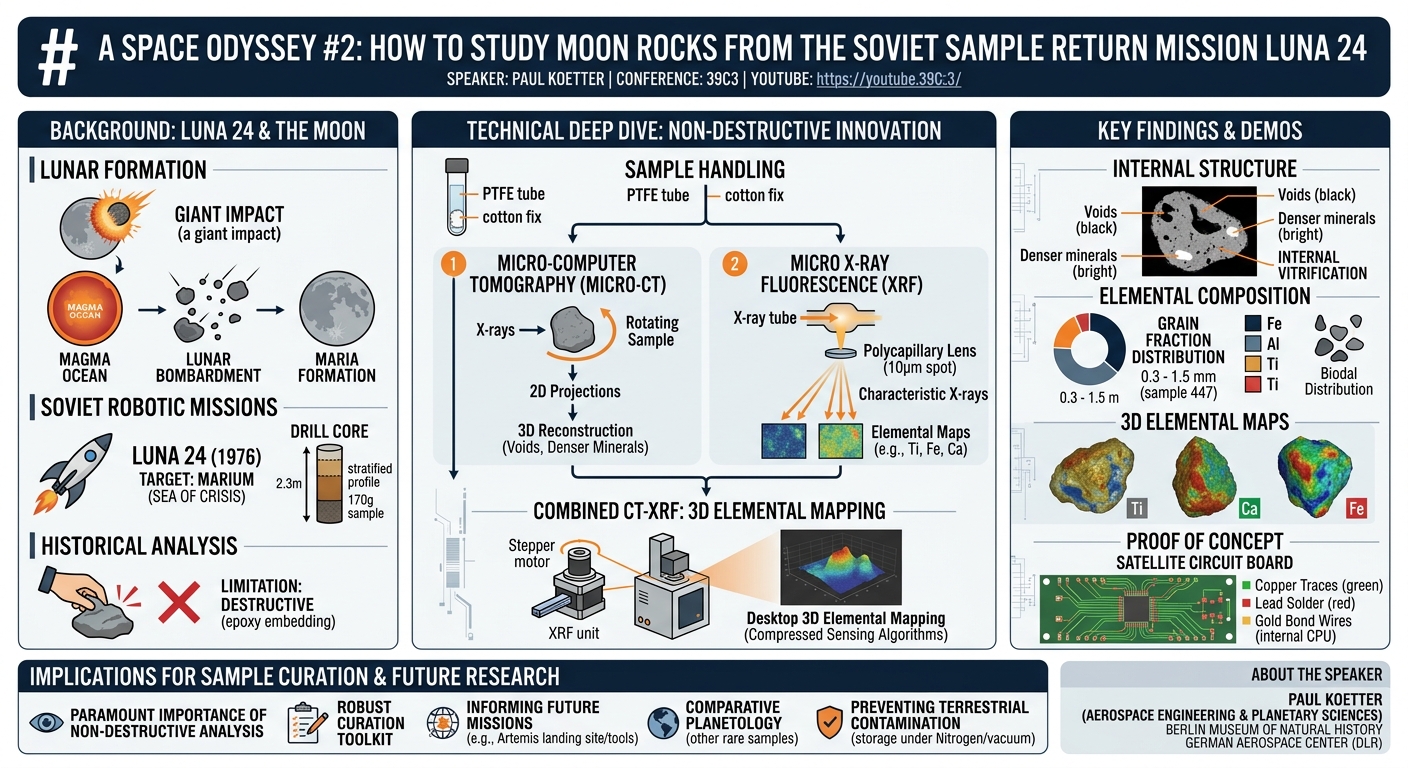
To appreciate the context of the Luna 24 samples, Koetter first provided a concise overview of the solar system's genesis and lunar formation. The solar system began as a giant molecular cloud that underwent gravitational collapse, forming a protoplanetary disk with a star at its center and planets coalescing around it. Early in its history, the Earth experienced a catastrophic impact with a Mars-sized body, leading to the formation of the Moon. This proto-Moon was initially a magma ocean, which gradually cooled and differentiated, with lighter minerals rising and denser ones sinking. This period was followed by intense lunar bombardment from asteroids and comets, creating large basins. These basins later filled with darker, basaltic lava, forming the familiar lunar maria we observe today.
Rocks themselves are defined geologically as complexes of mineral grains stuck together, distinct from single minerals which have a uniform atomic structure. Understanding these fundamental compositions is key to interpreting lunar samples. While the Apollo missions are widely known for bringing back extensive lunar samples, the Soviet Union also conducted three successful robotic sample return missions: Luna 16, Luna 20, and Luna 24. Luna 24, launched in 1976, was the last of these, retrieving an impressive 170 grams of lunar material. Its target was Marium, the Sea of Crisis, a geologically young and relatively flat area chosen for its scientific interest and safer landing conditions.
The Luna 24 spacecraft featured a sophisticated design: a landing stage that remained on the Moon, an ascent stage for returning to Earth, and a re-entry capsule containing the precious payload. A key innovation was its drill core, approximately 2.3 meters long, designed to preserve the stratigraphic profile (layering) of the lunar subsurface. Instead of transporting the entire core, it was ingeniously rolled up into a flexible membrane and sealed in the re-entry capsule. After landing in Siberia, the samples were transported to Moscow, analyzed by Soviet institutes, and then distributed globally, including to Germany, India, Iraq, and through an exchange with the USA. Early analyses utilized methods like optical microscopy, electron microprobe, scanning electron microscope (SEM), and X-ray diffraction (XRD). However, a significant limitation was the need to often grind down larger particles and embed them in epoxy resin, a destructive process that often restricted analysis to smaller grains and prevented further study of the original sample morphology. This historical context underscores the necessity for the non-destructive approach taken in Koetter's research.
Key Findings
▶ Watch: The giant impact theory of Moon's formation (2:50)
The research presented by Paul Koetter yielded several significant findings, primarily enabled by the application of advanced non-destructive analytical techniques to the Luna 24 samples. The team focused on a specific fraction of sample 447, comprising approximately 46 grains ranging from 0.3 to 1.5 millimeters – a size range often overlooked in previous studies due to the destructive nature of older analytical methods.
A major contribution was the ability to visualize the internal structure of these lunar grains for the first time in such detail. Through micro-CT, the researchers uncovered a remarkable heterogeneity, revealing internal voids (black areas), denser minerals (brighter areas), and average materials (gray areas). This internal architecture provided critical clues about the formation processes of these particles on the lunar surface. For instance, some grains exhibited smoother internal surfaces contrasted with rougher exteriors, leading to hypotheses about energetic events causing internal vitrification or rolling of molten material on fine regolith.
The elemental mapping capabilities of micro X-ray fluorescence spectrometry (XRF) further elucidated the composition of these grains. The analysis identified distinct types of particles, including aluminum-rich, iron-rich, and titanium-rich materials. This compositional diversity suggests varied origins and mixing processes within the lunar regolith. Koetter highlighted a "biodal distribution" of grain types, indicating two predominant compositional categories, which provides valuable data for understanding the geological processes at the Luna 24 landing site, Marium.
Perhaps the most innovative finding was the successful combination of micro-CT and XRF to achieve 3D elemental mapping at a desktop scale. This groundbreaking technique allowed the team to not only see the internal structure but also map the distribution of elements within that 3D volume, such as titanium, calcium, and iron. This capability offers an unprecedented level of detail for understanding how different minerals and glasses are distributed within a single lunar particle, providing fresh perspectives on impact-induced melting, friction welding, and degassing processes that shape lunar soil. This fusion of techniques represents a significant advancement in the study of extraterrestrial materials.
Technical Deep Dive
▶ Watch: Lunar bombardment and the formation of dark maria (4:30)
The cornerstone of Koetter's research was the rigorous adherence to non-destructive analysis, a critical requirement for studying the exceedingly rare Luna 24 samples. With only 46 grains above a certain size threshold (0.3 to 1.5 mm), any loss or alteration of the sample was unacceptable. This necessitated the use of highly specialized imaging and spectroscopic techniques.
The primary method for internal visualization was micro-Computer Tomography (micro-CT). This technology, which became widely available in the early 2000s, operates on the same principle as medical CT scans but at a much smaller scale. X-rays are directed through the sample, and a detector records their attenuation. By rotating the sample incrementally and capturing images from multiple angles, a series of 2D projections are acquired. These projections are then mathematically reconstructed using algorithms like back projection from a sinogram to create a detailed 3D model of the sample's interior. For the lunar grains, custom sample holders were fabricated: small PTFE tubes where the grains were carefully fixated with cotton to ensure stability during rotation without introducing contamination or damage. This allowed the researchers to generate high-resolution 3D models revealing voids, denser mineral inclusions, and the overall heterogeneity of the grains.
To determine the elemental composition, the team employed micro X-ray Fluorescence Spectrometry (XRF). The principle of XRF is based on atomic physics: when an incident X-ray strikes an atom, it can eject an electron from an inner shell. To stabilize, an electron from an outer shell immediately drops into the vacated inner shell, emitting a secondary X-ray. Crucially, the energy (and thus wavelength) of this emitted X-ray is characteristic of the specific element. By detecting and measuring these characteristic X-rays, both the identity and quantity of elements present can be determined. The setup featured an X-ray tube with a rhodium target that emitted primary X-rays. These X-rays were then focused onto the sample using a sophisticated polycapillary lens, capable of concentrating the beam down to a remarkable 10-micrometer spot size. The sample was placed in a vacuum environment, which significantly enhances signal detection by minimizing X-ray absorption by air. An energy dispersive detector captured the fluorescent X-rays, and specialized software processed the data to create elemental maps.
The most innovative technical aspect was the combination of micro-CT and XRF for 3D elemental mapping. This was achieved by integrating a simple, off-the-shelf stepper motor into the XRF machine. The motor precisely rotated the lunar grains by defined angular increments, allowing the XRF system to acquire elemental maps at each rotation. The subsequent reconstruction of these 2D elemental maps into a 3D elemental volume was made possible by advanced compressed sensing algorithms. These algorithms are crucial because they allow for high-resolution 3D reconstruction from a significantly fewer number of projections than traditionally required (e.g., avoiding the need to image every two degrees). This desktop-scale innovation, previously mostly confined to large, multi-billion-dollar synchrotron radiation facilities, allowed for unprecedented 3D insights into the elemental distribution within the precious Luna 24 samples.
Demo / Proof of Concept
▶ Watch: Overview of Soviet Luna sample return missions (7:00)
Koetter's presentation included several compelling demonstrations and proof-of-concept examples that validated the efficacy and power of their chosen analytical methods. Before applying these techniques to the invaluable lunar samples, the team developed training samples to test their protocols and minimize risks. A key challenge was replicating lunar agglutinates—small, glassy particles formed by the melting and welding of lunar soil due to micrometeorite impacts. Since such particles don't naturally form on Earth due to atmospheric ablation of micrometeorites, the researchers created simulants. They meticulously ground terrestrial materials known to exist on the Moon into fine grains, packed them into small wells, and then blasted them with a laser. The laser energy was carefully calculated to mimic the kinetic energy of micrometeorite impacts, successfully producing artificial agglutinates that, while not perfect matches, were sufficient for testing the analytical methods and identifying potential issues like grain loss.
A vivid illustration of the micro-XRF system's capabilities was provided through its application to a satellite computer circuit board. The resulting elemental map beautifully revealed the intricate internal structure of the board. Copper traces appeared green, clearly delineating the pathways between components. Lead (red) highlighted the solder points, indicating the use of leaded solder. Bromine (blue) was mapped, revealing its presence as a flame retardant in the FR4 circuit board material. Most impressively, the XRF was able to peer inside the central chip (CPU), visualizing the delicate gold bond wires connecting the silicon die to the external package. This demonstration underscored the high spatial resolution and penetrative power of the XRF, showcasing its ability to reveal hidden internal details of complex objects.
Finally, the culmination of the methodological approach was demonstrated with the actual Luna 24 samples. The micro-CT images displayed the intricate 3D internal structure, revealing voids and denser inclusions within the lunar grains. The subsequent 3D elemental mapping, achieved by combining micro-CT and XRF, provided a stunning visualization of elemental distribution. For instance, images clearly showed areas rich in titanium (blue), calcium (green), and iron (red) distributed heterogeneously within the same grain. This imagery, previously only attainable at large-scale facilities, was now being produced on a desktop instrument, marking a significant advancement for planetary science. These demonstrations effectively proved that the non-destructive, combined CT-XRF approach could deliver novel, high-resolution insights into the composition and internal structure of precious extraterrestrial materials.
Implications for Sample Curation and Future Research
▶ Watch: Luna 9's pioneering soft landing and first lunar picture (8:00)
While the original prompt requested "Defensive Implications" in the context of a security conference talk, the provided content is a scientific presentation on lunar sample analysis. Therefore, this section will be reframed to discuss the Implications for Sample Curation and Future Research, focusing on the protection and optimal utilization of invaluable extraterrestrial materials.
The paramount implication of this research is the reinforcement of the critical importance of non-destructive analysis for irreplaceable extraterrestrial samples. The Luna 24 samples, along with those from Apollo and future missions like Artemis, represent finite and precious resources. Any method that extracts maximum scientific information without altering or damaging the sample ensures its long-term preservation for future generations of scientists and the application of even more advanced, yet-to-be-developed technologies. This "defensive" posture against sample degradation or loss is fundamental to planetary science.
The advanced techniques demonstrated, particularly the innovative combination of micro-CT and micro-XRF for 3D elemental mapping, offer a robust toolkit for sample curation. By providing detailed internal structural and compositional data, these methods enable a thorough characterization of samples, which is essential for understanding their history and selecting appropriate future analyses. The careful handling protocols, such as using specialized tweezers and particle-shed-free paper, and stringent storage conditions (e.g., under nitrogen or in high vacuum for pristine samples), are crucial "defensive" measures against terrestrial contamination and degradation, ensuring the scientific integrity of the samples for decades to come. The talk highlighted that some Luna samples were already exposed to air and moisture for 40 years, leading to the absorption of O groups (water), underscoring the importance of pristine storage for future missions.
Furthermore, the methodologies developed here have significant implications for guiding future lunar and planetary missions. Understanding the detailed composition and internal structure of regolith from different lunar regions (like Marium from Luna 24) informs the design of new sampling tools, the selection of landing sites (e.g., the lunar poles for Artemis 3, chosen for their unique temperature cycling and environments), and the scientific objectives of sample return missions. The ability to analyze very small, rare fractions of material means that even minute samples from other missions (like Luna 16, Luna 20, or upcoming Chinese missions) can yield substantial data, fostering comparative planetology. The speaker also mentioned the possibility of applying these techniques to micrometeorites, further extending their utility in studying extraterrestrial materials found on Earth. This research effectively "defends" the scientific potential of these samples by maximizing the information extracted from them while ensuring their longevity.
Key Takeaways
- Non-destructive analysis is paramount: For irreplaceable extraterrestrial samples like those from Luna 24, advanced non-destructive techniques are essential to preserve them for future research.
- Micro-CT reveals internal secrets: Micro-computer tomography provides unprecedented 3D visualization of lunar grains' internal structures, including voids, denser minerals, and overall heterogeneity.
- Micro-XRF maps elemental composition: Micro X-ray fluorescence spectrometry precisely identifies and maps the distribution of elements (e.g., aluminum, iron, titanium) within lunar particles at a 10-micrometer resolution.
- Desktop 3D elemental mapping is a reality: The innovative combination of micro-CT and XRF, utilizing a simple stepper motor and advanced reconstruction algorithms, enables detailed 3D elemental imaging at a desktop scale, previously limited to large facilities.
- Luna 24 samples are complex: Analysis shows the Luna 24 samples from Marium exhibit diverse compositions and internal structures, reflecting complex lunar geological processes like impact-induced melting, friction welding, and degassing.
- Methodologies for future missions: The developed techniques provide a robust framework for analyzing other rare extraterrestrial samples, informing future lunar missions, and ensuring optimal curation of precious materials.
About the Speaker(s)
Paul Koetter is a researcher whose academic journey bridges the realms of engineering and planetary science. He initially pursued aerospace engineering, providing him with a strong foundation in the technical aspects of space missions and instrumentation. Following his bachelor's degree, he transitioned to studying planetary sciences, which led him to this fascinating research into lunar geology. Koetter conducted this work as part of a joint effort between the Museum of Natural History in Berlin and the German Aerospace Center (DLR), indicating his affiliation with these prominent scientific institutions. His expertise lies in applying advanced analytical techniques, such as micro-CT and XRF, to extraterrestrial samples. Koetter's talk not only presented novel scientific findings but also highlighted his passion for the field, inviting attendees to visit the Museum of Natural History in Berlin to see actual moon rocks on display and to engage in further collaboration or discussion.
All talks from 39th Chaos Communication Congress (39C3): Power Cycles