A post-American, enshittification-resistant internet
Cory Doctorow
39th Chaos Communication Congress (39C3): Power Cycles · Day 2 · Saal One
Overview
In his compelling 39C3 talk, "A post-American, enshittification-resistant internet," long-time Electronic Frontier Foundation (EFF) activist Cory Doctorow delivers a powerful indictment of modern digital platforms and the legal frameworks that underpin their monopolistic control. Doctorow, known for coining the term "enshittification" to describe the inevitable decay of online platforms as they extract value from users and producers, argues that the root cause lies in the "war on general-purpose computing." This war, waged through anti-circumvention laws, has systematically eroded technological self-determination and stifled genuine competition.
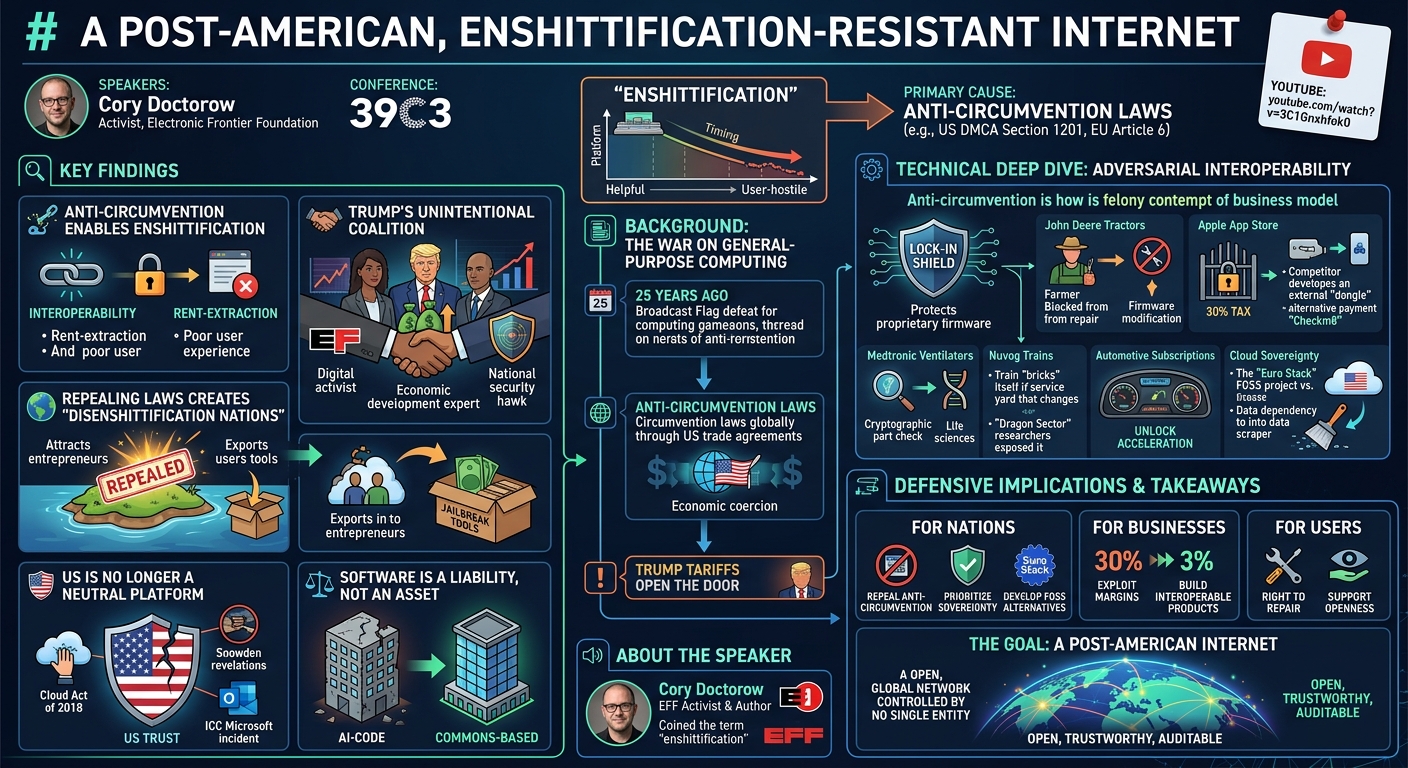
Key moments
- 0:00 Introduction to EFF and the 'War on General Purpose Computing'
- 2:00 EFF's Broadcast Flag victory, despite losing the war
- 2:20 A new internet is possible: the door is unlocked
- 2:50 Donald Trump's unintentional role in a post-American internet
- 4:00 New coalition fighting the war on general purpose computing
- 5:00 Explaining anti-circumvention law and its felony implications
- 7:00 Europe's problematic adoption of anti-circumvention laws
A post-American, enshittification-resistant internet
Speakers: Cory Doctorow, Activist, Electronic Frontier Foundation
Conference: 39C3
YouTube: https://www.youtube.com/watch?v=3C1Gnxhfok0
Overview
In his compelling 39C3 talk, "A post-American, enshittification-resistant internet," long-time Electronic Frontier Foundation (EFF) activist Cory Doctorow delivers a powerful indictment of modern digital platforms and the legal frameworks that underpin their monopolistic control. Doctorow, known for coining the term "enshittification" to describe the inevitable decay of online platforms as they extract value from users and producers, argues that the root cause lies in the "war on general-purpose computing." This war, waged through anti-circumvention laws, has systematically eroded technological self-determination and stifled genuine competition.
Doctorow contends that despite decades of fighting against these restrictive laws, a unique geopolitical shift—triggered inadvertently by former US President Donald Trump's trade policies—has created an unprecedented opportunity for a "post-American internet." This new digital nervous system, he suggests, can be built collaboratively, free from America's demands and priorities. By repealing anti-circumvention legislation, nations can foster adversarial interoperability, reclaim digital sovereignty, and unlock immense economic potential currently monopolized by a handful of US big tech companies.
The talk is a rallying cry for activists, entrepreneurs, and even national security strategists to unite in dismantling the legal and technical barriers that enable platform decay and foreign technological dependence. Doctorow outlines how this "unstoppable coalition" can usher in an era where technology serves the public good, rather than the insatiable rent-seeking of corporate shareholders, ultimately leading to a more resilient, open, and user-centric global internet.
Background
▶ Watch: Introduction to EFF and the 'War on General Purpose Computing' (0:00)
Cory Doctorow frames his decades-long career at the Electronic Frontier Foundation as a continuous engagement in the "war on general-purpose computing." This conflict, he explains, dates back to his very first day at the EFF 25 years ago, when he crashed the inaugural meeting of the Broadcast Protection Discussion Group. This coalition of tech, media, broadcast, and cable companies, convened by a "lavishly corrupt American congressman" named Billy Tosen, sought new regulations to ban the manufacture and sale of digital computers unless they were "damaged to specifications" set by the group. These specifications involved technical measures to block the execution of code not approved by their shareholders. This initiative, known as the Broadcast Flag, was initially passed by the Federal Communications Commission but was successfully overturned by an EFF lawsuit.
Despite this early victory, Doctorow asserts that the broader war has largely been lost over the past quarter-century. The legislative embodiment of this war is anti-circumvention law, which Doctorow describes as the "boring name" for the legal framework that criminalizes altering the functioning of a digital product or service without the manufacturer's explicit approval. This is true, he emphasizes, even if the modification violates no other law. The foundational piece of this legislation in the USA is Section 1201 of the Digital Millennium Copyright Act (DMCA) of 1998. This section establishes a felony punishable by a 5-year prison sentence and a $500,000 fine for a first offense merely for bypassing an access control to a copyrighted work. Critically, it also criminalizes the disclosure of information about how to bypass such controls, effectively silencing security researchers and pen testers. Doctorow, quoting J. Freeman, aptly calls this legal regime "felony contempt of business model."
While the DMCA originated in the US, Doctorow highlights a critical global pattern: "Every other country in the world has passed a law just like this one in the years since." In the European Union, for instance, a similar provision was enacted through Article 6 of the Copyright Directive in 2001. Doctorow explains that these laws were not adopted willingly by other nations. Instead, the US Trade Representative systematically forced its trading partners—including Australia, Mexico, Canada, CAFTA nations, and others—to enact anti-circumvention laws as a condition for trade agreements (e.g., the US-Australia Free Trade Agreement). This mechanism, he reveals through an anecdote from a former Central American information minister, amounted to economic coercion: accept anti-circumvention, or lose vital export markets like the US coffee market. This effectively enabled US big tech companies to "declare open season on their own people's private data and ready cash," facilitating a one-way transfer of value from tech-importing nations to American firms. However, Doctorow argues that the advent of Trump's tariffs fundamentally alters this calculus. If the US is already imposing tariffs, the threat of further trade penalties for non-compliance with anti-circumvention demands loses its leverage, opening a crack in the door for countries to reclaim their digital autonomy.
Key Findings
▶ Watch: A new internet is possible: the door is unlocked (2:20)
Doctorow's talk centers on several critical findings that collectively paint a picture of systemic digital decline and a potential path to liberation:
- Enshittification is a Direct Consequence of Anti-Circumvention Laws: Doctorow posits that the pervasive "enshittification"—the degradation of online platforms and digital products over time, as they prioritize shareholder value over user experience—is not an accident but a direct result of the legal ban on adversarial interoperability. By making it illegal to modify products or create competing services that plug into existing ones, anti-circumvention laws eliminate competitive pressure, allowing companies to extract rents, degrade service, and abuse user trust without consequence.
- Trump's Actions Forge an Unstoppable Coalition: Paradoxically, Donald Trump's belligerent trade policies and weaponization of US tech platforms have inadvertently created a powerful, "unstoppable coalition" to fight the war on general-purpose computing. This diverse alliance includes:
- Digital rights activists (like EFF), who have fought these battles for decades.
- Entrepreneurs and economic development wonks, who see the repeal of anti-circumvention laws as an opportunity to raid the "highest margin lines of business of the most profitable companies in America," turning America's tech trillions into billions for their domestic economies.
- National security hawks, who are increasingly concerned about their countries' reliance on US-based platforms, which have proven vulnerable to political pressure and weaponization by the US government.
- Repealing Anti-Circumvention Laws Enables "Disenshittification Nations": Any country that repeals its anti-circumvention laws can become a "disenshittification nation." This would create a legal haven for technologists and businesses to develop and sell "disenshittificatory products"—tools and services that jailbreak, reverse engineer, and interoperate with existing defective US tech exports. This not only protects the privacy and money of their own citizens but also allows them to export these tools globally, generating significant revenue and fostering a vibrant domestic tech sector.
- The US Has Shattered Global Trust as a Neutral Platform: Doctorow argues that the US, long seen as a stable maintainer of critical global systems, has systematically eroded this trust. He cites examples beyond tech, such as the US control over transoceanic fiber cable landing points (revealed by Snowden's NSA documents) and the weaponization of the dollar clearing system (e.g., against Russian oligarchs). In the digital realm, the US Cloud Act of 2018 allows the US government to compel US-based companies to disclose user data, including that of foreign governments, regardless of where the data is stored, often with gag orders. This, combined with incidents like Microsoft allegedly bricking the International Criminal Court's (ICC) Outlook access, demonstrates the severe infrastructural risk of relying on US tech platforms.
- Software is a Liability, Not an Asset: Doctorow challenges the conventional wisdom that software is an asset. He argues that while the capabilities software delivers (automation, analysis) are assets, the software itself is a liability—brittle, fragile, and prone to breaking. He advocates for commons-based production of software as a way to distribute and reduce this liability, contrasting it with the "tech debt at scale" produced by AI-generated code, which he dismisses as "defective spicy autocomplete." He views the current AI hype as a "fantasy of a company without workers," driven by bosses who secretly despise their employees.
Technical Deep Dive
▶ Watch: Donald Trump's unintentional role in a post-American internet (2:50)
The core technical concept underpinning Doctorow's talk is adversarial interoperability, a term describing the ability of third parties to create products or services that work with existing dominant platforms or devices, often without the original manufacturer's explicit permission or cooperation. This is fundamentally opposed by anti-circumvention laws, which criminalize the very acts required for such interoperability.
Doctorow illustrates how anti-circumvention laws protect manufacturers' ability to lock down their products:
- Firmware Locks and Parts Pairing: A prime example is John Deere tractors. When a farmer replaces a broken part, the tractor's main computing unit will not recognize the new component and will refuse to operate until an authorized John Deere service representative inputs an unlock code. Modifying the tractor's firmware to bypass this "parts pairing check" is a violation of anti-circumvention law. This forces farmers into costly service calls and prevents independent repair. Doctorow points to Canadian company Honeybee as a potential firm that, if anti-circumvention laws were repealed, could legally "jailbreak" John Deere firmware and sell it globally.
- Monopolistic App Store Controls: Apple's App Store is cited as a massive rent-extraction mechanism. Apple mandates the use of its own payment processor, charging a 30% commission on every transaction, generating an estimated $100 billion annually. If Article 6 of the EU Copyright Directive were repealed, Doctorow suggests, Finnish technologists could reverse engineer Apple's bootloaders and create hardware dongles to jailbreak iPhones. This would enable alternative app stores and payment processors, allowing competitors to offer significant discounts (e.g., 90%) to app vendors and still generate substantial profits (e.g., $10 billion annually). The Checkm8 exploit, which permanently jailbroke eight generations of iOS devices, is mentioned as an example of the technical feasibility of such circumvention.
- Medical Device Sabotage: The medical technology company Medtronic (the world's largest) is accused of similar practices. Its ventilators incorporate cryptographic handshakes for new parts, requiring an authorized Medtronic technician to "bless" repairs performed by hospital staff, costing hundreds of euros per fix. This was lethally problematic during COVID-19 lockdowns when technicians couldn't travel. Doctorow also mentions the unpermitted, but technically possible, jailbreaking of inexpensive CPAP machines into ventilators during the pandemic, which Medtronic refused to enable citing "medical certification reasons."
- Industrial Equipment Bricking: The Polish train company Nuvog is highlighted for deliberately sabotaging its locomotives. If a Nuvog train detects it has been taken to a rival service yard, it "bricks itself." Nuvog then charges €20,000 to remotely send an "unbricking command." Polish security researchers from Dragon Sector exposed this "disgusting racket" at a previous CCC event, only to face a lawsuit from Nuvog under anti-circumvention law for disclosing their findings.
- Automotive Rent-Seeking: Even luxury car manufacturers engage in this. Mercedes-Benz, for example, rents out the full acceleration curve of its luxury cars, while BMW rents an automated high-beam dimming system, both available via monthly subscriptions. Legalized jailbreaking would allow mechanics to unlock these features permanently for a single fee.
- Geopolitical Weaponization of Cloud Services: The US Cloud Act of 2018 grants the US government the power to compel any US-based company (like Microsoft) to disclose user data, including that of foreign governments, regardless of where the data is physically stored. This power can be exercised with gag orders, preventing disclosure. Doctorow cites the alleged incident where Microsoft bricked the International Criminal Court's (ICC) Outlook access following Trump's denunciation, illustrating the vulnerability of nations relying on US cloud infrastructure. Similarly, John Deere's ability to remotely "kill signal" and brick millions of dollars worth of tractors looted from Ukraine demonstrates the potential for agricultural infrastructure to be weaponized.
- Digital Sovereignty Initiatives: Projects like Euro Stack aim to clone US big tech silo functionality using Free and Open Source Software (FOSS) and build EU-based data centers. However, Doctorow stresses that such initiatives are incomplete without adversarial interoperability tools like scrapers and headless browsers to facilitate the mass export of data and ensure connectivity to institutions still housed in US data centers, as US companies will not willingly facilitate such an exodus. This highlights the need to "tear down the wall" by killing anti-circumvention laws to enable these migration tools.
In essence, the technical deep dive reveals how anti-circumvention laws create a shield for manufacturers to implement technical locks, digital rights management (DRM), and proprietary interfaces that prevent users, independent repair shops, and competitors from exercising control over their own devices and data. Removing this legal shield is the technical key to unlocking competition and fostering an "enshittification-resistant" digital ecosystem.
Demo / Proof of Concept
▶ Watch: Explaining anti-circumvention law and its felony implications (5:00)
Cory Doctorow's talk, while highly technical in its analysis of digital rights and the mechanisms of control, does not feature a live, in-person technical demonstration or proof of concept in the traditional sense. Instead, the entire presentation serves as a conceptual blueprint for how such demonstrations and adversarial interoperability products could and should exist if the legal barriers of anti-circumvention laws were removed.
Doctorow vividly describes numerous real-world scenarios where technical circumvention is either already happening (often illegally) or would immediately become viable and economically attractive:
- John Deere Tractor Jailbreaking: He details how farmers are currently forced to pay for official service calls to "initialize" new parts due to proprietary firmware. He then envisions a Canadian company, Honeybee, legally developing and selling jailbroken John Deere firmware globally, enabling independent repair and saving farmers significant costs. This illustrates a direct proof of concept waiting for legal enablement.
- Apple App Store Alternatives: The idea of Finnish "geeks" reverse-engineering Apple's bootloaders to create hardware dongles that enable alternative app stores and payment methods is a hypothetical but technically plausible scenario, especially given the existence of exploits like Checkm8 which provide unpatchable access to older iOS devices. This highlights the potential for disrupting Apple's $100 billion annual "digital tax."
- Medtronic Ventilator Circumvention: Doctorow recounts the lethal consequences of Medtronic's cryptographic parts-pairing during COVID-19 lockdowns, where hospital technicians could not service critical ventilators. He also mentions the conversion of less expensive CPAP machines into ventilators, a technical feat blocked by Medtronic. These examples serve as a stark reminder of the life-saving potential of circumvention.
- Nuvog Train Unbricking: The research by Polish hackers from Dragon Sector, who publicly demonstrated how Nuvog sabotaged its own locomotives to force expensive service calls, is presented as a concrete example of reverse engineering exposing anti-competitive practices. The fact that Dragon Sector is now being sued under anti-circumvention law underscores the very problem Doctorow is addressing.
In essence, Doctorow's talk itself functions as a compelling argument for the necessity and feasibility of these "proofs of concept" within a liberated legal framework. He doesn't need to demonstrate them because the technology largely exists; what is lacking is the legal permission for widespread, legitimate implementation. The "demo" is the vision of a world where such technical ingenuity is rewarded, not criminalized.
Defensive Implications
▶ Watch: Europe's problematic adoption of anti-circumvention laws (7:00)
The implications of Doctorow's call to action are profound and multi-faceted, offering clear defensive strategies for nations, businesses, and individuals against the encroaching "enshittification" and digital dependency:
For Nations and Governments:
- Repeal Anti-Circumvention Laws: The primary defensive measure is the immediate repeal of national anti-circumvention legislation, such as Article 6 of the EU Copyright Directive or Canada's Bill C11. This would strip monopolistic tech companies of their legal shield, enabling adversarial interoperability and fostering competition.
- Prioritize Digital Sovereignty: Governments must recognize the severe national security and economic risks posed by reliance on US-controlled platforms and infrastructure. The US Cloud Act of 2018, Microsoft's alleged actions against the ICC, and John Deere's ability to remotely brick tractors all demonstrate how platforms can be weaponized. Investing in and promoting Free and Open Source Software (FOSS) alternatives, like the Euro Stack project, is crucial.
- Develop Migration Tools: For digital sovereignty initiatives to succeed, governments must support the development of adversarial interoperability tools (e.g., scrapers, headless browsers) that enable mass data export and seamless migration from proprietary US cloud services, even without the cooperation of the original providers.
- Establish Democratic Oversight for Safety: Instead of allowing manufacturers to dictate what can and cannot be done with their products, democratically accountable institutions must be empowered to set and enforce standards for safety, privacy, consumer rights, and labor rights. This ensures that modifications that benefit society (e.g., medical device repairs) are not criminalized under the guise of "safety" by companies with inherent conflicts of interest.
- Foster Domestic Innovation: By legalizing jailbreaking and reverse engineering, nations can create a fertile ground for domestic tech companies to innovate, compete, and capture market share from established monopolies, transforming "America's tech trillions into European billions" and becoming "disenshittification nations."
- Challenge Corporate Power Globally: Join the global movement against monopolies and concentrated corporate power. Doctorow notes that "all over the world, governments are declaring war on monopolies," indicating a favorable political climate for such actions.
For Businesses and Entrepreneurs:
- Identify and Exploit Margin Opportunities: Entrepreneurs should seek to identify areas where dominant tech companies are extracting excessive rents (e.g., Apple's 30% App Store commission, John Deere's parts-pairing fees). With the repeal of anti-circumvention laws, these become massive market opportunities for alternative services, app stores, payment processors, and repair solutions.
- Build Interoperable Products: Focus on developing products and services that can interoperate with existing ecosystems, providing users with choice and leverage. This means building on open standards and actively working to circumvent proprietary lock-ins where legally permitted.
- Embrace Open Source: Leverage and contribute to FOSS projects to build resilient, auditable, and collectively maintained infrastructure, reducing reliance on single vendors and proprietary black boxes.
- Advocate for Policy Change: Businesses stand to gain significantly from these reforms and should actively lobby their governments to repeal anti-circumvention laws and support right-to-repair initiatives.
For Users and Consumers:
- Demand Technological Self-Determination: Users should advocate for their right to repair, modify, and control the devices and software they own. This includes supporting organizations like the EFF and local digital rights groups.
- Be Aware of Enshittification: Understand how platforms degrade over time due to a lack of competition and legal protections for monopolies. Make informed choices about which services and products to use, prioritizing those that offer more openness and control.
- Support Companies that Practice Adversarial Interoperability: When such services become legal, actively choose and support businesses that offer alternative app stores, independent repair, and other interoperable solutions.
- Engage in Political Action: Recognize that the fight for digital rights is a political one. Engage with policymakers, educate friends and family, and support movements that aim to dismantle monopolistic control and foster a more open and equitable digital future.
In summary, the defensive implications revolve around a fundamental shift: from allowing manufacturers to dictate terms, to empowering users, fostering competition, and ensuring national digital autonomy through legislative reform and the embrace of open, interoperable technologies.
Key Takeaways
- Anti-circumvention laws are the primary enabler of "enshittification": Laws like the DMCA's Section 1201 and the EU's Article 6 have criminalized adversarial interoperability, leading to monopolistic control, rent-seeking, and the inevitable degradation of digital platforms and products.
- Trump's actions have inadvertently created an "unstoppable coalition": His trade tariffs and the weaponization of US tech platforms have galvanized digital rights activists, profit-seeking entrepreneurs, and national security hawks, creating a powerful alliance to push for the repeal of anti-circumvention laws.
- Repealing these laws fosters competition and digital sovereignty: By legalizing jailbreaking, reverse engineering, and interoperability, nations can attract investment, create jobs, and become "disenshittification nations," generating billions by providing alternatives to locked-down US tech.
- Reliance on US-controlled platforms poses significant risks: The US Cloud Act of 2018, incidents like Microsoft allegedly bricking the ICC, and John Deere's ability to remotely disable tractors highlight the geopolitical and infrastructural vulnerabilities of relying on US tech and financial systems.
- Software should be treated as a liability, not an asset: Shifting towards commons-based production of software reduces inherent liabilities, promotes auditable and trustworthy code, and counters the "tech debt at scale" generated by current AI development.
- The "post-American internet" offers a path to a better future: This vision entails collectively maintained, open, trustworthy, and auditable systems that deliver technological self-determination and ease of use, freeing the world from corporate monopolies and geopolitical leverage.
About the Speaker(s)
Cory Doctorow is a renowned activist with the Electronic Frontier Foundation (EFF), where he has dedicated nearly 25 years to fighting for digital rights and technological self-determination. He is a prominent author, journalist, and speaker, widely recognized for his insightful commentary on technology, copyright, and internet policy. Doctorow is particularly known for coining the term "enshittification" to describe the process of platforms decaying as they extract value from users and producers. His work consistently advocates for open systems, user freedom, and robust competition in the digital realm.
All talks from 39th Chaos Communication Congress (39C3): Power Cycles