Cracking open what makes Apple's Low-Latency WiFi so fast
Henri Jäger
39th Chaos Communication Congress (39C3): Power Cycles · Day 2 · Saal One
Overview
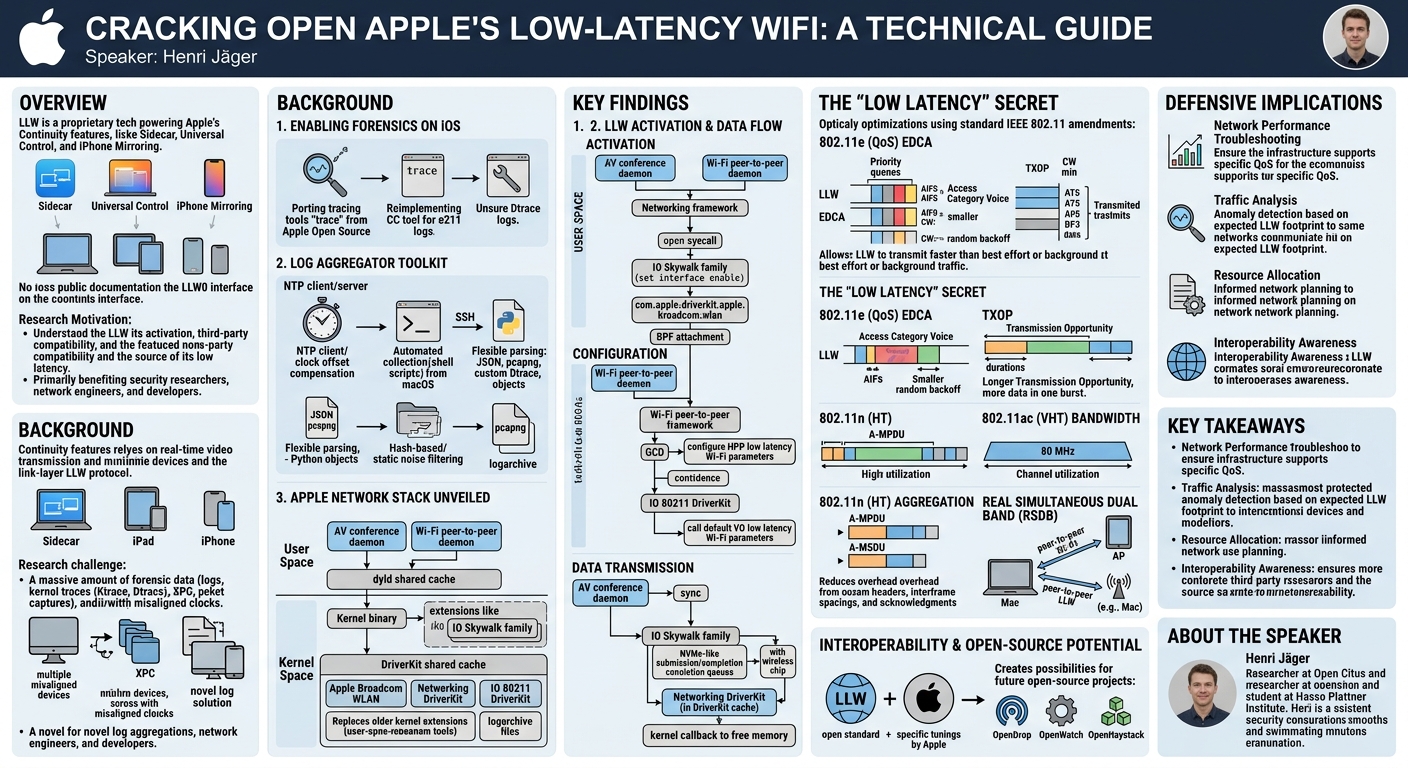
This talk, presented by Henri Jäger, delves into the intricate mechanisms behind Apple's proprietary low-latency Wi-Fi (LLW) technology, which underpins many of the company's "Continuity" features like Sidecar, Universal Control, and iPhone Mirroring. Jäger, a researcher at Open Citus and a student at the Hassop Platner Institute, shares insights derived from his master's thesis, aiming to demystify how Apple achieves such high-performance wireless communication between its devices. The research not only uncovers the technical specifics of LLW but also highlights the broader implications for interoperability and the potential for open-source reimplementations of Apple's tightly integrated ecosystem features.
Key moments
- 0:00 Introduction to Apple's continuity features and low-latency Wi-Fi.
- 2:26 What makes Apple's low-latency Wi-Fi so fast?
- 3:40 The need for a log aggregator to correlate data.
- 4:40 Difficulties in collecting forensic data from iOS devices.
- 5:30 Reverse engineering and porting K trace support to iOS.
- 7:00 Overcoming clock offset issues with an NTP solution.
- 8:00 Automating log collection across multiple Apple devices.
- 10:00 Developing parsers for various log and capture file formats.
Cracking open what makes Apple's Low-Latency WiFi so fast
Speakers: Henri Jäger
Conference: 39C3
YouTube: https://www.youtube.com/watch?v=9AgnAWdnDvg
Overview
This talk, presented by Henri Jäger, delves into the intricate mechanisms behind Apple's proprietary low-latency Wi-Fi (LLW) technology, which underpins many of the company's "Continuity" features like Sidecar, Universal Control, and iPhone Mirroring. Jäger, a researcher at Open Citus and a student at the Hassop Platner Institute, shares insights derived from his master's thesis, aiming to demystify how Apple achieves such high-performance wireless communication between its devices. The research not only uncovers the technical specifics of LLW but also highlights the broader implications for interoperability and the potential for open-source reimplementations of Apple's tightly integrated ecosystem features.
The core motivation for this investigation stems from the lack of public documentation regarding LLW, specifically the LLW0 interface, and questions surrounding its system-level activation, compatibility with third-party devices, and the precise technical characteristics that contribute to its low-latency performance. By meticulously dissecting Apple's network stack and proprietary protocols, Jäger provides a comprehensive technical breakdown, revealing that LLW leverages standard IEEE 802.11 amendments in highly optimized ways. This work is significant for security researchers, network engineers, and developers interested in understanding and potentially replicating the seamless user experience offered by Apple's interconnected devices.
Background
▶ Watch: Introduction to Apple's continuity features and low-latency Wi-Fi. (0:00)
Apple's ecosystem is renowned for its seamless integration, exemplified by its Continuity features. These allow users to effortlessly transition tasks and data between macOS, iOS, and iPadOS devices. Examples include Sidecar Display for extending a Mac's desktop to an iPad, Universal Control for using a single mouse and keyboard across multiple Apple devices, Continuity Camera for using an iPhone as a Mac webcam, and iPhone Mirroring for remote control of an iPhone from a Mac. A common thread across these features is their reliance on transmitting video data, operating under real-time constraints, and leveraging a specialized link-layer protocol: low-latency Wi-Fi.
Despite its critical role, details about LLW and its associated interface, LLW0, have remained largely obscure. Previous research efforts struggled to answer fundamental questions: how is LLW0 activated from a system perspective? Are third-party devices compatible? And crucially, what makes it "low-latency"? The challenge in answering these questions stems from the sheer volume and diversity of forensic data sources on Apple platforms. Researchers face a labyrinth of system logs, kernel traces (Ktrace, Dtrace), cross-process communication via XPC, backtraces, and packet captures across various interfaces. Correlating this disparate information, especially across multiple devices with potentially misaligned clocks, has historically been a significant hurdle, necessitating a novel solution for log aggregation and analysis.
Key Findings
▶ Watch: The need for a log aggregator to correlate data. (3:40)
Henri Jäger's research yielded several crucial findings, beginning with the development of a robust log aggregator to overcome the challenges of multi-device, multi-source data analysis.
1. Enabling Multi-Device Forensic Collection on iOS:
A significant initial hurdle was the limited availability of forensic tools on iOS compared to macOS. Jäger's work successfully brought key tracing capabilities to iOS:
- Ktrace Alternative: By investigating the Apple open-source software distributions, Jäger discovered a utility called
tracewithin thesystem_commandsrepository. This tool, released in 2022, is capable of generating Ktrace-compatible output. With the correct build commands and kernel header dependencies, Jäger successfully builttracefor iOS and iPadOS. - CC tool Reimplementation: Jäger reverse-engineered the underlying framework of
CC tool, known as co capture control, enabling him to reimplementCC toolfor iOS. This provides crucial access toe211(802.11) related logging information. - Dtrace: The feasibility of
Dtraceon iOS remains uncertain, requiring further research.
2. The Log Aggregator Toolkit:
To address the complexity of correlating diverse logs, Jäger developed a comprehensive log aggregator:
- Clock Offset Compensation: An NTP client and server implementation was crucial for collecting and computing clock offsets between multiple devices, ensuring accurate temporal alignment of aggregated logs.
- Automated Collection: A toolkit of shell scripts, invoked from macOS via SSH tunnels, automates the initiation, management, and termination of data collection tools (e.g., T-shark, TCP dump, system logs) on connected iOS devices. It also handles file transfer back to macOS.
- Flexible Parsing: The aggregator incorporates file-specific parsers to handle varying input formats (JSON from Console/Ktrace, pcap/pcapng from CC tool/Wireshark, custom Dtrace output), transforming data into a unified business logic (e.g., Python objects).
- Noise Filtering: To focus on relevant data, the aggregator employs hash-based noise filtering, comparing traces against reference "boring" data. It also supports static filters (whitelists/blacklists) based on process names.
- Output Formats: The aggregated data can be outputted as
pcapngfiles orlogarchivefiles.
3. Unveiling the Apple Network Stack:
Jäger's deep dive into the network stack revealed a multi-layered architecture:
- User Space: System daemons like AV conference daemon (for video) and Wi-Fi peer-to-peer daemon initiate LLW operations.
- dyld shared cache: Contains core frameworks and libraries used by user-space daemons.
- Kernel Space: Comprises the kernel binary and kernel extensions (e.g., IO Skywalk family for networking tasks).
- DriverKit shared cache: A relatively new development where Apple has moved certain networking-related kernel parts and extensions into user space. Key frameworks here include Apple Broadcom WLAN (reimplementing the core kernel extension, managing interfaces and configuring wireless chips), Networking DriverKit (public framework for driver communication), and IO 80211 DriverKit (handling 802.11 concepts, substituting the former
IO 80211 familykernel extension).
4. LLW0 Activation and Data Flow:
- Activation: The
AV conference daemoncalls into theNetworking framework, which uses anopensyscall. This path leads through the kernel to theIO Skywalk familykernel extension, which then callsset interface enable. This ultimately interacts with thecom.apple.driverkit.apple.broadcom.wlanDriverKit component, essentially attaching a Berkeley Packet Filter (BPF) for data transmission/reception. - Configuration: The
Wi-Fi peer-to-peer daemonconfigures LLW, likely via theWi-Fi peer-to-peer frameworkandIO Skywalk family, eventually interacting with theIO 80211 DriverKit. A critical function identified isconfigure HPP low latency Wi-Fi parameters, used by all investigated Continuity features (Sidecar, Universal Control, iPhone Mirroring, AirPlay to Mac, Apple Watch Mirroring). This function callsdefault VO low latency Wi-Fi parameters, which provides static configurations. - Data Transmission: The
AV conference daemonuses asyncsyscall, leading to theIO Skywalk family. This kernel extension appears to use NVMe-like submission and completion queues for communicating with the wireless chip, informing it when data is ready to be sent and when memory can be freed after transmission.
5. The "Low Latency" Secret:
LLW's performance hinges on specific optimizations leveraging existing IEEE 802.11 standards:
- Enhanced Distributed Channel Access (EDCA) - 802.11e: LLW classifies its traffic (including video) into the Access Category Voice, granting it the highest priority for medium access. This involves shorter Arbitration Interframe Spacing (AIFS) and a smaller Contention Window minimum (CW min) for the random backoff period, allowing LLW devices to transmit sooner.
- Transmission Opportunity (TXOP): LLW traffic, particularly video, is granted longer
TXOPvalues, allowing more data to be sent in a single burst after gaining channel access. - Aggregated MAC Protocol Data Unit (A-MPDU) & Aggregated MAC Service Data Unit (A-MSDU) - 802.11n: These mechanisms aggregate multiple data units into single physical or MAC layer frames, reducing overhead from headers and interframe spacings, and saving on acknowledgment frames.
- 80 MHz Channel Bandwidth - 802.11ac: Analysis of the macOS device tree for LLW0 shows configuration for an 80 MHz channel bandwidth, indicative of very high throughput capabilities.
- Real Simultaneous Dual Band (RSDB): Hardware capabilities play a crucial role.
RSDBallows devices to establish two independent Wi-Fi links simultaneously (e.g., one to an access point, another for peer-to-peer communication). Broadcom firmware references in the kernel cache of Apple devices confirmRSDBsupport, strongly suggesting its use in LLW.
6. Interoperability and Open-Source Potential:
A key takeaway is that LLW largely implements an open standard (IEEE 802.11 amendments) with specific parameter tunings and hardware capabilities. However, Apple seemingly reserves this for proprietary features, lacking public documentation for third-party interaction. This opens the door for future open-source reimplementations of Continuity features, akin to past projects like OpenDrop (AirDrop), OpenWatch (Apple Watch on Android), and OpenHaystack (Find My network).
Technical Deep Dive
▶ Watch: Reverse engineering and porting K trace support to iOS. (5:30)
The deep dive into Apple's low-latency Wi-Fi begins with the foundational log aggregator, a multi-component system designed to fuse disparate forensic data. The toolkit employs an NTP client and server to achieve precise clock synchronization, crucial for correlating events across multiple devices. During data collection, the client queries the server, and the computed offset is then applied during log aggregation, preventing misalignment. Collection itself is orchestrated by a command-line interface (CLI) on macOS, which leverages SSH tunnels to remotely execute shell scripts on connected iOS devices. These scripts manage process initiation (e.g., T-shark for network captures, TCP dump, system log collection via Console utility on macOS, or the reimplemented CC tool and trace on iOS). After capture, the scripts facilitate secure file transfers back to the macOS host.
Once collected, logs undergo parsing by file-specific parsers tailored for formats like JSON (from Console and Ktrace-like trace output), pcap/pcapng (from Wireshark and CC tool), and custom Dtrace outputs. These parsers normalize the data into a common internal object model, typically Python objects, for unified processing. A critical step is noise filtering, implemented through two primary mechanisms: hash-based filtering and static filters. Hash-based filtering involves collecting "boring" baseline traces during idle periods, hashing unique log lines or event patterns, and then comparing these hashes against traces collected during LLW activity. Any log lines matching the "noise" hashes are discarded. Static filters allow researchers to define whitelists or blacklists, filtering log lines based on process names (e.g., excluding electron process logs). The final aggregated data can be written to pcapng files for network analysis or logarchive files for system-level event review.
The investigation into the network stack reveals a sophisticated interplay between user-space daemons, the kernel, and specialized frameworks. In user space, the AV conference daemon is central to video-centric Continuity features, while the Wi-Fi peer-to-peer daemon handles peer-to-peer connectivity. These daemons interact with the dyld shared cache, a repository of shared libraries and frameworks. Critically, Apple has increasingly moved networking components from the traditional kernel space into a user-space DriverKit shared cache. This cache contains frameworks like com.apple.driverkit.apple.broadcom.wlan, which acts as a user-space reimplementation of the core Apple Broadcom WLAN kernel extension, responsible for managing network interfaces, queues, and configuring the physical wireless chip. Other DriverKit frameworks include Networking DriverKit (a public framework providing foundational driver communication) and IO 80211 DriverKit (handling 802.11 concepts and states, replacing the older IO 80211 family kernel extension).
The activation of the LLW0 interface exemplifies this multi-layered interaction. The AV conference daemon initiates the process by calling into the Networking framework, which then uses a standard open system call. This call traverses the kernel, reaching the IO Skywalk family kernel extension – a key component for networking tasks. Within IO Skywalk family, a function named set interface enable is invoked, which subsequently communicates with the com.apple.driverkit.apple.broadcom.wlan DriverKit component. The ultimate effect of enabling LLW0 is the attachment of a Berkeley Packet Filter (BPF), providing a dedicated memory region for the AV conference daemon to transmit and receive data over the LLW0 interface.
LLW configuration is handled by the Wi-Fi peer-to-peer daemon, which presumably calls into the Wi-Fi peer-to-peer framework. Due to the involvement of Grand Central Dispatch (GCD) for asynchronous function calls, precise tracing is complex, but the execution flow is presumed to move through the kernel and IO Skywalk family into the DriverKit domain. A pivotal discovery here is the function configure HPP low latency Wi-Fi parameters within the IO 80211 DriverKit. This function is universally utilized by all investigated LLW-dependent Continuity features. It, in turn, calls default VO low latency Wi-Fi parameters, which provides a set of static, pre-defined configuration values for LLW. A second function, default LLW parameters (not observed in real-world usage but present in code), demonstrates an even more aggressive configuration, potentially skipping the initial contention window and offering a significantly extended Transmission Opportunity (TXOP) of up to 8 milliseconds.
Data transmission over LLW0 also involves the AV conference daemon initiating a sync system call. This again flows into the IO Skywalk family kernel extension. Intriguingly, Jäger's research indicates that IO Skywalk family employs data structures suggestive of NVMe-like submission and completion queues. This implies that the kernel offloads the task of transmitting network packets to the wireless chip through a highly efficient, queue-based mechanism, similar to how NVMe interfaces with co-processors. After transmission, the Networking DriverKit (within the DriverKit shared cache) is informed, and it then calls back into kernel space to signal which packets can be safely freed from memory. This architecture, spanning user space, kernel space, and DriverKit, and leveraging concepts like NVMe queues and BPF, underscores the highly optimized nature of Apple's LLW implementation.
The "low-latency" characteristic of LLW is not achieved through entirely new standards but by aggressively optimizing parameters within existing IEEE 802.11 amendments. Specifically, LLW extensively leverages IEEE 802.11e (Quality of Service) and 802.11n (High Throughput), with contributions from 802.11ac (Very High Throughput).
- 802.11e's Enhanced Distributed Channel Access (EDCA): LLW classifies its traffic, including video, into the highest priority Access Category Voice. This classification grants it a shorter Arbitration Interframe Spacing (AIFS) compared to other traffic categories (e.g., best effort, background). Furthermore, the random backoff period before transmission is governed by a Contention Window (CW), which has a smaller minimum value (CW min) for voice traffic. This means LLW devices pick a random backoff counter from a smaller range, increasing their probability of gaining channel access faster.
- Transmission Opportunity (TXOP): Once channel access is secured, LLW traffic, especially video, benefits from extended
TXOPvalues. This allows a device to transmit for a longer duration before relinquishing the medium, reducing the overhead of repeated contention. - 802.11n's Aggregation Mechanisms: LLW employs Aggregated MAC Protocol Data Unit (A-MPDU) and Aggregated MAC Service Data Unit (A-MSDU). A-MPDU aggregates multiple MAC Protocol Data Units into a single physical layer data frame, while A-MSDU aggregates multiple payload data units into a single MAC layer frame. Both techniques significantly reduce the overhead associated with MAC and physical headers, interframe spacings, and the number of acknowledgment frames, thereby enhancing efficiency and reducing latency.
- 80 MHz Channel Bandwidth (802.11ac): Examination of the macOS device tree for LLW0 reveals a configured 80 MHz channel bandwidth, operating on frequencies like 5260 MHz (channel 52). This wide bandwidth, specified in 802.11ac, enables very high data rates essential for real-time video streaming.
- Real Simultaneous Dual Band (RSDB): At the hardware level, Real Simultaneous Dual Band (RSDB) is a key enabler. This capability, supported by Broadcom chips commonly found in Apple devices (as evidenced by kernel cache references), allows a device to maintain two independent Wi-Fi links simultaneously. For example, a Mac could connect to a standard access point while also establishing a direct peer-to-peer LLW link with an iPad, optimizing channel utilization and performance for Continuity features.
In essence, Apple's low-latency Wi-Fi is a highly tuned, standard-compliant implementation that strategically utilizes the most performant features of modern Wi-Fi amendments, coupled with specific hardware capabilities, to deliver a superior real-time wireless experience.
Demo / Proof of Concept
▶ Watch: Overcoming clock offset issues with an NTP solution. (7:00)
The talk primarily details the methodology used to reverse engineer Apple's low-latency Wi-Fi and the findings from that research. While a specific exploit or live code demonstration was not the focus, the speaker effectively demonstrated the process of building a multi-device log aggregation and analysis toolkit, which served as the foundational proof-of-concept for their investigative work. This toolkit enabled the collection and correlation of diverse forensic data from macOS and iOS devices, which was crucial for uncovering the inner workings of LLW. The detailed explanation of how the log aggregator was built, its functionalities (clock offset compensation, automated collection, noise filtering), and how it facilitated the analysis of system logs and network traces across different Apple platforms, served as a compelling demonstration of the research methodology itself.
Defensive Implications
▶ Watch: Developing parsers for various log and capture file formats. (10:00)
Understanding the intricacies of Apple's low-latency Wi-Fi, while not revealing direct vulnerabilities, offers several defensive implications, primarily concerning network visibility, performance management, and interoperability.
For network defenders and administrators, this research provides crucial insight into the specific characteristics of traffic generated by Apple's Continuity features. Knowing that LLW traffic is classified under the Access Category Voice (even for video), utilizes 80 MHz channel bandwidth, and leverages techniques like A-MPDU/A-MSDU means that network monitoring systems can be configured to specifically identify and analyze this traffic. This can aid in:
- Network Performance Troubleshooting: If Apple devices are experiencing poor performance with Continuity features, administrators can investigate if their wireless infrastructure (access points, QoS settings) is adequately supporting the specific 802.11e parameters and bandwidth requirements of LLW. They can ensure that Wi-Fi networks are configured to prioritize voice/video traffic appropriately to avoid conflicts with other network activity.
- Traffic Analysis and Anomaly Detection: Understanding the typical footprint of LLW traffic allows for the detection of unusual patterns. While LLW is designed for legitimate Apple features, any deviation from its expected behavior (e.g., unexpected protocols tunneling over LLW, or LLW-like traffic from non-Apple devices trying to mimic the protocol) could signal a potential misuse or an attempt to bypass network policies.
- Resource Allocation: In environments with a high density of Apple devices, network planners can make informed decisions about Wi-Fi access point placement, channel allocation, and overall network capacity to ensure sufficient bandwidth and low latency for critical Continuity workflows.
- Interoperability Awareness: The finding that LLW utilizes standard 802.11 amendments, albeit with proprietary parameter tunings, is a double-edged sword. While it suggests that third-party devices could theoretically interoperate, Apple's lack of documentation makes this challenging. Defenders should be aware that any attempts to force interoperability without full protocol understanding could lead to unpredictable network behavior or security risks. The research highlights the need for a deeper understanding of proprietary protocol stacks to fully secure and manage networks containing such devices.
Ultimately, the defensive value lies in demystifying a previously opaque but critical component of Apple's ecosystem, enabling more informed network design, monitoring, and management.
Key Takeaways
- Apple's low-latency Wi-Fi (LLW) is the backbone of its Continuity features, relying on highly optimized configurations of standard IEEE 802.11 amendments.
- LLW achieves its low-latency by classifying traffic as Access Category Voice (802.11e EDCA), utilizing shorter AIFS, smaller CW min, and longer TXOPs.
- Efficiency is further boosted by A-MPDU and A-MSDU (802.11n) for data aggregation, and operation on 80 MHz channel bandwidth (802.11ac).
- Hardware capabilities like Real Simultaneous Dual Band (RSDB) are crucial, enabling devices to maintain two independent Wi-Fi links concurrently for seamless peer-to-peer communication.
- Reverse engineering Apple's complex, multi-layered network stack (user space, kernel, DriverKit shared cache) is challenging but possible with custom tools like the developed multi-device log aggregator.
- Despite being built on open standards, LLW remains proprietary due to Apple's lack of public documentation, hindering third-party interoperability but creating opportunities for open-source reimplementations of Continuity features.
About the Speaker(s)
Henri Jäger is a researcher at Open Citus, an organization focused on publishing information about German and EU cybersecurity regulations (e.g., NIS2, eIDAS). Concurrently, he is a student at the Hasso Plattner Institute, where the content of this talk and his extensive research into Apple's low-latency Wi-Fi originated from his master's thesis and his work at the chair of mobile and wireless security. His work demonstrates a deep technical aptitude for reverse engineering complex systems and a commitment to understanding the underlying mechanisms of modern technologies.
All talks from 39th Chaos Communication Congress (39C3): Power Cycles