Recharge your batteries with us: – an empowering journey through the energy transition
Salacidre, JulianeB
39th Chaos Communication Congress (39C3): Power Cycles · Day 2 · Saal Ground
Overview
This talk, "Recharge your batteries with us: – an empowering journey through the energy transition," delivered by JulianeB and Salacidre at 39C3, offers a much-needed optimistic perspective on the global effort to combat the climate crisis. While the standard context for such a technical article might typically involve cybersecurity or digital security, this presentation delves into the triumphs and ongoing challenges of shifting towards renewable energy. The speakers, a physicist specializing in advanced solar materials and a climate scientist deeply involved in grassroots activism, aimed to counteract the pervasive sense of despair surrounding climate change by highlighting concrete successes in technological innovation, political action, and community engagement.
Key moments
- 0:00 Introduction: Recharging batteries by focusing on climate successes
- 2:00 The world is on fire: Acknowledging the climate crisis
- 2:50 Angela Merkel's 1990s prediction on renewable energy limits
- 3:50 Germany surpasses 50% renewable electricity, exceeding predictions
- 5:00 Grassroots power: The electricity rebels of the Black Forest
- 6:00 Crowdfunding enables community to acquire and green local grid
- 8:00 Technological progress: The evolution of solar panel efficiency
Recharge your batteries with us: – an empowering journey through the energy transition
Speakers: Salacidre, Climate Scientist; JulianeB, Physicist
Conference: 39C3
YouTube: https://www.youtube.com/watch?v=R-J9jegwleU
Overview
This talk, "Recharge your batteries with us: – an empowering journey through the energy transition," delivered by JulianeB and Salacidre at 39C3, offers a much-needed optimistic perspective on the global effort to combat the climate crisis. While the standard context for such a technical article might typically involve cybersecurity or digital security, this presentation delves into the triumphs and ongoing challenges of shifting towards renewable energy. The speakers, a physicist specializing in advanced solar materials and a climate scientist deeply involved in grassroots activism, aimed to counteract the pervasive sense of despair surrounding climate change by highlighting concrete successes in technological innovation, political action, and community engagement.
The core message is one of empowerment and collective action, demonstrating that a sustainable energy future is not only possible but is actively being built through diverse contributions. The talk serves as a powerful reminder that progress, though often incremental and subject to setbacks, is accelerating globally. By showcasing inspiring examples from Germany, China, Brazil, and the U.S., JulianeB and Salacidre effectively illustrate how individual efforts, technological breakthroughs, and supportive policy frameworks can collectively drive monumental change, urging the audience to actively participate in this crucial transition.
Background
▶ Watch: Introduction: Recharging batteries by focusing on climate successes (0:00)
The genesis of this talk lies in the overwhelming and often depressing reality of the climate crisis. As the speakers noted, daily headlines are filled with grim reports of flooding, droughts, and climate misinformation, creating a sense of helplessness. This pervasive negativity can be emotionally draining, leading to what the speakers termed a need to "recharge our batteries" by focusing on achievements rather than solely on problems.
Historically, the feasibility of a large-scale energy transition has been met with skepticism, even from influential figures. A striking example cited was former German Chancellor Angela Merkel's statement in the 1990s, when she served as the federal minister for the environment, that "sun, water, or wind cannot cover more than 4% of our electricity needs. Not even long term." This prediction, influenced by the fossil fuel lobby, starkly contrasts with today's reality. In 1995, Germany was already at 5% renewables, demonstrating an early underestimation of the potential of green energy. The problem, therefore, has not always been a lack of solutions, but often a lack of political will, public awareness, and the necessary frameworks to enable widespread adoption.
To combat this historical pessimism and current climate anxiety, the speakers proposed a metaphor: brewing a "magic potion for a sustainable energy future." This potion requires three key ingredients: grassroots activism, technological progress, and effective laws or political frameworks. The talk aimed to provide the context for why each of these ingredients is vital, demonstrating how their interplay has already yielded significant, often underestimated, successes in the global energy transition.
Key Findings
▶ Watch: Angela Merkel's 1990s prediction on renewable energy limits (2:50)
The talk meticulously presented a series of key findings that underscore the rapid and often underestimated progress in the global energy transition:
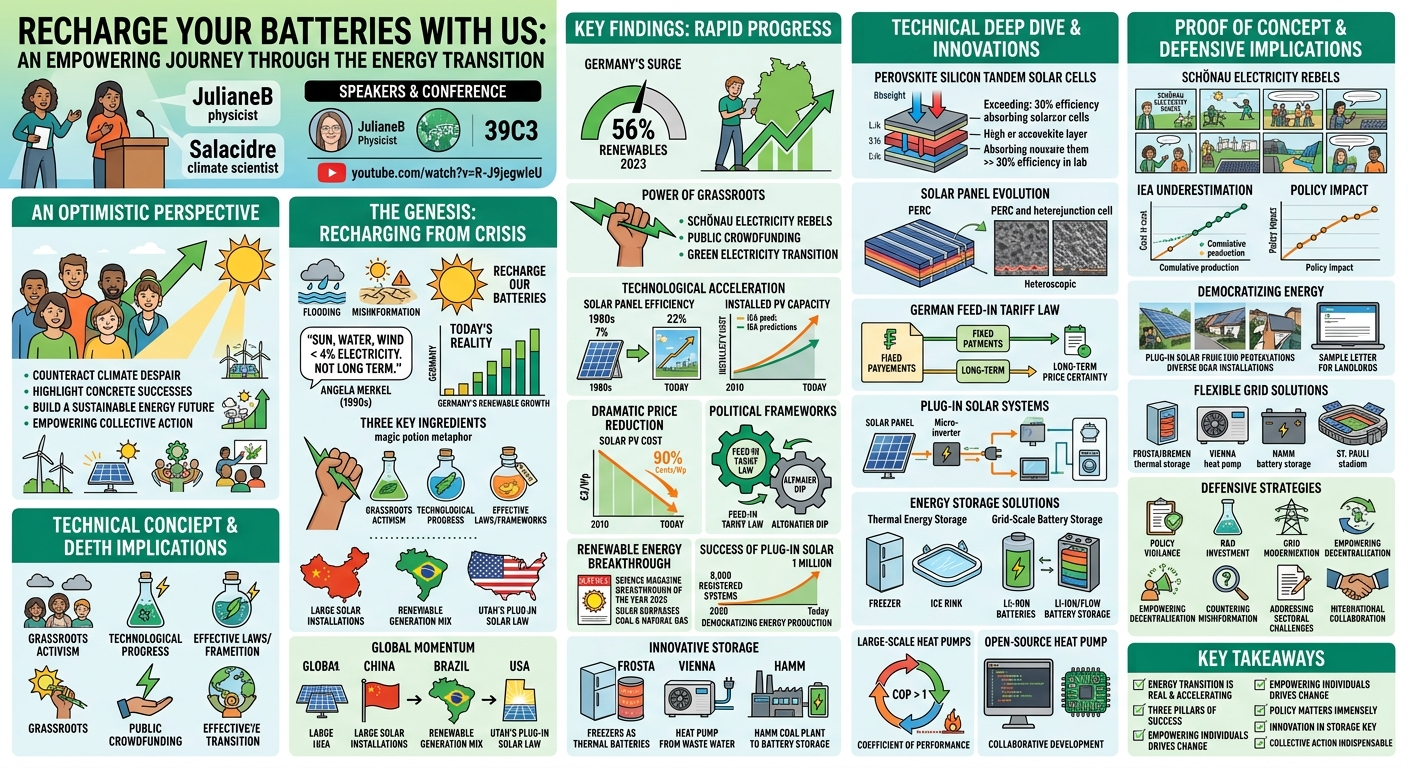
- Germany's Renewable Surge: Defying earlier pessimistic predictions, Germany reached an impressive 56% of its electricity from renewables in 2023. This significantly surpasses Angela Merkel's 1995 prediction of a maximum 4%, illustrating how quickly the energy landscape can change with concerted effort and technological advancements.
- Power of Grassroots Activism: The "electricity rebels" of Schönau in the Black Forest serve as a prime example. Following the Chernobyl disaster in 1986, ordinary citizens successfully initiated a public crowdfunding campaign to buy their local electricity grid for over 4 million Deutsche Mark. They then transitioned it to green electricity, earning international recognition, including an award from then-President Obama. This demonstrates the immense power of community-led initiatives in driving local energy independence and sustainability.
- Accelerated Technological Progress in Solar PV: Solar panel technology has seen dramatic improvements. In the 1980s, common photovoltaic (PV) systems had an efficiency of around 7%. Today, modern panels achieve 22% efficiency, representing a threefold increase in energy conversion capabilities. This continuous innovation, particularly in areas like perovskite silicon tandem solar cells researched by JulianeB, promises even higher efficiencies in the future.
- Consistent Underestimation by Energy Agencies: The International Energy Agency (IEA) has repeatedly underestimated the growth of solar PV. Since 2010, their annual "World Energy Outlooks" have consistently had to correct their predictions upwards, as the actual annual new PV additions have massively surpassed their forecasts. This highlights a persistent institutional bias or difficulty in grasping the exponential nature of renewable energy adoption.
- Dramatic Price Reduction in Solar PV: A significant factor in the widespread adoption of solar is the price learning curve. Over the past decade, the cost of solar PV per watt peak has plummeted. In 2010, the price was approximately €2 per watt peak (Wp); today, it stands at around 20 cents per Wp. This 90% cost reduction has made solar power economically viable for a vast array of applications globally.
- Crucial Role of Political Frameworks: The German feed-in tariff law, championed by Hermann Scheer, was pivotal in the early 2000s, guaranteeing producers a fixed payment for electricity fed into the grid for 20 years. This certainty spurred massive solar and wind installations. Conversely, sudden changes to this framework by Minister Peter Altmaier in 2012-2013 led to the "Altmaier dip," decimating Germany's solar industry and causing a decade-long stagnation in new installations. This starkly illustrates how policy decisions can either accelerate or cripple renewable energy development.
- Global Momentum and Diverse Approaches: The energy transition is a global phenomenon. China, for example, installed more solar capacity in a single recent year than Germany has in total throughout its history, even building iconic "panda-shaped" solar plants. Brazil's electricity generation in 2024 was overwhelmingly from renewables (hydropower, biofuels, wind, solar), with only a small fraction from natural gas, though challenges remain in other sectors like transportation. In the U.S., Utah adopted a law enabling plug-in solar systems, inspired by German efforts, demonstrating cross-cultural policy transfer even across political divides (a Republican legislator championed the bill).
- Renewable Energy as "Breakthrough of the Year": Science magazine recognized the "unstoppable growth of renewable energy" as its 2025 Breakthrough of the Year. The article noted that it wasn't new technology but the unprecedented magnitude and widespread adoption that warranted this recognition. Globally, solar has now surpassed coal and natural gas in installed electricity capacity, with wind rapidly catching up, marking a significant milestone.
- Success of Plug-in Solar in Germany: The Balcony Solar Association, led by Salacidre, successfully advocated for a legal change in Germany, allowing tenants to install plug-in solar systems without landlord permission. This initiative led to a surge from 8,000 registered systems in 2020 to 1 million registered systems this year, with an estimated 4 million devices actually in use. This democratizes energy production, giving tenants a sense of participation and ownership in the energy transition.
- Innovative Storage and Demand Management: Examples like the frozen food company Frosta using large freezers as thermal batteries (cooling them further when wind energy is abundant) and the city of Bremen doing something similar with an ice rink demonstrate creative approaches to demand-side management. Vienna's large heat pumps utilizing waste energy from water treatment for district heating, and the conversion of a former coal plant in Hamm into a battery storage facility, highlight the diverse and scalable solutions for energy storage and efficient energy use.
Technical Deep Dive
▶ Watch: Germany surpasses 50% renewable electricity, exceeding predictions (3:50)
The talk, while inspiring, also touched upon several technical aspects crucial to the energy transition, from advanced material science to large-scale energy infrastructure and innovative storage solutions.
At the cutting edge of solar technology, JulianeB's research focuses on perovskite silicon tandem solar cells. These advanced cells aim to exceed the efficiency limits of conventional silicon solar cells by stacking a perovskite layer on top of a silicon layer. Perovskites are a class of materials that can absorb high-energy photons (blue light) very efficiently, while silicon is better at absorbing lower-energy photons (red and infrared light). By combining them, these tandem cells can capture a broader spectrum of sunlight, promising significantly higher power conversion efficiencies—potentially exceeding 30% in laboratory settings—compared to the current commercial silicon panels at 22%. This pursuit of higher efficiency is critical for maximizing energy output from limited land areas and reducing the overall cost per kilowatt-hour.
The dramatic improvement in solar panel efficiency from 7% in the 1980s to 22% today is a testament to decades of materials science, engineering, and manufacturing advancements. Early solar cells were often single-crystal silicon, expensive to produce and less efficient. Modern panels utilize more refined silicon purification processes, improved cell architectures (e.g., passivated emitter rear contact (PERC) cells, heterojunction cells), and advanced anti-reflective coatings. These innovations have not only boosted efficiency but also improved durability and reduced degradation rates, extending the operational lifespan of panels.
The price learning curve for solar PV, where costs decrease with cumulative production, is a well-documented phenomenon. This economic principle, often referred to as Wright's Law or experience curve, suggests that for every doubling of cumulative production, the cost per unit decreases by a constant percentage. For solar, this has been a consistent decline of approximately 20-30% for every doubling of installed capacity. The talk highlighted a price drop from €2 per watt peak (Wp) in 2010 to 20 cents per Wp today, illustrating a remarkable cost reduction of 90%. This rapid cost decline, driven by economies of scale in manufacturing, automation, and global supply chain optimization, has made solar power the cheapest form of electricity generation in many parts of the world.
The German feed-in tariff (FIT) law, a pioneering policy, was technically sophisticated in its design. It mandated grid operators to purchase renewable electricity from producers at a fixed, above-market price for a guaranteed period, typically 20 years. This long-term price certainty significantly de-risked investments in solar and wind projects, making them attractive for individuals, communities, and businesses. The tariff rates were often differentiated by technology type and system size, and gradually degreased over time (digression) to reflect falling technology costs. This mechanism was instrumental in fostering a domestic solar industry and widespread deployment, demonstrating how a well-crafted legal framework can directly stimulate technological adoption and market growth.
Plug-in solar systems, also known as balcony solar systems, are a key innovation for democratizing energy production. These small-scale PV systems (typically 300-800 watts) are designed for easy installation by individuals, often on balconies, patios, or flat roofs, and connect directly to a standard power outlet. Technically, they consist of one or two solar panels, a micro-inverter (which converts the DC electricity from the panels into AC electricity compatible with the household grid), and a standard plug. The electricity generated is consumed directly by household appliances, reducing reliance on grid power. The German legal reforms, spearheaded by the Balcony Solar Association, specifically addressed bureaucratic hurdles like mandatory landlord permission and complex registration processes, making these systems accessible to tenants and fostering a sense of active participation in the energy transition.
Beyond generation, the talk highlighted crucial technical advancements in energy storage and demand-side management:
- Thermal Energy Storage (TES): Frosta's use of large industrial freezers and Bremen's ice rink illustrate a practical application of TES. By cooling these facilities to lower temperatures when renewable electricity (e.g., from wind turbines) is abundant and cheap, they effectively store energy in the form of cold. When renewable generation is low, they can reduce or pause cooling, drawing less electricity from the grid. This shifts demand, acting as a flexible load rather than a direct electrical battery, and helps balance grid fluctuations caused by intermittent renewables.
- Large-Scale Heat Pumps for District Heating: The city of Vienna's project leverages massive industrial heat pumps to extract low-grade waste heat from its water waste treatment plant. These heat pumps, operating on principles similar to refrigerators but in reverse, use a refrigerant cycle to absorb heat from a relatively cool source and transfer it to a much warmer sink (in this case, the district heating network). This process is highly energy-efficient, characterized by a Coefficient of Performance (COP) greater than 1, meaning they deliver more thermal energy than the electrical energy they consume. This technology is vital for decarbonizing heating, a significant energy consumption sector.
- Grid-Scale Battery Storage: The conversion of a former coal plant site in Hamm into a battery storage facility represents a shift from fossil fuel generation to modern energy infrastructure. These large-scale battery systems, typically using lithium-ion (Li-ion) or flow battery technologies, are crucial for grid stability. They can store excess renewable energy when generation exceeds demand and discharge it rapidly when demand peaks or renewable output drops, providing frequency regulation, voltage support, and peak shaving services to the grid.
- Open-Source Heat Pump Development: The Rectlingen project, involving a former coal mine transformed into a chaos space, is developing an open-source heat pump. This initiative promotes transparency, collaborative development, and accessibility in renewable heating technologies. By making designs, software, and operational data openly available, it aims to accelerate innovation and enable broader adoption and customization of heat pump systems, potentially reducing costs and fostering a community of developers and users.
These diverse technical solutions, from advanced solar materials to innovative storage and demand management, collectively form the backbone of a robust and resilient renewable energy system, demonstrating that the technical capabilities for a full energy transition are already largely in place or under rapid development.
Demo / Proof of Concept
▶ Watch: Crowdfunding enables community to acquire and green local grid (6:00)
While this talk did not feature a live technical demonstration in the traditional sense, the speakers presented numerous compelling real-world examples and proofs of concept that illustrate the successful implementation and impact of renewable energy initiatives across various scales. The talk itself served as a narrative demonstration of these successes, effectively "recharging the battery" of optimism through concrete evidence.
One of the most powerful proofs of concept was the story of the Schönau electricity rebels. This community in the Black Forest demonstrated that ordinary citizens could, through public crowdfunding and persistent political action, take ownership of their local grid and transition to 100% green electricity. This wasn't a hypothetical model but a decades-long, internationally recognized success story that continues to inspire.
Another key "demonstration" was the visual representation of the International Energy Agency's (IEA) repeated underestimation of solar PV growth. The graph showing successive IEA predictions being dwarfed by actual installed capacity served as a powerful visual proof that the real-world adoption of renewables is outstripping even expert forecasts, highlighting the technology's inherent momentum.
The talk also showcased the tangible impact of policy change through the German feed-in tariff law and its subsequent alterations. The initial boom in solar installations in the early 2000s, followed by the "Altmaier dip" and then a recovery, graphically illustrated the direct correlation between supportive policy frameworks and the rate of renewable energy deployment. This served as a cautionary tale and a call to action regarding political vigilance.
On a more personal scale, the success of the plug-in solar systems in Germany, driven by the Balcony Solar Association, was a crucial proof of concept for decentralized energy generation. The rapid increase from 8,000 to an estimated 4 million systems demonstrated that empowering individuals, particularly tenants, to generate their own electricity is not only feasible but highly effective in accelerating the energy transition and fostering a sense of collective ownership. The speakers even shared a sample letter for landlords on their website, providing a practical tool for individuals to implement this concept.
Finally, the talk highlighted innovative energy storage and integration solutions as proofs of concept for a flexible grid:
- Frosta's freezers and Bremen's ice rink demonstrated the practical application of thermal energy storage and demand-side management to balance intermittent renewable generation.
- Vienna's heat pump for district heating showcased the effective capture and reuse of waste heat on a municipal scale.
- The conversion of the Hamm coal plant site into a battery storage facility provided a powerful symbol of transitioning from fossil fuels to modern, flexible energy infrastructure.
- The St. Pauli stadium with its colorful solar panels (using technology developed by JulianeB's colleagues) and the chaotic but effective "balcony solar" installations on residential buildings served as visual proofs of aesthetic and diverse integration of solar technology.
These examples collectively served to demonstrate that the energy transition is not merely an aspiration but a tangible reality, being built and scaled through a combination of community spirit, technological ingenuity, and supportive policies.
Defensive Implications
▶ Watch: Technological progress: The evolution of solar panel efficiency (8:00)
In the context of an energy transition, "defensive implications" can be reframed as strategies and actions to protect, sustain, and accelerate the shift towards renewable energy, safeguarding it against setbacks and ensuring its resilience. This involves defending against policy reversals, technological stagnation, grid instability, and public apathy.
- Policy Vigilance and Advocacy: The most critical defensive measure is active monitoring and advocacy against detrimental policy changes. The "Altmaier dip" in Germany, which crippled the solar industry for a decade due to sudden shifts in the feed-in tariff law, serves as a stark warning. Citizens, activists, and industry stakeholders must remain vigilant against proposals that introduce uncertainty (e.g., making people pay for feeding in electricity) or roll back supportive frameworks. Engaging with political processes, lobbying, and supporting pro-renewable legislation (as the Balcony Solar Association did) are essential defensive actions to prevent future setbacks and ensure a stable regulatory environment for investment.
- Investment in Research & Development (R&D): While existing technologies are powerful, continued investment in R&D, particularly in areas like perovskite silicon tandem solar cells and advanced battery chemistries, is a defensive measure against technological plateaus. Higher efficiencies, lower costs, and improved durability make renewables more competitive and resilient to market fluctuations. Open-source initiatives, such as the Rectlingen heat pump project, also contribute by fostering collaborative innovation and reducing barriers to entry for new solutions.
- Grid Modernization and Flexibility: Defending the grid against the intermittency of renewables requires significant investment in grid modernization. This includes advanced smart grid technologies, demand-side management (e.g., Frosta's freezers, Bremen's ice rink), and diverse energy storage solutions (e.g., Hamm's large-scale battery facility). Integrating these flexible resources ensures grid stability, reduces reliance on fossil fuel "peaker plants," and maximizes the utilization of renewable energy, thereby making the entire system more robust.
- Empowering Decentralized Generation and Ownership: Promoting and defending the right to decentralized energy generation, such as plug-in solar systems, is crucial. By enabling individuals and communities to produce their own power, the energy system becomes more resilient to centralized failures and less susceptible to monopolistic control. This also fosters public engagement and a sense of ownership, creating a broad base of support for the energy transition that is harder to dismantle politically. Providing resources like sample letters for landlords empowers individuals to overcome local barriers.
- Countering Misinformation and Fostering Education: Defending the energy transition also means actively combating climate misinformation and historical skepticism (like Angela Merkel's 4% claim). Presenting clear data on renewable growth, cost reductions, and successful implementations helps build public trust and counter narratives that undermine progress. Educational initiatives, such as solar camps, are vital for equipping individuals with practical skills and knowledge, transforming passive consumers into active participants.
- Addressing Sectoral Challenges: The talk highlighted that while electricity generation is progressing, other sectors like transportation and heating/cooling still heavily rely on fossil fuels (e.g., Brazil's oil consumption for transport). Defensive strategies must encompass these sectors, promoting electric vehicles, public transport, and widespread adoption of efficient heat pumps for buildings and industrial processes. Diversifying the focus of the energy transition beyond just electricity is essential for a comprehensive and resilient shift.
- Fostering International Collaboration: The success stories from China, Brazil, and Utah demonstrate the power of global efforts and cross-border inspiration. Defending the energy transition involves continued international collaboration on policy best practices, technology transfer, and shared goals, recognizing that climate change is a global challenge requiring collective action.
By implementing these defensive strategies, stakeholders can not only accelerate the energy transition but also build a more resilient, equitable, and sustainable energy future capable of withstanding political shifts and unforeseen challenges.
Key Takeaways
- The Energy Transition is Real and Accelerating: Despite pervasive climate anxiety, the global shift to renewable energy is happening faster than many experts predicted, with solar capacity now surpassing coal and natural gas globally.
- Three Pillars of Success: Grassroots activism, continuous technological innovation, and supportive political frameworks are the essential ingredients for a successful and rapid energy transition.
- Empowering Individuals Drives Change: Decentralized energy solutions like plug-in solar systems, coupled with legal reforms and community engagement, empower citizens to actively participate, fostering a sense of ownership and significantly boosting renewable deployment.
- Policy Matters Immensely: Political decisions, such as feed-in tariffs, can either dramatically accelerate or severely hinder the growth of renewable energy industries, necessitating constant vigilance and advocacy from citizens and stakeholders.
- Innovation in Storage and Demand Management is Key: Creative solutions like using industrial freezers or ice rinks as thermal batteries, and large-scale heat pumps for district heating, are crucial for integrating intermittent renewables and ensuring grid stability.
- Collective Action is Indispensable: The scale of the climate challenge requires everyone to get involved, from participating in solar camps to advocating for local solar installations, to collectively "stir the pot" and push the energy transition forward.
About the Speaker(s)
JulianeB is a physicist and researcher specializing in new materials for solar panels. Her work focuses on advanced photovoltaic technologies, specifically perovskite silicon tandem solar cells, which aim to achieve significantly higher efficiencies than conventional solar cells. She conducts her research in Freiburg, Germany.
Salacidre (Simona) is a climate scientist by training, currently working in science communication for atmospheric sciences at the Karlsruhe Institute of Technology (KIT) in Germany. In her free time, she is a prominent figure in grassroots activism, serving as the head of the Balcony Solar Association and actively participating in other political groups dedicated to promoting renewable energy and influencing policy. She was instrumental in advocating for legal changes in Germany to make plug-in solar systems accessible to tenants.
All talks from 39th Chaos Communication Congress (39C3): Power Cycles