In-house electronics manufacturing from scratch: How hard can it be?
Augustin Bielefeld, Alexander Willer
39th Chaos Communication Congress (39C3): Power Cycles · Day 2 · Saal One
Overview
In this compelling talk at 39C3, Augustin Bielefeld and Alexander Willer share their arduous yet enlightening journey into the world of DIY electronics manufacturing from scratch. Driven by a passion for well-made products, a desire to anchor a future where technology serves humanity, and a profound frustration with the state of European electronics contract manufacturing, the duo embarked on a mission to prove that small-scale, in-house production is not only possible but strategically vital. Their presentation meticulously details the technical hurdles, economic realities, and philosophical underpinnings of establishing a fully functional, open-source-based electronics production line in Europe.
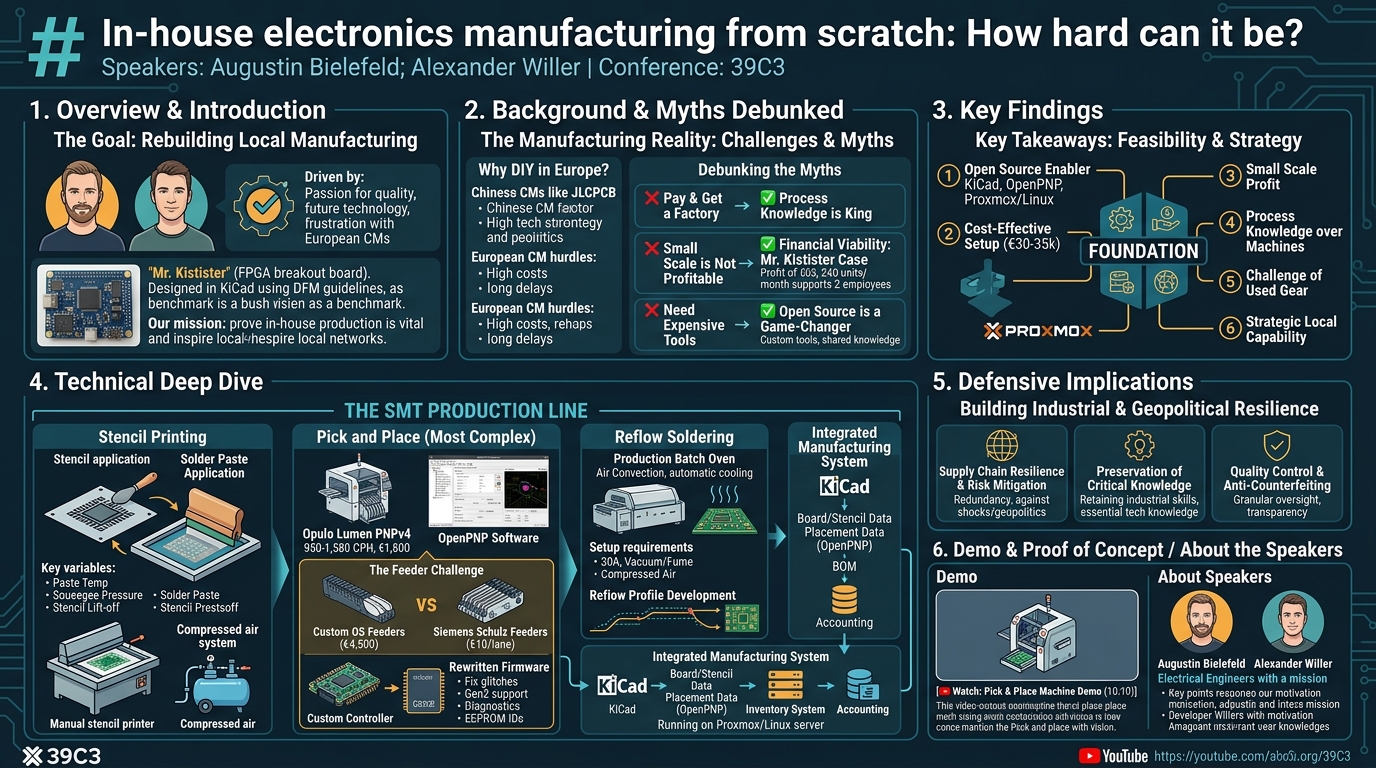
Key moments
- 0:00 Introduction: Why DIY electronics manufacturing?
- 2:00 The naive thought and initial failure of in-house manufacturing
- 3:50 Why not use Chinese manufacturers? European CM issues
- 5:00 Introducing the 'Myths of Manufacturing'
- 5:10 Myth 1: 'Pay money and get a factory' (process knowledge)
- 6:10 Myth 2: 'Small scale is not profitable' (financial data)
In-house electronics manufacturing from scratch: How hard can it be?
Speakers: Augustin Bielefeld; Alexander Willer
Conference: 39C3
YouTube: https://www.youtube.com/watch?v=G3y9sTUDEYk
Overview
In this compelling talk at 39C3, Augustin Bielefeld and Alexander Willer share their arduous yet enlightening journey into the world of DIY electronics manufacturing from scratch. Driven by a passion for well-made products, a desire to anchor a future where technology serves humanity, and a profound frustration with the state of European electronics contract manufacturing, the duo embarked on a mission to prove that small-scale, in-house production is not only possible but strategically vital. Their presentation meticulously details the technical hurdles, economic realities, and philosophical underpinnings of establishing a fully functional, open-source-based electronics production line in Europe.
The core of their endeavor revolves around manufacturing their own product, Mr. Kistister, a high-quality breakout board for the popular MR FPGA retro gaming project. This product, designed with KiCad and adhering to design for manufacturing (DFM) guidelines, serves as a real-world benchmark for their production line. The speakers aim to demystify electronics manufacturing, challenging prevailing myths and demonstrating how open-source hardware and software can empower individuals and small companies to regain critical industrial capabilities. Their ultimate goal extends beyond their own project: they seek to inspire and enable others to reproduce their efforts, fostering a distributed network of local manufacturing in an increasingly technology-dependent world.
Background
▶ Watch: Introduction: Why DIY electronics manufacturing? (0:00)
The genesis of Bielefeld and Willer's project stems from a perceived crisis in European electronics manufacturing. While major contract manufacturers (CMs) in China, such as JLCPCB, offer rapid, affordable, and responsive services, their European counterparts often lag, presenting exorbitant quotes (€2,300 net for SMT vs. €150 in China), lengthy response times (two weeks for an answer), and extended lead times (six weeks for manufacturing). This disparity forces many small-scale, open-source hardware projects to outsource production to Asia, leading to a loss of local control, knowledge, and economic opportunity. The speakers, as electrical engineers, found this situation unacceptable and decided to tackle the problem head-on, driven by a stubborn belief that they could "do it better ourselves."
They identified and debunked several "myths of manufacturing" that often deter potential entrants:
- "Pay some money and get a factory": Conventional wisdom suggests manufacturing is gated by capital expense. However, the speakers argue that process knowledge—the intricate details of production—is far more critical and can only be acquired through hands-on experience or by paying a premium for existing expertise. European manufacturers, they contend, often guard this knowledge and cater primarily to large original equipment manufacturers (OEMs), neglecting smaller, innovative projects. China, by contrast, benefits from a collaborative ecosystem of small players who share knowledge.
- "Small scale is not profitable": Using their Mr. Kistister product as an example, they demonstrated the financial viability of small-scale production. With a net price of €147 and a Cost of Goods Sold (COGS) of €84 (€50 materials, €34 labor), each kit yields a gross profit of €63. Even at a conservative throughput of one kit per hour, manufacturing 240 units a month could generate enough revenue to sustain two employees. This challenges the notion that only massive production runs are economically sensible.
- "You need expensive tools for production": The speakers highlight open source and open hardware as game-changers. These technologies enable the construction of custom tools, leveraging shared knowledge and avoiding the prohibitive costs of proprietary enterprise solutions. Such open-source tools, largely nonexistent 20-25 years ago, are now key enablers for accessible manufacturing.
Despite the potential, few are undertaking such initiatives due to the inherent difficulty, the deep electronics knowledge and industry experience required, and the lack of investor interest in what is perceived as a struggling, integrated business model, especially for smaller projects that scale slowly compared to digital products. The speakers revealed that their foundational setup, including physical space and basic equipment, cost approximately €30,000-€35,000, excluding their living costs, which they covered through freelance work. After six months dedicated to the production line, following a year of company and infrastructure setup, they consider themselves "50% done," confident in the path they've forged.
Key Findings
▶ Watch: Why not use Chinese manufacturers? European CM issues (3:50)
The central finding of Bielefeld and Willer's work is that in-house, small-scale electronics manufacturing in Europe is not only technically feasible but also economically viable, provided a strategic reliance on open-source tools and a commitment to acquiring deep process knowledge. Their journey with Mr. Kistister illuminated several critical insights:
- Open Source as an Enabler: Open-source software like KiCad for design, OpenPNP for pick and place, and open-source operating systems like Proxmox and Linux for infrastructure are fundamental to democratizing manufacturing. They allow for customization, integration, and cost reduction that would be impossible with proprietary solutions.
- Cost-Effective Setup: The initial investment for a basic SMT production line, capable of handling products like Mr. Kistister, can be as low as €30,000-€35,000. This significantly undercuts the perceived capital requirements for establishing manufacturing capabilities.
- Profitability at Small Scale: Their detailed cost analysis for Mr. Kistister demonstrated a healthy gross profit margin of €63 per kit. This suggests that focused, small-batch production can sustain a dedicated team, challenging the industry's bias towards mass production.
- Process Knowledge is Paramount: Beyond machinery, the mastery of intricate process variables (e.g., solder paste temperature, squeegee pressure, reflow profiles) is crucial for reliable and repeatable results. This knowledge is often tribal and difficult to acquire, making hands-on experimentation indispensable.
- Challenges of Used Equipment & Integration: While second-hand machines (like their manual stencil printer or Siemens feeders) offer cost savings, they often require significant effort in cleaning, repair, and reverse engineering to integrate them into a modern, automated workflow. This highlights the need for deep technical expertise and a problem-solving mindset.
- Demand for Local Production: The persistent difficulties with traditional European contract manufacturers underscore a latent demand for more responsive, local manufacturing options, especially for innovative, small-batch projects.
- Strategic Importance of Local Capability: The speakers implicitly argue for the strategic necessity of local manufacturing capabilities to ensure supply chain resilience, reduce reliance on distant suppliers, and retain critical industrial know-how within a region.
Technical Deep Dive
▶ Watch: Introducing the 'Myths of Manufacturing' (5:00)
The technical core of the talk focuses on the three primary stages of Surface Mount Technology (SMT) production: stencil printing, pick and place, and reflow soldering. The speakers detail their approach to each, emphasizing the role of open-source tools and the challenges overcome.
1. Stencil Printing:
SMT begins with applying solder paste—a metallic paste—to specific pads on a bare Printed Circuit Board (PCB) through a stencil. The goal is perfect printing for excellent soldering results and minimal rework. Key process variables include paste temperature, room temperature, paste expiration, squeegee angle, pressure, speed, stencil tensioning, support, and lift-off speed.
The speakers acquired a second-hand manual stencil printer for €1,000-€2,000. This large, 1x1 meter machine accommodates production-sized stencils. Despite its apparent simplicity, the used machine required extensive work: cleaning, designing and creating custom squeegees, replacing broken parts, and installing a compressed air system in their workshop. Through considerable experimentation, they achieved good results, though its performance in small-scale series production remains to be fully tested.
2. Pick and Place:
This is the most complex and labor-intensive step. After paste application, electronic components are precisely placed onto the board. Buying a used industrial pick and place machine (5-15k EUR, 2,000-20,000 CPH) presented issues with spare parts, service availability, high costs, and outdated software (e.g., Windows XP dependency). Size was also a practical limitation.
Their solution was the Opulo Lumen PNPv4, an open-source pick and place machine released in 2024, costing about €1,800 without feeders. It offers 950-1,580 components per hour (CPH), a machine frame, motion, vision, and two pickup heads. Crucially, it is open, hackable, and extensible.
The OpenPNP software, the most popular and essentially only open-source pick and place software, is central to their setup. It handles board and part data, executes placement jobs, and uses machine vision for inspection. Opulo provides a ready-made machine profile for OpenPNP.
A significant challenge in pick and place is component handling. Components vary widely in shape and size, packaged in tape and reel. Feeders are required for each component type to reliably dispense parts from the tape onto the PCB. For their Mr. Kistister mainboard, 53 unique component types necessitated 53 feeders. The reliability of the entire line is inversely proportional to the number of feeders, as a single feeder failure requires human intervention.
Opulo offers 8mm and 12mm open-source feeders. However, the Mr. Kistister design required wider feeders (16mm, 24mm, 32mm, 44mm, 56mm). Commercial open-source feeders would cost €4,500 for 60 lanes (€75 per lane), a steep price with uncertain reliability.
Instead, they opted for deprecated Siemens Series feeders (Schulz feeders). These are widely available second-hand in Germany, costing around €10 per 8mm lane. Despite being old, they are extremely reliable, with some showing over 30 million picks.
Integrating these Siemens feeders with OpenPNP was a significant undertaking. Community members like Bill Ruckman and Burn Walter had reverse-engineered their simple UART interface and developed an Arduino-based G-code interface for OpenPNP. However, the speakers encountered reliability issues (glitches, timeouts) and compatibility problems with Gen2 feeders (all wider than 8mm). They completely rewrote the controller firmware to fix glitches, support Gen2 feeders, and implement full diagnostic coverage. They also utilized unused EEPROM sections to store unique IDs and feeder types, enabling future integrations like feeder-specific offset data and inventory management.
Current OpenPNP and Lumen PNP integration challenges include improving the GUI, refactoring the pick cycle logic to prevent nozzle crashes into feeder shutters, and developing an SQL database provider to allow feeder data to be shared across multiple machines, rather than being stored in local XML configuration files. A brief video demonstration showed the pick and place machine in action, performing vision alignment and component placement.
3. Reflow Soldering:
After components are placed, they are soldered to the board in a reflow oven. DIY modified toaster ovens were deemed unsuitable for continuous, reliable, and safe production (8 hours/day). Industrial conveyor ovens were too large for their space or had steep thermal gradients that could damage boards.
They purchased a production batch oven designed for series production, not just prototyping. This oven uses air convection for uniform heating, preventing component damage. It features automatic forced cooling and good human interaction. Setting it up was complex, requiring a 30-amp single-pole outlet, high vacuum and fume extraction, and compressed air cooling, taking months rather than weeks.
Developing a working reflow profile for the oven involved extensive trials with a data logger and multiple probing points on the PCB. They are confident in their profile, but its performance in series production also awaits full validation.
Integrated Manufacturing:
Beyond individual machines, the speakers emphasized the need for an integrated manufacturing system. They draw parallels to Gene Kim's "every company is a technology company." Their system aims for complete data control throughout the product lifecycle.
KiCad generates all required data (board, stencil, placement, Bill of Materials - BOM). Board and stencil data go to the PCB fabricator. Placement data is used by OpenPNP. The BOM is imported into an inventory management system for material logistics and production planning. OpenPNP accesses this inventory for part data. Custom scripts integrate inventory with their accounting software for accurate stock tracking. Their server infrastructure relies on Proxmox and Linux, highlighting the critical role of open-source software in building such an integrated system.
Demo / Proof of Concept
▶ Watch: Myth 1: 'Pay money and get a factory' (process knowledge) (5:10)
The talk included a brief video demonstration illustrating the pick and place machine's operation. The video showed the machine's head performing machine vision to check component alignment before precisely placing it onto the PCB. This visual example concretely showcased the functionality of their Opulo Lumen PNPv4 integrated with OpenPNP and their custom Siemens feeder setup. While brief, it served as tangible evidence of their progress in automating the most complex step of SMT manufacturing. The Mr. Kistister board itself, displayed in various images and referred to throughout the talk, also serves as the primary proof of concept for the entire production line's capability, designed specifically to test the limits of their in-house manufacturing process.
Defensive Implications
▶ Watch: Myth 2: 'Small scale is not profitable' (financial data) (6:10)
While not a traditional cybersecurity talk, the core message of "In-house electronics manufacturing from scratch" carries significant defensive implications, particularly concerning supply chain resilience, national security, and industrial autonomy.
- Supply Chain Resilience and Geopolitical Risk Mitigation: The speakers' frustration with the reliance on overseas (specifically Chinese) contract manufacturers highlights a critical vulnerability in global supply chains. Geopolitical tensions, trade disputes, natural disasters, or pandemics can severely disrupt the flow of electronic components and finished products. By establishing local, in-house manufacturing capabilities, companies and regions can build redundancy and resilience, defending against external shocks and ensuring continued access to essential technologies. This local production reduces dependency on single points of failure, a key defensive strategy in an interconnected world.
- Preservation of Critical Industrial Knowledge: The speakers lament the apparent loss of process knowledge and willingness to innovate among European manufacturers. The ability to "learn to do it and do it well" locally is a defensive measure against the erosion of vital industrial skills. In a society that runs on technology, the capacity to manufacture basic electronic systems – those that "keep our lights on and our water flowing" – is a critical capability. Ceding this knowledge and expertise entirely to external entities represents a strategic weakness. Fostering a distributed network of small, local manufacturers helps retain and disseminate this essential know-how.
- Enhanced Quality Control and Anti-Counterfeiting: Local, in-house production offers direct and granular control over the entire manufacturing process. This direct oversight can significantly improve quality assurance and help defend against the infiltration of substandard or counterfeit components into the supply chain. While the talk doesn't explicitly mention counterfeits, the emphasis on "well-made products" and the ability to visit and interact with local PCB fabs suggests a desire for greater transparency and control over material sourcing and assembly integrity, which are crucial defensive postures against product compromise.
- Intellectual Property Protection (in context): Although the project itself is open source, for companies dealing with proprietary designs, local manufacturing can offer a degree of intellectual property (IP) protection by reducing the exposure of sensitive designs to external manufacturing partners. While not the primary focus, the ability to control the production environment reduces the attack surface for IP theft.
In essence, the "defensive implications" of this talk revolve around securing a region's technological future by rebuilding and democratizing its manufacturing base. It's a call to action to defend against complacency, external dependencies, and the loss of fundamental industrial capabilities that underpin modern society.
Key Takeaways
- Manufacturing is Demystifiable but Hard: Electronics manufacturing, particularly SMT, is complex and requires deep process knowledge and hands-on experience, but it is not "mystical." It can be learned and executed effectively by dedicated small teams.
- Open Source is a Game-Changer: Open-source hardware (Opulo Lumen PNPv4) and software (OpenPNP, KiCad, Proxmox, Linux) are critical enablers, significantly lowering cost barriers and empowering customization and integration previously exclusive to enterprise solutions.
- Small-Scale Production is Economically Viable: Contrary to popular belief, small-batch electronics manufacturing can be profitable, generating sufficient margins to sustain operations and employees, as demonstrated by the Mr. Kistister product's financial model.
- Local Manufacturing is a Strategic Imperative: Relocating electronics manufacturing back to regions like Europe is a valid investment, crucial for supply chain resilience, reducing reliance on distant suppliers, and preserving critical industrial capabilities.
- Process Knowledge and Integration are Key: Beyond acquiring machines, mastering the nuances of each process step (e.g., stencil printing parameters, reflow profiles) and integrating them digitally through open-source tools is essential for reliable and efficient production.
- Collaboration and Community are Vital: The speakers actively seek collaboration and encourage others to reproduce their work, emphasizing that open-sourcing their findings (like feeder documentation and firmware) aims to foster a distributed network of local manufacturers and ensure knowledge continuity.
About the Speaker(s)
Augustin Bielefeld and Alexander Willer are electrical engineers with a long-standing passion for making electronics and machines. They describe themselves as individuals who "see issues every day that we'd like to solve with technology" and who "simply love well-made products." Their motivation extends beyond technical challenges, deeply rooted in a desire to "build, protect, and anchor a future where humanity, liberty, and democracy are at the center of our lives," recognizing technology's key role in this vision. They are driven by a "stubborn" refusal to accept the current state of European electronics manufacturing. Both speakers have experience in freelance work and consulting, which they leveraged to support their ambitious manufacturing project. Their commitment to open source is evident in their efforts to share their designs, firmware, and process knowledge with the wider community.
All talks from 39th Chaos Communication Congress (39C3): Power Cycles