Design for 3D-Printing
rahix
39th Chaos Communication Congress (39C3): Power Cycles · Day 3 · Saal Ground
Overview
In this insightful talk, "Design for 3D-Printing," rahix challenges the common perception that 3D printing is an unpredictable, hit-or-miss manufacturing process. He argues that by understanding and applying fundamental engineering principles, designers can consistently create robust, functional parts that print successfully on the first attempt, fit perfectly, and don't break. This discipline, known as design engineering, focuses on perfecting the shape of mechanical parts by adhering to underlying rules rather than relying on trial and error.
Key moments
- 0:00 Introduction and bold claim: parts 'just work'
- 1:35 Defining 'design engineering': perfecting mechanical parts
- 2:30 Understanding the real limits of 3D printing
- 4:15 Sharing the general approach and design mindset
- 5:00 What makes a 'good part': functionality (fit, strength)
- 7:30 Crucial question: 'Can the part be made well?'
- 8:50 Design engineer's role: finding optimal compromises
- 10:05 Solution for design: using heuristics (rules of thumb)
Design for 3D-Printing
Speakers: rahix
Conference: 39C3
YouTube: https://www.youtube.com/watch?v=B8B7CvKROnk
Overview
In this insightful talk, "Design for 3D-Printing," rahix challenges the common perception that 3D printing is an unpredictable, hit-or-miss manufacturing process. He argues that by understanding and applying fundamental engineering principles, designers can consistently create robust, functional parts that print successfully on the first attempt, fit perfectly, and don't break. This discipline, known as design engineering, focuses on perfecting the shape of mechanical parts by adhering to underlying rules rather than relying on trial and error.
The presentation serves as a crucial guide for the burgeoning community of 3D printer owners who are moving beyond downloading existing models to designing their own. rahix emphasizes that while 3D printing opens up a world of possibilities for creating complex physical parts affordably, it is not without its limitations. These limitations, from material strength to geometric constraints inherent in fused filament fabrication (FFF), necessitate a thoughtful design approach. By sharing accumulated wisdom from the 3D printing community and his own extensive experimentation, rahix provides a framework for developing a "right mindset" for design that transcends specific CAD software or tools, focusing instead on abstract principles that lead to reliable outcomes.
The talk is particularly relevant for anyone looking to leverage 3D printing for functional applications, from hobbyists to small businesses seeking to prototype or produce custom components. It demystifies the process, transforming it from an art reliant on luck into a science grounded in predictable engineering principles. By focusing on manufacturability, strength, and fit, rahix empowers designers to create parts that are not only aesthetically pleasing but also perform reliably in real-world scenarios, ultimately expanding the practical utility and accessibility of 3D printing technology.
Background
▶ Watch: Introduction and bold claim: parts 'just work' (0:00)
The advent of 3D printing has been an "eye-opening moment" for many, democratizing access to complex physical part creation at a fraction of the cost of traditional manufacturing methods. However, the initial enthusiasm often meets the harsh reality of failed prints, ill-fitting components, or parts that break prematurely. While 3D printing is often advertised as capable of producing "arbitrary shapes," rahix clarifies that this is far from true, especially for functional parts. Materials have finite stiffness and strength, and common FFF printers have inherent geometric limitations, struggling with certain overhangs or very thin structures.
This gap between expectation and reality led rahix on a journey to understand how to design parts that consistently work. He discovered a vibrant online community actively experimenting with design tricks and documenting their findings. His talk synthesizes this collective knowledge, emphasizing that the success or failure of a 3D-printed part is not magic but subject to fundamental engineering rules. This led him to the concept of design engineering, which he defines as the art of perfecting the shape of mechanical parts.
A core challenge in design engineering is defining what constitutes a "good" part. Beyond obvious functional aspects like whether it fits with other components or possesses sufficient strength to withstand forces (including avoiding long-term issues like material fatigue), other considerations include cost, weight, and size. Crucially, rahix introduces manufacturability as an equally important, if not more fundamental, requirement: "Can it be made?" This isn't a simple yes-or-no question; it encompasses a spectrum from parts requiring extensive post-processing or special equipment to those with high scrap rates. The design engineer's role is to find the optimal compromise across all these requirements, navigating inherent trade-offs (e.g., strength vs. cost).
The traditional engineering approach often involves extensive mathematical calculations and simulations to answer every design question precisely. However, this is impractical for the iterative and often time-constrained nature of 3D printing design. The solution, rahix proposes, lies in heuristics—rules of thumb that guide designers when precise calculations are infeasible. These heuristics, common in all engineering domains (e.g., guiding forces along the most direct path, maximizing tolerances), encode accumulated knowledge, offering "sane defaults" that lead to a high likelihood of success without exhaustive analysis. For 3D printing, these specialized heuristics are what rahix has sought to collect and share.
Key Findings
▶ Watch: Understanding the real limits of 3D printing (2:30)
rahix's talk highlights several critical findings and principles for effective 3D-printed part design:
- Heuristics are indispensable: The sheer complexity and time constraints of design necessitate rules of thumb to guide decisions, especially in the absence of exhaustive calculations or simulations. These heuristics, derived from community experience and engineering principles, offer a high probability of success.
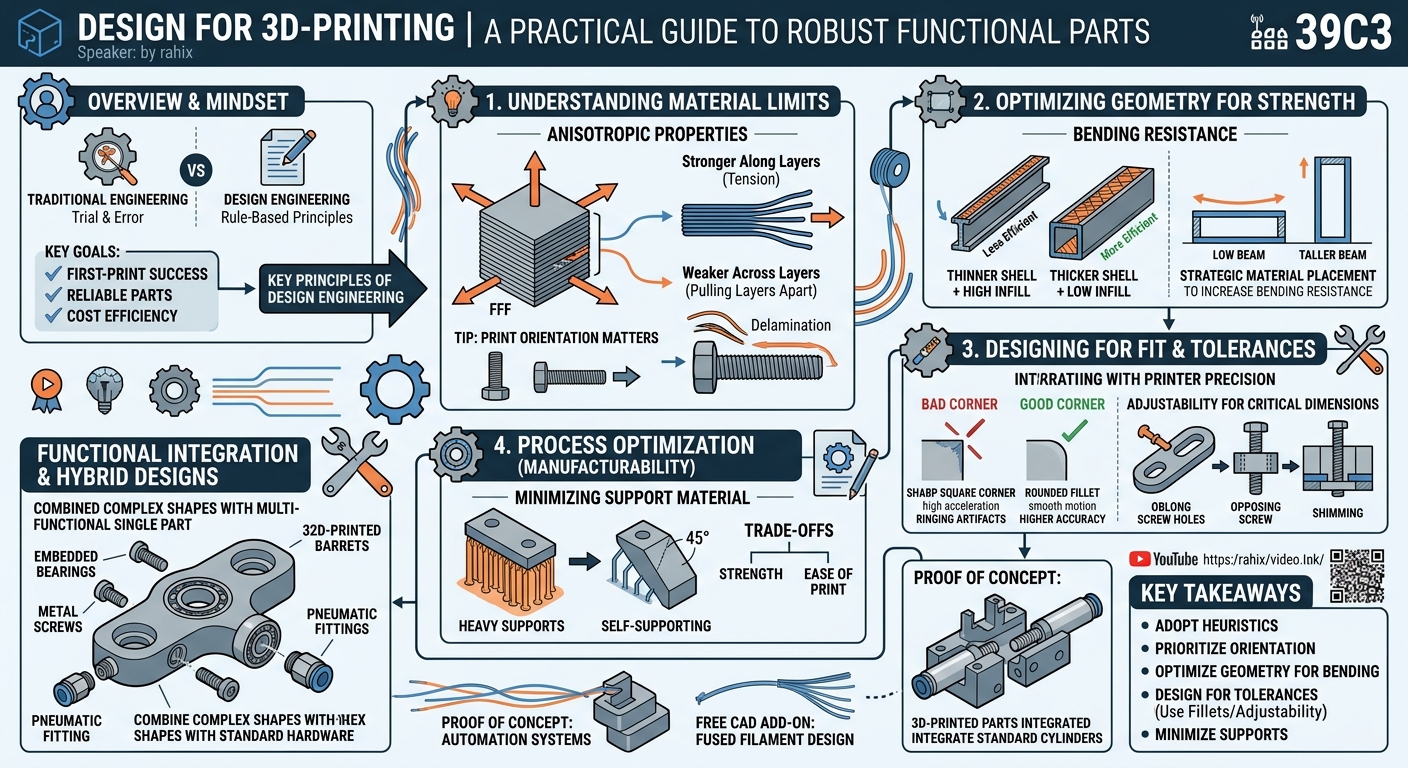
- Anisotropic Material Properties: FFF 3D-printed parts exhibit different strengths depending on the direction of force relative to the print layers. They are generally stronger along the layers (stretching individual filaments) than across the layers (pulling layers apart) due to imperfect layer adhesion.
- Print Orientation is Paramount: Deciding the print orientation early in the design process is a fundamental decision, akin to choosing a software framework. It should be based on anticipating the primary tensile forces the part will experience, orienting them parallel to the print bed for maximum strength.
- Shell Thickness Trumps Infill for Bending: Most parts are subjected to bending forces, not pure tension or compression. For bending, material at the surface is most effective. Therefore, making the outer shell thicker is a far more efficient way to increase bending resistance than simply increasing infill density, as infill material near the neutral axis contributes minimally to strength.
- Geometric Optimization for Strength: Rather than adding more material, designers can significantly increase a part's resistance to bending by strategically moving existing material further from the neutral axis. For example, increasing the height of a beam dramatically enhances its strength against bending without substantially increasing material usage or weight. The emphasis should be on optimizing surface area rather than just volume.
- Design for Manufacturing Tolerances: Instead of setting ideal functional tolerances and hoping the printer can meet them, designers should understand and design within the tolerances achievable by their 3D printer. This "manufacturing process defines tolerances" approach leads to more reliable outcomes.
- Fillets Improve Accuracy: Sharp, square corners require high acceleration changes during printing, leading to reduced accuracy and potential artifacts like ringing. Fillets (rounded corners) allow for smoother, gradual direction changes, resulting in much higher print accuracy and better tolerances.
- Adjustability for Precision: When a 3D printer's inherent precision isn't sufficient for critical dimensions, incorporating adjustment mechanisms (e.g., oblong holes for screws, opposing screws, shimming) allows for fine-tuning after printing, achieving higher effective accuracy.
- Minimize Support Material: While supports enable complex geometries, they introduce significant headaches (post-processing, rough surfaces, poor tolerances). Designers should strive to eliminate or reduce supports through clever part geometry (e.g., adding angled surfaces, reorienting parts).
- Embrace Trade-offs: Design for 3D printing is a constant balancing act. Decisions like prioritizing strength over support material avoidance, or cost over absolute precision, are inherent to the process.
- Functional Integration and Hybrid Designs: 3D printing excels at integrating multiple functions into a single part, which would be prohibitively expensive with traditional methods. It also pairs effectively with standard machine elements (screws, bearings) or embedded materials, creating robust hybrid solutions.
Technical Deep Dive
▶ Watch: What makes a 'good part': functionality (fit, strength) (5:00)
The core of rahix's talk delves into specific technical aspects of designing for FFF 3D printing, focusing on strength, fit, and manufacturability.
Design for Strength
The "does it break?" question is fundamental, and 3D-printed parts have unique characteristics that influence their strength.
- Layer Anisotropy: FFF parts are built layer by layer, leading to anisotropic material properties. The bond between layers, formed by the thermal fusion of plastic, is typically weaker than the strength of the extruded plastic filament itself. This means:
- Tension along layers: When tensile forces are applied parallel to the print bed, stretching the individual filaments, the part exhibits higher strength.
- Tension across layers: When tensile forces pull the layers apart, perpendicular to the print bed, the part is significantly weaker. This is the primary failure mode for many poorly oriented prints.
- Design Implication: A critical heuristic is to orient parts such that primary tensile forces are parallel to the print bed. rahix illustrates this with a screw: printing it vertically results in tensile forces along the threads pulling layers apart, making it weak. Printing it flat on the bed, though potentially requiring more supports, aligns the tensile forces more favorably.
- Print Orientation Strategy: The decision of print orientation is not an afterthought but a foundational step in the design process. It should be made very early, considering the expected load directions. rahix compares this to choosing a framework for a software project: changing it later is difficult and costly. Designers must mentally project the layer structure onto their CAD model, understanding how changes in geometry will affect the printed part's internal structure and strength.
- Infill vs. Shell for Bending: Most mechanical parts are subjected to bending forces rather than pure tension or compression. Bending forces create a neutral axis through the center of the part where internal stress is zero. As one moves outwards from this axis, stress increases, becoming maximum tension on one surface and maximum compression on the opposite surface.
- Inefficiency of Infill: Material located near the neutral axis contributes very little to resisting bending. Therefore, simply increasing the infill density in the core of a part is an inefficient way to boost strength against bending.
- Efficiency of Shell: Material at the surfaces of a part (the outer shell) is where the bending stresses are highest. Consequently, making the outer shell thicker is a far more effective strategy to increase bending resistance than increasing infill percentage.
- Geometric Optimization: A more advanced technique for resisting bending is to optimize the part's geometry by moving material further from the neutral axis without necessarily adding more material. rahix demonstrates this with a beam: increasing its height by a factor of two significantly increases its bending resistance. This is because the resistance to bending scales with the cube of the distance from the neutral axis for a rectangular cross-section. The takeaway: "Always think more about the surface area of your parts than the volume" because the hollow volume does little for strength.
Design for Fit (Tolerances)
Ensuring parts fit together correctly involves managing tolerances, the permissible deviation from a nominal dimension.
- Manufacturing-Driven Tolerances: The traditional approach is to define functional tolerances first, then try to manufacture to them. rahix advocates for the opposite: understand the manufacturing process's inherent tolerances and design accordingly. If a printer cannot reliably hold a tight tolerance for mounting holes, the designer should make the holes larger, increasing the acceptable tolerance range.
- Printer Limitations and Solutions:
- Sharp Corners: When printing sharp, square corners, an FFF printer must rapidly decelerate, change direction, and accelerate again. This high acceleration puts stress on the printer's frame, leading to slight shifts and reduced accuracy around corners. This can manifest as ringing or ghosting.
- Fillets: The design solution is to replace sharp corners with fillets (rounded corners). Fillets allow the print head to follow a much smoother, more gradual path, reducing accelerations and dramatically improving print accuracy and surface quality in these areas.
- Other Challenges: Overhangs beyond a certain angle (typically 45-60 degrees without supports) and large flat surfaces prone to warping due to thermal stress are other common tolerance-related issues that must be considered in design.
- Adjustable Mechanisms: When even optimized designs cannot meet necessary precision, particularly for critical interfaces, adjustment mechanisms can be integrated:
- Oblong Holes: Instead of perfectly round holes for screws, slightly elongated (oblong) holes allow for minor positional adjustments during assembly.
- Opposing Screws: Using two screws on opposing sides to clamp a part allows fine-tuning of its position.
- Spring-Loaded Screws: A screw opposed by a spring can provide adjustable clamping or positioning.
- Shimming: The industrial practice of inserting thin, precisely sized shims between parts to achieve exact dimensions is also applicable, even with 3D-printed shims or standard metal ones. While adding degrees of freedom, these mechanisms offer a practical workaround for inherent printer imprecision.
Process Optimization (Manufacturability)
Optimizing a design for the 3D printing process primarily revolves around managing support material.
- Support Material Headaches: Supports are necessary for printing overhangs and bridges but create several problems:
- Post-processing: Supports must be removed, which can be time-consuming and tedious.
- Surface Finish: The surface where supports meet the part is often rough, visually unappealing, and has poor dimensional accuracy.
- Slicer Tweaking: Optimizing support generation often requires extensive trial and error with slicer settings.
- Material Waste: Supports consume extra filament.
- Support Avoidance Strategies:
- Angled Surfaces: Replacing steep overhangs with gentler angled surfaces (e.g., 45 degrees or less) allows the printer to build without supports.
- Part Orientation: Reorienting the part can sometimes eliminate or drastically reduce the need for supports. For example, flipping a part to a 45-degree angle might make previously unprintable bridges self-supporting, though this might introduce other trade-offs like adhesion issues.
- Inherent Trade-offs: rahix emphasizes that design is a game of trade-offs. For instance, a part designed to avoid supports might have a print orientation that compromises its strength (e.g., a hook printed across layer lines). Conversely, orienting for maximum strength might necessitate extensive supports. The designer must weigh these factors based on the part's primary function and requirements.
Other Considerations
rahix briefly touches upon other advanced concepts:
- Functional Integration: 3D printing uniquely allows combining multiple components or functions into a single, complex part, which is often impossible or too expensive with traditional methods.
- Flexures / Compliant Mechanisms: Using the inherent flexibility of thermoplastics to create movable joints or mechanisms within a single printed part, reducing external component count. However, he notes these can be "really tricky" to make robust over time.
- Print-in-Place Designs: Parts that print fully assembled and functional, often with moving components.
- Hybrid Designs: Combining 3D-printed components with standard off-the-shelf hardware like screws, nuts, bearings, or embedding other materials (e.g., glass or carbon fibers for reinforcement). This leverages the strengths of both manufacturing methods.
Demo / Proof of Concept
▶ Watch: Crucial question: 'Can the part be made well?' (7:30)
While rahix did not perform a live, interactive demo of a 3D print or a physical object during the talk, he referenced and briefly showcased a significant tool he developed that embodies the principles discussed: a FreeCAD add-on called "Fused Filament Design." This add-on is designed to automate common design-for-3D-printing shapes and features, making it easier for designers to implement the heuristics and best practices he outlined. He encouraged attendees to read his blog post for more details on this tool.
Furthermore, rahix discussed his personal primary use case for 3D printing, which serves as a powerful proof of concept for the efficacy of his design philosophy. He designs automation systems by integrating standard machine hardware, such as pneumatic cylinders, with custom 3D-printed parts. He specifically highlights the challenge of replacing "very stiff machine frames with the very compliant 3D-printed parts." Despite these material limitations, he has found it "surprisingly possible" to achieve "amazing accuracy" and "good repeatability" in these systems, doing so for much cheaper than industrial solutions. This practical application demonstrates that by carefully designing around the limitations and leveraging the strengths of 3D printing, highly functional and precise outcomes are achievable.
Defensive Implications
▶ Watch: Solution for design: using heuristics (rules of thumb) (10:05)
While this talk is not within the typical cybersecurity domain, its "defensive implications" translate directly to how designers and engineers can "defend" against common 3D printing failures and create more robust, reliable, and functional parts. The core message is proactive design to prevent problems, rather than reactive troubleshooting.
- Adopt a Proactive Design Engineering Mindset: Designers should shift from a trial-and-error approach to a principled one. This means actively considering manufacturability, expected loads, and material properties from the very initial conceptual stages, not just during post-design validation. Understanding and applying heuristics is the primary defense against common design flaws.
- Prioritize Print Orientation for Strength: Given the anisotropic nature of FFF prints, always analyze the expected stress points and orient the part to align primary tensile forces parallel to the print bed. This is the first line of defense against premature mechanical failure. For critical parts, this may involve sacrificing ease of printing (e.g., requiring more supports) for structural integrity.
- Optimize Geometry for Bending Resistance: Since most parts experience bending, defenders should focus on intelligent material distribution. This means designing with thicker outer shells rather than relying on dense infill for strength. Furthermore, actively adjust part geometry (e.g., increasing beam height) to move material away from the neutral axis, providing significantly more bending resistance with minimal material increase. This defends against inefficient material usage and unexpected structural weaknesses.
- Design for Manufacturing Tolerances, Not Just Functional Ideals: Acknowledge the inherent precision limitations of the 3D printer. Rather than forcing tight tolerances that lead to ill-fitting parts, designers should proactively incorporate features like fillets at corners to improve print accuracy and provide sufficient clearances (e.g., slightly larger holes) where precision is less critical. This prevents frustrating fit issues and reduces iterative reprints.
- Integrate Adjustability for Critical Dimensions: For interfaces requiring high precision that the printer cannot reliably deliver, embed adjustment mechanisms (e.g., oblong holes, opposing screws, shimming). This is a crucial defense against dimensional inaccuracies, allowing for post-print fine-tuning and ensuring functional fit where it matters most.
- Strategically Minimize Support Material: Supports are a necessary evil, but designers should proactively redesign parts to reduce or eliminate them. Utilize angled surfaces and clever part orientations to create self-supporting geometries. This defends against post-processing overhead, wasted material, and compromised surface quality on critical interfaces.
- Leverage 3D Printing's Unique Strengths: Defend against over-complicating designs by embracing functional integration, combining multiple parts into one where feasible. Also, strategically integrate 3D-printed components with standard hardware (screws, bearings) to leverage the best of both worlds, creating more robust and cost-effective solutions. This holistic approach prevents designs that are overly complex, expensive, or prone to failure.
By adopting these "defensive" design strategies, users can transform 3D printing from a source of frustration into a reliable, efficient, and powerful manufacturing tool.
Key Takeaways
- Embrace Design Engineering Principles: Successful 3D printing is not magic but relies on understanding and applying fundamental engineering rules and heuristics to create robust and functional parts.
- Prioritize Print Orientation for Strength: Due to the anisotropic nature of FFF prints, orient parts to align primary tensile forces parallel to the print bed to maximize strength and prevent layer delamination.
- Optimize Geometry for Bending Resistance: For most parts, which are loaded in bending, thicken the outer shell and strategically shape parts (e.g., increasing beam height) to move material further from the neutral axis, rather than relying on inefficient infill.
- Design for Manufacturing Tolerances: Understand your 3D printer's capabilities and design accordingly. Use fillets on corners for improved accuracy and incorporate adjustable mechanisms (like oblong holes or shims) for critical dimensions that require higher precision.
- Minimize Support Material: Actively design geometries to reduce or eliminate the need for support structures by using angled surfaces and optimizing part orientation, thereby avoiding post-processing and improving surface quality.
- Leverage 3D Printing's Unique Advantages: Utilize 3D printing for functional integration of multiple components into single parts and combine with standard hardware or embedded materials to create cost-effective and highly functional designs.
About the Speaker(s)
rahix is a passionate advocate for effective design in 3D printing, driven by the belief that robust, functional parts can consistently be created on the first try. He has extensively collected and experimented with design tricks and techniques from the 3D printing community, synthesizing this knowledge to help others avoid common pitfalls. His main interest lies in designing purely functional parts, particularly for automation systems, where he integrates standard machine hardware like pneumatic cylinders with 3D-printed components. He has achieved surprising accuracy and repeatability in these systems despite the compliant nature of 3D-printed parts, demonstrating the practical potential of thoughtful design. rahix is a strong proponent of FreeCAD and has even developed a FreeCAD add-on called "Fused Filament Design" to automate common design-for-3D-printing shapes. He is deeply invested in the idea that 3D printing enables the easy sharing and iteration of physical object designs, akin to how software is developed, and seeks to further explore and expand this potential within the community.
All talks from 39th Chaos Communication Congress (39C3): Power Cycles