Greenhouse Gas Emission Data: Public, difficult to access, and not always correct
Hanno Böck
39th Chaos Communication Congress (39C3): Power Cycles · Day 3 · Saal One
Overview
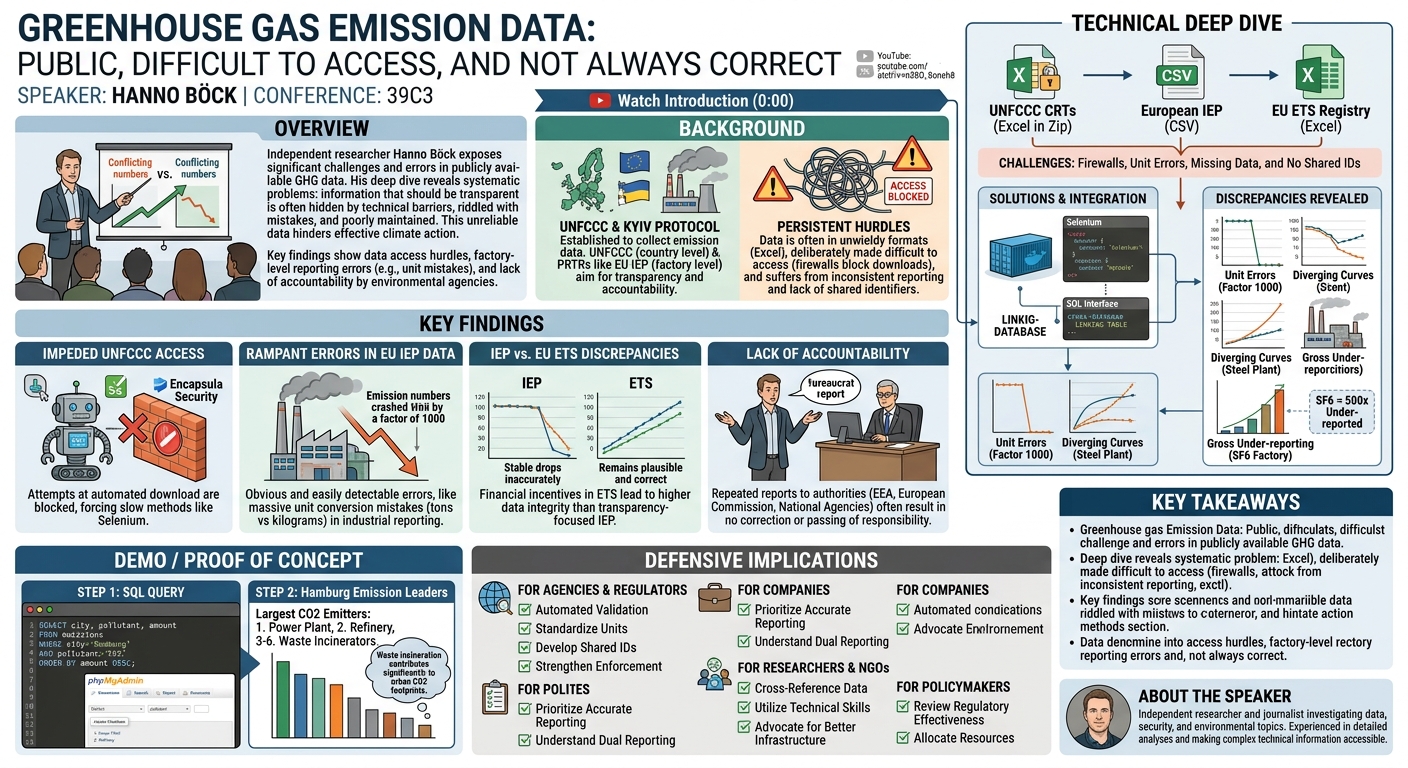
In this compelling talk, independent researcher Hanno Böck exposes the significant challenges and alarming inaccuracies prevalent in publicly available greenhouse gas (GHG) emission data. Addressing the critical issue of climate change, Böck delves into various international and European data sources, demonstrating how information that should be transparent and easily accessible is often hidden behind technical barriers, plagued by errors, and poorly maintained by responsible authorities. His investigation reveals a systemic problem where critical environmental data, intended to foster accountability and inform climate policy, is unreliable, hindering effective action.
Key moments
- 0:00 Introduction: Climate change, data, and the problem
- 2:00 UNFCCC's role in collecting country-level emission data
- 4:30 Outdated API and strange JSON data publication policy
- 6:00 Automated data download blocked by security firewall
- 8:00 Speaker's solution: automating downloads and sharing data
- 9:00 Example: Rapid N2O emission reduction in caprolactam production
Greenhouse Gas Emission Data: Public, difficult to access, and not always correct
Speakers: Hanno Böck
Conference: 39C3
YouTube: https://www.youtube.com/watch?v=n38O_8oneh8
Overview
In this compelling talk, independent researcher Hanno Böck exposes the significant challenges and alarming inaccuracies prevalent in publicly available greenhouse gas (GHG) emission data. Addressing the critical issue of climate change, Böck delves into various international and European data sources, demonstrating how information that should be transparent and easily accessible is often hidden behind technical barriers, plagued by errors, and poorly maintained by responsible authorities. His investigation reveals a systemic problem where critical environmental data, intended to foster accountability and inform climate policy, is unreliable, hindering effective action.
Böck's presentation is a technical deep dive into the practical difficulties of accessing and processing this data, from circumventing sophisticated web firewalls to grappling with inconsistent reporting units and the absence of standardized identifiers between different databases. He highlights specific cases of egregious data discrepancies, such as factories reporting emissions a thousand times lower than plausible, and the subsequent lack of effective response from environmental agencies. The talk underscores that while climate change is not purely an information problem, the integrity and accessibility of emission data are fundamental to understanding its causes and tracking progress towards mitigation.
The implications of Böck's findings are profound, revealing a gap between regulatory intent and real-world enforcement. Accurate, verifiable data is essential for holding polluters accountable, designing effective climate policies, and ensuring public trust. Böck's work serves as a powerful call to action for improved data infrastructure, rigorous validation processes, and greater transparency from both industries and governmental bodies tasked with monitoring environmental impact.
Background
▶ Watch: Introduction: Climate change, data, and the problem (0:00)
The global imperative to address climate change necessitates a clear understanding of where greenhouse gases originate. International bodies like the United Nations Framework Convention on Climate Change (UNFCCC) were established to facilitate climate diplomacy and, crucially, to collect emission data from member countries. This data is intended to provide a comprehensive, country-level overview of emissions across various sectors, enabling policymakers and the public to track environmental impact. Similarly, the Kyiv Protocol on Pollutant Release and Transfer Registers (PRTRs), signed in 2003, mandates signatory countries to establish public registers detailing pollutants released by industries, fostering transparency around environmental impacts at a more granular, factory-specific level. The European Union, a key signatory, has implemented this through its European Industrial Emissions Portal (IEP).
Despite these established frameworks and the commitment to public data, significant hurdles persist. The problem is multi-faceted: data is often published in unwieldy formats like Excel spreadsheets, making automated analysis challenging. Crucially, the talk highlights that even when data is technically "public," it can be deliberately difficult to access, as demonstrated by web firewalls blocking automated downloads. Furthermore, the sheer volume and complexity of data, coupled with a lack of standardized reporting and identifier systems across different databases, create an environment ripe for inconsistencies and errors. This fragmented and often flawed data landscape undermines the very goal of transparency, making it arduous for researchers, journalists, and citizens to gain accurate insights into actual emission levels and hold entities accountable for their environmental footprint. The underlying issue is not a complete absence of data, but rather a profound deficiency in its accessibility, quality, and the enforcement mechanisms designed to ensure its accuracy.
Key Findings
▶ Watch: Outdated API and strange JSON data publication policy (4:30)
Hanno Böck's investigation unearthed several critical findings that collectively paint a concerning picture of greenhouse gas emission data reliability:
- Impeded Access to UNFCCC Data: While country-level emission data from the UNFCCC is theoretically public, it is distributed solely as individual Excel files within numerous zip archives. Attempts at automated download are thwarted by an Encapsula security firewall, which employs sophisticated fingerprinting to block programmatic access. This forces researchers to resort to cumbersome methods like Selenium for data collection, or to rely on third-party aggregators.
- Rampant Errors in European Industrial Emissions Portal (IEP) Data: The factory-level data available via the IEP, intended to provide transparency, contains "obvious and easily detectable errors." Böck showcased instances where reported emissions for major industrial plants in Iceland (a ferro-silicon plant and an aluminum plant) inexplicably dropped by factors of one thousand or even a million in certain years, only to return to plausible levels later. These discrepancies were attributed to likely unit conversion mistakes (e.g., reporting tons instead of kilograms or kilotons).
- Discrepancies Between IEP and EU Emission Trading System (ETS) Data: A significant finding was the divergence between emission figures reported in the IEP and those in the EU Emission Trading System (ETS) Union Registry. The ETS, which involves monetary transactions for emission certificates, consistently showed more plausible and stable emission figures. This suggests that the financial incentives tied to ETS reporting lead to higher data integrity compared to the transparency-focused IEP, where errors persist uncorrected. Examples included a French steel plant in Dunkirk and a French fertilizer factory, where the curves diverged significantly for several years.
- Uncorrected and Missing Data Despite Reporting: Böck highlighted a pattern of uncorrected errors even after being reported to authorities. A German factory producing SF6 (sulfur hexafluoride), the most potent greenhouse gas, was found by scientists through atmospheric measurements to be emitting 500 times more than its reported 60 kilograms. Despite Böck flagging this and other issues (like a missing CO2 report for a Hamburg steel plant that should be above reporting thresholds), a subsequent data update showed no corrections.
- Lack of Accountability and Enforcement: Repeated attempts by Böck to get meaningful explanations or corrections from the European Environmental Agency (EEA), the European Commission, and various national authorities (Icelandic, French, German) largely resulted in non-answers or a passing of responsibility. This indicates a systemic failure in enforcing reporting regulations and ensuring data accuracy, leading to a climate of impunity for erroneous or incomplete disclosures.
- Challenges in Data Interoperability: A core technical issue identified was the complete lack of shared identifiers between critical databases like the IEP and the ETS. This necessitates manual matching or the creation of complex linking tables, a task undertaken by Böck in collaboration with a scientist from Ghent University, to enable cross-referencing and validation.
Technical Deep Dive
▶ Watch: Automated data download blocked by security firewall (6:00)
The technical core of Hanno Böck's presentation revolves around the acquisition, processing, and comparative analysis of disparate greenhouse gas emission datasets. His work highlights both the technical hurdles imposed by data providers and the methodologies required to overcome them for meaningful insights.
Data Sources and Their Peculiarities:
- UNFCCC Common Reporting Tables (CRTs): This is a foundational source for country-level emissions data, detailing various GHGs (CO2, methane, N2O, etc.) across sectors like energy and industry. The data is available as highly detailed Excel tables, with one file per year, per country, compressed within zip archives. A significant technical challenge here is the Encapsula security firewall protecting the UNFCCC download portal. Direct programmatic downloads using tools like
curlare blocked, as the firewall employs sophisticated fingerprinting techniques. Böck circumvented this by using Selenium, a browser automation framework, to programmatically interact with the web interface, simulate user clicks, and download the files. This approach, while effective, is cumbersome and resource-intensive, underscoring the deliberate obstruction of automated data access. Furthermore, Böck noted that while the UNFCCC possesses this data in a more structured JSON format, it is not published due to a lack of consensus among member countries, highlighting bureaucratic inertia over data utility.
- European Industrial Emissions Portal (IEP): This database provides factory-level emission data for the EU and associated countries (like Iceland, part of the European Economic Area). It implements the Kyiv Protocol and aims for environmental transparency. The IEP offers data in a "user-friendly CSV file" format under a Creative Commons Attribution license, making it more amenable to processing than the UNFCCC's Excel files. Böck developed a solution to ingest this data into a structured database, providing a Docker container with a SQL interface and a PHPMyAdmin web interface. This allows for efficient querying and analysis of factory-specific emissions, demonstrating how raw CSV data can be transformed into an actionable analytical tool.
- EU Emission Trading System (ETS) Union Registry: This system is a cornerstone of EU climate policy, requiring companies to purchase emission certificates for their CO2 emissions. Crucially, this system is tied to financial transactions, implying a higher degree of scrutiny and accuracy in its reporting. Like the UNFCCC data, ETS data is also primarily available in Excel tables and is Creative Commons licensed.
Challenges in Data Integration and Analysis:
A primary technical obstacle in comparing IEP and ETS data is the absence of shared identifiers between the two databases. Company names are often written inconsistently, and no common unique ID exists to link records. Böck collaborated with Leonard from Ghent University, who developed a linking table to bridge this gap, enabling researchers to cross-reference data from both sources. This linking table is a critical enabler for validating emission reports and uncovering discrepancies.
Revealing Data Inconsistencies:
Through this integrated approach, Böck uncovered several types of errors:
- Unit Errors: The most common and glaring errors involved incorrect units. For instance, the Elm ferro-silicon plant in Iceland reported emissions in the IEP that were a factor of a thousand too low in some years, compared to consistent figures in the ETS. This was likely due to reporting in tons or kilotons where kilograms were expected, or vice-versa. Similar issues were observed for Icelandic aluminum plants, where emissions would suddenly drop by a factor of 1000.
- Missing Data: The talk highlighted cases where factories, despite being above reporting thresholds, simply did not report emissions to the IEP, such as a large steel plant in Hamburg.
- Suspiciously Constant Emissions: Böck noted many instances where emissions were reported as exactly the same value for multiple consecutive years, which is highly improbable for industrial operations.
- Diverging Curves: For facilities like the French steel plant in Dunkirk and a French fertilizer factory, the IEP and ETS data diverged significantly for several years before converging again, with no clear explanation provided by authorities.
- Gross Under-reporting: The case of the German SF6 factory in Bad Wimpfen was particularly alarming. While the company reported around 60 kilograms of SF6 emissions, atmospheric measurements by scientists estimated actual emissions to be around 30 tons – a 500-fold difference. SF6 is the most powerful greenhouse gas, with a global warming potential significantly higher than CO2 (e.g., 1 ton SF6 = 23,500 tons CO2 equivalent). This level of under-reporting has massive implications for national emission inventories.
Böck's technical work not only exposed these flaws but also provided a framework for other researchers to conduct similar analyses, stressing the importance of robust data engineering and cross-validation in environmental monitoring.
Demo / Proof of Concept
▶ Watch: Speaker's solution: automating downloads and sharing data (8:00)
Hanno Böck provided a live demonstration of how the European Industrial Emissions Portal (IEP) data, once processed and stored in a structured database, can be used to gain specific insights into industrial emissions. He showcased his local setup, which consists of a Docker container providing a SQL interface and a PHPMyAdmin web interface, making the raw CSV data from the IEP accessible and queryable.
During the demo, Böck performed a targeted SQL query to identify major CO2 emission sources in Hamburg for the year 2023 (the latest available data at the time). The query filtered for the pollutant 'CO2' and the city 'Hamburg', then ordered the results by emission volume. The output visually confirmed his earlier claim: the Hamburg Tiefstack power plant was indeed the largest CO2 emitter in the city. Following this, the results highlighted a refinery and, notably, four waste incinerators among the largest sources. This specific finding, Böck noted, often surprises people, underscoring the significant contribution of waste incineration to urban CO2 footprints.
He further illustrated the analytical power by showing how he initially investigated the Icelandic emission data. He presented a raw SQL query: SELECT year, releases FROM table WHERE pollutant = 'CO2' AND country = 'Iceland' AND name LIKE '%ELM%' ORDER BY year;. This query, targeting the Elm ferro-silicon plant in Iceland, revealed the dramatic and implausible drops in reported emissions by factors of a thousand, which were a key catalyst for his deeper investigation into data accuracy.
The demonstration served as a powerful proof of concept, illustrating that while raw data might be difficult to access and process, transforming it into a queryable database allows for rapid, precise analysis. It highlights the potential for independent researchers and the public to scrutinize official reports and uncover critical environmental information, provided they have the tools and persistence to overcome the initial data acquisition hurdles.
Defensive Implications
▶ Watch: Example: Rapid N2O emission reduction in caprolactam production (9:00)
The findings presented by Hanno Böck have profound defensive implications for various stakeholders involved in climate action and environmental protection.
- For Environmental Agencies and Regulators:
- Implement Robust Data Validation: Agencies like the EEA and national authorities must establish automated, rigorous plausibility checks for incoming emission data. Sudden, drastic drops or increases (e.g., by factors of 1000) should immediately flag data for manual review and investigation. The current system, where such obvious errors persist for years, is unacceptable.
- Standardize Reporting Units and Formats: Enforce strict standardization of reporting units (e.g., always kilograms, or clearly specified units) and data formats to prevent unit conversion errors.
- Develop Shared Identifiers: Mandate and implement unique, persistent identifiers for facilities across all related databases (e.g., IEP, ETS, national registers) to enable seamless cross-referencing and validation.
- Strengthen Enforcement and Accountability: Move beyond simply referring inquiries back to national reporters. Establish clear mechanisms for escalating non-compliance, imposing penalties for false reporting, and ensuring corrections are made promptly. The current "nothing we can do" attitude is a significant vulnerability.
- Improve Data Accessibility: Re-evaluate the purpose of security firewalls that impede legitimate research. Data intended for public transparency should be easily accessible via APIs or bulk downloads without requiring complex workarounds.
- For Companies and Industrial Operators:
- Prioritize Accurate Reporting: Companies should recognize that inaccurate reporting, even if unintentional (like unit errors), erodes trust and can lead to scrutiny. Implement internal quality control for environmental data.
- Understand Dual Reporting Implications: Be aware of the differences in data integrity between financially incentivized systems (ETS) and transparency-focused ones (IEP). Ensure consistency across all public disclosures. While one might be about "money" and the other about "transparency," both reflect on the company's environmental performance.
- For Researchers, Journalists, and NGOs:
- Cross-Reference Data Actively: Always compare emission data from multiple sources (e.g., IEP, ETS, national reports, scientific studies like atmospheric measurements) to identify inconsistencies.
- Utilize Technical Skills: Employ tools like scripting languages, database management systems, and browser automation (if necessary) to access and analyze publicly available data that is deliberately obscured.
- Advocate for Better Data Infrastructure: Continuously push for open APIs, standardized data formats, and shared identifiers from governmental and international bodies.
- Report Discrepancies Systematically: Document and report errors to relevant authorities, but also publicize findings to create external pressure for correction and accountability.
- For Policymakers:
- Review Regulatory Effectiveness: Assess whether current environmental reporting regulations are achieving their intended goals of transparency and accuracy.
- Allocate Resources for Data Quality: Ensure that environmental agencies have sufficient funding and mandates to develop robust data infrastructure, conduct thorough validation, and enforce compliance.
In essence, the primary defensive implication is a call for a paradigm shift from passive data publication to active data stewardship, characterized by robust validation, transparent accessibility, and stringent enforcement. Without accurate and reliable emission data, efforts to combat climate change risk being built on a foundation of flawed information, hindering effective policy and accountability.
Key Takeaways
- Publicly available greenhouse gas emission data is often difficult to access and riddled with significant errors. While data exists at country and factory levels from sources like the UNFCCC and the European Industrial Emissions Portal (IEP), it's frequently hidden behind technical barriers or presented in inconvenient formats.
- Unit conversion mistakes and missing data lead to massive discrepancies in reported emissions. Examples like Icelandic factories reporting emissions thousands of times lower than plausible due to unit errors highlight a fundamental flaw in data entry and validation processes.
- Emission data linked to financial incentives (e.g., EU Emission Trading System) tends to be more reliable. The ETS Union Registry consistently provides more plausible figures compared to the transparency-focused IEP, suggesting that economic consequences drive greater accuracy.
- Environmental authorities and companies are often slow or ineffective in addressing reported data inaccuracies. Despite Hanno Böck's persistent efforts to highlight errors, subsequent data updates showed no corrections, and responses from authorities were often evasive or pointed to a lack of enforcement power.
- Cross-referencing and independent analysis are crucial for identifying and exposing data discrepancies. Due to the lack of shared identifiers between databases, researchers must employ technical solutions like linking tables and data integration to validate official reports.
- Improved data accessibility, robust validation, and stronger enforcement mechanisms are vital for effective climate action. The current state of emission data undermines accountability and the ability to accurately track progress towards climate goals, necessitating a significant overhaul in how this critical information is managed.
About the Speaker(s)
Hanno Böck is an independent researcher and journalist dedicated to investigating data, security, and environmental topics. Through his work, he aims to shed light on critical issues that impact public understanding and policy. He is known for his detailed analyses and for making complex technical information accessible. Böck regularly shares his findings through talks at conferences like 39C3 and maintains a newsletter, where he publishes articles on his ongoing investigations. While his specific title and company affiliations were not explicitly stated in the talk or metadata, his presentation demonstrates a deep expertise in data analysis, environmental monitoring, and a commitment to transparency and accountability.
All talks from 39th Chaos Communication Congress (39C3): Power Cycles