CCC&T - Cosmic ray, the Climate Catastrophe and Trains.
FantasticMisterFux, louiT
39th Chaos Communication Congress (39C3): Power Cycles · Day 4 · Saal One
Overview
This talk, titled "CCC&T - Cosmic ray, the Climate Catastrophe and Trains," delves into innovative methodologies for measuring soil moisture, a critical parameter for understanding and mitigating the impacts of climate change. Presented by FantasticMisterFux from the Helmholtz Centre for Environmental Research (UFZ) in Leipzig, the session explores both traditional modeling approaches and a cutting-edge measurement technique known as Cosmic Ray Neutron Sensing (CRNS). While the speaker, a bioinformatician by background, candidly admits to not being a "geo person," their enthusiasm for the interdisciplinary nature of the project—spanning physics, environmental science, and technology—shines through, making a complex topic accessible and engaging.
Key moments
- 0:00 Introduction and speaker's background
- 2:00 Talk structure and main topic: soil moisture
- 2:40 Understanding the Duro monitor's drought scale
- 4:30 Field capacity: a plant's perspective on drought
- 6:00 Discrepancy: model drought vs. plant-relevant dryness
- 6:50 Introducing the Mesoscale Hydrological Model (MHM)
- 8:00 MHM optimized for stream flows, soil moisture a byproduct
- 9:00 Technical details: model parallelization via catchments
CCC&T - Cosmic ray, the Climate Catastrophe and Trains.
Speakers: FantasticMisterFux; louiT
Conference: 39C3
YouTube: https://www.youtube.com/watch?v=Y7oYHKnvR_c
Overview
This talk, titled "CCC&T - Cosmic ray, the Climate Catastrophe and Trains," delves into innovative methodologies for measuring soil moisture, a critical parameter for understanding and mitigating the impacts of climate change. Presented by FantasticMisterFux from the Helmholtz Centre for Environmental Research (UFZ) in Leipzig, the session explores both traditional modeling approaches and a cutting-edge measurement technique known as Cosmic Ray Neutron Sensing (CRNS). While the speaker, a bioinformatician by background, candidly admits to not being a "geo person," their enthusiasm for the interdisciplinary nature of the project—spanning physics, environmental science, and technology—shines through, making a complex topic accessible and engaging.
The core of the presentation addresses the urgent need for accurate and scalable soil moisture data in an era of escalating climate variability, characterized by more frequent and intense droughts and floods. The speaker highlights the limitations of existing methods, whether they are hydrological models optimized for stream flow or localized point measurements, and positions CRNS as a transformative solution. By harnessing naturally occurring cosmic ray neutrons, CRNS offers a non-invasive, large-area measurement capability that promises to significantly enhance our understanding of terrestrial water dynamics and improve our predictive capacities for environmental challenges.
The talk underscores the importance of proactive research and development in foundational environmental monitoring technologies. It argues that investing in such "aces up our sleeve" now is crucial for building resilience and informed decision-making in the face of an uncertain future. The integration of CRNS with mobile platforms, including its deployment on trains, exemplifies the ingenuity required to collect vital environmental data at unprecedented scales, providing a compelling intersection of advanced physics and practical application for climate resilience.
Background
▶ Watch: Introduction and speaker's background (0:00)
The pervasive and intensifying effects of climate change, particularly the increase in extreme weather events like droughts and floods, necessitate robust and accurate environmental monitoring. Central to this is the precise measurement of soil moisture, a key variable influencing agricultural productivity, hydrological cycles, and ecosystem health. However, acquiring reliable soil moisture data at relevant spatial and temporal scales has historically been a significant challenge.
One prominent approach to understanding soil moisture dynamics is through hydrological modeling. The talk introduces the Mesoscale Hydrological Model (MHM), a physically-based model used by institutions like the UFZ. This model aims to represent the physical world by simulating water movement through processes such as transpiration, evaporation, runoff, and snow formation. While comprehensive, the MHM is primarily optimized for stream flow measurements, which are relatively easier to validate. Soil moisture, in this context, is often a byproduct of the model, derived from precipitation data and a complex set of parameters. The model operates on a daily time scale with a 1-kilometer by 1-kilometer grid cell resolution across Germany. A key limitation highlighted is that a "deviation from a long-term mean" in modeled soil moisture, which the DUR monitor often uses to depict drought, does not necessarily correlate with "dryness for plants." For agricultural purposes, a better metric is field capacity, which measures the suction a plant needs to extract water. Plants begin to wilt at around 30% field capacity, and crop yields can be significantly impacted at 60%. Current models, while useful for broad hydrological assessments, may misrepresent agricultural drought conditions.
Traditional direct measurement methods for soil moisture also present their own set of limitations. The most fundamental is the gravimetric soil moisture method, which involves physically sampling soil, sealing it, weighing it, baking it to remove water, and then re-weighing it. While highly accurate, this method is labor-intensive, destructive, and utterly impractical for large-scale or continuous monitoring. More advanced techniques include Time Domain Reflectrometry (TDR) sensors, which involve inserting two metal rods into the soil and sending high-frequency electromagnetic pulses. The travel time of these pulses is measured, with more water in the soil leading to slower travel times due to the orientation of water molecules in the electromagnetic field. TDR sensors, however, provide only point measurements, making them unsuitable for characterizing the highly heterogeneous nature of most soil environments, where moisture levels can vary significantly over short distances due to factors like rocks, varying soil depths, and different soil types.
Another method, Ground Penetrating Radar (GPR), uses radar signals sent into the ground, which slow down in wetter soil and reflect off subsurface features like bedrock. While GPR can provide a broader assessment than TDR, its accuracy is heavily dependent on knowing the depth of the bedrock, often requiring manual excavation, which again limits its scalability and practicality for widespread application. These inherent challenges in both modeling and traditional measurement techniques underscore the critical need for innovative solutions capable of delivering accurate, integrated, and scalable soil moisture data, a gap that Cosmic Ray Neutron Sensing aims to fill.
Key Findings
▶ Watch: Understanding the Duro monitor's drought scale (2:40)
The central revelation of the talk is the introduction and detailed explanation of Cosmic Ray Neutron Sensing (CRNS) as a highly promising and versatile technology for large-scale soil moisture measurement. The speaker positions CRNS as a significant advancement over existing methods, addressing their limitations in terms of spatial representation and practical deployment.
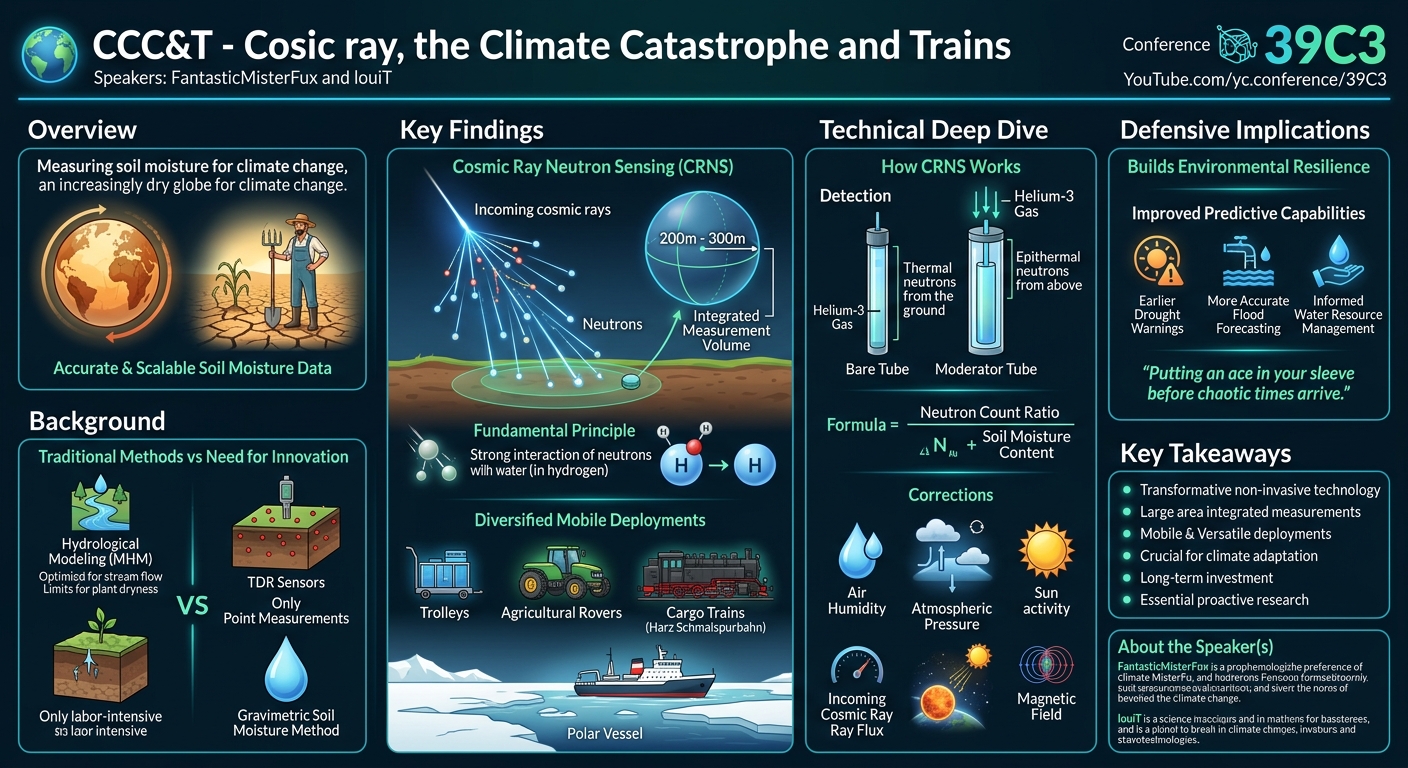
The fundamental principle behind CRNS is the detection of neutrons that originate from cosmic rays interacting with the Earth's atmosphere and surface. Crucially, the attenuation and reflection of these neutrons in the soil are predominantly influenced by the presence of hydrogen, which is overwhelmingly found in water molecules. By measuring the ratio of different energy levels of neutrons—specifically thermal neutrons (low energy, reflected from the ground) and epithermal neutrons (higher energy, coming from above)—CRNS sensors can accurately infer the soil moisture content within a substantial radius.
A key advantage of CRNS is its integrated measurement volume. Unlike point-measurement sensors like TDR, a single CRNS device can effectively measure the average soil moisture in a sphere spanning 200 to 300 meters around it. This characteristic makes it exceptionally well-suited for heterogeneous landscapes, where point measurements would be insufficient or misleading. Furthermore, the technology is non-invasive, requiring no direct contact with the soil beyond the sensor's placement.
The talk highlights the remarkable adaptability of CRNS sensors, showcasing their deployment in a variety of mobile configurations. These include portable versions mounted on trolleys for field surveys, more robust installations on rovers for extensive agricultural monitoring, and even highly innovative applications such as permanent installation on cargo trains (including the historic Harz Schmalspurbahn) to collect data along vast railway networks. The technology has also been successfully tested on sleds for snow moisture assessment, on boats for measuring water bodies (e.g., lakes in Leipzig, polar research in Antarctica), and even experimentally in balloons to study atmospheric neutron profiles. These diverse deployments underscore the versatility and practical utility of CRNS for collecting data across vastly different environments and scales.
While acknowledging that a comprehensive, direct comparison with the MHM model and other standard methods is complex due to differences in data representation (e.g., deviations in CRNS measurements versus lack of deviation data for models), the speaker notes that CRNS measurements generally show good correlation with other established techniques. This suggests that CRNS provides a reliable and complementary data source, poised to significantly improve the accuracy and spatial coverage of soil moisture monitoring, thereby offering a robust tool for environmental science and climate impact assessment.
Technical Deep Dive
▶ Watch: Discrepancy: model drought vs. plant-relevant dryness (6:00)
The technical core of Cosmic Ray Neutron Sensing (CRNS) lies in its sophisticated detection of naturally occurring neutrons and the subsequent calculation of soil moisture based on their energy profiles. At the heart of each CRNS sensor are two specialized tubes filled with heavy helium (specifically, Helium-3, ³He). One is a bare tube, and the other is a moderator tube coated with polyethylene. These tubes function as neutron collision detectors.
When a neutron passes through one of these cylinders, it can interact with the ³He gas. This interaction triggers a nuclear reaction: ³He + n → ³H (tritium) + p (proton) + energy. The resulting charged particles (tritium and proton) then ionize the gas molecules within the tube, knocking off electrons. These electrons are attracted to a positively charged electric wire running through the center of the tube, creating a detectable voltage change or "count." Each count signifies a neutron interaction.
The distinction between the bare and moderator tubes is crucial for differentiating neutron energies. Thermal neutrons are low-energy neutrons that have lost most of their kinetic energy through collisions, typically after being reflected from the ground. The bare tube is designed to primarily detect these thermal neutrons. In contrast, epithermal neutrons are higher-energy neutrons that arrive from the atmosphere. The moderator tube, with its polyethylene coating, slows down these high-energy epithermal neutrons through inelastic collisions, allowing them to be detected by the ³He gas. Without the moderator, high-energy neutrons would mostly pass through the sensor without interacting. The ratio of counts from these two tube types provides the basis for soil moisture estimation.
The neutrons themselves originate from cosmic rays, high-energy particles primarily from supernovae and other galactic events. These cosmic rays constantly bombard Earth's atmosphere, where they collide with atmospheric gases like nitrogen and oxygen. These collisions produce a cascade of secondary particles, including high-energy neutrons. These neutrons travel downwards, interacting further with atmospheric molecules, but most arrive at the Earth's surface in a near-vertical trajectory, still possessing high energy.
Upon hitting the ground, these high-energy neutrons interact with the mass of the Earth. A critical factor in these interactions is the presence of hydrogen. Hydrogen atoms, being light, are highly efficient at absorbing and scattering neutrons, causing them to lose energy rapidly and become thermalized. In soil, the vast majority of hydrogen is found in water molecules. Therefore, the higher the water content in the soil, the more efficiently neutrons are absorbed or reflected with reduced energy. This means that a wetter soil will result in fewer high-energy epithermal neutrons escaping the ground and fewer thermal neutrons being reflected upwards. By measuring the ratio of epithermal (from above) to thermal (from below) neutrons, the CRNS sensor can infer the soil moisture content.
Accurate CRNS measurements require several corrections to account for external factors. Firstly, atmospheric conditions impact neutron counts: air humidity (water vapor absorbs neutrons) and atmospheric pressure (more air molecules mean more interactions) must be corrected for. Secondly, the incoming cosmic ray flux itself fluctuates over time due to solar activity and other cosmic phenomena. To normalize for this, CRNS data is typically corrected using readings from global neutron monitor networks, such as those located in Kiel, Germany, and Jungfraujoch, Switzerland (the highest post office in Europe). Thirdly, the Earth's magnetic field shields cosmic radiation, leading to higher neutron counts at the poles compared to the equator, a factor that must be accounted for in global deployments.
Once corrected neutron counts are obtained, they are converted into either volumetric or gravimetric soil moisture using empirically derived constants. This calculation also incorporates the density of the soil and two site-specific factors: n0 (a measurement of neutron counts over perfectly dry soil, representing the baseline neutron production and attenuation in the dry soil matrix) and the soil moisture offset (accounting for hydrogen present in the soil itself, independent of water, e.g., in organic matter). For stationary devices, these factors can be precisely measured, leading to higher quality data. For mobile devices, these factors must be estimated, which can slightly reduce precision but maintains the advantage of broad spatial coverage.
Despite the high initial cost of the ³He gas, CRNS sensors are remarkably durable and low-maintenance. The speaker notes that it would take over a thousand years for the ³He to degrade sufficiently to impact measurements, making the initial investment a long-term asset with minimal operational energy requirements.
Demo / Proof of Concept
▶ Watch: Introducing the Mesoscale Hydrological Model (MHM) (6:50)
While the talk did not feature a live, real-time demonstration in the conventional sense, it extensively showcased various deployments and applications of the Cosmic Ray Neutron Sensing (CRNS) technology, effectively serving as a comprehensive "proof of concept" for its versatility and efficacy. The speaker presented a compelling visual tour of how CRNS sensors have been adapted for diverse environmental monitoring scenarios, moving beyond static installations to highly mobile platforms.
The journey of CRNS deployment began with basic portability. Early iterations included sensors mounted on trolleys, allowing researchers to manually traverse fields and measure soil moisture over larger areas than traditional point sensors. This quickly evolved into more sophisticated rover-mounted systems, enabling automated and extensive surveys across agricultural landscapes, providing detailed spatial maps of soil moisture.
A particularly innovative and highlighted application is the integration of CRNS sensors onto trains. The talk featured images of a sensor permanently installed on the Harz Schmalspurbahn, a historic narrow-gauge railway, demonstrating the feasibility of collecting continuous soil moisture data along railway corridors. This concept has since been professionalized, with CRNS units being deployed on cargo trains, aiming to leverage existing infrastructure for widespread environmental monitoring. The rationale is that trains can cover vast distances efficiently, providing invaluable linear transects of soil moisture data that would be otherwise impractical to obtain. The speaker noted that these train-mounted systems typically incorporate a larger number of ³He tubes (likened to a "fridge" full of them) to maintain reliable measurements even at higher speeds, such as 200 kilometers per hour.
Further expanding the sensor's adaptability, the talk illustrated its use on sleds for measuring snow water equivalent, crucial for understanding winter precipitation and spring runoff. The successful deployment on boats in the lakes of Leipzig to measure water bodies, ensuring 100% "wet" ground for calibration, paved the way for more ambitious projects. This included a professionalized deployment on a polar vessel traveling through Antarctica, which provided fascinating data on neutron counts varying with the Earth's magnetic field—demonstrating higher counts at the poles due to reduced shielding from cosmic radiation.
The talk even touched upon the historical context of cosmic ray discovery, mentioning a physicist who used a balloon to measure radiation at altitude. CRNS technology, too, can be deployed via balloons, with simulations showing that useful measurements can still be obtained up to 30 meters above the ground, albeit with reduced precision compared to ground-level deployments.
Collectively, these diverse mobile and static deployments serve as robust demonstrations that CRNS is not merely a theoretical concept but a practical, adaptable, and scalable tool for environmental monitoring. They underscore its capability to gather critical soil moisture data across varied terrains, climates, and modes of transport, proving its potential to revolutionize how we observe and understand terrestrial water dynamics.
Defensive Implications
▶ Watch: Technical details: model parallelization via catchments (9:00)
While the talk "CCC&T - Cosmic ray, the Climate Catastrophe and Trains" does not directly address cybersecurity or traditional "defensive" measures in a digital context, its implications for environmental resilience and societal defense against the impacts of climate change are profound. In an era of increasing climate variability, accurate and widespread soil moisture data becomes a critical "ace up our sleeve" in defending against the escalating challenges of droughts and floods.
The primary defensive implication lies in enhancing our predictive capabilities for environmental hazards. Improved soil moisture data, particularly from technologies like CRNS, can significantly refine hydrological models such as the MHM. By providing more accurate inputs and validation points, CRNS can lead to:
- Earlier and more precise drought warnings: Better understanding of soil water deficits allows for proactive measures in agriculture, such as optimizing irrigation schedules, selecting drought-resistant crops, and implementing water conservation strategies. This directly defends food security and agricultural livelihoods against the economic and social devastations of prolonged dry spells.
- Improved flood forecasting and mitigation: Although the MHM is optimized for stream flow, accurate soil moisture data is a crucial component for predicting runoff. Knowing the saturation levels of soil can help forecast how much rainfall will become surface runoff, leading to more accurate flood warnings and enabling communities to prepare and implement defensive measures like sandbagging, evacuations, and infrastructure protection. This defends lives, property, and critical infrastructure from flood damage.
- Informed water resource management: With precise knowledge of soil moisture, water authorities can make more strategic decisions regarding reservoir management, water allocation for different sectors, and long-term planning for water security. This defends vital water resources against overexploitation and ensures sustainable availability.
- Enhanced climate modeling and policy development: Comprehensive soil moisture data contributes to more robust global and regional climate models. These improved models, in turn, provide a stronger scientific basis for developing effective climate adaptation and mitigation policies, defending future generations from the worst impacts of climate change.
The speaker's metaphor of "putting an ace in your sleeve" before chaotic times arrive perfectly encapsulates the defensive posture. Developing and deploying technologies like CRNS now, even when the immediate, large-scale projects heavily utilizing them might not yet be fully realized, is a proactive defense. It ensures that when environmental crises escalate, humanity will possess the necessary tools and data to respond effectively, adapt intelligently, and build greater resilience against the ongoing climate catastrophe.
Key Takeaways
- CRNS is a transformative technology for soil moisture measurement: Cosmic Ray Neutron Sensing (CRNS) offers a non-invasive method to measure soil moisture over large areas (200-300m radius), addressing the limitations of point measurements and model-derived estimates.
- Leverages cosmic ray physics: The technology works by detecting neutrons originating from cosmic ray interactions, with the ratio of thermal to epithermal neutrons indicating soil water content, primarily due to hydrogen's strong neutron absorption properties.
- Highly versatile and mobile: CRNS sensors can be deployed on a wide array of platforms, including trolleys, rovers, cargo trains, sleds, boats, and even balloons, enabling data collection across diverse and extensive environments.
- Crucial for climate change adaptation: Accurate and scalable soil moisture data is vital for improving predictions of droughts and floods, optimizing agricultural practices, informing water resource management, and enhancing climate models, thereby bolstering societal resilience against climate catastrophe.
- Long-term investment with high utility: Despite the high initial cost of heavy helium (Helium-3), CRNS sensors are exceptionally durable, low-maintenance, and have a lifespan of over a thousand years, making them a sustainable long-term asset for environmental monitoring.
- Proactive research is essential: The talk emphasizes that continued research and development in foundational environmental monitoring technologies like CRNS are necessary to equip society with the "aces" needed to face an increasingly uncertain and challenging climate future.
About the Speaker(s)
FantasticMisterFux is a bioinformatician who holds a PhD in the field. Approximately two and a half years prior to this talk, they joined a project at the Helmholtz Centre for Environmental Research (UFZ) in Leipzig. Despite not being a "geo person" by training, they found the intersection of the project's topics—cosmic rays, climate catastrophe, and trains—to be highly relevant and compelling for the 39C3 conference audience. FantasticMisterFux stepped in to deliver this presentation after the lead physicist on the project was unable to attend due to personal commitments, providing a passionate and insightful overview of complex environmental monitoring technologies.
louiT served as the moderator for the session, facilitating questions from the audience and online platforms.
All talks from 39th Chaos Communication Congress (39C3): Power Cycles