Rebooting the cyber arsenal of democracy
Eric Foster (CEO · 10X AI)
BSides NYC 2025 (0x05) · Day 1 · Entrepreneur
Overview
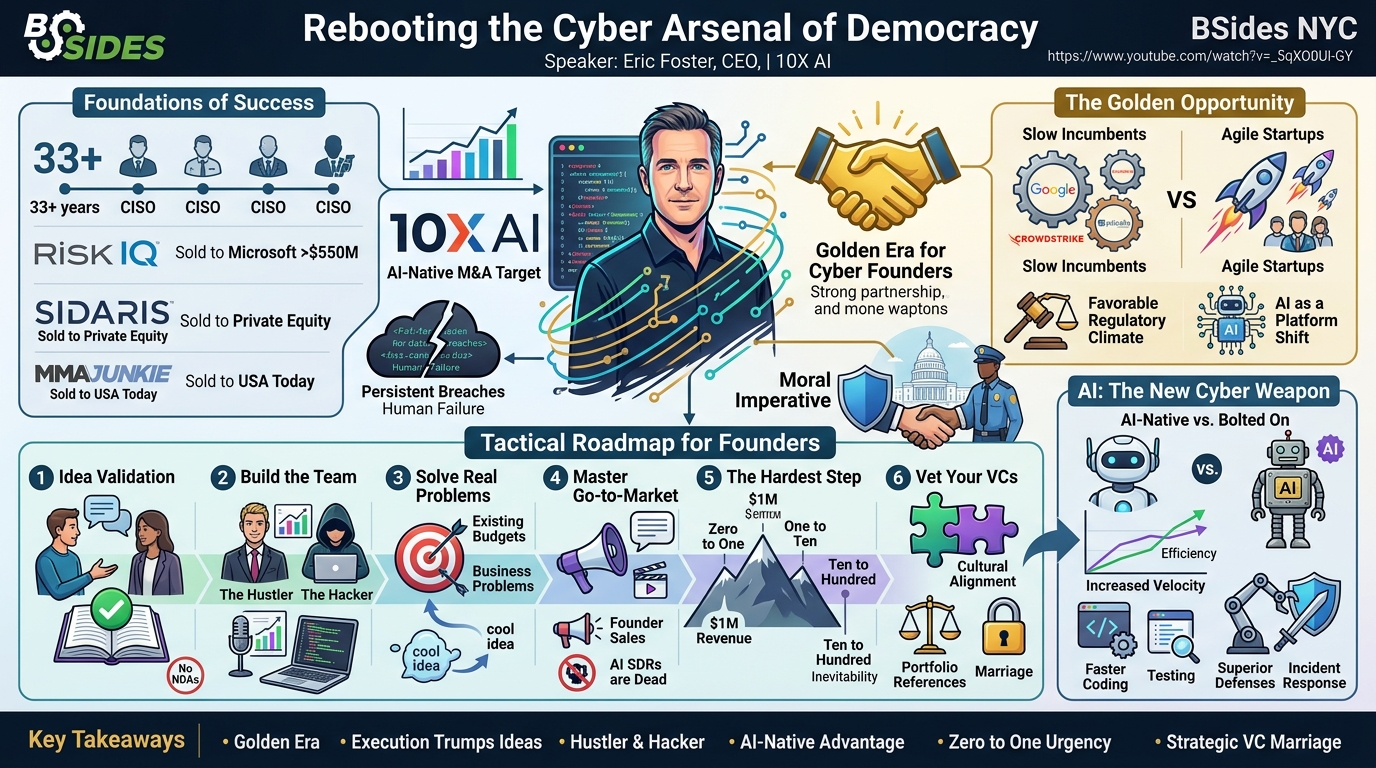
In a compelling presentation at BSides NYC, Eric Foster, CEO of 10X AI and a veteran of the cybersecurity industry, laid out a powerful argument for why now is the "golden era" for aspiring cybersecurity founders. Titled "Rebooting the Cyber Arsenal of Democracy," Foster's talk wasn't just a guide for entrepreneurs; it was a call to action, framed as a "moral imperative" for individuals to innovate and build new companies to safeguard national security and the broader digital ecosystem. Drawing on over three decades of experience, including multiple successful exits like Risk IQ (sold to Microsoft for over $550 million) and Sidaris, as well as insights from top-tier venture capitalists such as Andreessen Horowitz, TCV, and Ballistic Ventures, Foster presented a tactical roadmap for transforming ideas into high-growth security businesses.
Key moments
- 0:00 Speaker introduction, background, and entrepreneurial success
- 2:50 Why this is the 'golden era' for cyber founders
- 4:00 AI's impact on starting and scaling new businesses
- 5:45 Startups, not big companies, drive cybersecurity innovation
- 6:30 Cybersecurity innovation as a moral imperative for national defense
- 7:00 Upcoming practical advice and insights from top VCs
Rebooting the Cyber Arsenal of Democracy
Speakers: Eric Foster, CEO, 10X AI
Conference: BSides NYC
YouTube: https://www.youtube.com/watch?v=_5qXO0UI-GY
Overview
In a compelling presentation at BSides NYC, Eric Foster, CEO of 10X AI and a veteran of the cybersecurity industry, laid out a powerful argument for why now is the "golden era" for aspiring cybersecurity founders. Titled "Rebooting the Cyber Arsenal of Democracy," Foster's talk wasn't just a guide for entrepreneurs; it was a call to action, framed as a "moral imperative" for individuals to innovate and build new companies to safeguard national security and the broader digital ecosystem. Drawing on over three decades of experience, including multiple successful exits like Risk IQ (sold to Microsoft for over $550 million) and Sidaris, as well as insights from top-tier venture capitalists such as Andreessen Horowitz, TCV, and Ballistic Ventures, Foster presented a tactical roadmap for transforming ideas into high-growth security businesses.
Foster emphasized that the current landscape, characterized by a favorable regulatory climate, the transformative power of artificial intelligence (AI) as a platform shift, and the slow pace of innovation from large incumbent security vendors, creates an unprecedented opportunity for agile startups. He argued that despite the perceived maturity of the cybersecurity market, it remains an "unsolved problem," with a critical need for fresh, disruptive solutions. The core message resonated deeply: innovation in cybersecurity no longer primarily originates from corporate R&D departments but from small, dedicated teams and individual founders who are willing to tackle real-world pain points with urgency and conviction.
The talk served as a practical blueprint for navigating the complexities of startup creation, from validating initial ideas and building complementary teams to mastering go-to-market strategies and engaging effectively with venture capitalists. Foster's unique perspective, blending the experiences of a three-time CISO, a successful entrepreneur, and an active investor, provided a holistic view of what it takes to succeed. He challenged the audience to identify unmet needs within their own defensive roles and translate those frustrations into innovative products, ultimately contributing to a stronger, more resilient "cyber arsenal of democracy" against increasingly sophisticated threats.
Background
▶ Watch: Speaker introduction, background, and entrepreneurial success (0:00)
Eric Foster's journey through the cybersecurity landscape spans an impressive 33 years, witnessing firsthand the evolution of threats, technologies, and market dynamics. His extensive background includes serving as a three-time CISO, giving him a deep understanding of the daily challenges and unmet needs faced by defenders. Beyond operational security, Foster has proven himself a formidable entrepreneur, responsible for building more than a billion dollars in shareholder value across multiple successful company exits. Notable among these was his role in building Risk IQ, an external threat intelligence and attack surface management platform, which was eventually acquired by Microsoft for over $550 million. He also founded Sidaris, which was sold to private equity, and even ventured outside cyber to build and sell MMA Junkie to USA Today, demonstrating a versatile entrepreneurial acumen. Currently, he leads 10X AI, an AI-native company that Crunchbase recently named the number three M&A target globally, underscoring his continued success and relevance in the tech world.
The problem, as Foster articulates it, stems from several critical factors. Firstly, despite decades of investment and innovation, cybersecurity remains an "unsolved problem." The sheer volume and sophistication of threats continue to outpace existing defenses, leading to pervasive breaches—many of which, he asserts, are attributable to human failure. This persistent vulnerability highlights a fundamental gap in current solutions. Secondly, Foster observes a stagnation in "mind-blowing innovation" from larger, established cybersecurity companies. He posits that while giants like Google, Microsoft, CrowdStrike, and Palo Alto Networks certainly innovate, their size and entrenched processes often lead to slower movement compared to agile startups. Historically, he notes, transformative innovation often emerges from "the garage," with larger companies typically acquiring these breakthroughs rather than originating them.
This creates a significant market opportunity, particularly in light of current macro trends. The regulatory climate is increasingly favorable for business growth, with a decade-long outlook that supports new ventures. More profoundly, the advent of artificial intelligence represents a fundamental "platform shift," akin to the rise of the internet. This shift not only empowers "solopreneurs" to build companies with less capital and greater speed but also creates entirely new market opportunities. Foster argues that combining these elements—an unsolved problem, slow incumbents, a supportive regulatory environment, and a transformative technology like AI—makes the present moment an unprecedented "golden era" for cybersecurity founders. He reinforces this by sharing insights from leading venture capitalists, emphasizing that the need for innovation is not just a business opportunity but a "moral imperative" to defend against nation-state adversaries and secure the "cyber arsenal of democracy."
Key Findings
▶ Watch: AI's impact on starting and scaling new businesses (4:00)
Eric Foster's talk illuminated several crucial findings for anyone contemplating a cybersecurity startup in the current climate:
- The Golden Era for Cyber Founders: Foster unequivocally declared that "now is quite literally the golden era for cyber security founders." This assertion is based on a confluence of factors: a favorable long-term regulatory climate, the transformative power of artificial intelligence enabling faster, more efficient company building, and the inherent market opportunity created by AI as a platform shift.
- Big Companies' Slowness is a Startup Advantage: A critical insight is that while large security vendors like Google or CrowdStrike continue to innovate, their size often makes them "move slow." This sluggishness, Foster contends, is a direct "advantage as a founder," allowing nimble startups to outmaneuver incumbents in delivering cutting-edge solutions, especially in an AI-native world where fewer resources are needed to build.
- Moral Imperative for Innovation: Beyond mere business opportunity, Foster posited a "moral imperative" for individuals to start cybersecurity companies. He believes the country is "actively at war with a number of nation states," and innovation from new ventures is essential to "keep us safe" and allow the nation to "innovate and grow."
- Ideas are Cheap; Execution is Everything: A foundational principle shared is that "ideas are cheap," and true value lies in execution. Foster strongly advises against guarding ideas with NDAs, instead encouraging founders to openly discuss their concepts with VCs, CISOs, and peers for crucial market validation. The value, he states, is in the team's ability to execute a vision, not the initial concept itself, which can even "pivot" over time.
- The Essential "Hustler and Hacker" Duo: Success in early-stage startups often hinges on the presence of two complementary roles: the "hacker" who builds the product and the "hustler" who sells it. While rare individuals possess both skills, Foster stresses the importance of forming a team that collectively embodies these capabilities, warning that technical founders who refuse to engage with customers "fail almost every time."
- Solve a Real Problem, Target Existing Budgets: Entrepreneurs should "start with a business problem and work your way back from it," rather than building something merely because it's "cool." The most viable path involves targeting problems the market already understands, that are within existing buyer budgets, and for which solutions are already sought. The goal is to be "better, faster, cheaper" than existing options, avoiding the arduous task of creating entirely new categories, as Risk IQ initially experienced.
- Go-to-Market is Paramount: Foster repeatedly emphasized that go-to-market (GTM) strategy is "everything in cyber security and SaaS in general." This encompasses not just sales but effective storytelling, creating urgency, and leveraging founder sales. He highlighted that the motion for raising venture capital is nearly identical to the motion for acquiring customers, requiring compelling narratives and proactive outreach.
- Zero to One is the Hardest Milestone: The most challenging phase for any startup is going from "zero to one"—creating something from nothing and securing the first million in revenue. Foster revealed that 10X AI achieved $10 million in revenue in six months, placing them in the "top 1% of 1% of companies" funded by Andreessen Horowitz, underscoring the difficulty of this initial traction. He advises focusing intensely on the zero-to-one and one-to-ten million revenue stages, as "10 to 100 is an inevitability" if the earlier hurdles are cleared.
- AI Native vs. Bolting On AI: A key competitive edge for 10X AI is its AI-native approach, where "literally every part of our business" heavily uses AI. Foster argued that legacy companies trying to "bolt AI on" to existing processes are at a disadvantage compared to startups that build from a "clean sheet of paper." He also provocatively stated that AI, though non-deterministic, is "an order of magnitude provably better, faster, safer than a human driver" (referencing Tesla), and that "human failure" is the single cause of "every single major breach."
- Vet Your VCs Like a Marriage: Foster offered a stark warning about investor relationships: "It is way easier to get divorced than it is to get somebody off your cap table." He strongly advises founders to "vet your VCs," checking references from their portfolio companies and ensuring cultural alignment, rather than simply accepting the first check. Raising money, he added, should be a "somber" moment, as it involves diluting equity and setting high expectations.
Technical Deep Dive
▶ Watch: Startups, not big companies, drive cybersecurity innovation (5:45)
While Eric Foster's talk was primarily strategic and entrepreneurial, it provided a significant technical deep dive into the transformative role of Artificial Intelligence (AI) within the cybersecurity landscape and for startup creation. Foster positioned AI not merely as a feature, but as a fundamental platform shift that is reshaping how companies are built, how security challenges are addressed, and how innovation occurs.
At the core of his argument is the concept of being AI-native. Unlike established companies that attempt to integrate AI into existing, often cumbersome, workflows—a process he likens to "bolting AI on"—Foster's company, 10X AI, was built from a "clean sheet of paper" with AI integrated into "literally every part of our business." This pervasive adoption, he believes, is a primary reason for their rapid growth and efficiency. This AI-native approach is critical because it allows for a complete re-imagining of processes and product development, rather than retrofitting new capabilities onto old structures.
Foster elaborated on the practical applications and implications of AI:
- Increased Velocity and Efficiency: AI empowers "solopreneurs" and small teams to move "faster with solving more problems and delivering more value" with less capital than previously imaginable. This velocity is crucial in a market where urgency is paramount.
- Software Development Acceleration: He highlighted software development as the "single easiest one" for AI application. Tools leveraging AI can significantly accelerate coding, testing, and deployment cycles, allowing startups to ship products faster. This directly contributes to the "move fast and ship things you're embarrassed by" philosophy, where rapid iteration trumps perfection.
- Superiority over Human Performance: Foster made a provocative comparison, suggesting that while AI is "non-deterministic," so are humans. Citing the example of self-driving cars, he argued that AI is "an order of magnitude provably better, faster, safer than a human driver." This analogy extends to cybersecurity, where he attributes "every single major breach" he has worked on to "human failure." Therefore, AI's ability to automate, analyze, and respond can surpass human capabilities, leading to more robust defenses. The bar for AI, he stressed, is not perfection but being "better than people."
- Impact on Go-to-Market (GTM) Strategies: AI has already dramatically altered traditional GTM tactics. Foster noted that "AI SDRs" (Sales Development Representatives leveraging AI) have essentially "killed the SDR" role as traditionally understood. The proliferation of AI-generated cold emails and messages has desensitized recipients, making traditional outbound methods ineffective. This necessitates adapting GTM strategies to focus on authentic, in-person interactions and demand creation that AI spam cannot replicate.
- Hot Opportunities: From a technical perspective, Foster sees "AI-driven anything" as a hot opportunity. This includes leveraging AI to streamline incident response, enhance threat detection (where he believes "a lot of work" is still needed to separate "wheat from the chaff"), and build "future resilience." Identity and cloud security, which collectively constitute 70% of security budgets, are also ripe for AI-driven transformation.
- AI-Optimized Hiring: Foster revealed that an "AI-native" mindset is a screening question for 10X AI hires. The expectation is that every employee, regardless of role, must have a clear plan for "how you're using AI" to enhance their work, reflecting a company-wide commitment to leveraging the technology.
In essence, the technical deep dive in Foster's talk wasn't about a specific protocol or exploit, but rather the meta-technical shift brought about by AI. It's about how AI changes the very fabric of building, securing, and operating in the digital realm, creating unparalleled opportunities for those who embrace it from the ground up.
Demo / Proof of Concept
▶ Watch: Cybersecurity innovation as a moral imperative for national defense (6:30)
This talk was a strategic and motivational discussion for aspiring entrepreneurs rather than a demonstration of a specific security product or proof of concept. Eric Foster focused on the methodologies and mindset required to build a successful cybersecurity startup, drawing from his extensive experience and insights from leading venture capitalists.
Defensive Implications
▶ Watch: Upcoming practical advice and insights from top VCs (7:00)
For cybersecurity defenders, Eric Foster's insights carry significant implications, particularly for those contemplating a leap into entrepreneurship or seeking to enhance their current defensive strategies:
- Identify and Solve Your Own Pain Points: Foster's "Ferdinand Porsche" analogy ("Looking around and not seeing the car of my dreams, I decided to build it myself") is a direct call to action for practitioners. Defenders are on the front lines, intimately aware of the tools they wish they had, the inefficiencies they battle daily, and the specific pain points within their organizations (e.g., slow SIM queries taking "15 minutes," prohibitive SIM bills, or lack of visibility into cloud infrastructure). These firsthand frustrations are fertile ground for developing truly impactful solutions.
- Embrace AI for Enhanced Defense: The message on Artificial Intelligence is critical for defenders. While AI isn't a magic bullet to solve all cybersecurity problems, it is a powerful force multiplier. Defenders should actively integrate AI into their operations, not just as an add-on, but by fundamentally rethinking processes to leverage AI for faster analysis, more efficient incident response, and improved threat detection. Recognizing that "human failure" is the root cause of most breaches, AI offers a "provably better, faster, safer" alternative for many tasks, enabling defenders to move with greater speed and precision.
- Prioritize Real Business Problems: When evaluating new security tools or considering building one, defenders should critically assess whether it solves a "real business problem." Avoid solutions that are merely "cool" or incrementally faster if they don't address a tangible point of pain that impacts the organization's bottom line or operational security posture. Focus on tools that align with existing budgets and known security challenges, rather than creating new, unbudgeted categories.
- Stay Agile and Open to Innovation: Foster highlighted the slow pace of innovation among large security vendors. This means defenders should remain agile in their adoption strategies, actively seeking out and evaluating solutions from smaller, innovative startups that might offer more effective or efficient ways to tackle specific problems. Don't assume the biggest vendors always have the best or most cutting-edge answers.
- Cultivate a Mission-Driven Approach: For defenders considering becoming founders, Foster stresses the importance of a "mission-driven team focused on the long haul." The motivation should extend beyond profit to a genuine commitment to solving critical security challenges, driven by the "moral imperative" to protect digital assets and national interests. This conviction will be vital in attracting both talent and investment.
- Adapt Go-to-Market Engagement: Defenders, as potential buyers, should be aware of the evolving go-to-market landscape. The decline of effective "AI SDRs" and mass cold outreach means that genuine, authentic interactions, including "founder sales" and in-person engagement, are becoming more valuable. This implies that defenders might find more effective solutions by engaging directly with founders who deeply understand their problems.
In essence, Foster's talk empowers defenders to become active participants in shaping the future of cybersecurity, either by demanding better, problem-focused solutions from vendors or by becoming the founders who deliver those solutions themselves, leveraging AI and a clear understanding of market needs.
Key Takeaways
- Cybersecurity's Golden Era: The current landscape, marked by a favorable regulatory environment and the transformative power of Artificial Intelligence (AI), presents an unprecedented opportunity for cybersecurity founders to build impactful companies.
- Execution Trumps Ideas: While an initial concept is necessary, the true value and success of a startup lie in its ability to execute. Founders should validate ideas openly, focusing on solving real business problems that align with existing market needs and budgets, rather than creating new categories.
- The Indispensable Team Dynamic: A successful startup typically requires a "hustler" (sales/storytelling) and a "hacker" (builder/product) dynamic. Founders must either embody both roles or build a complementary team, as founder sales and compelling storytelling are critical, especially in the early stages.
- Embrace AI-Native Development: Building an AI-native company, where AI is integrated into every facet of the business from the ground up, offers a significant competitive advantage over traditional companies attempting to "bolt on" AI. This approach leverages AI's speed and efficiency, which Foster argues can surpass human capabilities in many areas, addressing the pervasive issue of "human failure" in security.
- Urgency and Zero-to-One Focus: Cultivating an extreme "sense of urgency" and prioritizing the challenging "zero-to-one" phase (achieving the first million in revenue) is crucial. This initial traction is the hardest, and success here makes subsequent growth (one-to-ten million, then ten-to-one hundred million) more achievable.
- Strategic Investor Engagement: Founders must carefully "vet your VCs," treating the relationship as more serious than a marriage. This involves checking references from portfolio companies, ensuring cultural alignment, and understanding that raising capital dilutes equity and sets high expectations for growth and valuation.
About the Speaker(s)
Eric Foster is a highly accomplished entrepreneur, operator, and investor with over 33 years of experience in the cybersecurity and technology sectors. He is currently the CEO of 10X AI, an AI-native company that was recently recognized by Crunchbase as the number three M&A target globally. Foster has a proven track record of building and exiting successful ventures, having been responsible for creating more than a billion dollars in shareholder value across multiple exits. Notably, he was an integral part of the team that built Risk IQ, which was acquired by Microsoft for over $550 million. He also founded Sidaris, selling it to private equity and working with Robert Herjavec. Beyond cybersecurity, Foster's entrepreneurial spirit led him to build and sell MMA Junkie to USA Today. A three-time CISO before transitioning into venture capital, he brings a unique "defender's" perspective to his investment and operational roles. His current venture, 10X AI, secured funding from prominent firms like Andreessen Horowitz, underscoring his standing in the venture capital community. Foster is known for his deep industry insights and his passionate advocacy for innovation in cybersecurity.
Reviews
Dr. Zero (Offensive Security Researcher) — WEAK
A founder-entrepreneur motivational talk dressed up with national-security framing — thin on substance, heavy on self-promotion, and misplaced at a BSides technical conference. Foster has real credentials and genuine exits, but this talk is essentially a VC pitch deck narrated aloud, with 10X AI as the hero of every example.
Heather Calloway (CISO) — WEAK
Eric Foster has real credentials and real experience, and some of what he says is true — but this talk is a founder recruitment pitch dressed as strategic insight. It produces almost nothing actionable for the defenders, executives, or governance professionals who most need to be in this conversation.