You got a lighter I need to do some Electroporation
J. Utley, P. Rhodes, J. Hill
DEF CON 32 Creator Stage · Day 1 · Creator Stage
Overview
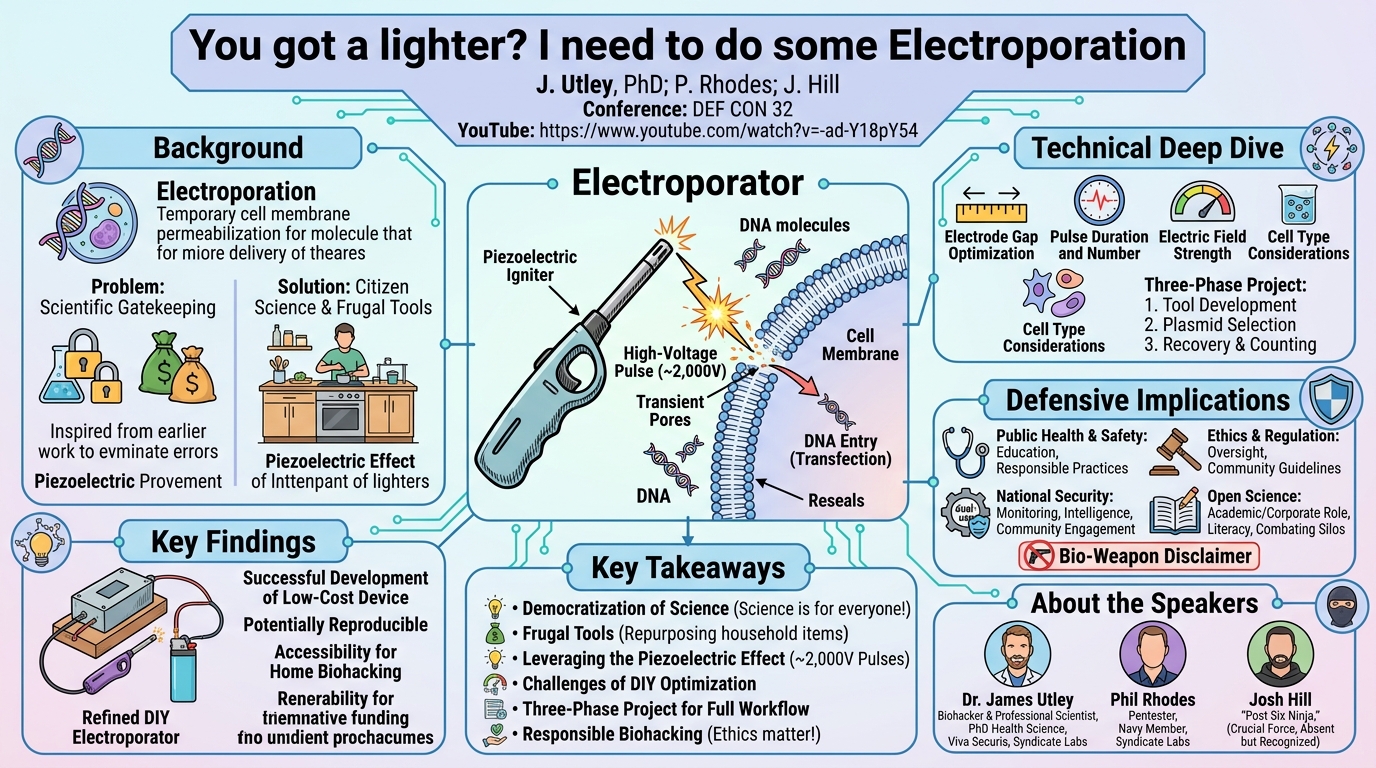
In an era where scientific advancement often feels confined to well-funded laboratories and academic institutions, "You got a lighter? I need to do some Electroporation" presented a refreshing and provocative vision for the democratization of biotechnology. Delivered by Dr. James Utley, alongside Phil Rhodes and the mystical "Post Six Ninja" Josh Hill of Viva Securis and Syndicate Laboratories, this DEF CON 32 talk unveiled a low-cost, portable electroporator constructed from a common barbecue lighter. The core message resonated deeply with the hacker ethos: complex scientific techniques, particularly genetic engineering, should be accessible to "the people," fostering curiosity and innovation beyond traditional gatekeepers.
Key moments
- 0:00 Talk title and crucial bio-weapon disclaimer
- 0:30 Speaker introductions and affiliations (Viva Securis)
- 2:00 Warning about dad jokes and talk's tone
- 2:20 Origin of project: Electroporation using a barbecue lighter
- 3:15 Democratizing science and genetic engineering with frugal tools
You got a lighter? I need to do some Electroporation
Speakers: J. Utley, PhD; P. Rhodes; J. Hill
Conference: DEF CON 32
YouTube: https://www.youtube.com/watch?v=-ad-Y18pY54
Overview
In an era where scientific advancement often feels confined to well-funded laboratories and academic institutions, "You got a lighter? I need to do some Electroporation" presented a refreshing and provocative vision for the democratization of biotechnology. Delivered by Dr. James Utley, alongside Phil Rhodes and the mystical "Post Six Ninja" Josh Hill of Viva Securis and Syndicate Laboratories, this DEF CON 32 talk unveiled a low-cost, portable electroporator constructed from a common barbecue lighter. The core message resonated deeply with the hacker ethos: complex scientific techniques, particularly genetic engineering, should be accessible to "the people," fostering curiosity and innovation beyond traditional gatekeepers.
The presentation, while infused with an irreverent spirit of "dad jokes" and Nicholas Cage memes, carried a serious underlying ambition: to enable individuals to perform basic genetic manipulation from the comfort of their homes using "frugal tools." The speakers explicitly disclaimed any intent for the device to be used as a bio-weapon, a crucial point given the sensitive nature of genetic engineering discussions at a security conference. Instead, the focus was squarely on empowering a new generation of citizen scientists and biohackers, challenging the notion that advanced scientific experimentation requires prohibitively expensive equipment or institutional affiliation.
This talk stands as a testament to the potential for innovation when resourcefulness meets scientific curiosity. By demonstrating how a ubiquitous household item can be repurposed for sophisticated biological processes like DNA transfection, the speakers not only provided a tangible tool but also ignited a discussion about the future of open science. It highlights the growing intersection of hacking culture and biotechnology, where the principles of accessibility, modification, and reappropriation are applied to the very building blocks of life.
Background
▶ Watch: Talk title and crucial bio-weapon disclaimer (0:00)
The concept of electroporation is a cornerstone technique in molecular biology, widely employed to introduce foreign DNA, RNA, or other molecules into cells. It works by applying a brief, high-voltage electrical pulse to cells, which temporarily disrupts the cell membrane's integrity, creating transient pores. These pores allow external molecules to enter the cell before the membrane reseals. Historically, this process requires specialized, often expensive, equipment known as electroporators, limiting its accessibility primarily to professional research laboratories, pharmaceutical companies, and academic institutions.
This talk's genesis lies in a foundational observation: the piezoelectric effect (which the speakers referred to as the "PTC electric effect") inherent in a common barbecue lighter. The clicking mechanism of these lighters generates a high-voltage spark, designed to ignite gas. Crucially, this spark is a manifestation of an electrical pulse, which, under the right conditions, can mimic the electrical fields used in conventional electroporation. The speakers were inspired by earlier work from university students who successfully constructed an electroporation device using a similar principle, demonstrating the feasibility of using such a mundane object for sophisticated biological processes.
The problem, as framed by the speakers, is the entrenched gatekeeping of scientific knowledge and tools. "Science is for everyone," Dr. Utley declared, lamenting how genetic engineering and advanced biotechnology are often "confined by fancy instruments or, you know, big Pharma or, you know, or academia just kind of like locking it up." This sentiment underscores a broader movement within the biohacker community to democratize science, making advanced techniques and knowledge available to individuals outside traditional research environments. The goal is to lower the barrier to entry for aspiring genetic engineers and bio-enthusiasts, fostering a culture of experimentation and discovery that is not limited by financial or institutional constraints. This approach aligns with the open-source philosophy prevalent in the wider hacking community, advocating for transparency, collaboration, and shared access to tools and information.
Key Findings
▶ Watch: Speaker introductions and affiliations (Viva Securis) (0:30)
The primary finding presented by Dr. Utley and his team is the successful development of a refined, "easier to assemble" low-cost, portable electroporator, building upon the pioneering work of university students who first demonstrated the concept. This iteration aims to enhance the accessibility and practicality of performing DNA transfection and other genetic engineering experiments outside of traditional laboratory settings. The core innovation lies in leveraging the piezoelectric igniter of a standard barbecue lighter as the high-voltage pulse generator for cell membrane permeabilization.
While specific quantitative data on transfection efficiency or cell viability were not detailed in the provided transcript as "key findings," the talk emphasizes the potential for reproducibility and the critical parameters involved. The speakers highlighted that the original "electro pen" developed by college students was deemed "very reliable," suggesting a baseline for reproducibility that their improved device seeks to match or exceed. The ability to achieve the necessary electrical field for electroporation – targeting approximately 2,000 volts – from such a rudimentary component is a significant practical finding. This voltage is sufficient to induce temporary pores in cell membranes, a prerequisite for successful molecular delivery.
Furthermore, the talk implicitly presents the finding that complex biological techniques can be broken down into accessible, DIY-friendly components. By focusing on the "frugal tools" philosophy, the speakers demonstrated that the intellectual and practical barriers to engaging with genetic engineering are not insurmountable. The project is conceptualized in three phases: first, the development of the tool itself and demonstrating its reproducibility; second, the crucial step of plasmid selection (choosing the genetic material to insert); and third, the recovery and counting of successfully transfected cells. This structured approach, even for a DIY project, underscores a methodical effort to validate the entire process, making the "easier to assemble" device a critical first step towards broader scientific democratization.
Technical Deep Dive
▶ Watch: Warning about dad jokes and talk's tone (2:00)
The technical foundation of this "frugal" electroporator hinges on the principle of electroporation, a biophysical technique that uses an electric field to increase the permeability of the cell membrane. The goal is to allow substances like DNA, RNA, or proteins to be introduced into the cell's cytoplasm. At its core, electroporation involves subjecting cells to short, high-intensity electrical pulses, which cause a temporary structural rearrangement of the cell membrane's lipid bilayer. This rearrangement leads to the formation of transient aqueous pores, through which molecules can pass. Once the electrical pulse subsides, these pores reseal, leaving the cell intact but with new genetic material inside.
The ingenious aspect of the device presented by Dr. Utley and his team is its reliance on the piezoelectric effect for generating these crucial electrical pulses. A barbecue lighter contains a piezoelectric crystal which, when subjected to mechanical stress (the "clicking" action), generates a high-voltage electrical discharge. This spark, typically used to ignite gas, is repurposed here. The speakers noted that the device aims to deliver around 2,000 volts, a voltage range commonly used in laboratory electroporators for various cell types. This voltage, when applied across a small gap containing cells suspended in an appropriate medium, creates the necessary electric field to induce poration.
Constructing such a device in a DIY environment presents several critical technical challenges and requires careful optimization of multiple parameters to ensure successful and reproducible transfection. These parameters include:
- Electrode Gap: The distance between the electrodes applying the pulse is crucial. A smaller gap generally leads to a higher electric field strength for a given voltage, but it must be optimized for the volume of cells and solution.
- Pulse Duration and Number: While a barbecue lighter provides a singular, sharp pulse per click, precise control over pulse duration and the number of pulses applied is vital in conventional electroporation. The DIY approach relies on the inherent characteristics of the lighter's spark and the user's manual "triggering" action.
- Electric Field Strength: This is a function of the applied voltage and the electrode gap. Achieving the optimal field strength is critical for creating pores without causing irreversible damage to the cells.
- Ionic Composition of the Fluid: The buffer solution in which the cells and DNA are suspended plays a significant role. Its conductivity and ionic strength affect the electric field distribution and the efficiency of DNA entry. Solutions must be carefully chosen to protect cells and facilitate DNA transport.
- Cell Type: Different cell types have varying membrane compositions and sizes, requiring specific optimization of electroporation parameters for optimal transfection efficiency and cell viability. Bacterial cells, for instance, often require different conditions than mammalian cells.
The speakers highlighted that their project is envisioned in three distinct phases. The current talk primarily addresses "Part 1," focusing on the development and reproducibility of the electroporation tool itself. "Part 2" would delve into the critical aspect of plasmid selection, which involves choosing the specific DNA sequence (e.g., a gene for a fluorescent protein) that one wishes to introduce into the cells. "Part 3," briefly mentioned, covers recovery and counting, referring to the methods used to grow the transfected cells and quantify the success of the genetic engineering experiment (e.g., by observing fluorescent protein expression). This multi-phase approach indicates a comprehensive understanding of the entire genetic engineering workflow, even when adapted for a frugal, DIY context.
Demo / Proof of Concept
▶ Watch: Origin of project: Electroporation using a barbecue lighter (2:20)
While the talk did not feature a live, real-time demonstration of successful DNA transfection into cells using the barbecue lighter electroporator, the speakers did present the concept of the device and its operational mechanism as a compelling proof of concept. Dr. Utley explicitly stated, "maybe Phil you want to show like what the device looks like," indicating that the physical manifestation of their low-cost, portable electroporator, inspired by a barbecue lighter, was available for the audience to see or was shown via slides.
The essence of the demo or proof of concept in this context is the feasibility of repurposing a common household item for a sophisticated scientific application. The speakers conveyed that their work builds directly on a prior study by university students who successfully used a barbecue lighter for electroporation and DNA transfection. Their contribution is an "easier device to assemble" that encapsulates this principle, aiming for improved practicality and user-friendliness for the home biohacker.
The presentation of the device itself, along with the detailed explanation of how the piezoelectric effect of the lighter generates the necessary 2,000-volt electrical pulse to create temporary pores in cell membranes, served as the conceptual demonstration. The talk focused on the "tool" (Part 1 of their three-phase project) and its potential for reproducibility, rather than the downstream biological outcomes of a specific transfection experiment. This approach effectively showcased the core innovation: transforming an everyday object into a functional scientific instrument, thereby proving the viability of the "frugal tools" philosophy in the realm of genetic engineering.
Defensive Implications
▶ Watch: Democratizing science and genetic engineering with frugal tools (3:15)
The "defensive implications" of a talk like "You got a lighter? I need to do some Electroporation" extend beyond traditional cybersecurity to encompass the broader societal and ethical considerations surrounding the democratization of biotechnology. While the speakers explicitly disclaimed any intent for their device to be used as a "bio-weapon" at the outset, the very act of making genetic engineering tools accessible raises important questions for defenders across various domains.
Firstly, for public health and safety organizations, the proliferation of DIY genetic engineering tools necessitates increased awareness and potentially new guidelines. While the immediate risk of an individual creating a harmful pathogen with a barbecue lighter is extremely low given the complexity and safety measures involved in handling biological materials, the principle of accessible tools means that the theoretical barrier to entry is lowered. Defenders in this space must focus on education, promoting responsible biohacking practices, and providing resources for safe experimentation, rather than solely on prohibition. This includes emphasizing proper sterile techniques, waste disposal, and understanding the biological implications of genetic modifications.
Secondly, from an ethical and regulatory standpoint, the talk highlights the ongoing tension between open science and the need for oversight. Traditional biotechnology is heavily regulated to prevent misuse and ensure safety. As tools become more accessible, regulators face the challenge of adapting existing frameworks or developing new ones that foster innovation without compromising public safety. This might involve encouraging community-driven ethical guidelines within biohacker collectives, much like the cybersecurity community develops best practices. The "defense" here is about safeguarding the integrity of science and preventing unintended consequences, rather than locking it down.
Thirdly, for national security agencies, the concept of easily accessible genetic engineering tools, even if rudimentary, demands careful monitoring and threat intelligence. While the speakers' intent was benign, the dual-use nature of biotechnology means that any tool capable of genetic modification could, in theory, be repurposed. The defensive posture here would involve tracking advancements in DIY biohacking, understanding the capabilities and limitations of such tools, and distinguishing between legitimate scientific exploration and potential malicious intent. This requires engagement with the biohacker community to build trust and understanding, rather than immediate suspicion.
Finally, for the scientific community itself, the talk serves as a call to action to "defend" the principles of open access and scientific literacy. By demonstrating that "science is for everyone," the speakers challenge academic and corporate institutions to re-evaluate their role in knowledge dissemination. The defense here is against the intellectual siloing and exclusivity that can stifle innovation. Encouraging citizen science and providing educational resources can empower individuals to engage responsibly, ultimately strengthening the scientific ecosystem by broadening participation and fostering a more scientifically literate populace.
In essence, the defensive implications of this talk revolve around proactive engagement, education, and the development of responsible frameworks to navigate the exciting, yet potentially complex, landscape of democratized biotechnology.
Key Takeaways
- Democratization of Science: The core message is that genetic engineering and advanced scientific techniques should be accessible to everyone, not just those in well-funded institutions, fostering a "science is for everyone" ethos.
- Frugal Tools for Biohacking: A common barbecue lighter can be repurposed as a low-cost, portable electroporator, demonstrating that sophisticated scientific experimentation does not require expensive, specialized equipment.
- Leveraging the Piezoelectric Effect: The device utilizes the piezoelectric igniter of a barbecue lighter to generate the necessary high-voltage electrical pulses (approximately 2,000 volts) for creating temporary pores in cell membranes.
- Challenges of DIY Genetic Engineering: While accessible, successful electroporation and transfection in a DIY environment are challenging, requiring careful optimization of parameters like electrode gap, pulse characteristics, fluid ionic composition, and cell type.
- Three-Phase Project for Full Workflow: The development of the electroporator is "Part 1" of a larger project, which also includes "Part 2" ( plasmid selection) and "Part 3" (recovery and counting), outlining a comprehensive approach to home genetic engineering.
- Responsible Biohacking: The speakers explicitly disclaimed the use of the device as a bio-weapon, underscoring the importance of ethical considerations and responsible conduct within the growing biohacker community.
About the Speaker(s)
The talk was presented by a team from Viva Securis and Syndicate Laboratories, led by Dr. James Utley, a distinguished figure in the biohacker community and a professional scientist. Dr. Utley holds a PhD in health science and describes himself as a "biohacker doubling as a professional scientist." His extensive background includes serving as the Chief Scientific Officer at Origins, a regenerative medicine stem cell clinic in Panama where he resides. He is also a co-founder of Syndicate Laboratories, a biohacker collective based in Las Vegas, which he describes as an homage to the YT Cracker album.
Joining Dr. Utley was Phil Rhodes, introduced as a pentester and a member of the Navy, bringing a unique blend of cybersecurity and military discipline to the team. The third member, Josh Hill, known mystically as "the Post Six Ninja," was unable to attend the conference but was credited as a crucial force behind the company's achievements. Together, this diverse team embodies the interdisciplinary spirit of biohacking, bridging gaps between traditional science, technology, and grassroots innovation.