The Past, Present, and Future of Bioweapons
Panel
DEF CON 32 Creator Stage · Day 1 · Creator Stage
Overview
This DEF CON 32 panel discussion, featuring Dr. Xavier Lewis Palmer, Meow, and Luke Potter, offered a compelling and accessible exploration of bioweapons, traversing their historical origins to their contemporary implications and future challenges. The talk aimed to demystify the topic, emphasizing the crucial need for public literacy and critical thinking in an increasingly complex biotechnological landscape. Far from a fear-mongering presentation, the speakers framed the discussion around building societal resilience against both biological threats and the pervasive misinformation surrounding them.
Key moments
- 0:00 Panel introduction and talk overview
- 1:19 Historical bioweapon: The 1348 Siege of Cafa
- 2:00 Plague-infested corpses spread the Black Death
- 2:30 Black Plague's devastation and 'original biohackers'
- 8:00 Addressing bioweapon hype and biotechnology misinformation
- 8:20 Building resilience through bio maker spaces and libraries
The Past, Present, and Future of Bioweapons
Speakers: Dr. Xavier Lewis Palmer, Meow (Biohacker from Australia), Luke Potter
Conference: DEF CON 32
YouTube: https://www.youtube.com/watch?v=slpJQmm3L8k
Overview
This DEF CON 32 panel discussion, featuring Dr. Xavier Lewis Palmer, Meow, and Luke Potter, offered a compelling and accessible exploration of bioweapons, traversing their historical origins to their contemporary implications and future challenges. The talk aimed to demystify the topic, emphasizing the crucial need for public literacy and critical thinking in an increasingly complex biotechnological landscape. Far from a fear-mongering presentation, the speakers framed the discussion around building societal resilience against both biological threats and the pervasive misinformation surrounding them.
The panel's approach was distinct, drawing parallels between ancient acts of biological warfare and modern "biohacking." By highlighting how rudimentary technology was once leveraged for devastating biological impact, they underscored a timeless principle: the combination of intent and accessible tools can yield catastrophic results. Ultimately, the talk served as a powerful call to action for individuals to engage more deeply with biological sciences, fostering a proactive and informed citizenry capable of navigating the hype and understanding the true nature of bioweapons.
Background
▶ Watch: Panel introduction and talk overview (0:00)
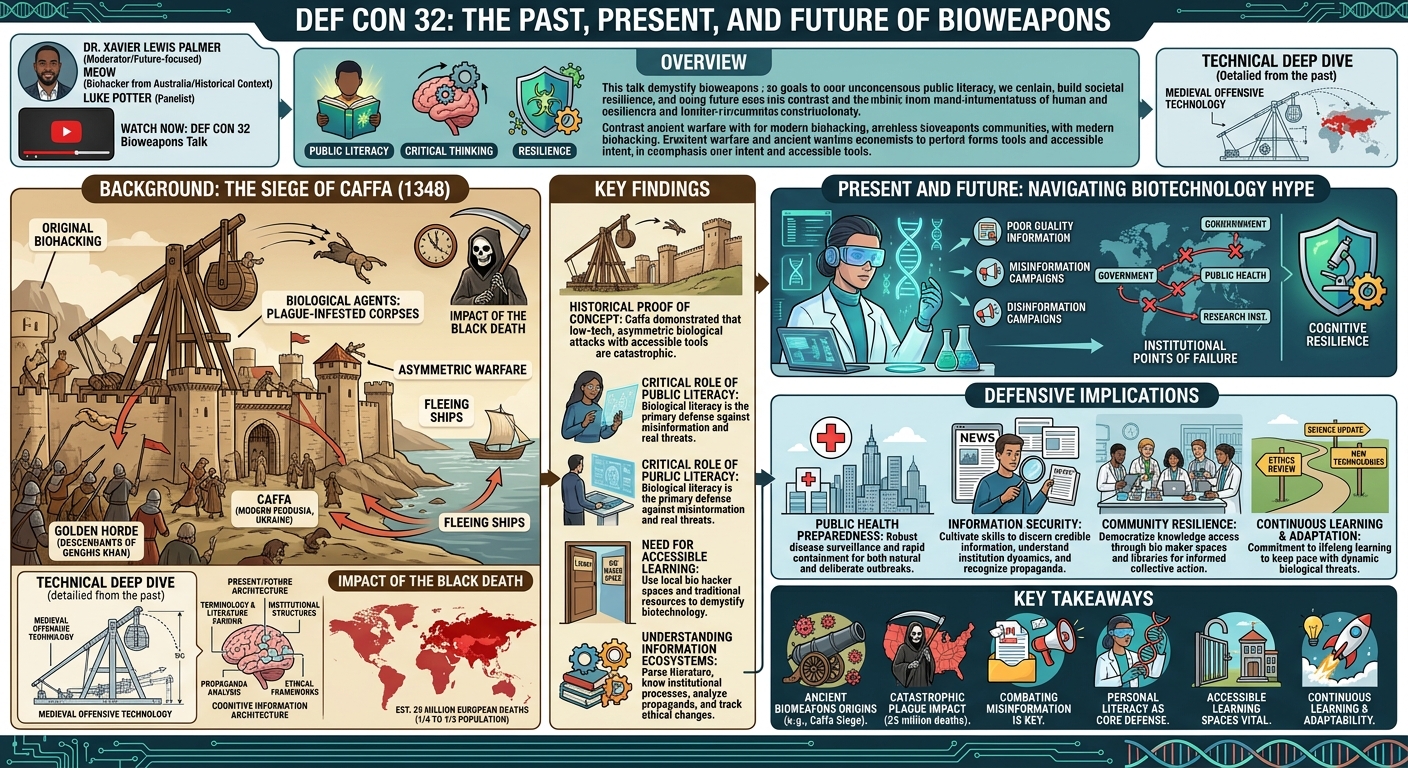
The historical context for bioweapons, as vividly recounted by Meow, traces back to ancient conflicts, with a particular focus on the infamous Siege of Caffa in 1348. This pivotal event, involving the Golden Horde—descendants of Genghis Khan—and the fortified city of Caffa (modern-day Feodosia, Ukraine), serves as a chilling precedent for biological warfare. During their protracted siege, the Golden Horde, facing a devastating outbreak of what was likely the Black Plague within their own ranks, resorted to an unprecedented tactic. They utilized trebuchets, medieval siege engines designed for launching heavy projectiles, to hurl plague-infested corpses over Caffa's formidable walls.
This act, described by Meow as an early form of "offensive biohacking," marked a significant escalation in the use of biological agents. While prior instances of biological warfare existed—such as poisoning wells with diseased animals or sending infected individuals into enemy towns—the Siege of Caffa represented the first documented instance where technology was employed specifically to project a biological weapon over fortifications. The consequences were catastrophic. As the putrid bodies exploded upon impact, the disease rapidly spread among Caffa's defenders and civilians. Those who fled the besieged city by boat, unknowingly carrying the infection, initiated the devastating spread of the Black Plague across Europe. This pandemic ultimately claimed the lives of an estimated 25 million Europeans, representing between a quarter and a third of the continent's population, making it one of the deadliest bioweapon attacks in human history. The event starkly illustrates the concept of asymmetric warfare, where a relatively simple, low-tech act can trigger an overwhelmingly disproportionate and far-reaching impact.
In the modern era, the landscape of biological threats has evolved dramatically with the rapid advancements in biotechnology. While the talk deliberately skirted a detailed "present" discussion to avoid sensationalism, it implicitly acknowledged the widespread "hype" and often "poor quality information" surrounding these advancements. This modern context of information overload and potential misuse of biological capabilities sets the stage for the panel's primary message: the imperative for individual and collective literacy, resilience, and ethical engagement to counter both emerging biological threats and the pervasive misinformation that can obscure them.
Key Findings
▶ Watch: Plague-infested corpses spread the Black Death (2:00)
The panel discussion brought forth several critical findings and perspectives that bridge historical lessons with contemporary challenges in the realm of bioweapons and biotechnology.
Firstly, the historical narrative of the Siege of Caffa in 1348 stands as a foundational "key finding" regarding the nature of biological warfare. Meow's compelling account positions the Golden Horde as the "original biohackers," demonstrating that the offensive use of biological agents, combined with available technology like the trebuchet, can lead to profoundly devastating and asymmetric outcomes. The subsequent spread of the Black Plague across Europe, resulting in 25 million deaths, serves as a stark historical proof of concept for the catastrophic potential of biological attacks, even those executed with rudimentary means. This finding emphasizes that the threat of biological warfare is not solely a modern construct, but a persistent historical reality, adaptable to the technological capabilities of any era.
Secondly, a central finding for the "present and future" aspect of bioweapons is the critical role of public literacy in biology and biotechnology. Dr. Palmer articulated that in an age inundated with "poor quality information," "misinformation campaigns," and "disinformation campaigns," individual theoretical and practical literacy becomes the primary defense. This means moving beyond passive consumption of information and actively engaging with biological concepts, terminology, and scientific literature. The speakers implicitly found that a lack of such literacy leaves individuals and societies vulnerable to both genuine threats and manipulative narratives.
Thirdly, the talk highlighted the necessity of fostering resilience and creating accessible spaces for learning and engagement. The encouragement to utilize local bio maker and hacker spaces, alongside traditional resources like libraries and interlibrary loan systems, represents a finding about the infrastructure required for societal preparedness. These spaces are identified as crucial for demystifying biotechnology, enabling hands-on learning, and building a community capable of informed discourse. This contrasts with a passive, "exporting your thinking" approach, advocating instead for internalized knowledge and critical discernment.
Finally, the panel implicitly found that understanding the broader ecosystem surrounding scientific information is vital. This includes parsing scientific literature, comprehending institutional structures, institutional responsibilities, institutional processes, and identifying institutional points of failure. Furthermore, a nuanced understanding of propaganda is essential to recognize its presence in all media. These elements collectively form a framework for robust intellectual defense against narratives that could either downplay or exaggerate biological threats, ultimately contributing to a more informed and adaptable society.
Technical Deep Dive
▶ Watch: Black Plague's devastation and 'original biohackers' (2:30)
While "The Past, Present, and Future of Bioweapons" did not delve into modern exploit code or network protocols in the traditional DEF CON sense, it offered a profound "technical deep dive" into the historical and conceptual underpinnings of biological warfare and the critical information infrastructure needed to address it. The talk effectively reframed what constitutes "technology" and "technical," expanding it beyond digital systems to encompass physical tools, biological agents, and the architecture of knowledge itself.
The primary "technical" component detailed from the past was the trebuchet. This medieval siege engine, a sophisticated piece of engineering for its time, operated on the principle of a counterweight system to launch heavy projectiles over significant distances. In 1348, during the Siege of Caffa, the Golden Horde's innovative (and horrific) application of this technology transformed it into a weapon of mass biological destruction. The "payload" for this offensive technology was not mere rock, but biological agents—specifically, the corpses of individuals infected with Yersinia pestis, the bacterium responsible for the Black Plague. This bacterium, transmitted primarily by fleas carried on rodents and, in its pneumonic form, directly between humans, causes bubonic, septicaemic, and pneumonic plague. The putrefaction of the corpses and the subsequent exposure of Caffa's population to the pathogen initiated an epidemic that rapidly overwhelmed the city's defenses and eventually spread across a continent. This historical example serves as a stark illustration of how a relatively simple mechanical device, combined with a potent biological agent, can achieve devastating effects, highlighting the core technical principles of delivery and impact in biological warfare.
Transitioning to the "present and future," the technical deep dive shifts from physical mechanisms to the information architecture surrounding biotechnology. Dr. Palmer emphasized that the modern "technical" challenge lies in navigating a landscape rife with "poor quality information" and sophisticated "misinformation and disinformation campaigns." The proposed technical solution is a robust framework of information literacy and cognitive resilience. This includes:
- Terminology and Literature Parsing: The ability to understand and correctly interpret specialized biological and biotechnological terminology is foundational. Furthermore, individuals must develop the skill to "parse and write literature," meaning they can critically read scientific papers, identify valid research, and articulate their own understanding, distinguishing credible sources from sensationalist or misleading content.
- Institutional Structures and Processes: A "technical" understanding extends to the recognition of the institutional structures that govern scientific research, public health, and biodefense. This involves comprehending institutional responsibilities, the established institutional processes for scientific validation and policy-making, and critically identifying institutional points of failure where misinformation can proliferate or threats can be mishandled. This systemic awareness is crucial for effective engagement and oversight.
- Propaganda Analysis: Understanding the "nature of propaganda" is presented as a vital technical skill. This involves being able to "see hints of it in all media that you consume," recognizing the persuasive techniques, biases, and ulterior motives behind narratives, especially those concerning sensitive topics like bioweapons. This analytical capability acts as a crucial filter against manipulation.
- Ethical Frameworks: Finally, the "technical" understanding encompasses systems of ethics and their evolution. As biotechnology advances, new ethical dilemmas emerge. The ability to learn about these frameworks and understand "how they change" is essential for responsible innovation and for guiding societal responses to potential threats.
In essence, the talk's technical deep dive, particularly concerning the present and future, is an architectural blueprint for an informed and resilient human mind—equipping individuals with the tools to process complex biological information, analyze its sources, and discern truth from fabrication in an era where biological knowledge is both empowering and potentially perilous.
Demo / Proof of Concept
▶ Watch: Addressing bioweapon hype and biotechnology misinformation (8:00)
In the context of a typical DEF CON talk, a "Demo / Proof of Concept" section often entails a live demonstration of an exploit, a new tool, or a novel attack vector. This particular panel discussion, however, did not feature a traditional technical demonstration of a bioweapon or a cybersecurity exploit. The nature of the subject matter, focusing on historical context and societal resilience, precluded such a presentation.
Instead, the "proof of concept" presented by the panel was primarily historical and conceptual. Meow's vivid recounting of the Siege of Caffa in 1348 served as a powerful historical proof of concept for the devastating effectiveness of biological warfare, even with rudimentary technology like the trebuchet. The subsequent spread of the Black Plague and the resulting 25 million deaths unequivocally demonstrated the catastrophic potential of biological agents. This narrative functioned as a "demo" of impact, illustrating how a single, ancient act of "biohacking" could reshape continents and history.
For the modern and future aspects, the "proof of concept" shifted to a conceptual framework. The call to action for widespread biological literacy, engagement with bio maker and hacker spaces, and critical analysis of information and institutions implicitly serves as a proof of concept for building societal resilience. It posits that an informed, critically thinking populace is the most effective defense against both the physical threat of bioweapons and the pervasive threat of misinformation surrounding them. While not a live technical demo, the entire talk functioned as an educational demonstration of the critical need for proactive, informed engagement with biotechnology.
Defensive Implications
▶ Watch: Building resilience through bio maker spaces and libraries (8:20)
The defensive implications stemming from "The Past, Present, and Future of Bioweapons" are multi-faceted, ranging from fundamental biodefense strategies to critical information security and cognitive resilience measures. The talk underscores that defense against biological threats is not solely a scientific or military endeavor but a societal one.
Firstly, the historical account of the Siege of Caffa provides a chilling reminder of the enduring threat of low-tech, high-impact biological attacks. Defenders must recognize that advanced genetic engineering is not the only vector for biological harm. Simple, accessible methods, when combined with potent pathogens like Yersinia pestis, can still achieve catastrophic results. This implies a need for robust public health infrastructure, rapid disease surveillance, and effective containment strategies that are not solely focused on novel threats but also prepared for the re-emergence or deliberate deployment of historical pathogens. Preparedness should encompass a broad spectrum of potential biological agents, considering both their natural occurrence and their deliberate misuse.
Secondly, and perhaps most critically for the modern era, the talk highlights the profound defensive implication of information literacy. In a world saturated with "poor quality information," "misinformation campaigns," and "disinformation campaigns" concerning biology and biotechnology, the primary defense becomes cognitive resilience. Defenders, whether individuals or institutions, must actively cultivate the ability to:
- Discern Credible Information: Develop skills in "parsing and writing literature" to critically evaluate scientific claims and sources, distinguishing evidence-based facts from speculative or propagandistic content.
- Understand Institutional Dynamics: Grasp the "institutional structures, responsibilities, processes, and points of failure" within scientific, governmental, and public health organizations. This understanding is crucial for identifying vulnerabilities in information flow, decision-making, and response mechanisms.
- Recognize Propaganda: Develop a keen awareness of the "nature of propaganda" to identify manipulative narratives in all media. This is vital to prevent panic, ensure rational decision-making, and counter efforts to exploit fear or misunderstanding for malicious purposes related to bioweapons.
Thirdly, the emphasis on creating and utilizing accessible spaces like "bio maker and hacker spaces" carries significant defensive weight. These environments, alongside traditional educational resources such as libraries and interlibrary loan systems, can serve as crucial counter-measures against ignorance and fear. By democratizing access to biological knowledge and practical experience, these spaces empower individuals to:
- Demystify Biotechnology: Reduce the "hype" around biotechnology by fostering a deeper, more grounded understanding of its capabilities and limitations.
- Promote Responsible Innovation: Encourage ethical engagement with biological tools and techniques, potentially fostering a community of responsible researchers and innovators who can contribute to biodefense rather than inadvertently creating new vulnerabilities.
- Build Community Resilience: Create networks of informed citizens capable of collectively challenging misinformation and supporting effective public health responses.
Finally, the call to "don't stop learning" and to adapt to changes in science and ethics is a continuous defensive posture. The biological threat landscape is dynamic; new discoveries, technologies, and ethical dilemmas will constantly emerge. A static understanding of the world or an inability to adapt to new information will leave individuals and societies vulnerable. Therefore, a commitment to lifelong learning and the continuous evolution of ethical frameworks in pace with technological advancements are paramount defensive strategies against the evolving threat of bioweapons.
Key Takeaways
- Ancient Roots of Biological Warfare: The 1348 Siege of Caffa, where the Golden Horde used trebuchets to launch plague-infested corpses, serves as a historical "proof of concept" for early biological warfare and asymmetric warfare, demonstrating how simple technology can achieve devastating impact.
- Catastrophic Potential of Biological Agents: The subsequent spread of the Black Plague across Europe, resulting in 25 million deaths (1/4 to 1/3 of the population), underscores the immense and long-lasting devastation that biological agents can inflict.
- Combating Misinformation is Paramount: In the modern era, combating "poor quality information," "misinformation campaigns," and "disinformation campaigns" related to biology and biotechnology is a critical defensive challenge, as these narratives can obscure real threats and incite irrational responses.
- Personal Literacy as a Core Defense: Developing theoretical and practical literacy in biology and biotechnology—including learning terminology, parsing scientific literature, and understanding institutional structures—is a universal responsibility to navigate hype and make informed decisions.
- Accessible Learning Spaces are Crucial: Supporting and utilizing accessible learning environments, such as local bio maker and hacker spaces, alongside traditional resources like libraries, is vital for demystifying biotechnology and building a resilient, informed public.
- Continuous Learning and Adaptability: Maintaining a commitment to "don't stop learning" and adapting to new scientific discoveries and evolving ethical systems is essential for individuals and society to effectively understand and mitigate emerging bioweapons threats.
About the Speaker(s)
The panel for "The Past, Present, and Future of Bioweapons" comprised Dr. Xavier Lewis Palmer, Meow, and Luke Potter. Dr. Xavier Lewis Palmer, introduced as "Dr.," led the discussion and focused on the contemporary and future implications of bioweapons, particularly emphasizing the need for public literacy and critical thinking. Meow, a self-identified biohacker from Australia, provided a captivating historical account of biological warfare, notably the Siege of Caffa. Luke Potter was also part of the panel, though no specific title, company, or detailed role was provided in the transcript.