Signature-Based Detection Using Network Timing
Josh Pyorre
DEF CON 32 Creator Stage · Day 1 · Creator Stage
Overview
This article delves into Josh Pyorre's talk at DEF CON 32, titled "Signature-Based Detection Using Network Timing." The presentation, as indicated by its title, aims to explore novel methods for identifying malicious activity by analyzing network timing characteristics, a sophisticated approach to enhancing traditional signature-based detection. Josh Pyorre, a seasoned security researcher with experience at prominent organizations such as Cisco Talos, Zscaler, Umbrella, OpenDNS, NASA, and Mandiant, brings a wealth of expertise to this complex subject.
Key moments
- 0:00 Speaker Introduction and Talk Focus
- 0:30 Threat Hunting: Following Attribution Trails (URL to Hash)
- 2:00 Using Malware Sandboxes (any.run) for Investigation
- 3:00 Introduction to MITRE ATT&CK Framework
- 3:40 Exploring Different Levels of Attribution
- 4:20 Understanding the Malware Infection Chain
Signature-Based Detection Using Network Timing
Speakers: Josh Pyorre
Conference: DEF CON 32
YouTube: https://www.youtube.com/watch?v=6lJ26UG9hLU
Overview
This article delves into Josh Pyorre's talk at DEF CON 32, titled "Signature-Based Detection Using Network Timing." The presentation, as indicated by its title, aims to explore novel methods for identifying malicious activity by analyzing network timing characteristics, a sophisticated approach to enhancing traditional signature-based detection. Josh Pyorre, a seasoned security researcher with experience at prominent organizations such as Cisco Talos, Zscaler, Umbrella, OpenDNS, NASA, and Mandiant, brings a wealth of expertise to this complex subject.
The core premise of the talk is to move beyond conventional static or behavioral signatures by incorporating the temporal aspects of network communications. This method promises to offer a more resilient and potentially proactive defense against evolving threats, providing an additional layer of detection that is harder for adversaries to evade. While the provided transcript primarily focuses on foundational concepts of threat hunting, malware attribution, and infection chains, it sets a crucial stage for understanding the broader context in which advanced detection techniques, like those based on network timing, become essential. The speaker's extensive background underscores the practical relevance and potential impact of such research on the cybersecurity landscape.
Background
▶ Watch: Speaker Introduction and Talk Focus (0:00)
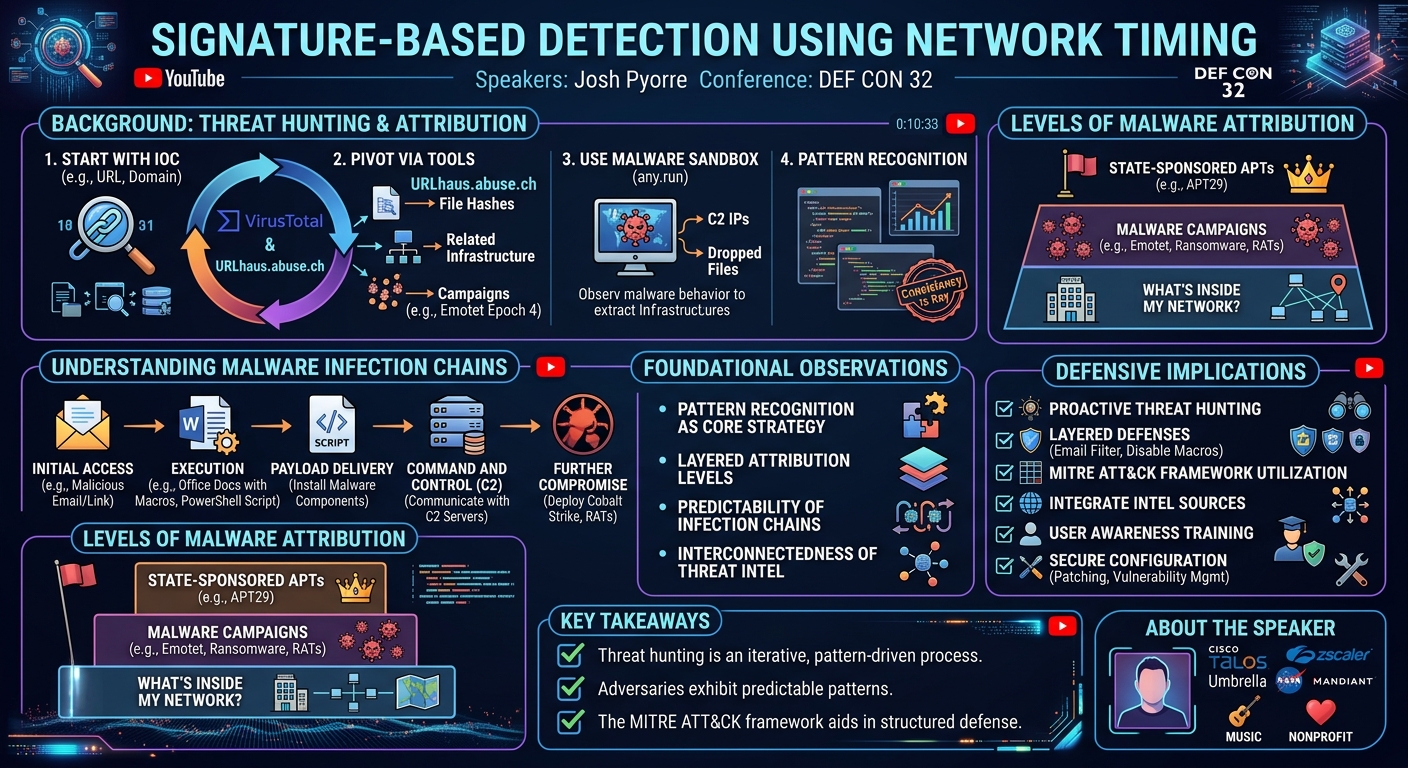
The initial segments of Josh Pyorre's presentation lay a comprehensive groundwork in the principles of threat hunting and malware attribution, emphasizing the iterative and pattern-driven nature of identifying malicious activities. Pyorre highlights that threat hunting often begins with a single indicator, such as a malicious domain or URL. He illustrates this process using real-world examples, like identifying an Emotet sample associated with a URL found on platforms like URLhaus.abuse.ch. From this initial point, a threat hunter can leverage tools such as VirusTotal to pivot from a URL to associated file hashes, and then further to other related hashes, infrastructure, or campaigns. This methodical approach allows for the discovery of additional compromised URLs, often leading to widespread infections on platforms like WordPress.
Pyorre also introduces the utility of dynamic analysis environments, citing any.run as an example of a malware sandbox where analysts can observe malware behavior, extract indicators like IP addresses, and then cross-reference these with other intelligence sources to build a richer picture of an adversary's operations. The speaker stresses that despite the apparent complexity, threat actors often exhibit consistent patterns in their operations, from the reuse of specific variable names in binaries to consistent host infrastructure, making attribution possible. This behavioral consistency is a cornerstone for developing effective detection mechanisms.
Malware attribution is discussed across several levels, reflecting different organizational needs and capabilities. At the highest level, government entities are often focused on identifying specific threat actors or Advanced Persistent Threat (APT) groups, such as APT29, to understand state-sponsored activities. This involves mapping specific tools, tactics, and procedures (TTPs) to known adversary groups, often facilitated by frameworks like MITRE ATT&CK. While powerful, Pyorre notes that automating attribution at this granular level can be challenging. For many organizations, attribution focuses on identifying specific malware campaigns—determining whether an observed threat is, for instance, Emotet, a Remote Access Trojan (RAT), or ransomware. In simpler environments, the primary concern is merely identifying "what's inside my network," representing the most basic level of attribution.
The infection chain is presented as another fundamental concept that, much like threat actor behavior, tends to follow predictable patterns. Pyorre uses Emotet as a classic example, describing a typical infection flow:
- Initial Access: Often via a malicious email containing a link or attachment.
- Execution: Leading to the download and execution of an Office document with macros, or a PowerShell script.
- Payload Delivery: Installation of additional malicious components.
- Command and Control (C2): Establishment of communication with C2 servers, potentially leading to further compromise, such as the deployment of Cobalt Strike or other RATs.
This consistent pattern across various malware families, whether through email droppers, malicious links, or drive-by downloads, reinforces the idea that understanding and tracking these predictable behaviors is critical for developing robust defenses. The repeated emphasis on patterns—in adversary behavior, binary analysis, and infection chains—underscores the underlying principle that even sophisticated attackers leave digital breadcrumbs that, with the right tools and methodologies, can be detected and attributed.
Key Findings
▶ Watch: Using Malware Sandboxes (any.run) for Investigation (2:00)
The provided transcript primarily establishes a foundational understanding of threat hunting, attribution, and malware infection chains, serving as a preamble to the talk's stated topic of "Signature-Based Detection Using Network Timing." As such, the transcript does not explicitly detail key findings or discoveries related to network timing or novel signature-based detection methods. Instead, the "findings" within the scope of the provided content are more accurately described as foundational observations and established methodologies in the realm of cybersecurity analysis:
- Pattern Recognition as a Core Attribution Strategy: A central theme is that threat actors, despite their efforts to evade detection, exhibit consistent patterns in their methodologies, infrastructure, and even code. This consistency, whether in specific variable names during binary analysis or the reuse of host infrastructure, forms the basis for effective attribution and tracking.
- Layered Attribution Levels: Attribution is not monolithic but operates on different scales, from identifying specific state-sponsored APTs (e.g., APT29) and individual threat actors, to mapping out broader malware campaigns (e.g., Emotet, ransomware), and simply understanding what threats reside within a local network. Each level serves distinct organizational security objectives.
- Predictability of Malware Infection Chains: The general progression of malware infections, exemplified by Emotet, tends to follow a repeatable sequence (e.g., email -> malicious document/link -> payload download -> C2). This predictability allows defenders to anticipate and interdict attacks at various stages, even if the specific malware variant changes.
- Interconnectedness of Threat Intelligence Data: Effective threat hunting involves pivoting across various data sources and tools, such as URLhaus.abuse.ch for initial indicators, VirusTotal for hash and infrastructure correlation, and any.run for behavioral analysis. This interconnectedness enables analysts to build comprehensive threat intelligence profiles from disparate pieces of information.
These observations, while crucial for context, are not the novel findings one might expect from a talk specifically titled "Signature-Based Detection Using Network Timing." The core discoveries related to network timing characteristics and their application in signature generation are not present in the provided transcript.
Technical Deep Dive
▶ Watch: Introduction to MITRE ATT&CK Framework (3:00)
While the provided transcript extensively covers the foundational methodologies of threat hunting and malware analysis, it does not delve into the specific technical details of "Signature-Based Detection Using Network Timing." The technical content presented focuses on the tools and processes used for initial threat intelligence gathering and attribution, rather than the core subject of the talk's title.
The technical processes outlined include:
- Indicator of Compromise (IOC) Pivoting: The speaker demonstrates how a threat hunter might start with a single IOC, such as a malicious URL (e.g., from URLhaus.abuse.ch). This URL is then used to find associated file hashes on platforms like VirusTotal. From these hashes, an analyst can then pivot to find other related files, domains, IP addresses, and potentially entire host infrastructures linked to a specific malware campaign, such as Emotet Epoch 4. This process involves querying large datasets of threat intelligence and leveraging the relationships between various indicators.
- Malware Sandbox Analysis: Tools like any.run are highlighted for their role in providing a dynamic analysis environment. In a sandbox, malware can be executed safely, and its behaviors observed. This includes network connections (to C2 IPs), file system modifications, process injections, and other runtime characteristics. The output from such sandboxes provides critical data points (e.g., C2 IP addresses, dropped file hashes) that can then be fed back into the IOC pivoting process.
- Behavioral and Binary Analysis: Pyorre touches upon the concept of binary analysis and the observation that threat actors often leave identifiable patterns, such as consistent variable names or code structures, across different malware variants. While not explicitly detailing how to perform such analysis, it underscores the technical principle that even obfuscated or polymorphic malware often retains underlying structural or behavioral commonalities that can be fingerprinted.
- MITRE ATT&CK Framework: The MITRE ATT&CK framework is presented as a structured taxonomy for attributing various tools, tactics, and procedures (TTPs) to specific threat groups (e.g., APT29). Technically, this involves mapping observed adversary actions during an incident to specific techniques and sub-techniques within the framework. While Pyorre notes it's challenging to automate this at a high level, it serves as a standardized language for technical communication and strategic defense planning. For example, the use of Office documents with macros for initial access or PowerShell for execution are specific techniques within ATT&CK that can be tracked.
- Malware Infection Chain Components: The typical Emotet infection chain involves several technical components:
- Email Droppers/Phishing Links: Social engineering vectors.
- Malicious Office Documents: Often contain VBA macros that execute scripts.
- PowerShell Scripts: Used for downloading subsequent stages or executing commands.
- Additional Components: Further malware modules installed.
- C2 Communication: Network protocols (e.g., HTTP, HTTPS, custom protocols) used to communicate with command-and-control servers, potentially leading to the deployment of tools like Cobalt Strike or other Remote Access Trojans (RATs).
The technical deep dive into network timing characteristics and how they are leveraged for signature generation—the core promise of the talk's title—is not present in the provided transcript. This would typically involve discussions on network latency, jitter, packet inter-arrival times, specific protocol timing anomalies, and how these could be used to create unique, non-content-based signatures for malicious traffic. Such discussions are absent.
Demo / Proof of Concept
▶ Watch: Exploring Different Levels of Attribution (3:40)
The provided transcript focuses exclusively on the foundational concepts of threat hunting, attribution, and malware infection chains, serving as an introductory segment to the broader topic. Consequently, there is no mention or description of any demonstration or proof of concept related to "Signature-Based Detection Using Network Timing." The speaker did not describe any live or pre-recorded demo of how network timing data could be collected, analyzed, or used to generate signatures for detection within the scope of the provided content.
Defensive Implications
▶ Watch: Understanding the Malware Infection Chain (4:20)
Given that the provided transcript primarily covers the background of threat hunting, attribution, and malware infection chains rather than the specific topic of "Signature-Based Detection Using Network Timing," the defensive implications derived directly from the transcript are foundational rather than advanced. However, these foundational elements are critical for any robust cybersecurity posture:
- Proactive Threat Hunting: Organizations should implement proactive threat hunting methodologies. This involves actively searching for indicators of compromise within their networks, rather than solely relying on automated alerts. Leveraging threat intelligence platforms and sandboxes like URLhaus.abuse.ch, VirusTotal, and any.run is crucial for this.
- Understanding Malware Infection Chains: Defenders must have a thorough understanding of common malware infection chains, such as those used by Emotet. Knowing the typical stages—from initial access (email, malicious links) to execution (macros, PowerShell) and C2 communication—enables the deployment of layered defenses at each stage. For instance, robust email filtering, disabling macros by default, and network egress filtering for C2 traffic are essential.
- Leveraging Attribution Frameworks: Utilizing frameworks like MITRE ATT&CK helps organizations to standardize their understanding of adversary TTPs. This allows for more structured defensive planning, enabling security teams to assess their coverage against known adversary techniques and prioritize defensive investments. It also facilitates better communication during incident response.
- Continuous Monitoring and Intelligence Integration: The ability to pivot between different types of Indicators of Compromise (IOCs) (URLs, IP addresses, file hashes) and integrate data from various threat intelligence sources is paramount. This requires continuous network monitoring, endpoint detection and response (EDR) solutions, and the ability to rapidly query and correlate security event data.
- User Awareness Training: Since many infection chains start with user interaction (e.g., clicking a malicious link or enabling macros in an Office document), comprehensive and regular user awareness training on phishing, social engineering, and safe computing practices remains a fundamental defensive measure.
- Secure Configuration Management: Given that malware often exploits common vulnerabilities or misconfigurations (e.g., unpatched WordPress sites used as droppers), maintaining secure system configurations, regular patching, and vulnerability management are critical to reduce the attack surface.
While the specific defensive implications of using "network timing" for signature generation are not detailed in the provided content, the background information strongly advocates for a multi-faceted defense strategy rooted in understanding adversary behavior, leveraging threat intelligence, and implementing robust security hygiene. The potential future integration of network timing analysis would add a sophisticated layer to these existing defensive strategies, allowing for the detection of subtle, behavioral anomalies that content-based signatures might miss.
Key Takeaways
- Threat hunting is an iterative, pattern-driven process: It starts with a single indicator (e.g., a URL) and expands by pivoting through various threat intelligence sources (e.g., VirusTotal, any.run) to uncover broader campaigns and infrastructure.
- Adversaries exhibit predictable patterns: Despite efforts to evade detection, threat actors often reuse code structures, variable names, and host infrastructure, making their activities attributable over time.
- Attribution has multiple levels: From identifying state-sponsored APTs (like APT29) and specific campaigns (e.g., Emotet, ransomware) to simply understanding what's inside one's network, the level of attribution depends on organizational objectives.
- Malware infection chains are largely consistent: The typical progression from initial access (email, malicious documents with macros or PowerShell) to payload delivery and C2 communication provides predictable points for defensive intervention.
- The MITRE ATT&CK framework aids in structured defense: It provides a common language and taxonomy for mapping adversary TTPs, helping organizations assess their defensive posture and prioritize security controls.
- Proactive defense requires integrated intelligence: Combining insights from dynamic analysis (sandboxes), static analysis, and global threat intelligence is essential for building a comprehensive understanding of evolving threats.
About the Speaker(s)
Josh Pyorre is a distinguished security researcher with a rich and diverse background spanning several leading organizations in the cybersecurity and technology sectors. He currently works with Cisco Talos, one of the largest commercial threat intelligence teams in the world. Prior to his role at Talos, Pyorre contributed his expertise to Zscaler, Umbrella (formerly OpenDNS), and the renowned government agency NASA. He also has experience with Mandiant, a prominent cybersecurity firm specializing in incident response and threat intelligence. Beyond his professional work in security research, Josh Pyorre is also involved in making music and other nonprofit activities, showcasing a broad range of interests and talents. His extensive experience across government, enterprise security, and research positions him as an authority on complex cybersecurity challenges.