RFID 101
Ege Feyzioglu, Andrew M
DEF CON 32 Creator Stage · Day 1 · Creator Stage
Overview
In the contemporary landscape of physical security, Radio-Frequency Identification (RFID) systems are ubiquitous, silently facilitating access to buildings, streamlining public transit, and enabling contactless payments. Despite their widespread integration, the underlying mechanisms and inherent security vulnerabilities of RFID often remain opaque to the average user, fostering a misplaced sense of security. This talk, "RFID 101," delivered by Ege Feyzioglu and Andrew M. from the Physical Security Village at DEF CON 32, aims to demystify RFID technology, providing a foundational understanding of its operation, common pitfalls, and practical methods for interaction and exploitation.
Key moments
- 0:00 Introduction and talk overview
- 2:00 Basic physics of how RFID works
- 3:28 Trivial sniffing of unencrypted RFID
- 4:10 How encryption secures RFID communication
- 5:48 Live Flipper Zero RFID cloning demonstration
- 6:20 Understanding simple 4-byte RFID IDs
- 7:10 Brute-forcing low-frequency RFID keys
RFID 101
Speakers: Ege Feyzioglu, Andrew M
Conference: DEF CON 32
YouTube: https://www.youtube.com/watch?v=0Zn5nj0NZVo
Overview
In the contemporary landscape of physical security, Radio-Frequency Identification (RFID) systems are ubiquitous, silently facilitating access to buildings, streamlining public transit, and enabling contactless payments. Despite their widespread integration, the underlying mechanisms and inherent security vulnerabilities of RFID often remain opaque to the average user, fostering a misplaced sense of security. This talk, "RFID 101," delivered by Ege Feyzioglu and Andrew M. from the Physical Security Village at DEF CON 32, aims to demystify RFID technology, providing a foundational understanding of its operation, common pitfalls, and practical methods for interaction and exploitation.
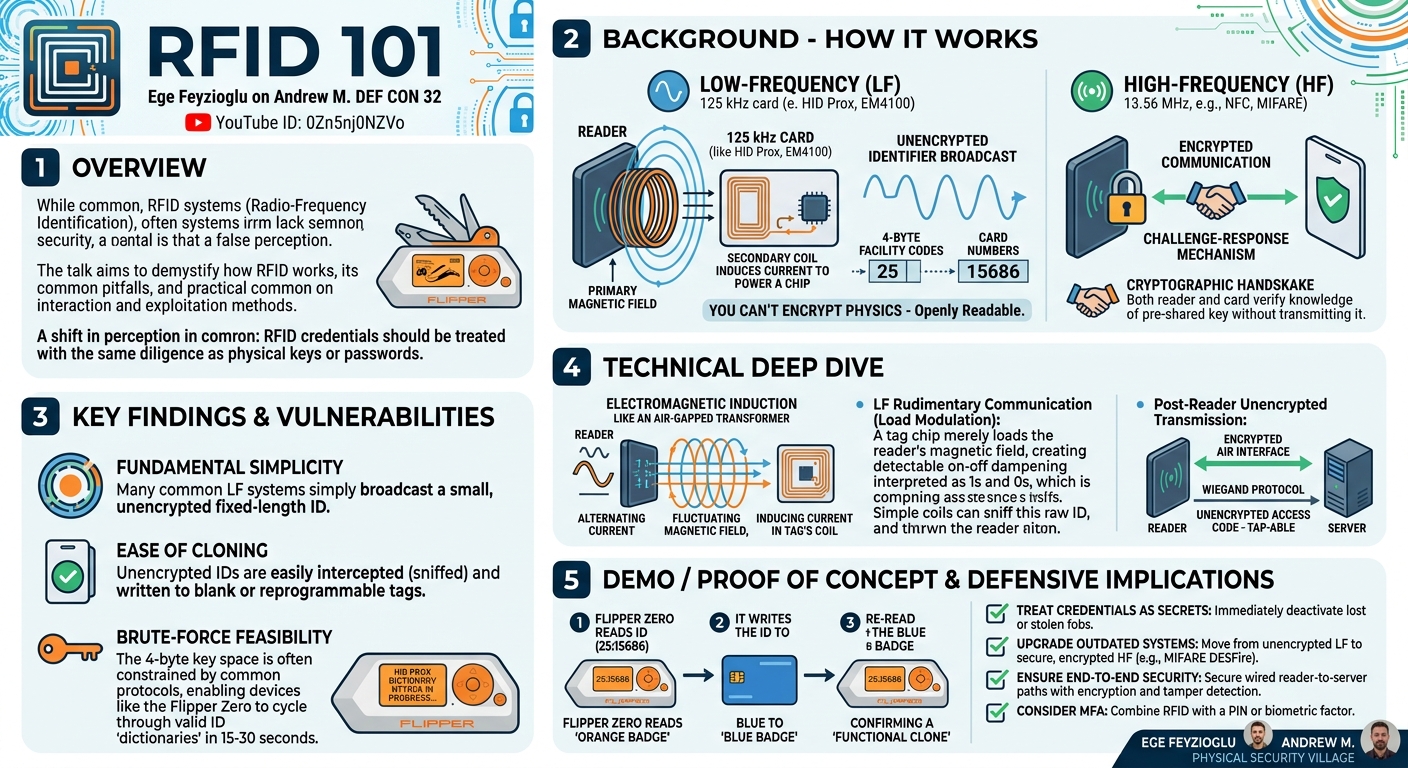
The speakers guide the audience through the fundamental principles of how RFID tags communicate with readers, distinguishing between the security postures of low-frequency (LF) and high-frequency (HF) systems. A significant portion of the presentation is dedicated to exposing the ease with which many common LF RFID systems can be compromised through sniffing, cloning, and even brute-forcing. The talk culminates in a practical demonstration using the popular Flipper Zero multi-tool, illustrating these vulnerabilities firsthand and offering crucial recommendations for bolstering RFID security.
Ultimately, "RFID 101" serves as a critical reminder that RFID is not a "silver bullet" for security. It encourages a shift in perception, urging individuals and organizations to treat RFID credentials with the same diligence and care as traditional physical keys or sensitive digital passwords. By shedding light on these often-overlooked vulnerabilities, the speakers empower defenders to make more informed decisions regarding the implementation and management of RFID-based access control systems.
Background
▶ Watch: Introduction and talk overview (0:00)
The pervasive nature of RFID technology in modern society has led to its integration into countless aspects of daily life, from corporate access badges and residential key fobs to public transportation cards and tap-to-pay credit cards. This convenience, however, often comes at the cost of security, largely due to a lack of public understanding regarding how these systems actually function. The talk highlights that many users perceive RFID as inherently secure, a "magical" solution that transcends the vulnerabilities of traditional keys. This misconception forms the core problem addressed by the speakers.
At its most fundamental level, RFID operates on principles akin to a simple transformer. An RFID reader contains a coil of wire through which an electrical current is constantly passed, generating a magnetic field. When an RFID card or fob, which also contains a small coil and a microchip, enters this magnetic field, the field induces a current in the card's coil. This induced current provides the necessary power to activate the chip embedded within the card. Once powered, the chip can then communicate with the reader by subtly altering the magnetic field.
For basic, low-frequency (LF) RFID systems, this communication mechanism is remarkably straightforward and inherently insecure. The chip transmits data by either drawing more or less current from the induced field, effectively modulating the magnetic field itself. A higher current draw might represent a binary '1', while a lower draw represents a '0'. As Ege Feyzioglu succinctly puts it, "You can't encrypt physics." This direct modulation of the magnetic field means that the communication is essentially an open broadcast, easily detectable and interpretable by anyone with a simple loop of wire and an oscilloscope. The speakers demonstrated how a basic breadboard jumper wire, looped several times, can be used to sniff this communication, revealing the unencrypted ID being transmitted. This fundamental lack of encryption in many legacy LF systems is the root cause of their widespread vulnerability, allowing for trivial eavesdropping and replication.
In contrast, high-frequency (HF) RFID systems, typically operating at 13.56 MHz, often incorporate more sophisticated security measures, including encryption. These systems utilize a challenge-response mechanism where the reader and the card engage in a cryptographic handshake based on a pre-shared key established by the manufacturer. Only after both parties have proven knowledge of this key, without ever explicitly transmitting the key itself, can encrypted communication commence. This more complex method requires greater bandwidth and processing power, which is why it is predominantly found in HF applications. However, the prevalence of older, unencrypted LF systems like HID Prox and EM4100, particularly in access control for buildings, means that a significant portion of the installed base remains highly susceptible to the basic attacks outlined in the talk.
Key Findings
▶ Watch: Trivial sniffing of unencrypted RFID (3:28)
The talk "RFID 101" presented several critical findings that underscore the pervasive security weaknesses in many widely deployed RFID systems, particularly those operating at low frequencies. These findings serve to debunk common misconceptions about RFID security and highlight actionable vulnerabilities.
Firstly, a core finding is the fundamental simplicity and lack of inherent security in many low-frequency (LF) RFID systems. Unlike the "magical" perception many users hold, these systems operate on basic principles of magnetic induction where a tag's primary function is to broadcast a simple identifier. This identifier is typically a small, fixed-length number, often just 4 bytes, comprising a facility code and a card number. The speakers explicitly demonstrated that this information is transmitted in the clear, making it trivially easy to intercept and understand. This straightforward data transmission is a direct consequence of the physical modulation method employed, where the tag merely loads the reader's magnetic field to encode binary data, making encryption practically impossible at this fundamental level.
Secondly, the talk unequivocally established the extreme ease of sniffing and cloning LF RFID credentials. Because the card's ID is broadcast unencrypted, any device capable of reading these magnetic field fluctuations can capture the full identifier. The speakers illustrated this by showing how even a makeshift loop of breadboard jumper wire can intercept the communication between an LF tag and a reader. This captured ID can then be written to a blank or reprogrammable RFID tag, effectively creating a perfect clone. The Flipper Zero, a popular multi-tool, was showcased as a readily available device that simplifies this process, allowing users to read an LF badge and then write its exact information to another badge within seconds. This demonstrates that the barrier to entry for performing such an attack is remarkably low.
Thirdly, the speakers highlighted the vulnerability of LF RFID systems to brute-force attacks due to their small key space. The 4-byte identifier, while potentially representing 2^32 unique values (approximately 4.3 billion), is often further constrained by common protocols like HID Prox and EM4100 to an even smaller "dictionary" or range of valid IDs. Even with the relatively slow query rates of LF readers (typically 1-2 times per second), this small key space makes brute-forcing feasible over a matter of hours. Andrew M. demonstrated how a Flipper Zero, running custom firmware or a specialized application, can cycle through an entire dictionary of common HID Prox IDs in as little as 15 to 30 seconds. This means an attacker could leave a device near a reader overnight and successfully discover a valid access code, gaining unauthorized entry.
Finally, a crucial overarching finding is the imperative to treat RFID credentials with the same level of security awareness as traditional physical keys or digital secrets. The talk emphasizes that "RFID is not a silver bullet" and that the perceived magical security is an illusion. Losing an RFID fob should trigger the same immediate security protocols as losing a house key or compromising a password. Furthermore, the speakers pointed out a critical, often overlooked vulnerability: even if the air interface between an RFID card and reader is encrypted (as in some HF systems), the communication from the reader to the central access control server often remains unencrypted over wired connections. This means an attacker could tamper with a reader, tap into its wiring, and intercept valid, unencrypted access credentials, which could then be replayed at will to bypass the system. This finding broadens the scope of RFID vulnerabilities beyond just the contactless interface to the entire system architecture.
Technical Deep Dive
▶ Watch: How encryption secures RFID communication (4:10)
The technical exposition of "RFID 101" provided a clear, accessible breakdown of how RFID systems function and where their vulnerabilities lie, particularly emphasizing the distinction between low-frequency (LF) and high-frequency (HF) implementations.
At its core, any RFID system relies on electromagnetic induction, essentially acting as a miniature, air-gapped transformer. The reader contains a primary coil that constantly emits an alternating magnetic field by passing an electrical current through it. When an RFID tag (embedded in a card, fob, or badge) is brought within range, its internal secondary coil is subjected to this fluctuating magnetic field. According to Faraday's Law of Induction, this induces an electrical current within the tag's coil. This induced current serves two critical purposes: it powers the tag's tiny microchip, and it facilitates communication back to the reader.
For low-frequency (LF) RFID systems, operating typically at 125 kHz (e.g., HID Prox, EM4100), the communication method is rudimentary. Once powered by the reader's field, the tag's microchip does not actively transmit a radio signal in the traditional sense. Instead, it modulates the reader's magnetic field by selectively loading or drawing more or less current from the induced power. When the chip draws more current, it slightly dampens the reader's magnetic field, and when it draws less, the field strength returns to its baseline. This on-off or high-low current draw creates a detectable change in the magnetic field that the reader can interpret as binary data (1s and 0s). This technique is known as load modulation or backscatter modulation. Crucially, because the tag is merely altering a physical property of the field rather than generating its own complex signal, there is no inherent mechanism for encryption. As the speakers highlighted, "you can't encrypt physics" – the physical changes in the magnetic field are inherently observable. This makes LF RFID communication trivial to sniff using simple, passive coils and readily available tools, allowing attackers to capture the raw, unencrypted ID.
In contrast, high-frequency (HF) RFID systems, most commonly operating at 13.56 MHz (e.g., NFC, MIFARE), employ a more sophisticated communication protocol. While still using inductive coupling for power and communication, HF tags are capable of more complex signal modulation and data exchange. This higher frequency and bandwidth enable the implementation of cryptographic protocols. For secure HF systems, communication begins with a challenge-response mechanism. The reader sends a cryptographic challenge to the tag, which then processes it using a pre-shared secret key (often provisioned during manufacturing) and generates a cryptographic response. The tag sends this response back to the reader, which verifies it using its own copy of the key. If the response is valid, both reader and tag have cryptographically proven their knowledge of the shared secret without ever transmitting the key itself. Only then do they establish a secure, encrypted communication channel for the actual data exchange. This level of complexity is why HF systems are generally considered more secure than LF systems, provided they are correctly implemented with strong cryptographic algorithms.
Despite the existence of encrypted HF systems, the talk focused heavily on the vulnerabilities of LF systems, which remain pervasive. The primary vulnerability stems from their practice of simply broadcasting a 4-byte identifier. This identifier typically consists of a facility code (e.g., 25) and a card number (e.g., 15686), which together uniquely identify the card within a given access control system. Since this 4-byte number is transmitted in the clear, it can be easily cloned. An attacker reads the ID from a legitimate card and then writes that exact 4-byte sequence to a blank, rewritable LF tag, effectively creating a duplicate that will grant the same access.
Furthermore, the small size of this 4-byte key space (2^32 possible values) makes these systems susceptible to brute-force attacks. While 4.3 billion combinations might seem large, the speakers noted that common LF protocols like HID Prox and EM4100 often use even smaller, more constrained "dictionaries" or ranges of numbers. Even at a slow query rate of 1-2 times per second (dictated by how frequently a reader queries for an ID), an attacker can systematically try a significant portion of the key space. As demonstrated, a Flipper Zero can cycle through known dictionaries for these protocols in as little as 15-30 seconds. For a full 4-byte space, leaving a device near a reader overnight (e.g., 8 hours at 1 query/second = 28,800 queries) would allow for a substantial number of attempts, making it a viable attack vector.
Beyond the air interface, the speakers highlighted a critical architectural vulnerability: post-reader unencrypted transmission. Even if an RFID system uses strong encryption between the card and the reader, the data transmitted from the reader to the central access control server often travels over unencrypted wired connections (e.g., Wiegand protocol). An attacker with physical access to a reader can tap into these wires, intercept the now-decrypted access code, and then replay it at will. This exposes a fundamental flaw in the end-to-end security chain, demonstrating that securing only the wireless segment is insufficient if the subsequent wired communication is vulnerable.
Demo / Proof of Concept
▶ Watch: Understanding simple 4-byte RFID IDs (6:20)
A central and highly impactful segment of the "RFID 101" talk was the live demonstration of RFID cloning and brute-forcing, primarily utilizing the Flipper Zero multi-tool. This practical proof-of-concept brought the theoretical vulnerabilities discussed earlier into stark reality, illustrating the ease with which common low-frequency (LF) RFID systems can be compromised.
The primary demonstration involved cloning an LF RFID badge. Andrew M. initiated the process by taking an "orange badge" and placing it against the Flipper Zero. The device quickly read and displayed the badge's unique identifier, which included a facility code (e.g., "25") and a card number (e.g., "15686"). This explicitly showed the audience the raw, unencrypted 4-byte data that constitutes the badge's "secret."
Following the successful read, Andrew then took a "blue badge," which already contained different stored information, and placed it against the Flipper Zero. He then used the device's functionality to write the previously captured ID from the orange badge onto the blue badge. To verify the success of the cloning operation, the blue badge was re-read by the Flipper Zero. The device confirmed that the blue badge now held the identical facility code and card number as the original orange badge, effectively transforming it into a functional clone. This straightforward process, executed in mere seconds, powerfully demonstrated how easily an attacker with physical proximity can duplicate access credentials.
Ege Feyzioglu further elaborated on the practical implications of this cloning capability by mentioning the test doors available at the Physical Security Village. Attendees were encouraged to use the disclosed facility code and card number (or to clone a badge themselves) to open one of the two test doors, providing a tangible, real-world example of the attack's effectiveness.
Beyond cloning, Andrew M. also showcased the Flipper Zero's capability for brute-forcing LF RFID systems. He demonstrated the device running a dictionary attack specifically targeting HID Prox devices. This involved the Flipper Zero systematically cycling through a list of common or probable HID Prox IDs. Andrew highlighted that for common protocols like HID Prox and EM4100, the entire dictionary could be traversed in approximately 15 to 30 seconds. This illustrates that even if an attacker doesn't have a valid card to clone, the limited key space of these systems, combined with the capabilities of tools like the Flipper Zero, makes unauthorized access a relatively trivial exercise, especially if the device can be left near a reader for an extended period (e.g., overnight).
The demonstrations served as a stark warning about the accessibility of these attacks. The Flipper Zero, a device widely available to hobbyists and security enthusiasts, makes advanced RFID manipulation capabilities readily available, underscoring the urgency for organizations to address these vulnerabilities. The "no encryption because you can't encrypt physics" explanation became palpably clear through these live, successful attacks.
Defensive Implications
▶ Watch: Brute-forcing low-frequency RFID keys (7:10)
The "RFID 101" talk delivered a critical message for anyone responsible for physical security: the perceived magic of RFID often masks significant vulnerabilities. Consequently, defenders must adopt a proactive and comprehensive strategy to mitigate these risks.
Firstly, the most fundamental defensive implication is to treat RFID cards and fobs with the same level of security and diligence as traditional physical keys or sensitive digital passwords. This means implementing robust policies for their issuance, management, and revocation. If an RFID credential is lost or stolen, it should trigger the same immediate response as a lost master key: immediate deactivation of that specific credential within the access control system. Similarly, when an employee is terminated, their RFID badge must be deactivated promptly to prevent unauthorized access. This shift in mindset from "magical convenience" to "tangible secret" is paramount.
Secondly, organizations relying on legacy low-frequency (LF) RFID systems, such as HID Prox or EM4100, are strongly advised to upgrade to more secure, encrypted solutions. These older systems, which transmit identifiers in the clear, are inherently vulnerable to cloning and brute-force attacks, as vividly demonstrated in the talk. Modern HF RFID systems (e.g., using MIFARE DESFire or similar technologies with strong cryptographic capabilities) offer significant improvements in security by implementing challenge-response authentication and robust encryption on the air interface. This upgrade should be a priority, especially for critical infrastructure or sensitive areas.
Thirdly, defenders must ensure end-to-end security, extending beyond the wireless communication between the card and the reader. The talk highlighted that even with encrypted air interfaces, the wired communication from the reader to the central access control server often transmits unencrypted data. This represents a critical architectural vulnerability. Organizations must ensure that the entire communication pathway, from the reader to the backend system, is secured through encryption and tamper detection. This may involve using secure network protocols for reader communication, encrypting the data stream, and physically securing the readers themselves against tampering or wiretapping. Regular audits of the access control system's architecture, including its wired components, are essential.
Fourthly, for systems where immediate upgrades are not feasible or for particularly sensitive access points, implementing multi-factor authentication (MFA) should be strongly considered. Combining an RFID badge with a PIN, a biometric scan (e.g., fingerprint), or another form of authentication significantly increases security. Even if an attacker manages to clone an RFID badge, they would still need the second factor to gain access, drastically raising the bar for successful exploitation.
Finally, maintaining physical security around readers themselves is crucial. Readers should be installed in locations that minimize the risk of tampering or covert brute-force attempts. Regular inspections for signs of tampering, such as unusual wiring or attached devices, should be part of a routine security protocol. Education for employees on the risks associated with unsecured RFID badges and the importance of reporting lost or suspicious activity is also a vital defensive measure.
Key Takeaways
- RFID is not inherently secure: Many common RFID systems, particularly low-frequency ones, operate on basic physical principles that make them inherently vulnerable to interception and cloning.
- Low-frequency RFID is easily compromised: Systems like HID Prox and EM4100 transmit unencrypted 4-byte identifiers, making them trivial to sniff, clone with tools like the Flipper Zero, and even brute-force within minutes to hours due to their small key space.
- Treat RFID credentials like any other secret: RFID fobs and cards should be managed with the same strict security protocols as physical keys or passwords, including immediate deactivation upon loss or employee termination.
- Upgrade outdated systems: Organizations still relying on unencrypted LF RFID for access control face significant risks and should prioritize upgrading to modern, cryptographically secure high-frequency RFID solutions.
- End-to-end security is paramount: Even if the wireless communication between an RFID card and reader is encrypted, the wired connection from the reader to the central access control server must also be secured to prevent interception and replay attacks.
- Consider Multi-Factor Authentication: For critical access points or where upgrades are not immediately possible, combining RFID with a PIN or biometric factor significantly enhances security.
About the Speaker(s)
Ege Feyzioglu is presented as a key figure from the Physical Security Village at DEF CON 32. He delivered the primary technical introduction to RFID, explaining its fundamental principles, the differences between low and high frequencies, and the inherent vulnerabilities of unencrypted systems. His expertise clearly lies in demystifying complex physical security technologies for a broader audience.
Andrew Marchment is also associated with the Physical Security Village, specifically working in its store within the vendor area. He brings a background in satellite telecom, which he notes gives him experience with high-frequency RF. In this talk, Andrew was instrumental in demonstrating the practical aspects of RFID exploitation, particularly leading the hands-on segment with the Flipper Zero for cloning and brute-forcing. He also mentioned partnerships with Keyport for key organizers and Covert Instruments for lock-picking tools, indicating a broader engagement with physical security tools and practices.