The wild and wonderful world of early Microprocessors w/a focus on 6502
Michael Brown
DEF CON 32 Creator Stage · Day 1 · Creator Stage
Overview
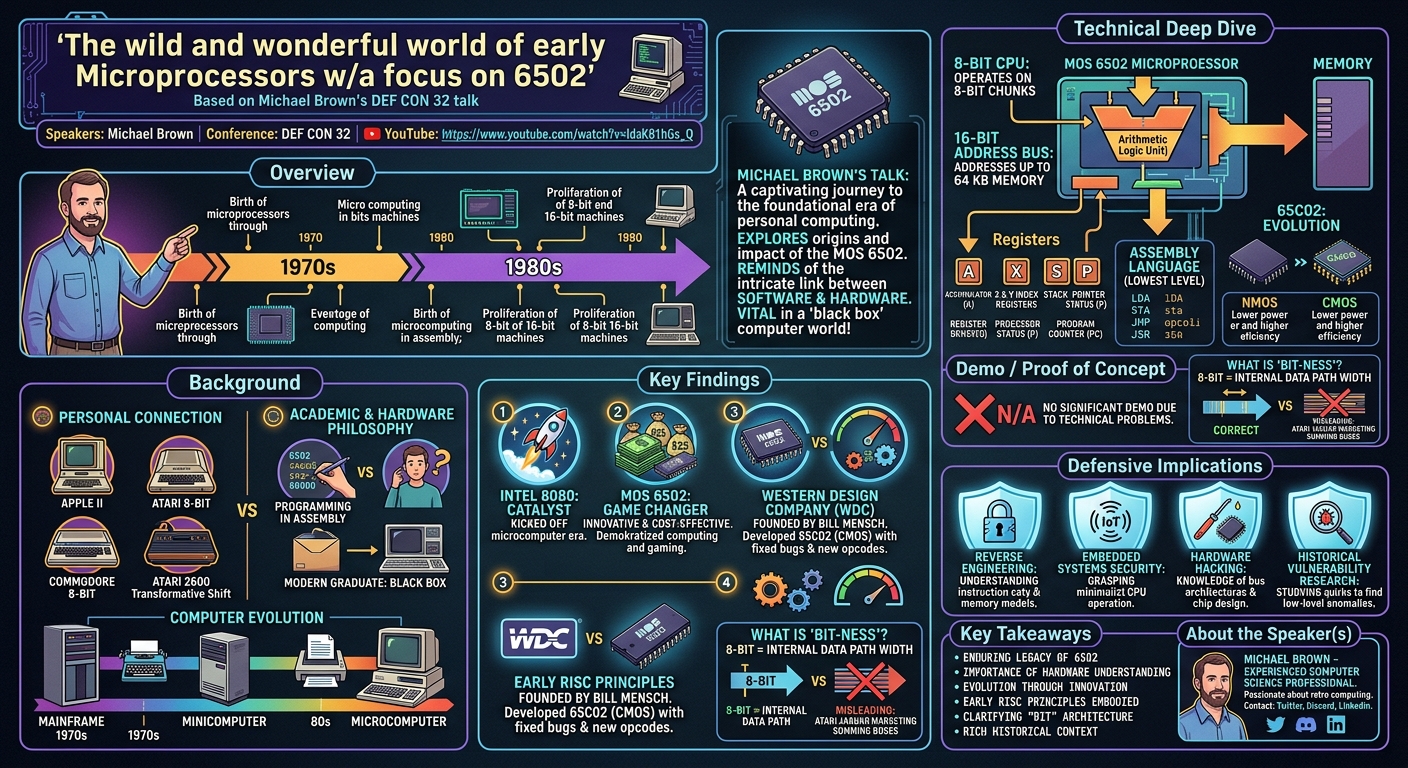
Michael Brown’s DEF CON 32 talk, "The wild and wonderful world of early Microprocessors w/a focus on 6502," offers a captivating journey back to the foundational era of personal computing. While DEF CON is typically synonymous with information security, Brown explicitly clarifies that this presentation is a passionate exploration of computer history and technology, rooted in his personal experiences growing up with 8-bit machines. The talk delves into the origins of the microprocessor, tracing the timeline from the early 1970s through the 1980s, and meticulously examines the architecture and impact of one of the most iconic chips of that period: the MOS 6502.
Key moments
- 0:00 Introduction and Speaker's Personal Connection to 8-bit Computers
- 2:18 Why Understanding Computer Hardware is Crucial for Software Developers
- 3:15 Comprehensive Outline of the Talk's Key Topics
- 4:00 Evolution of 8-bit Microcomputers and Consoles in the 70s-80s
- 5:10 Distinguishing Mainframes, Mini-computers, and Microcomputers by Size
- 6:00 The Enduring Legacy of MOS 6502 and Bill Mensch's WDC
The wild and wonderful world of early Microprocessors w/a focus on 6502
Speakers: Michael Brown
Conference: DEF CON 32
YouTube: https://www.youtube.com/watch?v=ldsK81hGs_Q
Overview
Michael Brown’s DEF CON 32 talk, "The wild and wonderful world of early Microprocessors w/a focus on 6502," offers a captivating journey back to the foundational era of personal computing. While DEF CON is typically synonymous with information security, Brown explicitly clarifies that this presentation is a passionate exploration of computer history and technology, rooted in his personal experiences growing up with 8-bit machines. The talk delves into the origins of the microprocessor, tracing the timeline from the early 1970s through the 1980s, and meticulously examines the architecture and impact of one of the most iconic chips of that period: the MOS 6502.
This talk serves as a vital reminder of the intricate relationship between software and the underlying hardware, a connection Brown argues is often overlooked by contemporary computer science professionals. By revisiting the constraints and innovations of the 8-bit era, the presentation highlights how ingenuity flourished within limited resources, shaping the trajectory of modern computing. Brown’s personal anecdotes and deep historical context make this not just a technical retrospective, but a call to appreciate the fundamental building blocks that paved the way for today's complex systems. Although a planned technical demonstration faced unforeseen issues, the depth of historical and technical insight provided more than compensates, offering a rich educational experience for enthusiasts and professionals alike.
Background
▶ Watch: Introduction and Speaker's Personal Connection to 8-bit Computers (0:00)
The genesis of Michael Brown’s passion for early microprocessors stems directly from his childhood and academic journey. He recounts growing up immersed in the nascent 8-bit computer scene, an era defined by iconic machines like the Apple II, Atari 8-bit series, and Commodore 8-bit systems. His first game console, the Atari 2600, and his first personal computer, an Atari 800 XL acquired in 1984 for college, provided hands-on experience with these groundbreaking technologies. He vividly recalls the transformative shift from writing papers on a typewriter to using a word processor, an innovation so new that his English teacher initially failed to recognize italicized titles without quotes. Later, his second computer, an Atari 1040 STFM, further solidified his engagement with the evolving landscape of personal computing.
Academically, Brown pursued computer science, not computer engineering, but maintained a steadfast belief in the importance of understanding the hardware that executes software. This philosophy was put into practice during his college years, where he programmed directly in assembly language for both the MOS 6502 and the Motorola 68000 processors, alongside higher-level languages like Pascal, Fortran, Cobol, and C. This hands-on, low-level experience contrasts sharply with what Brown observes in many modern computer science graduates, for whom the computer has become a "black box." He laments the current state where even the specific generation or capabilities of a modern Core i7 processor are often unknown to its user, underscoring a perceived disconnect from the foundational hardware that underpins all software.
The historical context of the talk begins in the 1970s, a decade that saw the birth of the microcomputer era. The Intel 8080 microprocessor is credited with kicking off this revolution, leading to systems like the Altair. This was swiftly followed by a proliferation of seminal machines such as the Apple II, various Commodore models, the Atari 2600 (a dominant game console), and the TRS-80 Model 1, affectionately known as the "trash 80." The 1980s continued this rapid evolution, introducing the Vic 20, the immensely popular Commodore 64, the IBM PC, the Macintosh, and later the Atari ST and Amiga. Brown categorizes these early systems into mainframes (room-sized, often seen with tape drives), minicomputers (refrigerator-sized), and microcomputers (personal desktop machines), noting that while mainframes still exist, their manufacturers have consolidated significantly from the "Snow White and the Seven Dwarfs" era. This historical backdrop sets the stage for a deeper dive into the specific architecture of the 6502, a chip that powered many of these early microcomputers and profoundly influenced the industry.
Key Findings
▶ Watch: Comprehensive Outline of the Talk's Key Topics (3:15)
The talk unearths several significant insights into the early microprocessor landscape, particularly highlighting the pivotal role and enduring legacy of the MOS 6502. One of the primary findings is the historical context of the Intel 8080, which Brown identifies as the catalyst for the entire microcomputer era. Its introduction paved the way for accessible computing, moving away from the behemoth mainframes and minicomputers towards personal machines.
Crucially, the presentation emphasizes the MOS 6502 as a game-changer due to its innovative design and cost-effectiveness. While the Intel 8080 and Motorola 6800 were prevalent, the 6502 offered comparable or superior performance at a significantly lower price point, making it the heart of numerous iconic systems like the Apple II, Commodore 64, and Atari 2600. This affordability democratized computing and gaming, making these devices accessible to a much broader audience and fostering the growth of the personal computer market.
Brown details the evolution of the 6502, particularly through the efforts of Bill Mensch, one of the original designers from MOS Technology. After MOS Technology's demise with Commodore, Mensch founded Western Design Company (WDC), which licensed and further developed the 6502 architecture. This led to the creation of the 65C02, where the 'C' signifies its fabrication using CMOS (Complementary Metal-Oxide-Semiconductor) technology. The 65C02 was not merely a re-release; it was an improved version that fixed some of the original 6502's bugs and introduced new opcodes, enhancing its capabilities and efficiency. This demonstrates the longevity and adaptability of a well-designed architecture, capable of modernization.
An intriguing aspect highlighted is the speculative claim that the MOS 6502 might be considered one of the earliest RISC (Reduced Instruction Set Computer) chips. While Brown acknowledges the lack of universal consensus on this classification, he points out that the 6502's design philosophy, characterized by a smaller, simpler set of instructions optimized for speed and efficiency, aligns with core RISC principles. This pre-dates the formalization of RISC theory in the 1980s, suggesting that the 6502 embodied some of these forward-thinking architectural ideas intuitively.
Finally, Brown addresses a common misconception regarding the "bit" designation of computer systems. He clarifies that terms like "8-bit," "16-bit," or "32-bit" primarily refer to the internal data path width of the processor – specifically, the size of its internal registers and the Arithmetic Logic Unit (ALU). He critiques misleading marketing practices, citing the Atari Jaguar, which was touted as a "64-bit system" by erroneously summing the widths of its various internal buses (address, data, etc.). This distinction is crucial for accurately understanding processor architecture and capabilities, emphasizing that genuine "bit-ness" relates to the CPU's ability to process data in chunks of that size, not merely the aggregate width of its connections.
Technical Deep Dive
▶ Watch: Evolution of 8-bit Microcomputers and Consoles in the 70s-80s (4:00)
The core of Michael Brown's technical discussion revolves around the MOS 6502 microprocessor, an 8-bit CPU that became a cornerstone of the early personal computer and gaming revolution. Introduced in 1975, the 6502 was a direct competitor to more expensive chips like the Intel 8080 and Motorola 6800. Its key differentiator was its price point, initially selling for just $25 (compared to $179 for the 8080 and $295 for the 6800), making advanced computing accessible to a mass market.
Architecturally, the 6502 is an 8-bit processor, meaning its internal data registers and Arithmetic Logic Unit (ALU) operate on 8-bit chunks of data. This defines its fundamental processing capability. However, it utilized a 16-bit address bus, allowing it to address up to 65,536 bytes (64 KB) of memory. This memory space was typically divided between RAM, ROM (for the operating system or firmware), and memory-mapped I/O devices. Despite its relatively small instruction set, the 6502 was highly efficient, often executing instructions in fewer clock cycles than its competitors, contributing to its perceived speed.
A defining characteristic of the 6502 was its elegant and somewhat unconventional design. It featured a small number of general-purpose registers: a single 8-bit accumulator (A), two 8-bit index registers (X and Y), an 8-bit stack pointer (S), and an 8-bit processor status register (P). The 16-bit program counter (PC) kept track of the current instruction address. The limited number of registers meant that the 6502 relied heavily on efficient memory addressing modes, including zero-page addressing (accessing the first 256 bytes of memory very quickly), indirect addressing, and indexed addressing, which were crucial for performance in the memory-constrained systems of the era.
The talk mentions the concept of assembly language, which is the lowest-level programming language directly corresponding to the machine code instructions a processor can execute. For the 6502, programming in assembly involved manipulating its registers and memory using mnemonics like LDA (Load Accumulator), STA (Store Accumulator), JMP (Jump), JSR (Jump to Subroutine), and various arithmetic and logical operations. This direct interaction with the hardware allowed programmers to optimize code for speed and memory usage, a critical skill when every byte and clock cycle counted. The speaker notes that assembly language is a polarizing topic—either "really interesting" or "freaking boring"—but for those who programmed the 6502, it was the primary means of unlocking the chip's full potential, especially for demanding applications like video games.
The evolution of the 6502 is also a key technical point. While MOS Technology eventually went out of business with Commodore, one of its original designers, Bill Mensch, formed Western Design Company (WDC). WDC continued to develop the 6502 architecture, leading to the 65C02. The 'C' in 65C02 signifies CMOS (Complementary Metal-Oxide-Semiconductor) fabrication. CMOS technology offered significant advantages over the original NMOS (N-type Metal-Oxide-Semiconductor) process, primarily lower power consumption and higher transistor density, allowing for more complex designs. The 65C02 also addressed some of the original 6502's minor bugs and introduced new opcodes, expanding its instruction set and making it more versatile. These additions included instructions for stack manipulation, bit manipulation, and new addressing modes, enhancing its capabilities while maintaining backward compatibility with the original 6502. The 65C02 saw widespread use in systems like the Apple IIc and IIgs, extending the life and relevance of the 6502 family well into the late 1980s and beyond.
Brown also touches on the broader context of processor "bit" definitions. He clarifies that an "8-bit" processor primarily refers to the width of its internal data paths and registers. This is distinct from the width of its address bus, which determines the amount of memory it can directly access, or the width of its external data bus, which governs how much data it can transfer to/from memory or peripherals at once. He provides the example of the Atari Jaguar, which was marketed as a "64-bit" console, but this claim was largely based on summing various internal bus widths, rather than reflecting a true 64-bit ALU or register set. This distinction is fundamental to understanding the actual computational power and architectural design of a microprocessor, rather than being swayed by marketing hype. The 6502, with its 8-bit data processing and 16-bit addressing, perfectly exemplifies the design trade-offs and innovations that defined the early microprocessor era.
Demo / Proof of Concept
▶ Watch: Distinguishing Mainframes, Mini-computers, and Microcomputers by Size (5:10)
The speaker, Michael Brown, explicitly stated at the beginning of his talk that there would not be much of a demonstration. He apologized for the lack of a demo, attributing it to technical problems, and clarified that the presentation would focus more on the history and technology of early microprocessors. Therefore, this section is not applicable to the talk as delivered.
Defensive Implications
▶ Watch: The Enduring Legacy of MOS 6502 and Bill Mensch's WDC (6:00)
Michael Brown explicitly states that this is "not an Infosec talk," distinguishing it from his usual DEF CON presentations. Consequently, there are no direct defensive implications, specific vulnerabilities, exploits, or mitigation strategies discussed in the context of modern cybersecurity. The talk is a historical and technical retrospective on early microprocessor design, particularly the MOS 6502.
However, for security professionals, an understanding of foundational computer architecture, even from decades past, can offer indirect benefits. Low-level knowledge of how processors operate, how memory is addressed, and how assembly language interacts with hardware can be invaluable for tasks such as:
- Reverse Engineering: Understanding processor instruction sets and memory models is crucial for analyzing malware, proprietary software, or embedded systems where source code is unavailable. The principles of assembly language from the 6502 era, while different in syntax, share conceptual similarities with modern architectures.
- Embedded Systems Security: Many modern embedded systems, IoT devices, and specialized hardware still rely on simplified architectures, some of which may draw conceptual lineage from early 8-bit designs. A grasp of minimalist CPU operation can aid in identifying vulnerabilities in such constrained environments.
- Hardware Hacking: For those involved in hardware security, understanding the physical components and their interaction at a fundamental level, as demonstrated by the speaker's emphasis on hardware knowledge, is essential. This includes understanding bus architectures, memory organization, and chip design principles.
- Historical Context for Vulnerability Research: Early processors often had undocumented features or subtle design quirks that could be exploited. While not directly applicable to modern systems, studying these historical "bugs" (like those fixed in the 65C02) can provide a mindset for identifying similar low-level anomalies in contemporary hardware.
In essence, while the talk does not present actionable defensive strategies, it reinforces the value of a deep, holistic understanding of computing systems, from the silicon up. This foundational knowledge is a critical asset for any security professional seeking to truly comprehend and defend against complex threats.
Key Takeaways
- The MOS 6502's Enduring Legacy: The MOS 6502 microprocessor, despite its 8-bit architecture, was a pivotal chip that democratized computing and gaming in the 1970s and 80s, powering iconic systems like the Apple II, Commodore 64, and Atari 2600 due to its cost-effectiveness and efficient design.
- Importance of Hardware Understanding: Michael Brown advocates for computer science professionals to understand the underlying hardware, emphasizing that software does not exist in a vacuum. This foundational knowledge, cultivated through hands-on experience with systems like the 6502, is crucial for truly comprehending how computers function.
- Evolution through Innovation: The 6502 architecture demonstrated remarkable adaptability, evolving into the 65C02 through the efforts of Western Design Company (WDC). This CMOS version improved upon the original by fixing bugs and adding new opcodes, showcasing how fundamental designs can be refined and extended.
- Early RISC Principles: The 6502's design, characterized by a reduced and highly optimized instruction set, pre-dated the formalization of RISC (Reduced Instruction Set Computer) architecture, suggesting it intuitively embodied some of these efficiency-focused principles.
- Clarifying "Bit" Architecture: The talk clarifies that a processor's "bit" designation (e.g., 8-bit, 16-bit) refers to its internal data processing width, specifically the ALU and register size, and not a misleading sum of various bus widths, as exemplified by the Atari Jaguar marketing.
- Historical Context of Microcomputers: The presentation provides a rich timeline of early microcomputers, highlighting key milestones like the Intel 8080 launching the microcomputer era and the subsequent proliferation of influential machines from companies like Apple, Commodore, Atari, and IBM.
About the Speaker(s)
Michael Brown is an experienced computer science professional with a deep-seated passion for the history and technology of early microprocessors. Although he typically delivers talks on Infosec topics at conferences like DEF CON, this presentation was a personal endeavor to share his enthusiasm for the foundational era of computing.
Brown's journey into computing began in the 8-bit era, where he gained hands-on experience with seminal machines such as the Atari 2600, Atari 800 XL, and Atari 1040 STFM. His academic background in computer science, coupled with practical programming experience in 6502 and 68000 assembly language during college, instilled in him a strong belief in the importance of understanding hardware for anyone writing software. He continues to collect and enjoy retro computers, including his original Atari systems and various classic game consoles. Brown can be reached via his Twitter handle, on the Defcon Discord and Maker's community Discord, and on LinkedIn, and often engages with enthusiasts at events like the Hardware Hacking Village.