Bluetooth Blues: Unmasking CVE 2023-52709-The TI BLE5-Stack Attack
Kevin Mitchell
DEF CON 32 Creator Stage · Day 1 · Creator Stage
Overview
In this compelling talk at DEF CON 32, Kevin Mitchell, a Senior Automotive Security Tester at Etos, unveiled a critical denial-of-service (DoS) vulnerability, designated as CVE-2023-52709, affecting the Texas Instruments (TI) BLE5-Stack. This vulnerability has significant implications for modern automotive systems, particularly those implementing "phone-as-key" (PaaK) functionalities, which rely heavily on Bluetooth Low Energy (BLE) technology for keyless entry and vehicle operation. Mitchell's presentation detailed the discovery, reproduction challenges, technical specifics, and the broader impact of this flaw on the automotive industry.
Key moments
- 0:00 Introduction to CVE 2023-52709
- 2:00 Speaker's background and hacking cars
- 4:00 Real-world impact of automotive recalls
- 4:50 Origin of CVE: Initial disclosure struggles
- 6:30 Bosch engineers reproduce the vulnerability
- 7:10 Technical details: Defensics test case 1001
Bluetooth Blues: Unmasking CVE 2023-52709-The TI BLE5-Stack Attack
Speakers: Kevin Mitchell, Senior Automotive Security Tester, Etos
Conference: DEF CON 32
YouTube: https://www.youtube.com/watch?v=mrb_3z5OP2M
Overview
In this compelling talk at DEF CON 32, Kevin Mitchell, a Senior Automotive Security Tester at Etos, unveiled a critical denial-of-service (DoS) vulnerability, designated as CVE-2023-52709, affecting the Texas Instruments (TI) BLE5-Stack. This vulnerability has significant implications for modern automotive systems, particularly those implementing "phone-as-key" (PaaK) functionalities, which rely heavily on Bluetooth Low Energy (BLE) technology for keyless entry and vehicle operation. Mitchell's presentation detailed the discovery, reproduction challenges, technical specifics, and the broader impact of this flaw on the automotive industry.
The core issue revolves around a specific test case that can reliably crash or freeze the BLE stack on affected TI microcontrollers, rendering PaaK systems inoperable. Mitchell's work highlights the critical need for rigorous security testing of foundational components in embedded systems, especially as vehicles become increasingly reliant on complex software and wireless communication. The talk not only exposed a significant technical vulnerability but also shed light on the often-arduous process of responsible disclosure and the substantial financial and reputational risks that OEMs face when such flaws are discovered late in the development cycle or, worse, after deployment.
Mitchell's presentation serves as a stark reminder that while technology aims to seamlessly integrate into our daily lives, its failure, particularly in critical applications like automotive access, can have profound consequences. His journey from discovery to mitigation underscores the persistent challenges in securing the ever-evolving automotive landscape and the invaluable role of dedicated automotive security researchers in safeguarding connected vehicles.
Background
▶ Watch: Introduction to CVE 2023-52709 (0:00)
The automotive industry is undergoing a profound transformation, moving rapidly towards increased connectivity, automation, and electrification. A key aspect of this evolution is the widespread adoption of keyless entry systems, with "phone-as-key" (PaaK) emerging as a prominent feature. PaaK systems allow vehicle owners to use their smartphones to lock, unlock, and even start their cars, leveraging wireless communication protocols such as Bluetooth Low Energy (BLE). While offering unparalleled convenience, this integration of consumer electronics with critical vehicle functions introduces a new attack surface and a complex web of security challenges.
The speaker, Kevin Mitchell, brings a wealth of experience to this domain. His journey in IT began in 2008 with the U.S. Army, followed by roles at Hewlett Packard. Crucially, he joined FCA (now Stellantis) as a Certified Ethical Hacker on the Uconnect team in the aftermath of the infamous 2015 Jeep hack, a pivotal event that dramatically raised awareness of automotive cybersecurity. As the sole cybersecurity professional among 30 quality assurance engineers on the Uconnect team, Mitchell specialized in automotive cybersecurity. He later expanded his expertise at Mercedes-Benz Financial Services, focusing on penetration testing and vulnerability management, before transitioning to his current role as a Senior Automotive Security Tester at Etos, where his primary mission is to "hack cars" to enhance automotive software security.
The problem addressed by Mitchell’s talk stems from the inherent complexity of modern automotive architectures, where sophisticated features like PaaK are built upon layers of hardware and software, often supplied by third-party vendors. The BLE5-Stack developed by Texas Instruments is a fundamental component used in countless embedded devices, including those within vehicles. As Bill Gates famously quoted, "The advance of technology is based on making it fit in so that you really don't even notice it, so it's a part of everyday life." However, as Mitchell points out with a follow-up quote, "The problem with technology is when it doesn't work, you're SOL." This perfectly encapsulates the danger when a foundational technology like a BLE stack, critical for a seamless user experience, harbors vulnerabilities that can lead to system failure. The talk emphasizes that a single flaw in a widely adopted component can have cascading effects across an entire industry, leading to significant recalls and financial repercussions, underscoring the vital importance of robust security at every layer of the automotive supply chain.
Key Findings
▶ Watch: Real-world impact of automotive recalls (4:00)
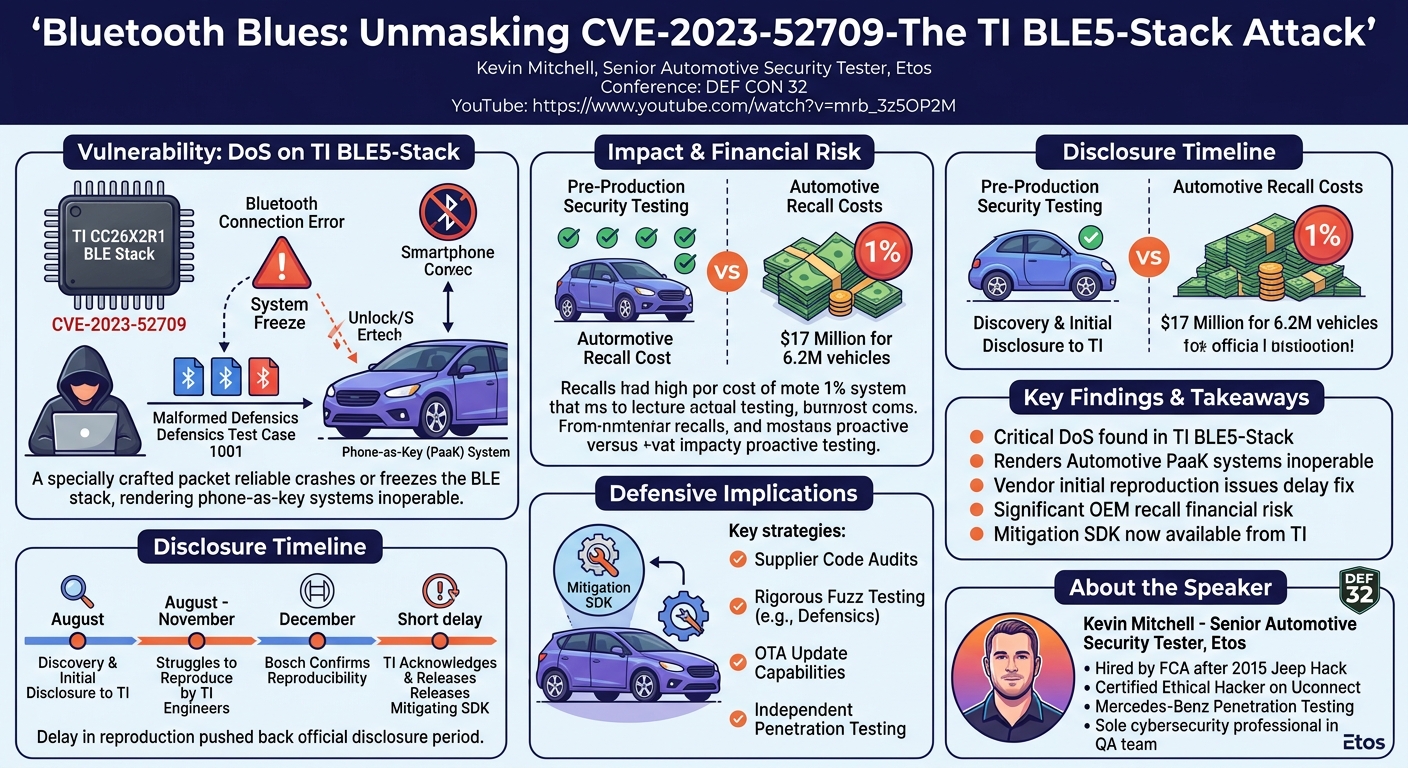
Kevin Mitchell's investigation uncovered a critical denial-of-service (DoS) vulnerability, identified as CVE-2023-52709, within the Texas Instruments (TI) BLE5-Stack. This vulnerability specifically impacts TI microcontrollers, most notably the CC26X2R1, which are integral to various embedded systems, including modern automotive "phone-as-key" (PaaK) functionalities. The core finding is that a specially crafted Bluetooth packet, triggered by a specific test case, can reliably crash or freeze the BLE stack on these devices, thereby preventing legitimate Bluetooth communication and rendering the PaaK system inoperable.
A significant aspect of Mitchell's findings was the challenge encountered during the vulnerability disclosure process. Despite providing clear instructions, TI engineers initially struggled to reproduce the issue for several months (from August to November). This delay was critical because, as Mitchell highlighted, the official responsible disclosure period does not commence until the vendor can confirm reproduction of the vulnerability. It was only after Bosch engineers, with whom Mitchell was collaborating, successfully reproduced the issue that TI acknowledged the flaw. Coincidentally, within two weeks of reproduction, TI had developed and was ready to push out a mitigating Software Development Kit (SDK), highlighting the efficiency with which a fix can be generated once the problem is understood and confirmed.
The vulnerability was consistently reproducible using Defensics test case 1001. While this test case did not always cause a failure on the TI LaunchPad development board, it achieved a 100% success rate in causing a DoS on the actual phone-as-key systems under test. This discrepancy underscores the importance of testing on production-like hardware and environments. The initial assessment of affected devices listed 19 specific devices in the CVE, but Mitchell indicated that an "extended list" of additional impacted devices was anticipated, suggesting a broader potential reach for this vulnerability across various product lines employing the TI BLE5-Stack. The potential real-world impact, particularly in the context of automotive recalls, was quantified by Mitchell, noting that even if a recall only cost 1% of the average $500 per vehicle, the total cost for an OEM producing 6.2 million vehicles (like GM in 2023) could still amount to $17 million, emphasizing the significant financial incentive for proactive security testing.
Technical Deep Dive
▶ Watch: Origin of CVE: Initial disclosure struggles (4:50)
The technical core of the vulnerability, CVE-2023-52709, lies within the Texas Instruments (TI) BLE5-Stack, specifically impacting devices utilizing the CC26X2R1 microcontroller. This particular chip is a versatile, low-power wireless MCU designed for a wide range of applications, including those requiring robust Bluetooth Low Energy connectivity, such as automotive phone-as-key (PaaK) systems. The vulnerability itself is a denial-of-service (DoS) condition, meaning that an attacker can render the target device's Bluetooth functionality inoperable, thereby disrupting critical operations like vehicle access.
The attack mechanism is triggered by a specific input, identified as Defensics test case 1001. Defensics is a widely used fuzzer for network protocols, and its ability to trigger this vulnerability suggests an issue within the BLE stack's handling of malformed or unexpected Bluetooth packets. While the talk doesn't delve into the precise byte-level details of the offending packet or the exact code path leading to the crash, the consistent reproducibility with Defensics indicates a robust, albeit unintended, trigger. The speaker mentioned performing Wireshark analysis as part of understanding the attack, which would have been crucial for dissecting the problematic Bluetooth communication frames and identifying the specific protocol elements that lead to the DoS. This analysis typically involves capturing Bluetooth traffic and examining the structure and content of packets exchanged between devices during the exploit attempt.
The root cause analysis, though briefly mentioned as a section in the agenda, was not detailed in the transcript. However, typical DoS vulnerabilities in communication stacks often stem from issues such as:
- Improper input validation: The stack may fail to adequately validate the length, format, or content of incoming Bluetooth packets, leading to buffer overflows, integer overflows, or other memory corruption issues.
- State machine errors: An unexpected sequence of valid or invalid packets might push the BLE stack into an unrecoverable state.
- Resource exhaustion: Maliciously crafted packets could consume excessive processing power, memory, or other resources, leading to a system freeze or crash.
- Unhandled exceptions: Specific edge cases in packet processing might trigger an unhandled exception or fault condition within the microcontroller's firmware.
The fact that the vulnerability was 100% reproducible on the actual phone-as-key systems, but not always on the TI LaunchPad development board, is a critical technical detail. This suggests that certain environmental factors, specific hardware configurations, or even subtle differences in the firmware build (e.g., debug vs. release configurations, or specific application code interactions) on the production-ready PaaK systems contributed to the consistent exploitability. The CC26X2R1 is a powerful MCU, but even robust hardware can be rendered vulnerable by flaws in its fundamental software components like the BLE stack. The impact of this DoS is profound: if a vehicle's PaaK system relies on this vulnerable stack, a nearby attacker could potentially prevent the owner from unlocking or starting their vehicle, leading to significant inconvenience, security concerns, and potential safety issues depending on the context. The initial CVE listing cited 19 affected devices, with an expectation for this list to grow, underscoring the widespread deployment of the vulnerable TI BLE5-Stack across various products.
Demo / Proof of Concept
▶ Watch: Bosch engineers reproduce the vulnerability (6:30)
While Kevin Mitchell's talk did not feature a live, explicit "demo" video in the traditional sense, the entire narrative revolves around the proof of concept and the rigorous testing methodology employed to validate the CVE-2023-52709 vulnerability. The demonstration of the vulnerability was achieved through a systematic testing process using specialized tools and target hardware.
The primary tool utilized for triggering the DoS was Defensics, a robust network protocol fuzzer. Mitchell specifically highlighted the use of Defensics test case 1001. This particular test case, when executed against the target BLE devices, was designed to send malformed or unexpected Bluetooth packets to probe for vulnerabilities in the TI BLE5-Stack.
The testing was performed on two distinct types of hardware:
- TI LaunchPad: This is a microcontroller development board, often used by engineers for prototyping and initial development. Mitchell and the Bosch engineers initially attempted to reproduce the issue on the LaunchPad. However, the speaker noted that Defensics test case 1001 "does not always work" on the development chip or board. This inconsistency proved to be a significant hurdle during the initial disclosure phase, contributing to TI's difficulty in reproducing the issue.
- Phone-as-Key (PaaK) Systems: These are the actual production-like systems that incorporate the TI CC26X2R1 microcontroller and the BLE5-Stack for vehicle access functionalities. Crucially, Mitchell emphasized that the Defensics test case 1001 "works 100% of the time on the phone as key systems." This consistent reproducibility on the real-world target system cemented the validity and severity of the vulnerability.
The outcome of this "demonstration" was a clear and consistent denial of service. When the specific Defensics test case was applied to the PaaK systems, the Bluetooth Low Energy stack on the TI CC26X2R1 microcontroller would crash or freeze. This effectively rendered the PaaK system inoperable, meaning the vehicle could not be unlocked or started using the smartphone. This direct impact on a critical automotive function serves as a powerful proof of concept for the real-world implications of CVE-2023-52709. The fact that Bosch engineers were eventually able to reproduce this exact behavior corroborated Mitchell's findings and finally prompted Texas Instruments to acknowledge and address the vulnerability.
Defensive Implications
▶ Watch: Technical details: Defensics test case 1001 (7:10)
The discovery of CVE-2023-52709 in a widely used component like the TI BLE5-Stack carries significant defensive implications for the entire automotive ecosystem, from chip manufacturers to vehicle OEMs and their customers. The primary takeaway for defenders is the critical importance of proactive and comprehensive security testing, particularly at the component level, before integration into final products.
For Texas Instruments and other component suppliers, this vulnerability underscores the need for more rigorous internal security testing of their Software Development Kits (SDKs) and firmware. The initial difficulty TI engineers faced in reproducing the issue, despite clear instructions, suggests potential gaps in their internal testing environments or methodologies. Investing in advanced fuzzing techniques, like those employed by Defensics, and ensuring that internal test setups accurately reflect real-world deployment scenarios are crucial. The swift release of a mitigating SDK once the issue was reproduced demonstrates that TI possesses the capability to respond effectively, but early detection would prevent widespread deployment of vulnerable code.
For Automotive OEMs and Tier 1 suppliers integrating components like the TI BLE5-Stack into their phone-as-key (PaaK) systems and other vehicle functionalities, the implications are profound:
- Supply Chain Security: OEMs must demand robust security assurances from their suppliers and consider independent security audits of critical components. Relying solely on a supplier's internal validation is insufficient.
- Pre-Production Penetration Testing: As Mitchell highlighted, "you should really just do a penetration test on your system before you're stuck paying for recalls." The potential cost of an automotive recall is substantial, with an average estimated at $500 per vehicle. For an OEM like GM, producing 6.2 million vehicles annually, even a small fraction of this cost (e.g., 1% of the average recall cost) could amount to $17 million for a single vulnerability. These figures do not even account for reputational damage or potential legal liabilities.
- Immediate Patching and Updates: OEMs using affected TI microcontrollers must prioritize the integration of the mitigating SDK provided by Texas Instruments. This involves updating firmware in existing vehicle platforms and ensuring all new production vehicles incorporate the patched BLE stack.
- Over-the-Air (OTA) Updates: The ability to deploy security patches via OTA updates is becoming increasingly vital. For critical vulnerabilities like a DoS in a keyless entry system, rapid deployment of fixes can minimize exposure and mitigate real-world risks.
- Redundancy and Fail-Safe Mechanisms: For critical functions like vehicle access, designers should consider implementing redundancy or fail-safe mechanisms that allow for alternative methods of entry and ignition even if the primary electronic system (like PaaK) experiences a denial of service.
Finally, for end-users, while they cannot directly patch the underlying BLE stack, awareness of such vulnerabilities reinforces the importance of keeping vehicle software updated and understanding the limitations or potential risks associated with advanced features. The talk underscores that security is a continuous process, requiring vigilance and collaboration across the entire automotive supply chain to protect against evolving threats.
Key Takeaways
- Critical DoS Vulnerability Discovered: CVE-2023-52709 is a denial-of-service vulnerability in the Texas Instruments (TI) BLE5-Stack affecting devices like the CC26X2R1 microcontroller, rendering phone-as-key (PaaK) systems inoperable.
- Importance of Independent Security Research: Kevin Mitchell's work as a Senior Automotive Security Tester at Etos demonstrates the vital role of independent penetration testing in uncovering flaws that internal vendor testing might miss, especially given TI's initial difficulty in reproducing the issue.
- Challenges in Vulnerability Disclosure: The responsible disclosure process can be protracted and challenging, as evidenced by TI's initial inability to reproduce the vulnerability for several months, which delayed the start of the official disclosure timeline.
- Significant Financial Impact of Recalls: Automotive recalls are extremely costly, with an average cost of $500 per vehicle. Even a minor vulnerability can lead to multi-million dollar expenses for OEMs if not caught in pre-production, emphasizing the ROI of early security testing.
- Effective Mitigation Available: Texas Instruments ultimately released an SDK to mitigate the vulnerability, highlighting the importance of vendor responsiveness once a flaw is confirmed and understood.
- Security in Foundational Technologies is Paramount: The talk underscores that security must be integrated into foundational technologies like BLE stacks, especially when they underpin critical vehicle functions such as keyless entry, to prevent widespread disruption and ensure user safety and convenience.
About the Speaker(s)
Kevin Mitchell is a Senior Automotive Security Tester at Etos, a company dedicated to enhancing automotive software. His professional journey in cybersecurity began in 2008 when he joined the U.S. Army as a Human Resources Information Management System Specialist. Following his military service, he worked for Hewlett Packard before making a significant entry into automotive cybersecurity.
Mitchell was hired by FCA (now Stellantis) as a Certified Ethical Hacker on the Uconnect team after the high-profile Jeep hack, becoming the sole cybersecurity professional among a team of 30 Quality Release Engineers specializing in automotive security. He further honed his skills at Mercedes-Benz Financial Services, where he was involved in penetration testing, vulnerability management, and penetration testing management, also gaining experience in web application penetration testing. In his current role at Etos, Kevin Mitchell actively "hacks cars" to identify vulnerabilities and contribute to the security of tomorrow's automotive software. His extensive background highlights a deep specialization in securing complex, connected vehicle systems.