Anyone can hack IoT- Beginner’s Guide to Hacking Your First IoT Device
Andrew Bellini
DEF CON 32 Creator Stage · Day 1 · Creator Stage
Overview
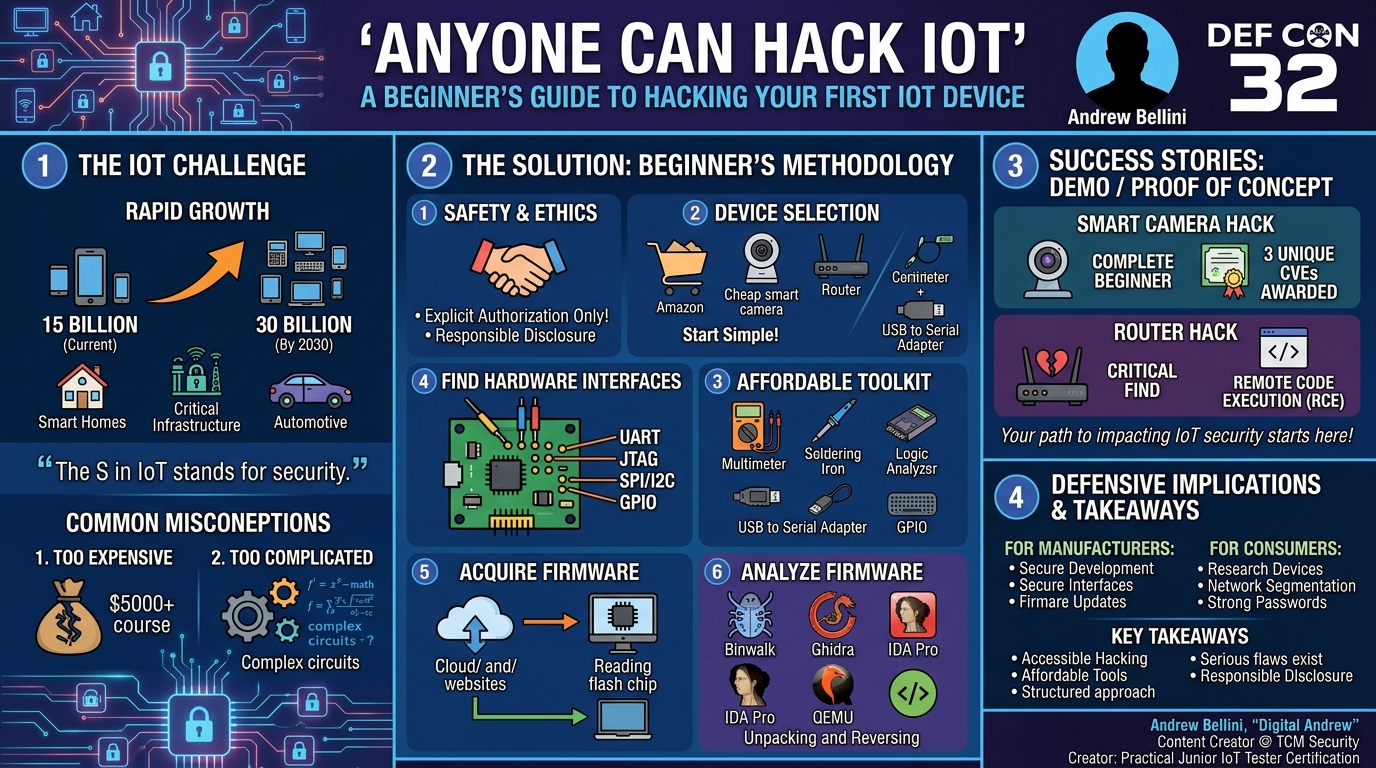
Andrew Bellini's DEF CON 32 talk, "Anyone can hack IoT- Beginner’s Guide to Hacking Your First IoT Device," challenges the prevailing misconceptions that IoT hacking is prohibitively expensive or overly complicated. Bellini, an electrical engineer turned cybersecurity content creator, asserts that with an affordable toolkit and a structured methodology, even beginners can uncover vulnerabilities in commercial Internet of Things (IoT) devices. The talk aims to demystify the process, empowering a broader audience to engage in ethical IoT security research.
Key moments
- 0:00 Introduction: Anyone can hack IoT & security joke
- 0:40 Scale of IoT problem: Billions of insecure devices
- 2:20 Dispelling misconceptions: IoT hacking isn't too expensive or complicated
- 4:00 Speaker's background and credibility in IoT security
- 4:40 Talk's goal: Learn to find vulnerabilities with student success stories
Anyone can hack IoT- Beginner’s Guide to Hacking Your First IoT Device
Speakers: Andrew Bellini
Conference: DEF CON 32
YouTube: https://www.youtube.com/watch?v=YPcOwKtRuDQ
Overview
Andrew Bellini's DEF CON 32 talk, "Anyone can hack IoT- Beginner’s Guide to Hacking Your First IoT Device," challenges the prevailing misconceptions that IoT hacking is prohibitively expensive or overly complicated. Bellini, an electrical engineer turned cybersecurity content creator, asserts that with an affordable toolkit and a structured methodology, even beginners can uncover vulnerabilities in commercial Internet of Things (IoT) devices. The talk aims to demystify the process, empowering a broader audience to engage in ethical IoT security research.
The significance of this talk stems from the rapidly expanding landscape of IoT devices, estimated at over 15 billion globally and projected to double to 30 billion by the end of the decade. These devices are ubiquitous, ranging from smart home gadgets like cameras and thermostats to critical infrastructure components and automotive systems. Despite their widespread adoption, IoT devices are notoriously insecure, making them prime targets for cybercriminals who exploit vulnerabilities for botnets, initial access, and other malicious activities. Bellini's presentation seeks to channel this vulnerability into a positive force, encouraging ethical hackers to contribute to improving IoT security through responsible disclosure.
Bellini’s primary goal is to provide a practical methodology, specific tools, and foundational knowledge necessary to identify vulnerabilities in off-the-shelf commercial IoT devices. He leverages his background in designing embedded and industrial IoT systems to offer insights into their inherent security weaknesses. By dispelling common myths and showcasing success stories from his students—including one who found three Common Vulnerabilities and Exposures (CVEs) in a smart camera and another who discovered a Remote Code Execution (RCE) vulnerability in a cheap router—Bellini builds a compelling case that IoT hacking is accessible and impactful for newcomers to the field.
Background
▶ Watch: Introduction: Anyone can hack IoT & security joke (0:00)
The talk opens with a widely circulated joke within the cybersecurity community: "The S in IoT stands for security." Bellini, with a candid acknowledgment of his own experience in embedded and industrial IoT design, concedes that the joke is "well deserved." This sets the stage for a critical examination of IoT security, or rather, its frequent absence. The sheer scale of IoT deployment underscores the urgency of addressing these security deficiencies. With current estimates exceeding 15 billion connected devices, equating to almost two per person globally, and projections indicating a surge to 30 billion devices by the decade's end, the attack surface is vast and rapidly expanding. These devices are not confined to consumer smart homes; they permeate critical infrastructure, automotive systems, and various industrial applications, making their vulnerabilities a significant societal risk.
Despite the obvious security risks and the active exploitation by cybercriminals who frequently leverage IoT vulnerabilities for botnets or initial network access, Bellini observes a notable reluctance among ethical hackers to engage with IoT security. He identifies two primary misconceptions that deter many from entering this domain. The first is the perception of prohibitive cost. Many believe that IoT hacking requires expensive specialized equipment such as oscilloscopes, microscopes, and high-end debuggers. Additionally, Bellini notes a historical lack of affordable training, recalling courses that cost upwards of $5,000 just five years prior, often requiring in-person attendance.
The second misconception is the perceived complexity. Aspiring IoT hackers often feel intimidated, believing they need an engineering degree, extensive knowledge of electronics, hardware circuits, and specialized communication protocols in addition to standard hacking skills. Bellini contends that while there is some truth to these concerns—a basic understanding of hardware can be beneficial—they are largely overstated. He argues that practical, effective IoT hacking can be learned without significant financial outlay or advanced engineering qualifications, especially for commercial off-the-shelf devices. His talk, and the methodology it presents, directly aim to counter these misconceptions by demonstrating an accessible and affordable path into IoT security research.
Key Findings
▶ Watch: Scale of IoT problem: Billions of insecure devices (0:40)
The central finding and empowering message of Andrew Bellini's talk is that anyone can hack IoT devices, irrespective of a deep engineering background or a substantial budget. This assertion directly challenges and dispels the two prevalent misconceptions identified: that IoT hacking is too expensive and too complicated. Bellini provides a clear methodology designed to guide beginners through the process of finding vulnerabilities in commercial IoT devices, emphasizing affordability and practical steps.
A crucial aspect of his findings is the demonstration of this methodology's efficacy through real-world examples from his students. He proudly shared two compelling success stories:
- Smart Camera Vulnerabilities: One student, with no prior IoT hacking experience, followed Bellini's course and advice. This student purchased a cheap smart camera from Amazon, applied the learned methodology, and successfully identified three unique vulnerabilities. These findings were responsibly disclosed to the vendor, leading to the student being awarded three CVEs. This case serves as concrete proof that significant security findings are within reach for motivated beginners using accessible devices.
- Router Remote Code Execution: Another student, whose identity remained anonymous, also utilized Bellini's methodology to hack a cheap router. This individual managed to discover a Remote Code Execution (RCE) vulnerability, a critical flaw that could allow an attacker to execute arbitrary commands on the device. While the vendor was reportedly unresponsive, Bellini discussed guiding the student on how to submit the finding to a CVE Numbering Authority (CNA), highlighting the importance of responsible disclosure even when vendors are uncooperative.
These anecdotes are not merely motivational; they are presented as direct evidence that Bellini's structured approach, combined with readily available and inexpensive devices, can lead to impactful security research. His methodology focuses on practical steps like device selection, building an affordable toolkit, understanding hardware interfaces, acquiring firmware, and then analyzing that firmware. By breaking down the complex process into manageable stages, Bellini demonstrates that the barrier to entry for IoT security research is much lower than commonly perceived, encouraging more individuals to contribute to securing the vast and vulnerable IoT ecosystem.
Technical Deep Dive
▶ Watch: Dispelling misconceptions: IoT hacking isn't too expensive or complicated (2:20)
Andrew Bellini's talk outlines a comprehensive, yet beginner-friendly, methodology for hacking commercial IoT devices. While the provided transcript focuses heavily on motivation and dispelling misconceptions, it clearly lays out the sequential steps involved in this process. The technical deep dive, as presented in the agenda, covers five critical stages: device selection, toolkit assembly, hardware interface exploration, firmware acquisition, and firmware analysis.
The methodology begins with safety and legal considerations. Bellini underscores the golden rule of ethical hacking: only test devices for which you have explicit authorization. He strongly advocates for responsible disclosure if vulnerabilities are found, even though many IoT vendors lack formal bug bounty programs. Reporting findings, even through less formal channels, is crucial for gaining credit and potentially securing CVEs.
The next step involves device selection. For beginners, Bellini advises choosing a cheap, readily available commercial IoT device, often found on platforms like Amazon. The rationale is to minimize investment while maximizing the chances of finding vulnerabilities, as lower-cost consumer devices often have less robust security. Alternatively, for those with more experience or specific interests, dumpster diving for discarded devices can also be a source of targets. The key is to select a device that allows for physical access and is likely to contain common vulnerabilities.
Following device selection, assembling an affordable toolkit is paramount. Bellini explicitly addresses the misconception that expensive gear is necessary. While the transcript does not detail specific tool names or models, the emphasis is on budget-friendly alternatives to high-cost equipment like oscilloscopes or microscopes. A typical beginner's IoT hacking toolkit might include a basic logic analyzer (e.g., Saleae Logic clones), a USB to serial adapter (e.g., FTDI or CH340 based), a multimeter, soldering equipment (a cheap iron and solder), and various jumper wires and prototyping boards. These tools collectively enable interaction with device hardware at a fundamental level without breaking the bank.
The core of hardware-level interaction lies in locating, using, and abusing hardware interfaces. This stage is critical for gaining deeper access to the device's internal workings. Common hardware interfaces found on IoT devices include:
- Universal Asynchronous Receiver-Transmitter (UART): Often used for debugging and providing a serial console to the device's operating system. Identifying UART pins typically involves looking for groups of four test points (VCC, GND, TX, RX) on the Printed Circuit Board (PCB).
- Joint Test Action Group (JTAG): A standard for debugging and boundary-scan testing, JTAG can provide extensive control over the device's processor and memory. It typically involves a specific set of pins (TCK, TMS, TDI, TDO, TRST, RTCK).
- Serial Peripheral Interface (SPI) and Inter-Integrated Circuit (I2C): These are synchronous serial communication interfaces often used for communication between the main microcontroller and peripheral components, such as flash memory chips.
- General Purpose Input/Output (GPIO) pins: These programmable pins can sometimes be leveraged for various purposes, including triggering specific device functions or even as alternative debug ports.
While the talk’s transcript does not delve into the specifics of how to locate these interfaces (e.g., using a multimeter for continuity checks, analyzing PCB traces, or looking for silkscreen labels) or how to abuse them (e.g., connecting a serial adapter to a UART port to gain a shell, or using a JTAG debugger to dump firmware), it highlights their significance as primary attack vectors for gaining initial access or extracting data.
The subsequent stage is acquiring firmware. Firmware is the embedded operating system and application code that runs on the IoT device. Gaining access to the firmware is often a prerequisite for detailed analysis and vulnerability discovery. Common methods for firmware acquisition include:
- Over-the-Air (OTA) Updates: Intercepting firmware update files as they are downloaded by the device.
- Vendor Websites: Many manufacturers make firmware updates publicly available for download.
- Direct Memory Access: Physically dumping the firmware from the device's flash memory chip (e.g., SPI flash, NAND flash) using a specialized programmer once the chip has been identified and potentially desoldered, or by leveraging hardware interfaces like JTAG.
The talk emphasizes that obtaining the firmware is a crucial step towards understanding the device's software logic.
Finally, the acquired firmware undergoes analysis and reverse engineering. This is where the vulnerabilities are typically identified. Key activities in this stage include:
- Firmware Extraction: Using tools like binwalk to unpack the firmware image and extract its constituent file systems (e.g., SquashFS, JFFS2).
- File System Analysis: Exploring the extracted file system for sensitive information (hardcoded credentials, API keys), configuration files, web server files, and executable binaries.
- Static Analysis: Using tools like Ghidra or IDA Pro to disassemble and decompile executable binaries, searching for common software vulnerabilities such as buffer overflows, format string bugs, command injection flaws, or improper input validation.
- Dynamic Analysis: Running the firmware in an emulated environment (e.g., using Firmadyne or QEMU) to observe its behavior, interact with its services, and test for vulnerabilities in a controlled setting.
- Web Interface Analysis: If the device has a web interface, analyzing its code for common web application vulnerabilities like XSS, CSRF, SQL injection, and authentication bypasses.
While the transcript outlines these stages, it does not provide specific tool walkthroughs or detailed technical demonstrations within the provided text. However, the structured approach itself serves as a robust framework, guiding aspiring IoT hackers through a logical progression from initial device interaction to deep code analysis. The emphasis remains on the accessibility of this process, suggesting that with dedication and the right conceptual understanding, these steps can be executed using affordable tools and publicly available resources.
Demo / Proof of Concept
▶ Watch: Speaker's background and credibility in IoT security (4:00)
While the provided transcript does not include a live, step-by-step demonstration of an IoT hacking process, Andrew Bellini effectively presented compelling anecdotal evidence as a "proof of concept" for his methodology. Instead of showcasing a direct hack, he highlighted the tangible successes of his students, which served to validate his core assertion that anyone can hack IoT devices with the right guidance and affordable resources.
The first example involved a student who, after taking Bellini's course and applying the recommended methodology, purchased a cheap smart camera from Amazon. This student, a complete beginner to IoT hacking, was able to identify three distinct vulnerabilities within the device. These findings were responsibly reported to the vendor, ultimately resulting in the student being credited with three CVEs. This success story underscores the potential for newcomers to make significant contributions to security research on widely available consumer devices.
The second powerful anecdote involved another student who, following the same methodology, discovered a Remote Code Execution (RCE) vulnerability in a cheap router. An RCE is a highly critical flaw, allowing an attacker to execute arbitrary code on the target device, potentially leading to full compromise. Bellini noted that the vendor in this instance was unresponsive, but he was assisting the student in submitting the vulnerability to a CVE Numbering Authority (CNA). This example not only demonstrates the severity of vulnerabilities that can be found but also reinforces the importance of responsible disclosure mechanisms, even when direct vendor engagement is challenging.
These two cases, though not live demonstrations, serve as powerful "proofs of concept" for Bellini's claim that his methodology works and that impactful vulnerabilities are ripe for discovery in the IoT ecosystem by individuals without extensive prior experience or expensive equipment. They effectively illustrate the potential outcomes of following the structured approach outlined in his talk.
Defensive Implications
▶ Watch: Talk's goal: Learn to find vulnerabilities with student success stories (4:40)
The insights presented by Andrew Bellini carry significant defensive implications for both IoT manufacturers and consumers. The core message—that IoT devices are easily hackable by individuals with modest resources and basic training—should serve as a stark warning and a call to action.
For IoT manufacturers, the talk highlights a critical need for a fundamental shift in their security practices. If beginners can readily uncover multiple CVEs and RCEs in commercial devices, it suggests a pervasive lack of security-by-design principles. Manufacturers should:
- Implement Secure Development Lifecycle (SDL): Integrate security considerations from the initial design phase through deployment and maintenance, rather than attempting to patch vulnerabilities post-release.
- Conduct Thorough Security Testing: Regularly perform penetration testing, vulnerability assessments, and code reviews, ideally by independent third parties, to identify and remediate flaws before products reach the market.
- Secure Hardware Interfaces: Ensure that debugging interfaces like UART and JTAG are properly disabled or secured in production devices, preventing unauthorized access to the device's internals.
- Encrypt and Authenticate Firmware: Protect firmware with strong encryption and cryptographic signatures to prevent unauthorized modification or acquisition.
- Establish Responsible Disclosure Programs: Create clear channels and policies for security researchers to report vulnerabilities, fostering collaboration rather than adversarial relationships. Bellini notes the lack of such programs for many IoT devices, which hinders ethical research.
- Regularly Update Firmware: Provide timely security updates for identified vulnerabilities and make these updates easy for users to apply.
For consumers and organizations deploying IoT devices, Bellini's talk underscores the need for vigilance and informed decision-making:
- Be Aware of Inherent Risks: Understand that many consumer-grade IoT devices are not built with robust security in mind and may pose significant risks to privacy and network security.
- Research Device Security: Before purchasing or deploying IoT devices, investigate their security track record, update policies, and any known vulnerabilities. Prioritize devices from reputable manufacturers with clear security commitments.
- Network Segmentation: Isolate IoT devices on separate network segments or VLANs to limit their ability to interact with critical systems if compromised.
- Strong Passwords and Unique Credentials: Change default credentials immediately and use strong, unique passwords for all IoT devices and their associated cloud accounts.
- Disable Unnecessary Features: Turn off any features or services not actively used to reduce the attack surface.
- Monitor Network Traffic: Implement network monitoring to detect unusual activity originating from IoT devices, which could indicate compromise.
Bellini's emphasis on responsible disclosure is also a crucial defensive implication. By encouraging ethical hackers to report vulnerabilities, the community can collectively work towards a more secure IoT ecosystem. Manufacturers who embrace these reports and act upon them demonstrate a commitment to customer safety and product integrity, ultimately leading to more secure devices for everyone.
Key Takeaways
- IoT Hacking is Accessible: Contrary to popular belief, hacking commercial IoT devices does not require extensive engineering expertise or prohibitively expensive equipment.
- Affordable Toolkit is Sufficient: A budget-friendly toolkit, comprising basic hardware and software tools, can enable effective vulnerability research.
- Structured Methodology is Key: Following a systematic approach—from device selection and hardware interaction to firmware acquisition and analysis—empowers beginners to find vulnerabilities.
- Significant Vulnerabilities Exist: Even cheap, off-the-shelf consumer IoT devices often contain critical flaws like CVEs and Remote Code Execution (RCE) vulnerabilities.
- Responsible Disclosure is Paramount: Ethical hacking should always be conducted responsibly, with vulnerabilities reported to vendors, ideally through formal disclosure programs or CVE Numbering Authorities (CNAs).
- Urgent Need for Better IoT Security: The ease with which vulnerabilities can be discovered highlights the widespread insecurity in the IoT landscape, demanding improved security-by-design from manufacturers.
About the Speaker(s)
Andrew Bellini, known as "Digital Andrew" on social media, brings a unique blend of engineering expertise and cybersecurity passion to the field of IoT security. His professional journey began with a background in electrical engineering, where he gained hands-on experience in designing embedded devices and industrial IoT devices. This foundational knowledge in how these systems are built provides him with a distinct advantage in understanding their inherent vulnerabilities and potential attack vectors.
Transitioning into cybersecurity, Bellini now serves as a content creator at TCM Security. In this role, he has become a prominent educator, developing and leading their IoT hacking course specifically tailored for beginners. Furthermore, he is the architect of the Practical Junior IoT Tester certification, demonstrating his commitment to formalizing and standardizing entry-level skills in IoT security testing. Bellini actively shares his knowledge and resources through his website, Andrewbellini.com, offering blogs and other materials to support aspiring IoT hackers. His work is driven by a strong motivation to democratize IoT security knowledge and empower more individuals to contribute to securing the vast and often vulnerable IoT landscape.