Eradicating Hepatitis C with BioTerrorism
Mixæl Swan Laufer
DEF CON 32 Creator Stage · Day 1 · Creator Stage
Overview
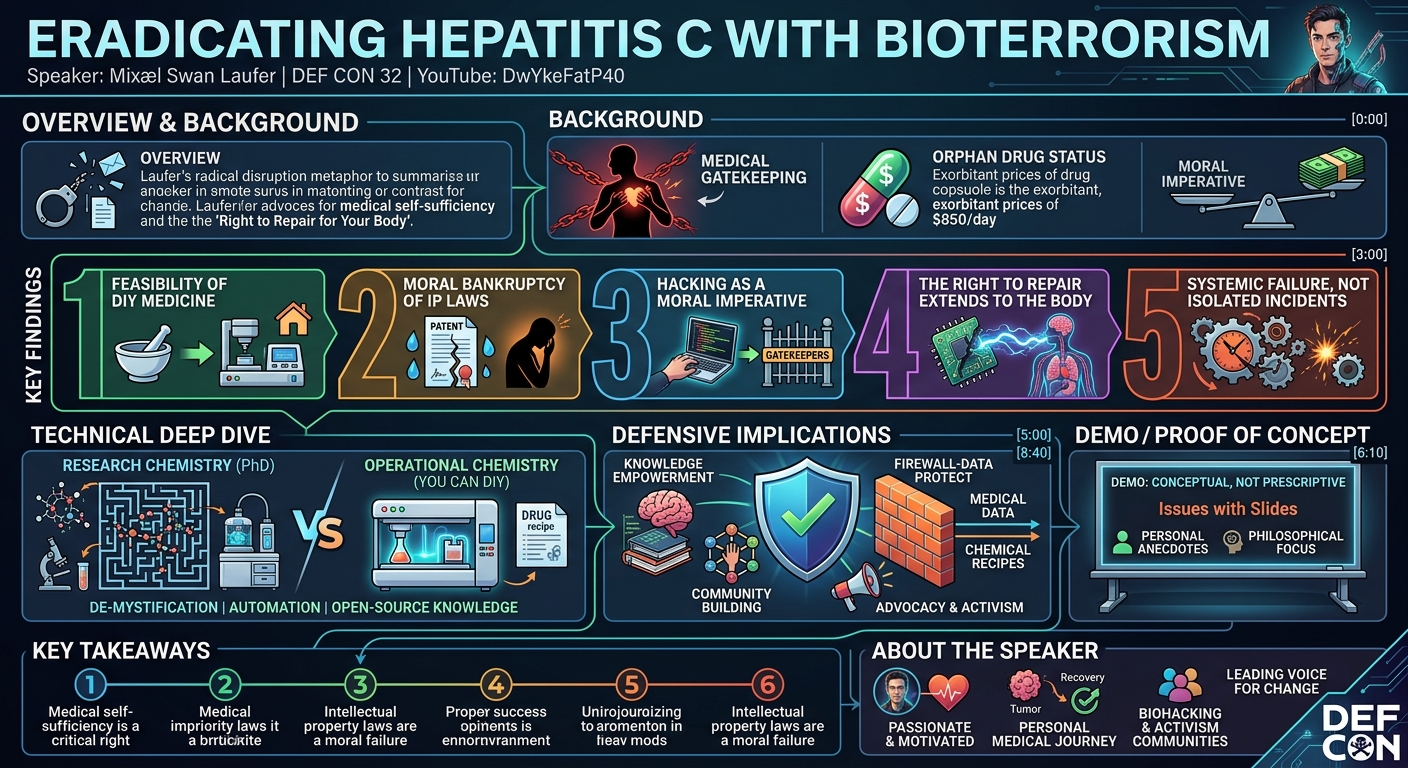
Mixæl Swan Laufer’s DEF CON 32 talk, "Eradicating Hepatitis C with BioTerrorism," is a powerful and provocative indictment of the global pharmaceutical industry and the intellectual property (IP) laws that govern access to life-saving medications. Far from a literal call for biological warfare, the titular "bioterrorism" serves as a metaphor for radical disruption—a deliberate, targeted act aimed at dismantling the systemic barriers that prevent individuals from accessing affordable healthcare and essential drugs. Laufer, motivated by deeply personal experiences with medical gatekeeping and exorbitant costs, advocates for a revolutionary paradigm: medical self-sufficiency and the democratization of drug production.
Key moments
- 0:00 Speaker's emotional introduction and personal health struggle
- 3:00 Connecting 'right to repair' ethos to healthcare autonomy
- 5:00 Critique of orphan drug status and prohibitive pricing
- 6:10 Hacking as greatest good; morality vs. economics
- 8:40 Defiant challenge to pharmaceutical companies and government
Eradicating Hepatitis C with BioTerrorism
Speakers: Mixæl Swan Laufer
Conference: DEF CON 32
YouTube: https://www.youtube.com/watch?v=DwYkeFatP40
Overview
Mixæl Swan Laufer’s DEF CON 32 talk, "Eradicating Hepatitis C with BioTerrorism," is a powerful and provocative indictment of the global pharmaceutical industry and the intellectual property (IP) laws that govern access to life-saving medications. Far from a literal call for biological warfare, the titular "bioterrorism" serves as a metaphor for radical disruption—a deliberate, targeted act aimed at dismantling the systemic barriers that prevent individuals from accessing affordable healthcare and essential drugs. Laufer, motivated by deeply personal experiences with medical gatekeeping and exorbitant costs, advocates for a revolutionary paradigm: medical self-sufficiency and the democratization of drug production.
This talk is a rallying cry for the "right to repair for your body," extending the hacker ethos of circumventing artificial limitations to the realm of personal health. Laufer argues that the current system, driven by corporate greed and restrictive IP laws, is morally bankrupt, leading to preventable suffering and death on a massive scale. He challenges the audience, and by extension, the broader hacker community, to apply their skills to liberate medical knowledge and empower individuals to take control of their own health by producing their own medications. The talk resonates deeply within the DEF CON environment, where challenging established norms and exposing systemic vulnerabilities are core tenets, positioning the fight for medical access as perhaps the most critical hack of our time.
Background
▶ Watch: Speaker's emotional introduction and personal health struggle (0:00)
The premise of Laufer’s talk is rooted in a profound critique of the modern healthcare system, particularly the pharmaceutical industry's control over drug development, distribution, and pricing. He posits that the notion of individuals being unable to manage their own health is a relatively recent construct, designed to consolidate power and profit within a specialized, gatekeeping medical establishment. Historically, self-care and community-based health practices were far more prevalent, a tradition that has been eroded by the professionalization and corporatization of medicine.
A central pillar of Laufer’s argument is the detrimental impact of intellectual property (IP) laws, specifically drug patents and mechanisms like orphan drug status. He illustrates this with a poignant anecdote about a childhood friend who died at 25 from a rare subtype of multiple sclerosis. The specific medicine required for her condition had been granted orphan drug status, which, while intended to incentivize drug development for rare diseases, also confers extended patent lengths and allows manufacturers to set arbitrarily high prices. In this friend's case, the drug was priced at an astronomical $850 per day, effectively rendering it inaccessible. Laufer frames this as a moral failing of the highest order, where economic considerations are prioritized over human lives.
He draws a powerful historical parallel to the abolition of slavery, noting how economists of the time defended the institution as integral to the economy, only to be ultimately overridden by a moral imperative. Laufer contends that current IP laws, which allow "trillions of dollars circling the world" to justify denying access to life-saving medicine, represent a similar moral crisis. He argues that this system forces individuals to "shop for a stranger who has the authority to maybe or maybe not give you what you need," and to contend with issues of legality, differing medical opinions, and, most frequently, unaffordability. His personal experiences—undergoing surgery for a tumor "invisible on the MRI" only because he "insisted on it," and the emotional toll of facing medical uncertainty and cost barriers—underscore the systemic failures he seeks to address. The talk is a direct challenge to the established order, asserting that "hacking is the greatest good" and "knowledge belongs to all of humanity."
Key Findings
▶ Watch: Connecting 'right to repair' ethos to healthcare autonomy (3:00)
While not presenting new scientific discoveries in the traditional sense, Mixæl Swan Laufer's talk delivers several critical "findings" in the form of assertive arguments and observations that challenge conventional thinking about medicine and intellectual property:
- Feasibility of DIY Medicine: The most significant assertion is that "most medications you can make a better, cheaper version of yourself at home. Anybody can. It's entirely doable." Laufer distinguishes between advanced research chemistry, which requires a PhD, and the operational chemistry needed to produce existing drugs, likening it to the difference between building a computer and using one. This "finding" suggests that the technical barrier to producing essential medicines is often artificially inflated, contributing to the gatekeeping by pharmaceutical companies.
- Moral Bankruptcy of Current IP Laws: Laufer unequivocally states that intellectual property laws, particularly as applied to pharmaceuticals, are directly responsible for preventable suffering and death. He argues that the economic system, which allows for exorbitant drug pricing under the guise of patent protection and market incentives, is morally indefensible when it denies basic human rights to health. This is presented not as an opinion but as a factual consequence of the existing legal framework.
- Hacking as a Moral Imperative: The talk positions "hacking" not merely as a technical skill but as a fundamental ethical stance. Laufer defines hacking as "taking something and you use it for a purpose for which it was not intended so that you are no longer gate kept against access." Applying this definition to medicine, he concludes that circumventing the established pharmaceutical control mechanisms—whether through open-source drug development, DIY synthesis, or challenging IP—is not just permissible but a moral obligation to save lives and democratize access.
- The "Right to Repair" Extends to the Body: Laufer effectively broadens the popular "right to repair" movement, typically associated with electronics and machinery, to encompass the human body and its necessary medical treatments. He argues that individuals should have the fundamental right to understand, manage, and "repair" their own health, free from artificial legal or economic barriers imposed by external authorities.
- Systemic Failure, Not Isolated Incidents: Through personal anecdotes and broader examples like the orphan drug pricing, Laufer highlights that the problems of access and affordability are not isolated failures but inherent features of a system designed to maximize profit over public health. He views the inability to access necessary medication due to cost, legality, or doctor's opinion as a systemic breakdown that "never should have occurred."
These "findings" collectively form a manifesto for a radical shift in how society approaches medicine, advocating for a future where knowledge is open, production is decentralized, and health is a universal right, not a commodity.
Technical Deep Dive
▶ Watch: Critique of orphan drug status and prohibitive pricing (5:00)
The technical core of Mixæl Swan Laufer's talk, while revolutionary in its implications, is notably conceptual rather than prescriptive. The speaker’s primary technical assertion is that the production of "most medications" is within the grasp of individuals, and can be achieved "at home" in a "better, cheaper version" than currently available commercially. This claim rests on a crucial distinction between research chemistry and operational chemistry.
Laufer explains that developing new chemical entities, understanding complex biological interactions, and conducting clinical trials—the realm of research chemistry—is indeed highly specialized, requiring advanced degrees and sophisticated laboratories. This is where the "reason that they get PhDs in it" lies. However, he argues that the actual synthesis or production of an already established chemical compound (i.e., an existing drug) is a significantly less complex undertaking. He likens this to the difference between "building a computer and using a computer," suggesting that while designing and manufacturing a CPU requires immense expertise, operating a computer for everyday tasks is accessible to many.
From a technical perspective, this implies that once a drug's chemical structure and synthesis pathway are known, the practical steps to replicate it can be simplified and potentially automated. Laufer explicitly states that if "all you're trying to do is pi [presumably referring to the production or synthesis of pharmaceutical compounds], that's doable and it can be automated." This suggests a vision of decentralized, almost open-source, pharmaceutical manufacturing where individuals or small community groups could, with the right knowledge and tools, create their own generic versions of essential drugs.
The talk, however, does not delve into specific chemical protocols, mention specific drug molecules (beyond Hepatitis C as a disease target), or name particular tools, reagents, or open-source hardware designs that would facilitate this "at home" production. This absence of specific technical details is partly due to the reported issues with slides throughout the presentation, which Laufer repeatedly acknowledges ("Sorry there may or may not be some slides"). It's also likely a strategic choice, given the sensitive and potentially legally fraught nature of discussing DIY drug synthesis in detail.
Despite the lack of granular technical specifics, the underlying technical philosophy is clear:
- De-mystification of Chemistry: Laufer aims to break down the perception that chemistry is an inaccessible, arcane field. He seeks to empower individuals by suggesting that the practical application of known chemical processes is not beyond the capabilities of an informed layperson or a hacker.
- Automation Potential: The mention of automation points towards the use of accessible robotics, programmable logic controllers (PLCs), or even simpler automated chemical synthesis platforms. This would reduce the need for highly specialized manual dexterity or constant supervision, making home production more consistent and scalable.
- Open-Source Knowledge: Implicit in his argument is the need for open access to chemical synthesis protocols, quality control methods, and safety guidelines. Without this, the "doable" aspect of home chemistry remains theoretical for most.
In essence, the "technical deep dive" of this talk is less about presenting a new chemical process and more about articulating the technical possibility and moral imperative of empowering individuals to engage in the practical aspects of drug production, thereby bypassing the gatekeepers of the traditional pharmaceutical industry. The "tools" he refers to are, at this stage, more conceptual—the knowledge, the hacker mindset, and the potential for accessible chemical synthesis equipment—rather than specific, ready-to-deploy solutions.
Demo / Proof of Concept
▶ Watch: Hacking as greatest good; morality vs. economics (6:10)
Despite the talk's title and its strong advocacy for practical, accessible solutions to medical gatekeeping, Mixæl Swan Laufer did not present a technical demonstration or a working proof of concept for synthesizing medications during his DEF CON 32 talk. Throughout the presentation, Laufer repeatedly referred to issues with his slides, stating, "Sorry there may or may not be some slides," and at one point, "I can see my slides. Sorry guys. I don't know if it's still getting black screen, but it's all right." He mentioned showing photographs of himself during his medical journey, including before and after surgery, and while recovering in a hospital, but these were personal anecdotes, not technical demonstrations.
The talk's emphasis was heavily on the philosophical, ethical, and socio-economic arguments for medical self-sufficiency, rather than showcasing a specific method or tool for drug synthesis. While Laufer asserted that "most medications you can make a better, cheaper version of yourself at home" and that "if all you're trying to do is pi [produce or synthesize], that's doable and it can be automated," he did not illustrate these claims with practical examples, code, or hardware. The "tools" he referenced were discussed in a conceptual sense, implying the knowledge and general capabilities required rather than specific, demonstrable instruments or protocols. Therefore, no live demo or detailed proof of concept was provided for the audience to witness the home production of pharmaceuticals.
Defensive Implications
▶ Watch: Defiant challenge to pharmaceutical companies and government (8:40)
For defenders, the implications of Mixæl Swan Laufer's talk extend far beyond traditional cybersecurity paradigms, challenging them to consider societal and ethical "defenses" against systemic failures in healthcare. The "bioterrorism" metaphor, in this context, suggests a disruptive, non-state actor approach to defending public health against the perceived "terrorism" of inaccessible and unaffordable medicine.
The primary defensive implication for individuals is empowerment through knowledge and practical skill acquisition. Laufer advocates for medical self-sufficiency, urging people to learn basic chemistry and understand the processes involved in drug synthesis. This acts as a defense against reliance on a system that can fail due to cost, legality, or infrastructure breakdown. Individuals can defend their health by:
- Educating Themselves: Understanding the chemistry behind common medications, their synthesis pathways, and quality control methods. This involves seeking out open-source scientific literature and potentially engaging in community-driven learning initiatives.
- Community Building: Forming or joining groups dedicated to sharing medical knowledge, open-source drug development, and potentially collaborative small-scale production. This decentralizes knowledge and resources, making it harder for any single entity to control access.
- Advocacy and Activism: Directly challenging intellectual property laws that create monopolies and restrict access. This can involve advocating for patent reform, supporting initiatives for generic drug production, or promoting open-source pharmaceutical models. The speaker's direct challenge to "feds" and "execs from pharmacy" is a call to arms for this type of defensive action.
For the broader cybersecurity community, the talk serves as a potent reminder that "hacking" can be applied to complex socio-economic systems, not just digital ones. The skills often used to identify vulnerabilities in software or networks can be repurposed to expose and exploit the weaknesses in current healthcare models. This means:
- Information Liberation: Defending access to medical knowledge by working to make scientific research, drug synthesis protocols, and manufacturing techniques openly available and resistant to censorship or corporate enclosure. This could involve secure platforms for sharing chemical recipes, cryptographic methods to protect medical data, or decentralized networks for distributing information.
- Tool Development: Collaborating on the development of affordable, open-source laboratory equipment and chemical synthesis platforms. This could range from simple DIY chemistry kits to more sophisticated automated systems, democratizing the means of production.
- Policy Hacking: Applying analytical and critical thinking skills to dissect and challenge the legal and regulatory frameworks that enable pharmaceutical monopolies. This involves understanding the mechanisms of orphan drug status, patent extensions, and lobbying efforts that influence drug pricing.
Ultimately, the defensive implications are about shifting power dynamics. By enabling individuals and communities to produce their own essential medicines, the talk proposes a defense mechanism that bypasses the traditional gatekeepers, making health access less vulnerable to corporate greed, political agendas, or economic fluctuations. It’s a call to build resilient, decentralized systems for health, much like building resilient, decentralized systems for information.
Key Takeaways
- Medical self-sufficiency is a critical right: Individuals should be empowered to understand and manage their own health, including the ability to produce essential medications, challenging the gatekeeping of the traditional medical system.
- Intellectual property laws are a moral failure: Current patent systems and mechanisms like orphan drug status are directly responsible for exorbitant drug prices and preventable deaths, prioritizing profit over human life.
- Hacking is a moral imperative for health: The hacker ethos of circumventing artificial limitations and democratizing access must be applied to medicine, treating the existing pharmaceutical control as a system to be "hacked" for the greater good.
- Chemistry for drug production can be accessible: Distinguishing between complex research chemistry and more straightforward operational chemistry, the talk asserts that many medications can be synthesized at home, potentially more cheaply and effectively.
- Radical disruption is necessary: The "bioterrorism" in the title symbolizes a call for aggressive, systemic change to dismantle the barriers to medical access, rather than incremental adjustments to a fundamentally flawed system.
- Knowledge belongs to all of humanity: Open access to medical and chemical knowledge is fundamental to achieving health equity and enabling individuals to exercise their "right to repair for their body."
About the Speaker(s)
Mixæl Swan Laufer is presented as a passionate and deeply motivated advocate for medical freedom and open-source health. His talk is heavily informed by profound personal experiences with the limitations and failures of the established healthcare system, including undergoing surgery for a tumor that was initially overlooked by conventional diagnostics and navigating the emotional and financial burdens of medical treatment. These experiences have fueled his conviction that "it never should have occurred" for individuals to be denied necessary medical care due to cost, legality, or institutional gatekeeping.
While the transcript does not provide specific professional affiliations or academic background beyond his role as a speaker at DEF CON 32, Laufer's arguments and framing strongly suggest he is an active figure in the biohacking, DIY medicine, or medical activism communities. His call to apply the hacker ethos to biology and medicine, coupled with his assertion that "most medications you can make a better, cheaper version of yourself at home," positions him as a proponent of decentralized, community-driven approaches to healthcare. He appears to be a leading voice challenging the status quo of pharmaceutical control, willing to confront powerful institutions and advocate for radical change to ensure that "knowledge belongs to all of humanity" in the realm of health. His willingness to provoke and challenge, even to the point of inviting "assassins" from the pharmaceutical industry, underscores his unwavering commitment to his cause.