Hunters and Gatherers A Deep Dive into the World of Bug Bounties
Panel
DEF CON 32 Creator Stage · Day 1 · Creator Stage
Overview
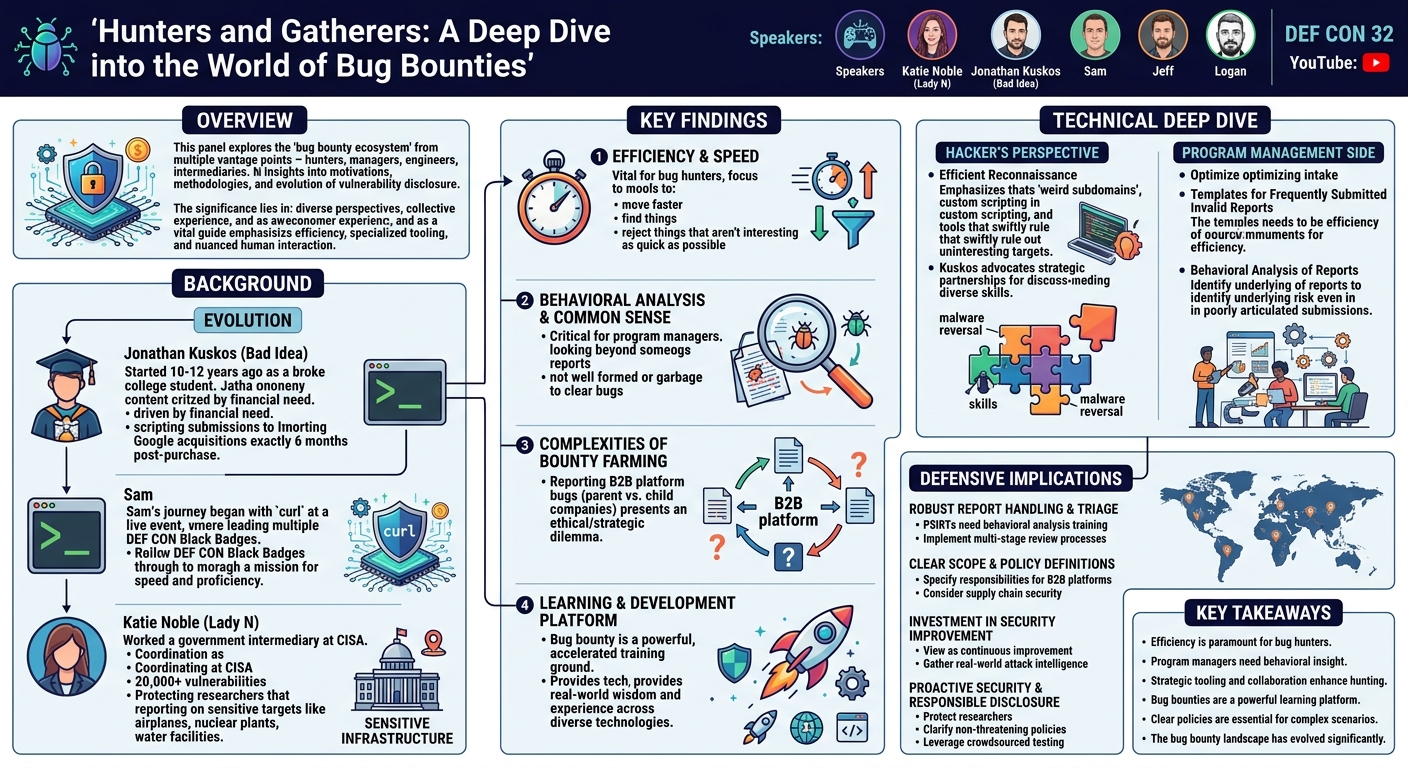
This DEF CON 32 panel, "Hunters and Gatherers: A Deep Dive into the World of Bug Bounties," offers a comprehensive exploration of the bug bounty ecosystem from multiple vantage points. Featuring a diverse group of experts—from seasoned bug bounty hunters and program managers to security engineers at tech giants and government intermediaries—the discussion provides invaluable insights into the motivations, methodologies, challenges, and evolution of vulnerability disclosure. The panel dissects the intricate dynamics between those who hunt for vulnerabilities and those who manage the programs designed to receive and remediate them, highlighting both the technical and behavioral aspects crucial for success on either side.
Key moments
- 0:00 Panelist introductions and talk overview
- 0:30 Katie Noble's background: government, Fortune 50, 20k vulns
- 1:45 Sam's role running Google's bug bounty programs
- 2:00 Jeff's passion for building bug bounty programs from scratch
- 2:20 Kuskos's origin: broke student, Google acquisitions
- 6:00 Katie Noble's journey: live hacking event with curl
Hunters and Gatherers: A Deep Dive into the World of Bug Bounties
Speakers: Katie Noble (Lady N), Jonathan Kuskos (Bad Idea), Sam, Jeff, Logan
Conference: DEF CON 32
YouTube: https://www.youtube.com/watch?v=9IN1Aj56hYA
Overview
This DEF CON 32 panel, "Hunters and Gatherers: A Deep Dive into the World of Bug Bounties," offers a comprehensive exploration of the bug bounty ecosystem from multiple vantage points. Featuring a diverse group of experts—from seasoned bug bounty hunters and program managers to security engineers at tech giants and government intermediaries—the discussion provides invaluable insights into the motivations, methodologies, challenges, and evolution of vulnerability disclosure. The panel dissects the intricate dynamics between those who hunt for vulnerabilities and those who manage the programs designed to receive and remediate them, highlighting both the technical and behavioral aspects crucial for success on either side.
The talk is particularly significant because it brings together perspectives from individuals who have either built bug bounty programs from the ground up, achieved significant recognition as hunters (including multiple DEF CON Black Badges), or played critical roles in mediating complex vulnerability disclosures at a national level. Their collective experience illuminates the journey of bug bounties from a nascent, informal practice to a sophisticated, commercialized industry. For security professionals, aspiring hackers, and organizations considering implementing their own bug bounty initiatives, this panel serves as a vital guide, emphasizing the strategic importance of efficiency, specialized tooling, and nuanced human interaction in the pursuit of a more secure digital landscape.
Background
▶ Watch: Panelist introductions and talk overview (0:00)
The concept of incentivizing security researchers to find and report vulnerabilities, rather than exploit them, has evolved significantly over the past decade or more. Jonathan Kuskos, known as Bad Idea, vividly recounts his entry into the bug bounty world approximately 10 to 12 years ago, a time predating the widespread commercial platforms like HackerOne and Bugcrowd. His initial motivation was starkly pragmatic: as a broke college student burdened with six-figure student loan debt, bug bounties offered a lucrative moonlighting opportunity beyond his entry-level penetration testing job. This era required a more resourceful approach, as Kuskos would actively seek out newly acquired Google companies. Google's policy at the time allowed vulnerability submissions only after they had owned an acquisition for six months. Kuskos would meticulously find these acquisitions, discover vulnerabilities, and then strategically "sit on them" until the six-month mark, scripting submissions to fire precisely at 12:01 AM on the eligible date to maximize his chances. This anecdote underscores the early, less structured, but highly competitive nature of the bug bounty landscape.
Sam, another panelist and a security engineer at Google with multiple DEF CON Black Badges, shared a different entry point. His journey began at a live hacking event in New York City where he found himself using rudimentary tools like curl, observing other hackers operate with far greater speed and efficiency. This experience ignited a mission to enhance his speed and become a more proficient bug bounty hunter, eventually leading him to win similar events. This highlights the practical, skill-driven aspect of bug hunting and the continuous drive for improvement.
Katie Noble, or Lady N, brought a unique governmental perspective to the panel. With 15 years in the US government, including a significant tenure at what is now CISA (then part of Homeland Security), her background in behavioral analysis proved invaluable. She acted as an intermediary, mediating between security researchers being threatened by companies and the companies themselves. Her role involved leveraging legal backing to protect researchers reporting critical vulnerabilities, some of which pertained to highly sensitive infrastructure like airplanes, nuclear power plants, and water treatment facilities. This crucial function established a foundation for responsible disclosure, bridging the gap between independent researchers and powerful organizations, and demonstrating the importance of trust and mediation in the vulnerability disclosure process. These diverse origin stories collectively paint a picture of an industry born out of necessity, driven by financial incentives and a passion for security, and gradually maturing into a formalized, yet still dynamic, field.
Key Findings
▶ Watch: Sam's role running Google's bug bounty programs (1:45)
The panel discussion unveiled several key findings regarding the contemporary state and strategic approaches within the bug bounty world, dissecting it from both the hunter's and the program manager's perspectives.
Firstly, a recurring theme was the paramount importance of efficiency and speed for successful bug hunting. Sam explicitly stated that the most valuable tools and techniques are those that enable a researcher to "move faster," "find things," and, crucially, "reject things that aren't interesting as quick as possible." This rapid triage allows hunters to cover more ground, examine a greater number of targets, and ultimately increase their chances of success. This efficiency extends beyond individual targets to strategic target identification, such as looking for "weird subdomains" or less obvious entry points.
Secondly, the panel highlighted the critical role of behavioral analysis and common sense in program management. Katie Noble, drawing from her extensive experience coordinating over 20,000 cybersecurity vulnerabilities, emphasized that not all valuable reports arrive in a perfectly structured or "well-formed" manner. She stressed the importance of engineers thoroughly investigating reports that might initially appear "incomplete or not well formed or just garbage," as some of the "very best critical vulnerabilities" can be hidden within them. This finding underscores that effective vulnerability management is not purely technical but requires a nuanced understanding of human behavior and the ability to look beyond superficial presentation.
Thirdly, the discussion brought to light the complexities and ethical considerations surrounding "bounty farming." Jonathan Kuskos defined this as a scenario where a vulnerability exists in a Business-to-Business (B2B) platform, which is then used by numerous customer companies. The question arises whether a researcher should report the vulnerability to the main parent company or to all the individual "child companies" who might have their own security teams and potentially offer separate bounties. Kuskos's personal stance leans towards reporting to the main parent company, implying a single responsible entity for the core vulnerability. This dilemma points to a systemic challenge in the bug bounty landscape, particularly with widely adopted software or services, where the line of responsibility and appropriate disclosure can become blurred.
Finally, the panelists underscored the immense value of bug bounty hunting as a learning and development platform for security professionals. Kuskos noted that engaging in bug bounties, especially in the real world outside of client-scoped engagements, exposes hunters to "various different maturities" and a "lot of different technologies really fast." This rapid exposure helps expand a hunter's "caliber," providing "real-world wisdom and experience very, very quickly" by observing how different organizations implement the same technologies in diverse ways. This highlights bug bounties not just as a source of income or a means of improving security, but as a powerful, accelerated training ground for offensive security skills.
Technical Deep Dive
▶ Watch: Jeff's passion for building bug bounty programs from scratch (2:00)
The technical deep dive into bug bounty hunting and program management, as presented by the panel, focuses less on specific exploit code and more on strategic methodologies, tooling philosophy, and the intricate dance between human intuition and automated processes.
From the hacker's perspective, the emphasis is overwhelmingly on efficiency and intelligent reconnaissance. Sam's initial experience with curl at a live hacking event served as a catalyst for him to pursue faster and more effective techniques. He advocates for tools that not only identify vulnerabilities but also swiftly rule out uninteresting targets. This involves sophisticated reconnaissance techniques, such as looking for "weird subdomains" or unconventional entry points that might be overlooked by others. While not explicitly named, this suggests the use of tools for subdomain enumeration (e.g., Subfinder, Amass), content discovery (e.g., DirBuster, Gobuster), and potentially custom scripting to automate repetitive tasks.
Jonathan Kuskos further refined this by stressing the importance of aligning tools with one's vertical expertise. He illustrated this by contrasting web application security specialists, who might deeply leverage tools like Burp Suite for proxying, modifying requests, and identifying web vulnerabilities, with those focused on network or endpoint security, for whom Burp Suite might be less relevant. This highlights a nuanced understanding that no single "magic tool" exists; rather, effective hunters build a toolkit tailored to their specific area of strength. Kuskos also advocated for strategic partnerships, where hunters collaborate with others who possess complementary skills. For instance, if he were to find malware on a machine, instead of spending "20 hours trying to figure out how to reverse it" – a personal weakness – he would partner with a friend skilled in malware reversal. This demonstrates an advanced, collaborative approach to bug hunting, where leveraging collective intelligence can lead to more impactful findings. His early-day approach of scripting submissions to Google acquisitions at 12:01 AM also showcases an early form of automation and strategic timing to gain an edge.
On the program management side, the technical discussion veered towards optimizing the intake and handling of vulnerability reports. Sam mentioned the utility of templates for responding to frequently submitted invalid reports. This is a crucial efficiency measure, as program managers often face a deluge of low-quality or out-of-scope submissions. Automating responses for these common cases frees up valuable time for security engineers to focus on legitimate and critical findings.
Katie Noble's insights highlighted the blend of technical assessment with behavioral analysis. While not a "technical tool" in the traditional sense, her "common sense" approach to reviewing reports is a critical component of effective vulnerability management. She emphasized the need for engineers to look beyond superficial flaws in a report's presentation, as some of the most critical vulnerabilities might be poorly articulated. This implies a need for robust Product Security Incident Response Team (PSIRT) processes, where initial triage is followed by deeper technical investigation, even for seemingly "garbage" reports. The ability to identify underlying risk, despite a researcher's communication style, is paramount. This also suggests the use of internal ticketing systems and vulnerability management platforms that allow for detailed tracking, collaboration, and escalation of reports, ensuring no critical vulnerability falls through the cracks due to a lack of initial clarity.
In essence, the technical deep dive from the panel emphasizes a holistic approach: for hunters, it's about efficient reconnaissance, specialized tooling, and smart collaboration; for program managers, it's about streamlined processes, intelligent triage, and the human element of discernment.
Demo / Proof of Concept
▶ Watch: Kuskos's origin: broke student, Google acquisitions (2:20)
The panel discussion "Hunters and Gatherers: A Deep Dive into the World of Bug Bounties" was primarily an expert panel discussion focused on experiences, methodologies, and strategic insights. As such, no specific technical demonstration or proof of concept was presented during the talk. The speakers shared anecdotal evidence and general principles rather than live hacking or code walkthroughs.
Defensive Implications
▶ Watch: Katie Noble's journey: live hacking event with curl (6:00)
The insights shared by the panel offer several critical defensive implications for organizations, whether they currently operate a bug bounty program or are considering establishing one.
Firstly, organizations running bug bounty programs must prioritize robust report handling and triage mechanisms. Katie Noble's experience underscores that critical vulnerabilities can often be obscured by poorly written or incomplete reports. This means defensive teams, particularly Product Security Incident Response Teams (PSIRTs), need to be trained not just in technical validation but also in behavioral analysis—the ability to discern potential severity despite initial presentation. Implementing a multi-stage review process where reports are thoroughly investigated, rather than immediately dismissed based on superficial quality, is crucial. Furthermore, adopting tools and workflows that allow for efficient categorization and response, such as template-based replies for common invalid reports, can significantly reduce overhead and allow security engineers to focus on high-value issues.
Secondly, the discussion around "bounty farming" highlights the necessity for clear program scope and policy definitions. For companies developing B2B platforms, it is imperative to explicitly state who is responsible for receiving and rewarding reports for vulnerabilities found in their core platform versus instances deployed by their customers. A clear policy can prevent confusion, reduce duplicate reports, and ensure that the primary vendor is incentivized to fix foundational issues. This also implies that organizations should consider the security implications of their supply chain and the software they integrate, understanding that a vulnerability in a third-party component could lead to widespread issues across their ecosystem.
Thirdly, organizations should view bug bounty programs not merely as a cost center but as an investment in continuous security improvement and talent development. Kuskos's point about bug bounties accelerating a hunter's learning curve suggests that companies can leverage this external expertise to rapidly identify weaknesses across diverse technologies. For internal security teams, engaging with bug bounty reports provides invaluable real-world attack intelligence, helping them understand evolving attacker methodologies and prioritize defensive efforts more effectively. Building strong relationships with the bug bounty community, fostering trust, and ensuring fair compensation are key to attracting top talent to contribute to an organization's security posture.
Finally, the panel implicitly encourages a culture of proactive security and responsible disclosure. Katie Noble's past role as a government intermediary highlights the importance of protecting researchers and fostering an environment where vulnerabilities can be reported without fear of reprisal. Organizations should ensure their disclosure policies are clear, non-threatening, and emphasize collaboration. By embracing bug bounties, companies are essentially crowdsourcing their security testing, gaining access to a breadth of perspectives and specialized skills that internal teams might lack, ultimately leading to a more resilient and secure product or service.
Key Takeaways
- Efficiency is paramount for bug hunters: Successful bug bounty hunting relies heavily on the ability to quickly identify promising targets, efficiently test them, and rapidly dismiss uninteresting leads to maximize coverage and success rates.
- Program managers need behavioral insight: Effective bug bounty program management extends beyond technical validation, requiring "common sense" and behavioral analysis to thoroughly investigate reports, as critical vulnerabilities can often be disguised within poorly articulated submissions.
- Strategic tooling and collaboration enhance hunting: Hunters should align their security tools with their specific vertical expertise and be open to collaborating with others who possess complementary skills (e.g., malware analysis) to tackle complex vulnerabilities more effectively.
- Bug bounties are a powerful learning platform: Engaging in bug bounty hunting provides unparalleled real-world experience, exposing researchers to diverse technologies and implementation styles, thereby rapidly enhancing their skills and understanding of security in practice.
- Clear policies are essential for complex scenarios: Issues like "bounty farming" in B2B contexts necessitate clear, well-defined program scopes and responsible disclosure policies to ensure vulnerabilities are reported to the appropriate entity and researchers are fairly compensated.
- The bug bounty landscape has evolved significantly: From informal responsible disclosure and manual effort (like Kuskos's Google acquisition strategy) to the prevalence of commercial platforms like HackerOne and Bugcrowd, the industry offers more structured opportunities for both hunters and organizations.
About the Speaker(s)
The panel featured a diverse group of experts, each bringing a unique perspective to the bug bounty ecosystem:
- Katie Noble (Lady N): A prominent figure in the security community, Katie leads the Policy Village at DEF CON. With a background in behavioral analysis, she spent approximately 15 years in the US government, including a significant role at an agency now known as CISA (then part of Homeland Security), where she coordinated over 20,000 cybersecurity vulnerabilities and acted as an intermediary between researchers and companies. She currently manages Product Security Incident Response and bug bounty programs for a large Fortune 50 company.
- Jonathan Kuskos (Bad Idea): Known for his dual expertise, Jonathan is the founder of Chaotic Good Information Security. He has experience as both a full-time bug bounty hunter and a manager of responsible disclosure programs. His background is rooted in offensive security, red teaming, and penetration testing, focusing on identifying true vulnerabilities, developing fixes, and effectively communicating these findings to engineers.
- Sam: A security engineer at Google, Sam plays a crucial role in running one of Google's nine bug bounty programs, including the core google.com program. His dedication to bug hunting is evidenced by his achievement of multiple DEF CON Black Badges.
- Jeff: A Senior Security Engineer at GitHub, Jeff is deeply involved in their bug bounty program. He is passionate about building bug bounty programs, having experience in developing both private and public initiatives "from nothing to full scope programs."
- Logan: Also working at GitHub alongside Jeff, Logan contributes to running their bug bounty program. He served as a co-host and moderator for the panel, facilitating the discussion among the experts.