Cybersecurity Schoolhouse Rock
Avi McGrady
DEF CON 32 Creator Stage · Day 1 · Creator Stage
Overview
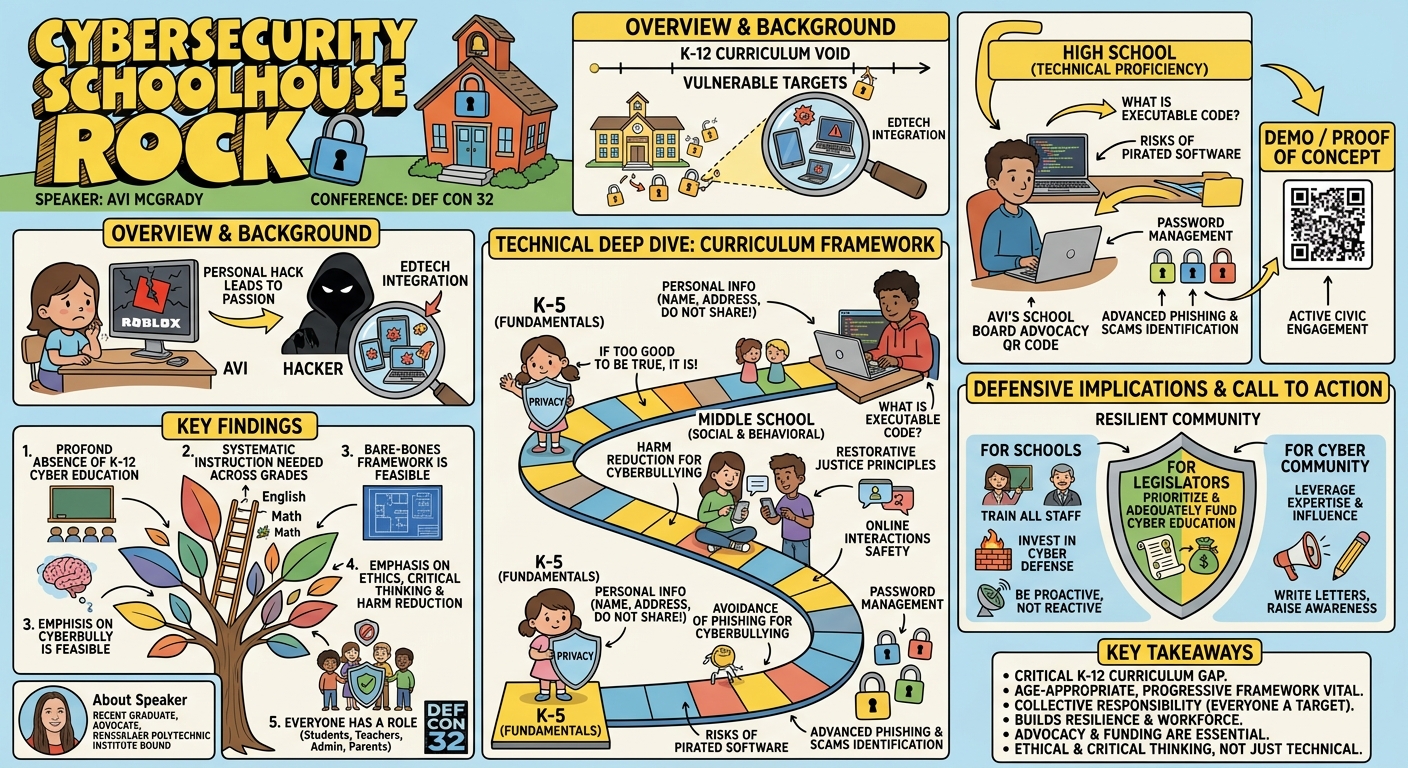
In "Cybersecurity Schoolhouse Rock," Avi McGrady presents a compelling and urgent call to action for integrating cybersecurity first principles into the kindergarten through 12th-grade (K-12) education system. Drawing from her personal experience as a high school graduate and a victim of a childhood Roblox account hack, McGrady highlights the widespread absence of foundational cybersecurity curriculum in schools across the nation. Her talk serves as both a critical analysis of the current educational void and a practical framework for addressing it, emphasizing the necessity of equipping students, teachers, and administrative staff with essential digital literacy and defense skills.
Key moments
- 0:00 Speaker's introduction and personal motivation
- 2:00 Key cyber problems facing kids and schools
- 3:00 Bo Woods' insights: deeper, broad-based cyber education
- 4:00 Josh Corman's insights: cybersecurity training for everyone
- 5:00 Critical gaps in current school cybersecurity curriculum
- 5:50 Proposed K-12 cybersecurity curriculum framework
- 6:50 Call to action for a cyber-resilient society
Cybersecurity Schoolhouse Rock
Speakers: Avi McGrady
Conference: DEF CON 32
YouTube: https://www.youtube.com/watch?v=BE0va6f3QwE
Overview
In "Cybersecurity Schoolhouse Rock," Avi McGrady presents a compelling and urgent call to action for integrating cybersecurity first principles into the kindergarten through 12th-grade (K-12) education system. Drawing from her personal experience as a high school graduate and a victim of a childhood Roblox account hack, McGrady highlights the widespread absence of foundational cybersecurity curriculum in schools across the nation. Her talk serves as both a critical analysis of the current educational void and a practical framework for addressing it, emphasizing the necessity of equipping students, teachers, and administrative staff with essential digital literacy and defense skills.
The presentation underscores that in an era dominated by educational technology (EdTech) and increasing online threats, cybersecurity is no longer an optional subject but a fundamental life skill. McGrady argues that early intervention and systematic education are crucial for developing good digital habits and fostering a more resilient society. By teaching children about online safety, privacy, ethical behavior, and the mechanics of cyber threats from a young age, schools can proactively combat the rising tide of cybercrime, protect vulnerable populations, and cultivate the next generation of cybersecurity professionals.
This talk is particularly significant because it comes from the perspective of a young person directly impacted by the problem and actively engaged in seeking solutions. McGrady's initiative to challenge her local school board and develop a curriculum framework demonstrates a proactive approach to a systemic issue. Her insights, bolstered by interviews with industry luminaries, provide a potent argument for comprehensive cybersecurity education as a critical component of modern schooling, essential for safeguarding individuals and institutions alike.
Background
▶ Watch: Speaker's introduction and personal motivation (0:00)
The genesis of Avi McGrady's passion for cybersecurity education stems from a personal incident at the age of eight, when her Roblox account was hacked, resulting in the loss of all her in-game assets. This formative experience, rather than deterring her, ignited a curiosity about the mechanisms of cyber threats and a desire to prevent similar incidents for herself and her peers. However, upon seeking formal education in cybersecurity within her school system, McGrady discovered a significant void: a complete absence of relevant classes or structured curriculum. This personal realization quickly expanded into a broader understanding that the lack of cybersecurity curriculum is a pervasive problem in educational institutions nationwide.
McGrady identifies several critical factors contributing to this educational deficit and its severe consequences. Firstly, schools themselves are frequent and vulnerable targets for cyber attacks, often operating with under-resourced cyber defense capabilities. This makes every student, teacher, and administrative staff member a potential entry point for attackers seeking to exploit sensitive data or disrupt operations. Secondly, the increasing integration of EdTech into daily learning necessitates that all users possess a foundational understanding of online risks. Without this, the very tools designed to enhance education become vectors for compromise.
The talk meticulously outlines the specific threats that a lack of cybersecurity education exacerbates across different age groups:
- Scams and phishing disproportionately target the youngest and oldest demographics, exploiting naivety or lack of technical awareness.
- Bullying and trolling are amplified by the internet, with the emergence of generative AI tools making it alarmingly easy to create and disseminate harmful content, such as non-consensual fake images, to harass classmates.
- Older students, gaining more autonomy, face risks like malware embedded in pirated software shared on platforms like Discord or other online chats. As they achieve financial freedom, the need to protect payment cards and other financial information becomes paramount.
McGrady argues that simply laying down rules is ineffective; true understanding and "buy-in" are essential. Students need to comprehend why these rules exist, how attackers operate, and the real-world negative consequences of becoming a victim. To bolster her arguments, McGrady interviewed prominent figures in the cybersecurity community. Bo Woods, a founder of the DEF CON villages, emphasized the need for "more than surface level instruction," advocating for a broad-based, multi-grade cybersecurity curriculum that revisits concepts with increasing detail. He stressed that understanding the "padlock in the browser address bar" goes beyond mere recognition to comprehending its underlying meaning and purpose. Similarly, Josh (Joshua Corman), a founder of the I Am The Cavalry project and organizer of Hackers on the Hill, highlighted that cybersecurity is an organizational responsibility, requiring involvement from everyone—not just IT staff, but teachers, administrators, and even those without a direct career interest in technology.
The current curriculum, McGrady asserts, is missing critical components: basic online privacy and safety instruction, education on password managers, guidance on ethical behavior online, and crucial online critical thinking skills to counter misinformation and disinformation. In essence, most fundamental cybersecurity concepts are not being taught in a systematic, widespread manner.
Key Findings
▶ Watch: Bo Woods' insights: deeper, broad-based cyber education (3:00)
Avi McGrady's research and advocacy reveal several pivotal findings concerning the state and future of cybersecurity education in K-12 schools. The overarching discovery is a profound and widespread absence of foundational cybersecurity instruction across all grade levels, leaving an entire generation vulnerable to escalating digital threats.
Firstly, McGrady empirically demonstrates that despite the pervasive integration of technology into daily life and education, cybersecurity education is largely absent in K-12 curricula. This gap is not merely a minor oversight but a systemic failure that leaves students unprepared for the realities of the digital world, mirroring her own experience with the Roblox hack. The existing educational frameworks fail to equip young people with the essential knowledge needed for safe, ethical, and secure online engagement.
Secondly, the talk firmly establishes that a systematic, widespread instruction is needed across all grades and subjects. Cybersecurity cannot be siloed as an elective or a topic for advanced IT students. Instead, its principles must be woven into the fabric of general education, introduced at early ages, and revisited with increasing complexity as students mature. This continuous exposure ensures that concepts like privacy, critical thinking, and threat identification become ingrained habits rather than isolated facts.
Thirdly, McGrady's development of a bare-bones framework curriculum proves that a structured, age-appropriate educational pathway is not only feasible but essential. This framework, detailed in the Technical Deep Dive, illustrates how complex cybersecurity concepts can be broken down and introduced progressively, from basic privacy for kindergarteners to understanding executable code for older students. This finding directly counters any notion that cybersecurity is too complex for young learners.
Fourthly, the problem extends significantly beyond just technical skills. McGrady highlights that effective cybersecurity education must also encompass ethical behavior, critical thinking, and harm reduction. Issues like cyberbullying, online misinformation, and the responsible use of generative AI tools require a holistic approach that integrates social and ethical considerations alongside technical safeguards. This broader scope acknowledges the human element as a primary vector for both attack and defense.
Finally, the talk emphasizes that everyone—students, teachers, administrators, parents, and legislators—has a crucial role to play in addressing this educational crisis. Cybersecurity is a collective responsibility, and its successful implementation in schools requires widespread buy-in, advocacy, and funding. The "cyber ignorance" that currently pervades society can only be overcome through a unified effort to educate and empower all stakeholders.
Technical Deep Dive
▶ Watch: Josh Corman's insights: cybersecurity training for everyone (4:00)
Avi McGrady's talk, while focused on pedagogical strategy, provides a crucial "technical deep dive" into the content that should form the backbone of a comprehensive K-12 cybersecurity curriculum. Her framework curriculum is structured to progressively introduce increasingly complex concepts, moving beyond superficial advice to foster genuine understanding of digital risks and defenses.
For the youngest learners, kindergarten through fifth graders, the curriculum focuses on fundamental concepts of online privacy. This involves teaching children what information is personal and why it is dangerous to share details about themselves online. The instruction aims to internalize the critical principle: "When it seems too good to be true, it usually is." This simple yet powerful adage serves as an early warning system against common phishing attempts and malware avoidance strategies, even before children fully grasp the technical underpinnings of these threats. The goal is to build an intuitive sense of caution and skepticism towards unsolicited offers or requests online.
As students transition into middle school, the curriculum expands to address more nuanced social and behavioral aspects of online interaction. A key focus here is harm reduction strategies for cyberbullying. McGrady advocates for the introduction of restorative justice principles to help address the consequences of online harassment, emphasizing empathy and repair over punitive measures. Furthermore, students are taught how to interact safely with individuals they only know online and have never met in person, a critical skill in an age of pervasive social media and online gaming communities. This includes understanding the risks of disclosing personal information or arranging in-person meetings with unknown online contacts.
For older students, as they become more tech proficient, the curriculum delves into more advanced technical concepts. This includes explaining "what is executable code" and outlining the potential consequences of running such code when its origin or purpose is unknown. This demystifies the abstract nature of software and helps students understand the direct impact of their digital actions. Alongside this, the curriculum revisits and deepens understanding of phishing, online fraud, and scams, equipping students with more sophisticated techniques for identification and prevention. Crucially, password management is introduced, moving beyond simply creating strong passwords to understanding the importance of unique passwords for different services and the utility of password managers as essential security tools. This shift from rote memorization to systemic security practices is vital.
The "technical deep dive" also implicitly incorporates the insights from Bo Woods and Josh. Bo Woods' emphasis on "more than surface level instruction" means moving beyond simply telling kids to "look for the padlock" to explaining what the padlock means – the underlying TLS/SSL encryption it represents, and why it's even there – to secure communication between a user and a website. This foundational understanding builds genuine digital literacy rather than just compliance. Josh's point about including everyone in cybersecurity training extends to all students, ensuring that even those not pursuing tech careers understand the technical basics required for everyday digital safety. The curriculum also implicitly includes the technical aspects of identifying and countering online misinformation and disinformation, which requires a critical understanding of how information is shared, manipulated, and consumed online. This cognitive "deep dive" into information integrity is as crucial as understanding code.
Demo / Proof of Concept
▶ Watch: Proposed K-12 cybersecurity curriculum framework (5:50)
Avi McGrady's talk does not feature a traditional technical demonstration or a proof of concept in the sense of exploiting vulnerabilities or showcasing a new tool. Instead, her presentation itself serves as a powerful demonstration of her advocacy and a proof of concept for the feasibility and necessity of her proposed educational framework.
McGrady mentions her direct engagement with her school board, challenging them to implement cybersecurity education. She provides a QR code linking to the public comment she delivered at a board meeting, which stands as a tangible artifact of her advocacy efforts. This act of civic engagement and direct appeal to educational authorities is her "proof of concept" that a young person can identify a systemic problem and actively work towards its resolution. While not a technical exploit, this demonstrates the real-world application of her passion and the initial steps towards implementing the changes she advocates for. Her framework curriculum, discussed in the technical deep dive, is the theoretical "proof of concept" that such education is achievable and can be structured effectively across different age groups.
Defensive Implications
▶ Watch: Call to action for a cyber-resilient society (6:50)
The defensive implications of Avi McGrady's "Cybersecurity Schoolhouse Rock" are profound and far-reaching, extending beyond individual protection to encompass the resilience of educational institutions and society at large. Her call to action provides a roadmap for proactive defense against the escalating threat landscape.
For Schools and School Districts: The primary defensive implication is the urgent need to implement comprehensive K-12 cybersecurity curriculum. This means moving beyond a reactive stance to a proactive one, embedding cybersecurity first principles into the core educational offering. A cyber smart administration and staff are crucial; as McGrady points out, schools are frequent targets for ransomware and other cyber crime, often under-resourced in IT. By training all personnel—teachers, administrators, counselors, and support staff—schools can transform every employee into a potential sensor and first responder, significantly bolstering their collective defense posture. This distributed awareness can protect sensitive student data, financial records, and operational integrity more effectively than a small, overburdened IT team alone. Furthermore, schools must actively invest in their own cyber defense capabilities, recognizing that the cost of prevention is far less than the cost of recovery from a breach or ransomware attack.
For Parents and Guardians: The talk implicitly urges parents to foster an environment of cyber awareness at home. By understanding the curriculum their children are exposed to, parents can reinforce lessons on online privacy, safe online interactions, and critical thinking. This collaboration between home and school creates a robust defense layer around children, protecting them from scams, phishing, cyberbullying, and exposure to harmful content.
For Legislators and State Boards of Education: McGrady's message is a direct challenge to policymakers: prioritize and adequately fund cybersecurity public education. Without legislative mandates and dedicated financial resources, the implementation of widespread K-12 cybersecurity education will remain an uphill battle. Investing in this area is an investment in national security and economic stability, as it directly contributes to reducing the "pool of cyber crime victims" and building a more resilient society.
For the Broader Cybersecurity Community (including hackers): McGrady explicitly calls upon the cybersecurity community to leverage their expertise and influence. This means writing letters to legislators, raising awareness among family and friends, and advocating for educational reform. The community's unique understanding of the gravity of the situation makes them powerful allies in driving this change. By championing early education, the community can help "dig our way out of the whole of cyber ignorance we live in," addressing the root cause of many cybersecurity challenges. This collective effort is essential for developing a larger, more capable cybersecurity workforce and for breaking the "vicious cycle" that perpetuates cybercrime victimization.
In essence, the defensive implications coalesce around a fundamental shift: from viewing cybersecurity as a niche technical problem to recognizing it as a universal literacy requirement, demanding a comprehensive, multi-stakeholder educational response.
Key Takeaways
- Critical Gap in K-12 Education: There is a widespread and critical absence of cybersecurity curriculum in kindergarten through 12th-grade schools, leaving students, teachers, and staff vulnerable to escalating online threats.
- Systematic, Age-Appropriate Curriculum is Vital: Effective cybersecurity education requires a structured framework curriculum that introduces cybersecurity first principles at an early age (K-5), progressively building on concepts like online privacy, ethical behavior online, harm reduction for cyberbullying, password management, and understanding executable code through middle and high school.
- Everyone is a Target and Needs Training: Cybersecurity is a collective responsibility; all members of a school community—students, teachers, administrators, and IT staff—are potential targets and require foundational training to protect against ransomware, phishing, malware, and other cyber crime.
- Early Education Builds Resilience and Workforce: Teaching cybersecurity basics from a young age helps develop good digital habits, reduces the "pool of cyber crime victims," and is crucial for cultivating a larger, more capable cybersecurity workforce to address future challenges.
- Advocacy and Funding are Essential: Implementing widespread cybersecurity education requires proactive advocacy from the cybersecurity community, parents, and students, along with committed funding and policy changes from legislators and state boards of education.
- Beyond Technical Skills: Ethical and Critical Thinking: Comprehensive cybersecurity education extends beyond technical safeguards to include crucial elements like online critical thinking skills to counter misinformation and disinformation, and fostering ethical behavior online to address issues like cyberbullying and the misuse of generative AI tools.
About the Speaker(s)
Avi McGrady is a recent high school graduate from New Vista High School in Boulder, Colorado, who will be attending Rensselaer Polytechnic Institute in the fall. Her journey into cybersecurity began at the age of eight after her Roblox account was hacked, an experience that fueled her interest in understanding and preventing cyber incidents. Recognizing a significant gap in K-12 education, McGrady took the initiative to challenge her local school board to implement cybersecurity education and developed a bare-bones framework curriculum. She conducted interviews with prominent cybersecurity figures like Bo Woods and Josh (Joshua Corman) to inform her project, demonstrating a proactive and analytical approach to addressing a systemic educational problem. McGrady attributes significant mentorship and guidance to Andrew Brandt, acknowledging his crucial support in her work. Her presentation at DEF CON 32 underscores her dedication to advocating for widespread cybersecurity literacy among young people.