Differential privacy beyond algorithm: Challenges for deployment
Rachel Cummings
DEF CON 32 Creator Stage · Day 1 · Creator Stage
Overview
In this DEF CON 32 talk, Professor Rachel Cummings of Columbia University introduced the foundational concepts of Differential Privacy (DP), a powerful and mathematically rigorous framework for analyzing sensitive datasets while safeguarding individual privacy. The talk, titled "Differential privacy beyond algorithm: Challenges for deployment," aimed to move past theoretical definitions to address the practical hurdles of implementing DP in real-world scenarios.
Key moments
- 0:00 Talk introduction and speaker welcome
- 1:00 Database analysis and need for privacy
- 1:54 Defining privacy as freedom from harm
- 2:18 Core informal definition of differential privacy
- 2:40 Visualizing differential privacy with probability curves
Differential privacy beyond algorithm: Challenges for deployment
Speakers: Rachel Cummings, Professor, Columbia University
Conference: DEF CON 32
YouTube: https://www.youtube.com/watch?v=3kA6oLhPbbs
Overview
In this DEF CON 32 talk, Professor Rachel Cummings of Columbia University introduced the foundational concepts of Differential Privacy (DP), a powerful and mathematically rigorous framework for analyzing sensitive datasets while safeguarding individual privacy. The talk, titled "Differential privacy beyond algorithm: Challenges for deployment," aimed to move past theoretical definitions to address the practical hurdles of implementing DP in real-world scenarios.
While the speaker acknowledged some initial technical difficulties and the need to skip certain slides, the core of the presented content focused on providing a comprehensive and intuitive understanding of what differential privacy is and why it matters. This foundational explanation is crucial for anyone engaging with data privacy, from researchers and data scientists to policymakers and security professionals, as it underpins the ability to extract valuable insights from data without compromising the privacy of individuals contributing to that data.
The overarching goal of differential privacy, as articulated by Professor Cummings, is to promise individuals "freedom from harm"—ensuring that no adverse outcome befalls them simply because their data was included in an analysis. This principle is not merely a philosophical stance but is encoded in the mathematical guarantees of DP, making it a critical tool in an era of increasing data collection and privacy concerns.
Background
▶ Watch: Talk introduction and speaker welcome (0:00)
The pervasive collection and analysis of personal data in modern society present a fundamental tension: the desire to extract valuable insights and drive innovation often clashes with the imperative to protect individual privacy. Traditional methods of data anonymization, such as removing direct identifiers like names or social security numbers, have repeatedly proven insufficient. Research has demonstrated that even seemingly anonymized datasets can be vulnerable to re-identification attacks, where sophisticated adversaries can link seemingly innocuous public information with private records, thereby exposing sensitive details about individuals. The inherent fragility of these methods necessitated a more robust and mathematically provable approach to privacy.
This is where Differential Privacy emerges as a transformative concept. Developed in the mid-2000s, DP provides a strong, quantifiable guarantee that an individual's presence or absence in a dataset does not significantly alter the outcome of a statistical analysis. It offers a cryptographic-like assurance, making it incredibly difficult for an attacker, even with auxiliary information, to infer anything specific about an individual from the published results of a query. This rigorous guarantee distinguishes DP from weaker privacy notions and has led to its adoption by major technology companies like Apple, Google, and Microsoft, as well as government agencies like the U.S. Census Bureau, for various applications ranging from collecting user analytics to publishing demographic statistics.
Professor Cummings framed the problem with a mental model involving a database, an analyst, and the flow of queries and answers. In this model, an analyst sends queries to a database, receives answers, and eventually makes a "scientific discovery" or produces a publishable dataset. The critical insight is the need for a "privacy preserving barrier" at various points in this process. This barrier could be placed between the raw database and the analyst, especially if the analyst is not fully trusted, or between the analyst and the publicly viewed outputs. The core problem DP addresses is how to construct this barrier in a way that truly protects individuals, ensuring that their decision to share data does not lead to any unique harm or revelation.
Key Findings
▶ Watch: Database analysis and need for privacy (1:00)
The primary "finding" or contribution of this talk, as presented in the transcript, is a clear, intuitive, and visually reinforced definition of Differential Privacy. While the talk's title promised a discussion on "challenges for deployment," the speaker devoted the available time to meticulously establishing this fundamental understanding, which is a prerequisite for tackling any practical implementation issues. The core insight conveyed is the elegant mathematical formulation that underpins DP, offering a robust promise of privacy.
Professor Cummings introduced the informal definition: "Some analysis of a data set is going to be private if an analyst can know almost no more about Alice afterwards than he would have known had he conducted the same analysis on an identical database with Alice's data removed." This statement encapsulates the essence of DP – that an individual's participation in a dataset should not lead to any discernible difference in the analysis results from their non-participation. This "freedom from harm" principle is the cornerstone of differential privacy, ensuring that individuals are protected from specific inferences or re-identification attempts.
The talk further elaborated on this by explaining that DP allows for the learning of general truths and population-level statistics, such as "smoking causes cancer," without exposing sensitive individual attributes like "your specific health information." This distinction highlights DP's unique ability to balance data utility with privacy. While the detailed "challenges for deployment" were not explicitly covered in the provided transcript, the profound explanation of DP's definition serves as a critical foundation for understanding why deploying such a rigorous privacy standard can indeed be complex, requiring careful consideration of noise parameters, data utility, and system design.
Technical Deep Dive
▶ Watch: Defining privacy as freedom from harm (1:54)
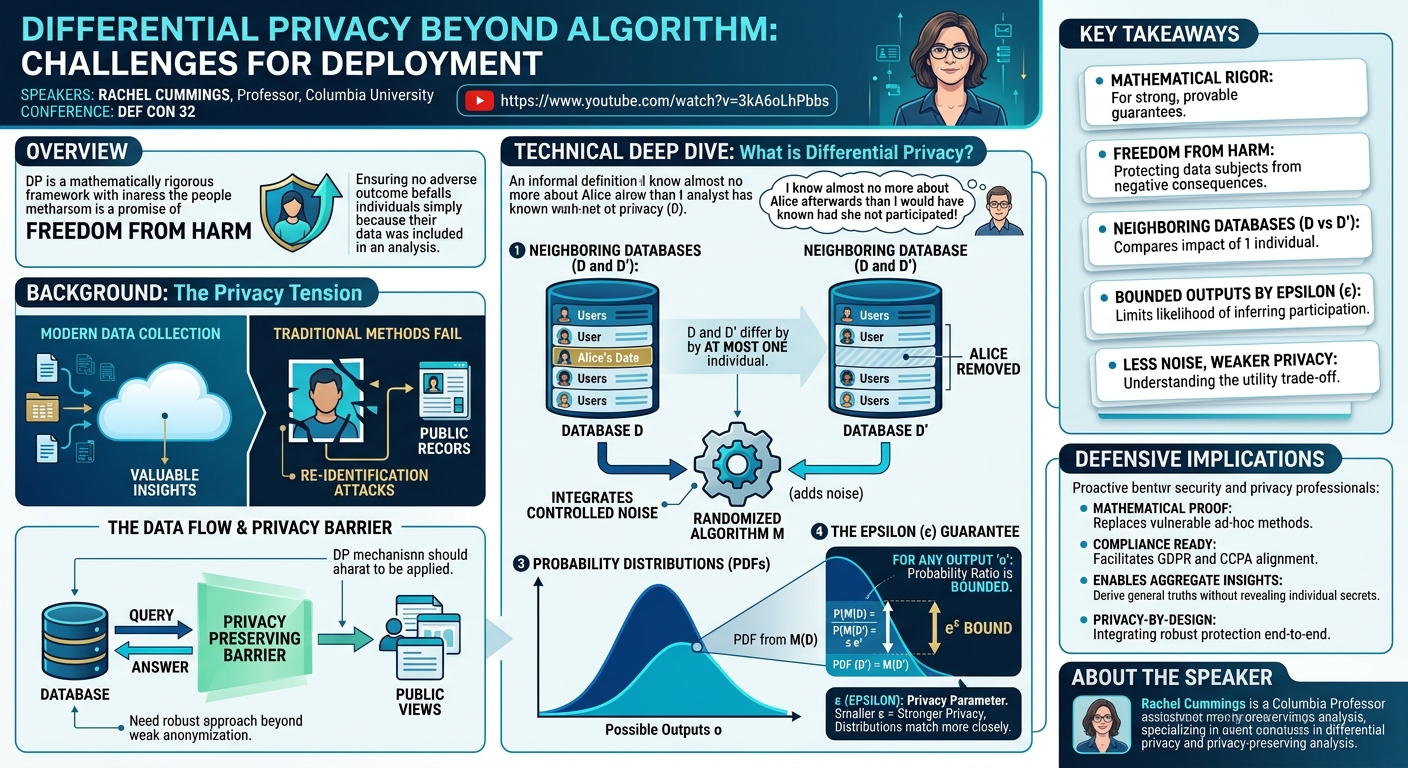
At its heart, Differential Privacy (DP) is a mathematical definition of privacy, providing a strong, provable guarantee against re-identification and individual attribute inference. Professor Cummings illustrated this concept using a visual model that forms the bedrock of understanding DP.
The informal definition provided is crucial: "Some analysis of a data set is going to be private if an analyst can know almost no more about Alice afterwards than he would have known had he conducted the same analysis on an identical database with Alice's data removed." This translates into a formal mathematical guarantee concerning the output probabilities of a randomized algorithm when applied to two neighboring databases.
Let's break down the visual and conceptual components:
- The Database (D) and Neighboring Databases (D'):
- Imagine a database
Dcontaining data from many individuals. - A neighboring database, denoted
D', is identical toDin every way except for the data of one single individual. This could mean Alice's data is present inDbut removed fromD', or Alice's data inDis replaced by Javier's data inD'. The key is thatDandD'differ by at most one record. This concept of "neighboring" databases is fundamental, as it allows us to quantify the impact of any single individual's data on the analysis.
- The Randomized Algorithm (M):
- The core mechanism for achieving differential privacy is a randomized algorithm, denoted
M. This algorithm takes a database as input and produces an output. The crucial aspect is "randomized" – it intentionally introduces noise into the computation. Without this randomness, any deterministic algorithm would reveal too much about individual records, as identical inputs would always yield identical outputs. The randomization ensures that even if an attacker knows the algorithm and the output, they cannot definitively determine if a specific individual's data was part of the input.
- Output Distributions (PDFs):
- When the randomized algorithm
Mis applied to a databaseD, it doesn't produce a single, fixed output. Instead, it produces a distribution of possible outputs. This can be visualized as a Probability Density Function (PDF) or a probability mass function, where the x-axis represents all possible outputsothat the algorithm might produce, and the y-axis represents the likelihood (probability) of that specific outputooccurring whenMis run on databaseD. - Similarly, if we apply the same randomized algorithm
Mto the neighboring databaseD', we get a slightly different output distribution (another PDF).
- The Bounded Ratio – The Differential Privacy Guarantee:
- The essence of differential privacy lies in the relationship between these two output distributions. The guarantee states that for any possible output
othat the algorithmMmight produce, the ratio of the probability ofooccurring whenMis run onDto the probability ofooccurring whenMis run onD'must be bounded. - Formally, an algorithm
Mis (ε, δ)-differentially private if for all neighboring datasetsDandD', and for all possible outputsofromM's range:
P(M(D) = o) ≤ e^ε * P(M(D') = o) + δ
- The speaker focused on the simpler ε-differential privacy, where
δ = 0. In this case, the definition simplifies to:
P(M(D) = o) ≤ e^ε * P(M(D') = o)
And symmetrically:
P(M(D') = o) ≤ e^ε * P(M(D) = o)
Which can be combined as:
P(M(D) = o) / P(M(D') = o) ≤ e^ε
- This means the ratio between the probabilities of any specific output
ooccurring fromDversusD'is bounded bye^ε. - The privacy parameter (ε), pronounced "epsilon," quantifies the strength of the privacy guarantee. A smaller ε value indicates stronger privacy, meaning the output distributions for
DandD'are more similar, making it harder to distinguish between them. Conversely, a larger ε means weaker privacy. Typical values for ε range from less than 1 (strong privacy) to around 10 (weaker privacy, but still offering some protection). - The term
δ(delta) allows for a small probability of privacy failure, often used in more complex DP mechanisms or when a small chance of a large privacy breach is acceptable for significantly higher utility. The speaker's explanation focused on theδ = 0case, where the privacy guarantee holds for all outputs with 100% certainty.
The practical implication of this bounded ratio is profound: an external observer, seeing the output o, cannot confidently determine whether Alice's data was included in the input database or not. The probability of observing o is nearly the same in either scenario. This mathematical guarantee provides a strong defense against various privacy attacks, including linkage attacks, reconstruction attacks, and inference attacks, because it limits the information gain an adversary can achieve about any single individual.
To achieve this, DP algorithms typically add carefully calibrated noise to query results. The amount of noise needed depends on the sensitivity of the query – how much a single individual's data can change the output of the query. For instance, a query counting the number of people with a certain disease might have a sensitivity of 1 (adding or removing one person changes the count by at most 1), requiring a specific amount of noise. Summing ages, however, might have a higher sensitivity if ages can be large, requiring more noise. The speaker did not delve into specific noise mechanisms (like the Laplace mechanism or Gaussian mechanism) but the concept of a "randomized algorithm" implicitly covers this.
In summary, the technical core of the talk established differential privacy as a robust framework that, through the introduction of controlled randomness, ensures that statistical analyses can reveal aggregate truths without revealing individual secrets. The repetitive emphasis on the visual definition underscores its importance as the foundational concept for understanding and eventually deploying DP.
Demo / Proof of Concept
▶ Watch: Core informal definition of differential privacy (2:18)
The provided transcript did not include details of a specific demo or proof of concept. The speaker focused on laying the foundational understanding of differential privacy, which is a prerequisite for understanding its practical applications and challenges. Due to initial technical difficulties and time constraints, the speaker mentioned having to skip some slides, suggesting that more application-oriented content might have been part of the full intended presentation but was not delivered in this segment.
Defensive Implications
▶ Watch: Visualizing differential privacy with probability curves (2:40)
Understanding Differential Privacy (DP) is crucial for defenders operating in environments where sensitive data is collected, analyzed, and potentially published. While the talk primarily focused on defining DP rather than detailing its implementation challenges or specific defensive techniques against DP systems, the very nature of DP presents significant implications for data protection strategies.
The foremost defensive implication is that organizations handling sensitive data can proactively adopt DP as a robust mechanism to protect individual privacy while still performing valuable data analytics. Instead of relying on ad-hoc anonymization techniques that have proven vulnerable to re-identification, DP offers a mathematically provable guarantee that severely limits an attacker's ability to infer individual attributes from query results. This makes it a powerful tool for compliance with stringent privacy regulations like GDPR and CCPA, which demand demonstrable protection of personal data.
Defenders should recognize DP as a means to achieve "freedom from harm" for data subjects. By implementing DP, organizations can confidently derive population-level insights—such as public health trends, consumer behaviors, or demographic shifts—without exposing the specific details of any single participant. This minimizes the risk of data breaches that lead to individual re-identification, thereby protecting the organization's reputation and avoiding legal repercussions.
However, the effective deployment of DP itself requires careful defensive considerations. While not detailed in the transcript, real-world DP implementations introduce new challenges:
- Privacy Budget Management: DP relies on a privacy budget (ε), which is consumed with each query. Defenders must establish clear policies and technical controls to manage this budget across multiple analyses to prevent its exhaustion, which can lead to privacy degradation.
- System Design: Integrating DP into existing data pipelines and systems requires careful architectural design to ensure that privacy guarantees are maintained end-to-end. This involves securing the data collection process, the DP mechanism itself, and the output dissemination.
- Utility vs. Privacy Trade-off: Defenders must work with data scientists and analysts to find the optimal balance between the level of privacy (small ε) and the utility of the data (accuracy of results). Too much noise for strong privacy can render the data useless, while too little noise risks privacy breaches.
- Adversarial Analysis: Although DP is robust, its implementations can still be vulnerable to side-channel attacks or incorrect parameterization. Defenders need to understand potential weak points in specific DP instantiations and ensure that the randomized algorithms are correctly applied and that noise sources are truly random and secure.
In essence, while the talk laid the theoretical groundwork, its message empowers defenders to consider DP as a fundamental, proactive security control. By embracing DP, organizations can shift from a reactive stance against re-identification threats to a proactive, privacy-by-design approach, thereby strengthening their overall data security posture.
Key Takeaways
- Differential Privacy (DP) is a mathematically rigorous framework designed to protect individual privacy in data analysis.
- DP ensures "freedom from harm" for individuals, meaning an analyst can learn almost no more about an individual from an analysis than if that individual's data had been excluded.
- The core concept involves comparing the output distributions of a randomized algorithm on two neighboring databases (differing by one individual's data).
- DP guarantees that the ratio of probabilities for any given output from these two neighboring databases is bounded by
e^ε, where ε is the privacy parameter. - A smaller ε value indicates a stronger privacy guarantee, making it harder to infer an individual's presence or absence in the dataset.
- DP allows for the extraction of aggregate, population-level insights (e.g., "smoking causes cancer") without revealing sensitive individual information (e.g., "your specific health information").
About the Speaker(s)
Rachel Cummings is a Professor at Columbia University, specializing in the field of differential privacy. Her work focuses on the theoretical underpinnings and practical applications of privacy-preserving data analysis. As evidenced by her DEF CON talk, Professor Cummings is dedicated to making complex privacy concepts accessible, aiming to equip audiences with a fundamental understanding of advanced privacy techniques like differential privacy.