Art in the Era of Artificial Intelligence
RSA Conference 2024 · West Stage Keynote
Overview
In an era increasingly defined by rapid technological advancement, the intersection of artificial intelligence and human creativity stands as a fascinating and often contentious frontier. This talk, delivered by media art curator Eileen Isagon Skyers at RSAC 2024, delves into the evolving landscape of AI art, exploring how machine learning models are not just tools, but collaborators, pushing the boundaries of what art can be. The presentation challenges conventional notions of originality and authorship, inviting the audience to critically evaluate artwork generated by machines and to consider AI as an extension of human creative potential rather than a threat.
Key moments
- 0:00 Introduction and common perceptions of AI art
- 2:00 Optimists vs. pessimists: AI's impact on human creativity
- 2:45 Mario Klingman: AI's uncanny interpretations of the human face
- 3:40 Sophia Crespo's Neural Zoo: envisioning otherworldly life forms
- 4:00 Sarah Ludi: outpainting to extend creativity beyond frame
- 4:30 Ivona Tau: AI art as curation and algorithmic memory
- 5:35 Claire Silver: collaborative AI artist, merging old and new
- 6:45 Conclusion: collective co-creation and future of AI art
Art in the Era of Artificial Intelligence
Speakers: Eileen Isagon Skyers, Media Art Curator
Conference: RSAC 2024
YouTube: https://www.youtube.com/watch?v=V8_G80cJrto
Overview
In an era increasingly defined by rapid technological advancement, the intersection of artificial intelligence and human creativity stands as a fascinating and often contentious frontier. This talk, delivered by media art curator Eileen Isagon Skyers at RSAC 2024, delves into the evolving landscape of AI art, exploring how machine learning models are not just tools, but collaborators, pushing the boundaries of what art can be. The presentation challenges conventional notions of originality and authorship, inviting the audience to critically evaluate artwork generated by machines and to consider AI as an extension of human creative potential rather than a threat.
Skyers navigates the philosophical and aesthetic implications of AI art, showcasing pioneering artists who are leveraging this technology to create novel forms and experiences. From real-time generative portraits to otherworldly biological forms and algorithmic memories, the talk illuminates the diverse applications of AI in contemporary art. It highlights the profound shift towards a future where humans and machines co-create, emphasizing that understanding these new forms of visual culture is essential for cultural literacy in an increasingly technological world.
While presented at a cybersecurity conference, the talk offers a broader perspective on the societal impact of AI, moving beyond security vulnerabilities to explore its transformative role in human expression. It posits that our encounter with AI in art is as much a moral and human one as it is an aesthetic journey, prompting reflection on our relationship with intelligent machines and the boundless creative possibilities they unlock.
Background
▶ Watch: Introduction and common perceptions of AI art (0:00)
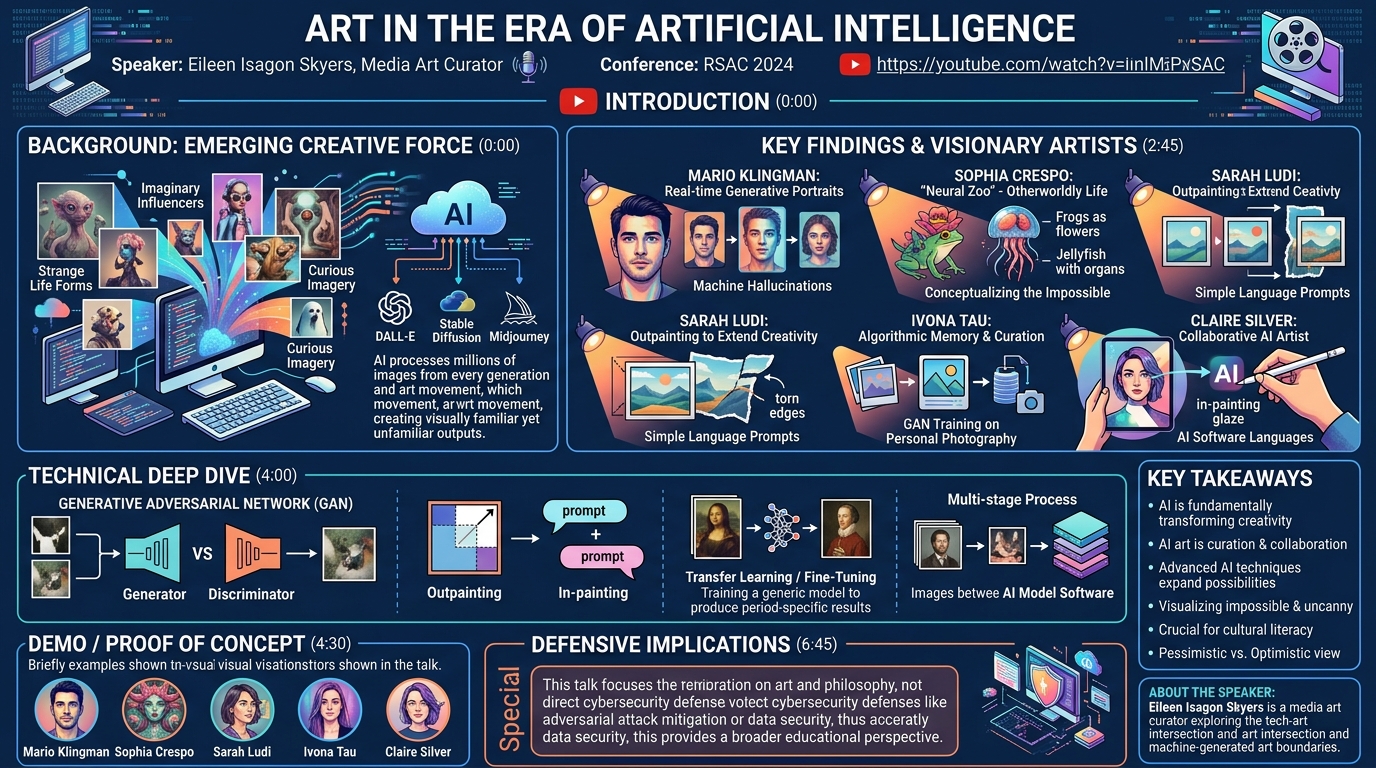
The emergence of artificial intelligence as a powerful creative force has sparked a global conversation, largely fueled by the accessibility and capabilities of advanced machine learning models such as DALL-E, Stable Diffusion, and Midjourney. These platforms have democratized the creation of AI-generated imagery, allowing users to produce a vast spectrum of visuals, from "strange life forms" and "imaginary influencers" to "entirely foreign, curious kinds of imagery." The inherent human fascination with the unknown, coupled with AI's ability to process and synthesize data from millions of existing images—encompassing every generation and art movement—results in outputs that are simultaneously familiar and strikingly unfamiliar.
This rapid evolution has bifurcated public opinion into two main schools of thought: the pessimists, who view AI as a significant threat to human creativity and artistic originality, and the optimists, who embrace it as a powerful extension of human imaginative capabilities. This fundamental division underpins critical questions for artists, critics, and the public alike: Can true originality still exist in an age of algorithmic generation? And how do we establish a framework for critically evaluating art produced by machines?
Before the widespread adoption of current generative AI models, artists experimented with algorithms and computational art, but the current wave has brought AI art into the mainstream consciousness. The problem, as framed by Skyers, is not merely technical but existential, challenging the very definition of art and the artist's role. By examining the work of contemporary AI artists, the talk seeks to provide "metaphors, narratives, and insights" that offer a glimpse into the "delight, surprise, confusion, and wonder" that characterize this new frontier, positing that this engagement with AI is a profound human and moral encounter.
Key Findings
▶ Watch: Mario Klingman: AI's uncanny interpretations of the human face (2:45)
The presentation by Eileen Isagon Skyers unveiled several key insights into the current state and future trajectory of AI art, primarily through the lens of pioneering artists. These findings illuminate both the technical capabilities of AI models and their profound impact on artistic practice and perception:
- AI as a Mirror of Humanity: Neural networks, by processing vast datasets of human-created art, produce visuals that are "so familiar, yet strikingly unfamiliar," effectively mirroring human creativity and perception in an uncanny valley of digital art.
- The Uncanny and Real-time Generation: Artists like Mario Klingman demonstrate AI's capacity to generate unique, real-time interpretations of subjects, such as human faces, which the speaker describes as "peering into the machine's hallucinations." This highlights AI's ability to create dynamic, ever-evolving artworks.
- Envisioning the Impossible: Sophia Crespo's "Neural Zoo" exemplifies how AI allows artists to conceptualize and visualize "otherworldly life forms in impeccable detail" that do not exist in reality, expanding the boundaries of biological and imaginative representation.
- Extended Creative Canvas through Outpainting: Tools like DALL-E 2's outpainting feature enable artists to extend their work beyond the original frame using simple language prompts, as demonstrated by Sarah Ludi. This technique fundamentally redefines the concept of a canvas and the creative process.
- AI Art as a Form of Curation and Algorithmic Memory: Ivona Tau's practice underscores that AI art is inherently a form of curation, involving meticulous selection of inputs and outputs. Her use of GAN (Generative Adversarial Network) training on personal archives to create "algorithmic memory" and "destructed data sets" for "forgetting" introduces profound conceptual dimensions to AI's capabilities.
- Intentional Collaboration and Evolving Techniques: Claire Silver's approach as a "collaborative AI artist" highlights the dynamic interplay between human and machine. Her use of in-painting techniques, masking, and transforming specific image sections, along with feeding images between different AI software, demonstrates a sophisticated, evolving partnership with the tools.
- Diverse "Languages" of AI Models: The observation that different AI models, trained on distinct datasets, are akin to "speaking different languages" emphasizes the varied aesthetic and conceptual outputs one can expect, influencing an artist's choice of tools.
- Collective Co-creation: The overarching finding is that "we are all collectively co-creating with AI, whether we're aware of it or not," underscoring a pervasive shift in cultural production and the necessity for "cultural literacy" in these new forms of images and predictions.
These findings collectively illustrate that AI is not merely a tool for replication but a catalyst for new forms of artistic expression, critical inquiry, and a re-evaluation of the human role in the creative process.
Technical Deep Dive
▶ Watch: Sarah Ludi: outpainting to extend creativity beyond frame (4:00)
The technical underpinnings of AI art, as explored in the talk, primarily revolve around advanced machine learning models and specific generative techniques that empower artists to create novel visual experiences. The speaker referenced prominent models such as DALL-E, Stable Diffusion, and Midjourney, which have become synonymous with the current wave of generative AI. These models leverage complex neural networks trained on colossal datasets—comprising "thousands of other images made by people from every generation, every possible art movement, millions of images in one single scan." This extensive training allows them to identify patterns, styles, and semantic relationships within visual data, enabling them to generate entirely new images that often exhibit an uncanny blend of familiarity and novelty.
A significant technical aspect highlighted is the use of Generative Adversarial Networks (GANs), specifically in the work of artist Ivona Tau. GANs consist of two competing neural networks: a generator that creates new data (e.g., images) and a discriminator that evaluates whether the generated data is real or fake. Through this adversarial process, the generator continuously improves its ability to produce highly realistic outputs. Tau's application involves training GANs on her "personal photography" collections to create "algorithmic memory." This process allows the AI to learn and recreate patterns, textures, and themes from her personal archive, effectively producing a digital, machine-generated recollection. Furthermore, her creation of a "destructed data set for the model to symbolize forgetting or fleeting memory" demonstrates a sophisticated manipulation of the training data to achieve specific conceptual outcomes, showcasing a profound understanding of how data input directly influences artistic output.
Another crucial technique discussed is outpainting, exemplified by Sarah Ludi's work with DALL-E 2. Outpainting is a feature that allows users to expand an image beyond its original canvas, generating new content that seamlessly blends with the existing picture. Artists provide textual prompts (e.g., "torn edges" in Ludi's case) to guide the AI in generating the extended portions, effectively allowing them to "extend their creativity beyond the scope of the frame." This capability transforms the traditional creative process, offering an infinite canvas where the artist's imagination, guided by simple language, can continuously expand a visual narrative.
Conversely, in-painting is presented through the work of Claire Silver. In-painting involves modifying or replacing specific parts of an existing image while maintaining the overall coherence and style. Silver's process includes "masking and transforming just one small piece of the image," and using tools like an Apple Pencil to "shift the opacity of various sections with an Apple Pencil, transforming it bit by bit." She likens this granular control to the traditional "glaze in an oil painting," highlighting the precision and artistic finesse achievable with AI tools. Silver also employs a unique method of "feeding AI images from one software into another, creating new languages and forms of understanding for the machine itself." This suggests a multi-stage, iterative process where the output of one AI model serves as the input for another, potentially layering different styles, interpretations, or data biases to achieve highly complex and nuanced results.
The talk also implicitly touches upon the concept of transfer learning and fine-tuning, where AI models are not necessarily built from scratch but are adapted from pre-trained, large-scale models using specialized datasets. Mario Klingman's piece, "running an AI model trained on thousands of portraits from the 17th to 19th centuries," is a prime example. By training a model on a specific historical art period, the AI learns the stylistic nuances, facial structures, and aesthetic sensibilities of that era, enabling it to generate "uncanny interpretations of the human face" that are stylistically consistent yet uniquely machine-generated. This demonstrates how targeted training data can sculpt the artistic "personality" of an AI model, making different models behave as if they are "speaking different languages" due to their distinct informational diets.
In essence, the technical deep dive reveals that contemporary AI art is not a monolithic practice but a diverse field leveraging specific machine learning architectures, data manipulation strategies, and iterative refinement techniques to achieve a broad spectrum of artistic expressions.
Demo / Proof of Concept
▶ Watch: Ivona Tau: AI art as curation and algorithmic memory (4:30)
While the talk did not feature a live, interactive demonstration in the traditional sense, Eileen Isagon Skyers effectively presented a series of compelling visual case studies and examples from prominent AI artists. These served as powerful "proofs of concept" illustrating the diverse applications and artistic potential of AI. Each example showcased a distinct approach to integrating artificial intelligence into the creative process:
- Mario Klingman's Real-time Generative Portraits: The first example presented was a piece by Mario Klingman, which was sold at auction in 2019. This artwork features an AI model trained on thousands of portraits from the 17th to 19th centuries. The demonstration highlighted how the model "constantly reveals uncanny interpretations of the human face," with each portrait being "unique, created in real time as the machine reads its own output." The visual effect was described as "peering into the machine's hallucinations," emphasizing the dynamic, ever-changing nature of the AI's creative process and its ability to generate infinite variations of a theme.
- Sophia Crespo's "Neural Zoo": Skyers then introduced Sophia Crespo's series, "Neural Zoo," which employs neural network interpretations of the real world to generate unreal sea creatures and diverse biological life forms. The visual examples showcased creatures where "Frogs look like flowers" and "Translucent jellyfish have vivid internal organs." The key takeaway from this demonstration was the AI's capacity to envision "otherworldly life forms in impeccable detail," creating creatures that are entirely fictitious yet possess a compelling, organic realism.
- Sarah Ludi's Outpainted Abstract: An abstract piece by Sarah Ludi served as a demonstration of DALL-E 2's outpainting capability. The artwork began as a digital painting and was subsequently "augmented to fit a 16x9 ratio using a prompt for torn edges in DALL-E 2's outpainting." This example visually illustrated how outpainting allows artists to "extend their creativity beyond the scope of the frame, using simple language prompts," fundamentally altering the compositional possibilities of a static image.
- Ivona Tau's Algorithmic Memory and Forgetting: Ivona Tau's work was presented as an example that, while initially appearing like a photograph, is "also the work of AI." This demonstration centered on GAN training applied to "collections from the artist's personal photography." Skyers explained how Tau "curates from her own photographs, carefully choosing the inputs and outputs for the model" to produce "a form of algorithmic memory." A video was shown that "pulls from GAN and AI models trained on thousands of photographs from Tau's personal archive." Furthermore, the demonstration included how Tau "created a destructed data set for the model to symbolize forgetting or fleeting memory," showcasing a conceptual depth in manipulating AI's learning process.
- Claire Silver's Collaborative In-painting: Finally, Claire Silver's portrait was used to illustrate her "collaborative AI artist" approach. This demonstration focused on her use of in-painting techniques, where she works by "masking and transforming just one small piece of the image." Specifically, she "shifted the opacity of various sections with an Apple Pencil, transforming it bit by bit," a technique she likens to "glaze in an oil painting." The visual evidence underscored how Silver "feeds AI images from one software into another, creating new languages and forms of understanding for the machine itself," resulting in works that are "half master painting, half digital art, both old and new," drawing from famed artists like John Singer Sargent, Evelyn De Morgan, and Gustav Klimt.
These visual demonstrations collectively served to illustrate the versatility, technical sophistication, and profound conceptual implications of AI in contemporary art, making tangible the abstract discussions of neural networks and machine creativity.
Defensive Implications
▶ Watch: Conclusion: collective co-creation and future of AI art (6:45)
While this talk, "Art in the Era of Artificial Intelligence," was presented at RSAC 2024, a premier cybersecurity conference, its focus was entirely on the artistic and philosophical dimensions of AI's impact on creativity, rather than direct security vulnerabilities, threats, or defensive strategies. The speaker, Eileen Isagon Skyers, a media art curator, explored how AI models are used to generate art, challenge human notions of originality, and foster new forms of creative collaboration.
Consequently, the presentation did not delve into specific defensive implications related to cybersecurity, such as protecting AI models from adversarial attacks, securing the data used for training, or mitigating the risks of deepfakes and synthetic media in disinformation campaigns. The discussion remained within the realm of artistic exploration and the cultural impact of AI. Therefore, there are no direct defensive implications for security professionals to extract from the content of this particular talk. The talk served as a broader educational piece on the societal and creative shifts brought about by AI, which, while relevant to understanding the pervasive influence of AI, did not offer actionable security advice or technical defenses.
Key Takeaways
- AI is fundamentally transforming art and human creativity: The advent of models like DALL-E, Stable Diffusion, and Midjourney challenges traditional notions of originality and authorship, prompting a re-evaluation of how art is created and perceived.
- AI art is a process of sophisticated curation and collaboration: Artists like Ivona Tau and Claire Silver demonstrate that working with AI involves intentional selection of inputs, careful manipulation of outputs, and an evolving partnership with machine learning tools.
- Advanced AI techniques expand artistic possibilities: Features such as DALL-E 2's outpainting (extending images beyond their frame) and in-painting (selectively modifying parts of an image) offer artists unprecedented control and new avenues for creative expression.
- AI enables the visualization of the impossible and the uncanny: Artists leverage neural networks to generate otherworldly life forms (Sophia Crespo) or real-time, "hallucinatory" interpretations of familiar subjects (Mario Klingman), pushing the boundaries of imagination.
- Understanding AI's impact on art is crucial for cultural literacy: As AI becomes ubiquitous, engaging with AI art provides insights into the "new languages and forms of understanding" machines create, preparing us for an increasingly technological and co-creative future.
- The debate between AI as a creative threat vs. an extension is central: The talk highlights the ongoing philosophical discussion, encouraging an optimistic view of AI as a powerful tool that multiplies creative possibilities at our fingertips.
About the Speaker(s)
Eileen Isagon Skyers is a media art curator. In her role, she focuses on exploring the intersection of technology and art, particularly how artificial intelligence is shaping contemporary creative practices. Her expertise lies in critically evaluating and presenting works that push the boundaries of machine-generated art, as evidenced by her discussion of artists like Mario Klingman, Sophia Crespo, Sarah Ludi, Ivona Tau, and Claire Silver. Through her curatorial work, Skyers aims to illuminate the philosophical, aesthetic, and human implications of AI's growing presence in the art world.